

A meditation in praise of Dr. Martin Luther King Jr.’s life
in light of Holy Week’s threat yet to come
Ken Sehested
Invocation. “Dr. King received a message / As he sat there in his cell / In Birmingham Alabama / He had gone there to repel / The troubles in that city / For which it was well known / Though his message spoke of peace / Into the prison he was thrown / Pastors sent that message / Urging King to wait / They didn’t want his protest He wasn’t welcome in their state / History has taught us The Reverend understood / The bad get their power / From the silence of the good.” —Eric Mcfadden, “The Silence of the Good”
§ § §
The principal strength from which the forces of despotism operate comes not from their accomplices in infamy but from the silence of those who turn a blind eye, who have been cowed into silence, saved (they think) by means of “hear no evil, see no evil, speak no evil.”
They are neither hot nor cold, which, according to the Ancient of Days speaking through John the Revelator, “I will spew you out of my mouth (3:16). These are the ones, like Pilate in the Gospels, who simply conspire to wash their hands of complicity.
As Dr. King complained, in his “Letter from a Birmingham Jail,” addressed to the more liberal  pastors in Montgomery, Alabama, who urged civil rights activists to be “patient”: “In the end, we will remember not the words of our enemies, but the silence of our friends.”
And later: “Our lives begin to end the day we become silent about the things that matter.”
“In times of war, the law falls silent,” warned the ancient Roman philosopher Cicero. For true lovers of God, and followers of The Way, there is another warrant—another commandment, another horizon to which we are to be oriented—upstaging entrenched tainted statutes, market’s rule, and judicial duplicity.
Verily, verily, ours is the mandate to conjoin the One who promises to make all things new, to the jubilee theme linking spiritual transformation to the very material cancellation of debts, land redistribution, sustainable agricultural practices, and manumission of slaves.
Yet adherence without advocacy is to be (in the words of the ancient bard) “full of sound and fury signifying nothing.” It is “holding the form of godliness but denying its power” (2 Timothy 3:5). The Lord Sabaoth rails against such vacuous piety: “these people draw near with their mouths and honor me with their lips, while their hearts are far from me” (Isaiah 29:13).
Careful what you long for in hoping for the Day of the Lord. For if you come across neighbors, “dressed in rags and half-starved,” and you say to them “Blessings! be warmed and filled” but do  not offer needed attire or a sufficient meal, “What good is that!” The One who shall separate the goats from the sheep keeps account. “Isn’t it obvious that God-talk without God-acts is outrageous nonsense!” And you say you believe in God?” Well, even the demons believe—and shudder when they do so” (James 2:14-19 The Message).
Of course, there is a silence which God honors and acknowledges: The sheer awe we experience in the face of the Almighty, when we proclaim “let all the earth keep silence before the Blessed One!” (Habbakuk 2:20) Such awe, such adoration, such exaltation is a confession of our interdependence, in a repentance, a turning away from self-centered living.
Other forms of silence choke the truth, resign the poor to bondage, countenances bribery and corruption in high places. Such silence stinks in the nostrils of the Advocate. Indeed, “Our God comes and does not keep silence” (Psalm 50). This One, whose Name is beyond all names, indicts all who collaborate with thieves; who slander the everlasting covenant; who cavort with philanderers; who practice deceit and whose smiling eyes tell lies.
But be of good cheer. It will be accounted to you as tzedek (righteousness) and mishpat (justice, advocacy for the vulnerable), as chesed (loving-kindness, mercy, generosity, and steadfast loyalty) should you embody metanoia (spiritual conversion, reorienting one’s life). Though the world’s insurrection act be provoked against you, Resurrection’s invocation shall steady your voice, strengthen your weak knees, shoe you with the wreath of peace, and guard your heart from the Deceiver.
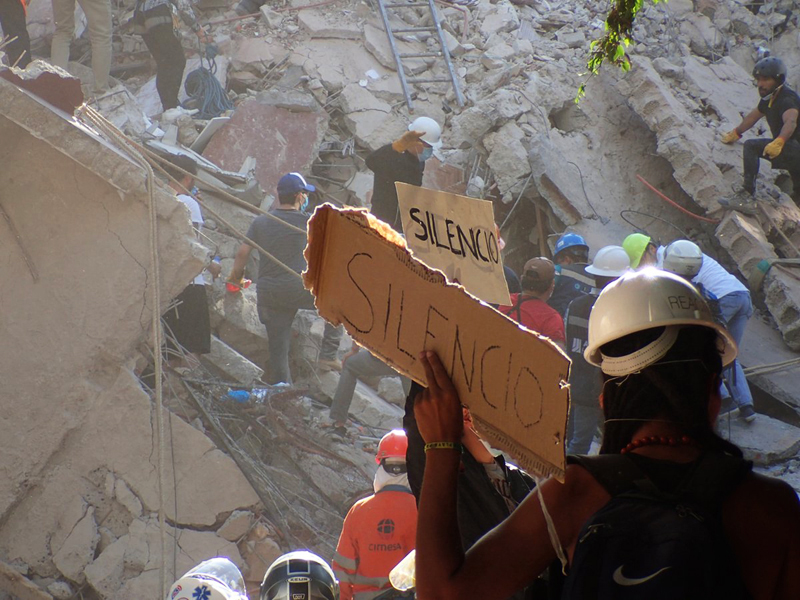
The silence you render in being enraptured by God’s beatific vision will empower you to practice silencio, as practiced by rescuers digging through earthquake rubble in Mexico City, assisting them in hearing the sounds of those trapped alive. (See photo.)
Such silencio—simultaneously practiced as reverence for God’s holiness and pursuing wholeness on the earth—is animated amid history’s rubble, as we listen for the faint cry of survivors from earth’s trauma and human atrocity.
This listening posture aligns us with God’s hearing, for the groans of the enslaved above the clamor of imperial pursuit and the remembrance of covenant ties. Heaven’s attention, like water, always travels to lowliness. The Beloved’s radar is oriented toward those left in every tyrant’s dust, those consigned to every empire’s ash heap.
“Isn’t there anything you understand? It’s from the ash heap God is seen. Always! Always from the ashes.”*
Kindred, do not confuse peace with quiet; tranquility with integrity; legality with equality; wealth with virtue. Lay bare the veil that quells the ache, that gags the wail. Let your life be a lighthouse to the fog-bound, weary mariners seeking a safe harbor. Declare the Beloved’s delight in the least, the last, and the lost. And count it all joy, even in calamity, for the grave’s dominion has been seized. And silenced forever.
§ § §
Benediction. “I’ve got a mind to do right, everyday / Since Jesus saved me, and the Holy Ghost filled me / I’ve got a mind to do right, everyday / I’ve got a mind to pray right, everyday / I’ve got a mind to sing right, everyday / I’ve got a mind to shout right, everyday.” —”Got a Mind To Do Right,” Morehouse College and Cornell University Glee Clubs
# # #
*Sarah, in Archibald MacLeish’s “J.B.”, a play on the Book of Job written in free verse.
Published 2025/12/15 at 10:05 pm