
Ken Sehested
Prelude. “Mozart y Mambo.” —Rondo alla Mambo, which combines the music of W.A. Mozart and Cuban Mambo, was featured in this flashmob on the streets of Havana, Cuba and was the grand finale of the Mozart y Mambo project. Inspired by W.A. Mozart and written by Joshua Davis and Yuniet Lombida Prieto, it is performed by Sarah Willis and the Havana Lyceum Orchestra.
Call to worship. “Hope is not denial of reality, but defiance of inevitability.” —Brent Barry, Stout Creek Farm, Saltillo, Texas
§ § §
President Trump has created a fracture in his MAGA base with a sudden bout of colonial delirium, targeting Venezuela first, now Iran, with Cuba as “next” on his rampage.
As one of his most ardent promoters in Congress, Sen. Lindsey Graham (R-SC), put it recently on a Fox News segment:
“We’re marching through the world. We’re cleaning out the bad guys. We’re gonna have relationships with new people that will make us prosperous and safe. I have never seen anybody like it. Donald Trump is resetting the world in a way nobody could have dreamed of a year ago. He is the greatest commander in chief of all time. Our military is the best of all time. Iran is going down, and Cuba is next.”
Just today, the New York Times reports that US and Cuban officials have been in conversation, and the Vatican may have a hand in fostering the dialog.
For its part, the fact that Cuba has little to offer by way of “natural resources” may make a military confrontation less likely. But the fact that the US has maintained an economic embargo for the past 66+ years is considered by some as one step 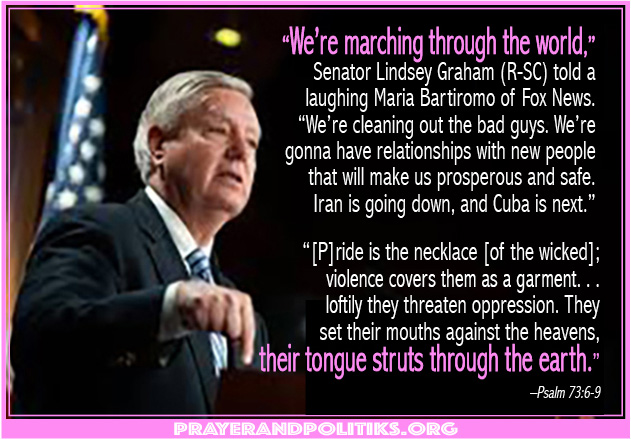 short of a state of war. (The U.S embargo against Cuba is a comprehensive set of economic sanctions, largely enforced through the “Trading with the Enemy Act” of 1917.) Mostly because Cuba posed such a threat to “free market” order in the Western Hemisphere, a market—not unlike casino odds-making—that always tilts toward the house.
Remember, no one has surpassed Trump’s record of bankrupting four casinos.
Below are three items for your consideration. The first, “A Plea for Peace With Cuba,” is a call for normalization of relations between the US and Cuba, endorsed by local congregations here in the US. Second, a first-person story by Kiran Sigmon, “While Washing My Daughter’s Feet,” about a foot-washing service with our congregation’s partner in Cuba. Third, a profile of José Martí, considered the “Apostle of Cuban Independence.”
§ § §
Hymn of confession. “O you whose blade, like a spear, is stretched for oppression, even the sharpness of your blade shall pass.” —“This Too Shall Pass,” Iranian music by Farya Faraji, ney by Ali Farbodnia, lyrics from a 14th century poem by Saif Farghani (scroll down to see the translated lyrics)
Word. “The society we seek, based on communal values, is spelled out not in Marx or Engels but in the Book of Acts. It’s not pure socialism, but it’s surely not capitalism either. I would applaud capitalism if it would feed the people of the world. But in fact, the forces of capitalism have a deteriorating effect on the two primary projects of God: human nature, and the creations of the natural world.” —Rev. Raul Suarez, pastor emeritus, Ebenezer Baptist Church, Havana, Cuba, founder of the Martin Luther King Center, and among the first Christians elected to Cuba’s National Assembly in 1992, following Cuba’s revised constitution which exchanged the word “secular” for “atheist”
§ § §
Thirteen US congregations, each partnered with
a congregation in Cuba, issue the follow statement*
A Plea for Peace With Cuba
10 March 2026
“There is a humanitarian crisis now, which will worsen. We, the US, are almost fully responsible for that crisis; we can change it.” (The Peace Advocate Feb. 2026)
We, members of faith communities across the US, call your attention to what has been described as a “moment of exceptional urgency” in Cuba. We sound this call as those who have walked with and seen the suffering of our Cuban brothers and sisters. Since the 1990s each of our churches has partnered with Cuban congregations, worshiping together, sharing faith together, and being in each others’ homes. We are not enemies. We are family. It breaks our hearts to see those dear to us, children, women and men, needlessly suffering from US policies.
For 66 years, the US economic embargo—not to mention the news blackout—has isolated Cuba from the world community and devastated the Cuban economy. Now, the recent US blockage of Cuba’s oil purchases from Venezuela and Mexico is creating a situation of catastrophic proportion. Because Cuba relies heavily on oil to produce electricity, the resulting lack of power generation affects every aspect of the Cuban people’s lives. “Across Cuba, many people are struggling to meet basic needs, including reliable access to food, clean water, electricity, transportation, and safe housing. Reduced fuel supplies have immediate consequences, contributing to blackouts, limited water access, reduced mobility, and disruptions to essential services.” (“A Call to Stand with the People of Cuba,” Alliance of Baptists ). Cuba is experiencing an intensifying humanitarian crisis caused by an embargo that is a breach of widely accepted international law. We can change it.
As people of faith, we believe the road to peace does not involve weapons or embargoes. Please contact your congressional representatives and ask them to stand with us as we call for an end to these harmful policies.
Endorsing congregations include (in alphabetical order):
Baptist Church of the Covenant, Birmingham, AL; Circle of Mercy Congregation, Asheville, NC; Ecclesia Baptist Church, Asheville, NC; First Baptist Church, Asheville, NC; First Baptist Church, Jamaica Plains, MA; First Baptist Church, Sylva, NC; First Baptist Church, Washington, DC; Glendale Baptist Church, Nashville, TN; Lovely Lane United Methodist Church, Cedar Rapids, IA; Northminster Baptist Church, Monroe, LA; Oakhurst Baptist Church; Decatur, GA; Park Road Baptist Church, Charlotte, NC; Williamsburg Baptist Church, Williamsburg, VA
*Original draft by Doug Berky, coordinator of the Circle of Mercy Cuba Partner Mission Group, with editing from several in the US and in Cuba.
§ § §
While Washing My Daughter’s Feet
Kiran Sigmon, February 19, 2008
A sermon I will never forget was preached not long ago in a Cuban living room. Eleven members of our church were visiting our sister congregation in Camagüey, Cuba. Most of our group were in Cuba for the first time. We were building the foundation for what we hoped will be a long and strong church friendship. We had had a complex and rich week with new 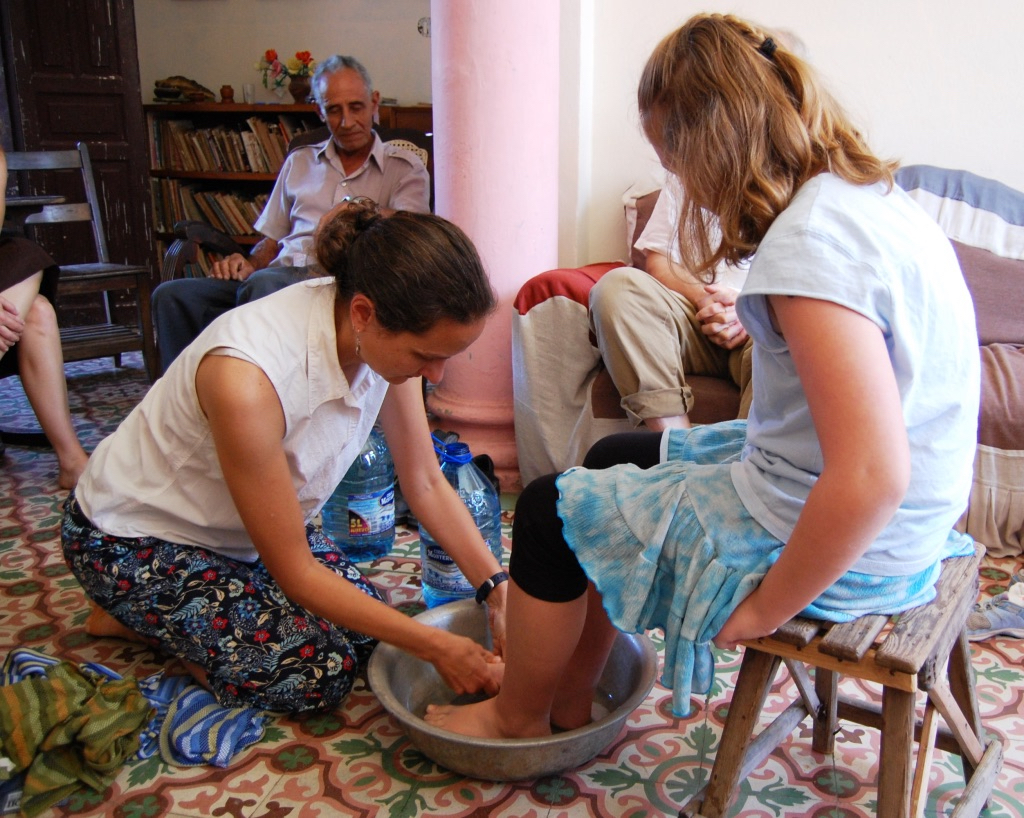 friends, we were sad on our fifth day together to be leaving. Ken was among the group and was sick for the formal worship service held earlier that week. I knew the outline of his sermon as I was to be his interpreter and my limited Spanish worked best with time to prepare. On our last day in Camagüey I encouraged him to recap his intended sermon. I was a bit nervous about this. I was a bit nervous about the translating, yet I was more nervous about his message and the fact we were considering whether or not to offer a foot washing. Would that be culturally taboo, too much too soon, offensive in any way?
“We sat in the high-ceilinged living room, and I took a deep breath. I explained to our friends that we wanted to end our time with a few words and a parting ritual. Ken began speaking about the cross as a symbol of Christianity. He pleaded that it has been weakened and manipulated. He spoke of gold chains and crosses, jewelry symbolizing wealth and power. He regretted how too often the cross is turned upside down and used as a sword. He then spoke about alternative symbols. “Consider then the basin and towel.” He told the story of the last night Jesus had with his disciples. It was the night before Passover in Jerusalem. An unsafe time and a risky place. The political climate intense, the Roman Army occupied the streets and Passover was a time of potential violence. Surely the disciples were fearful and reluctant. “Why here? Why now?” they must have been thinking. He walked in, took off his robe, wrapped a towel around his waist, and began washing the disciples’ feet. When he got to Peter, Peter said, “NO, not my feet. You will never wash my feet.” Jesus responded, “If you do not allow me to do this, then you will have no part of me. . . .”
“Suddenly, a Peter-like thought flashed into my mind: “Are we ready for that intimacy, that vulnerability, that connection in our lives? Am I?”
Then “we offered to the small group of our Cuban friends the idea of doing a foot washing before we left. “We are different 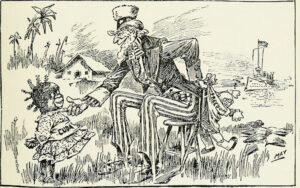 now because of this trip and our time with you,” I said. “We would like to share this ritual with one another and with you, if you care to join us.” We admitted that we as a congregation, and as our small group of travelers, had not done this together before.
“It was powerful. A simple wooden stool was placed in the middle of the circle. A large, dented, metal basin quickly appeared, and a two-gallon water bottle, one of the many we had used for drinking water, became part of the ritual. We slowly made our way around the circle pouring cool Cuban water over each others’ naked feet and into the common basin. We quietly sang, swayed, and washed each other’s precious, precious feet.
“For someone for whom public emotion is a rarity, I could not contain the sweetness and goodness I felt in this moment. It felt wonderful to place my feet in the puddle left by those before me, and it felt healing to feel the water poured anew. I then I had the chance to wash the feet of Joy, my courageous 9-year-old daughter. Be cleaned, I thought. Be free, I prayed.”
§ § §
Hymn of supplication. “God I give You all I can today / These scattered ashes that are hid away / I lay them all at Your feet / From the corners of my deepest shame / The empty places where I’ve worn Your name / Show me the love I say I believe. —Lauren Daigle, “Once and For All”
Word. “Cuba seems to have the same effect on U.S. administrations as the full moon once had on werewolves.” —Dr. Wayne Smith, former director of the US Interest Section in Havana, Cuba
§ § §
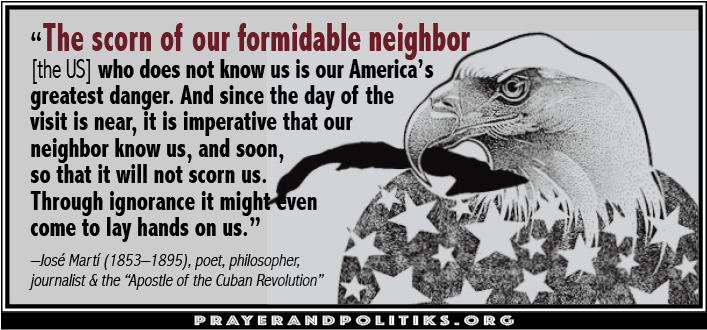
José Julián Martí y Pérez (1853–1895) was a leader of the Cuban independence movement as well as a renowned poet, journalist and essayist. Considered the Cuban people’s national hero, he is often referred to as the Apostle of Cuban Independence.
He was first imprisoned at age 16 for his criticism of Spanish rule in Cuba. After exile, he moved to New York City where, for 14 years, he came to know both the wonder and the woe of U.S. domestic and international policies. He died fighting 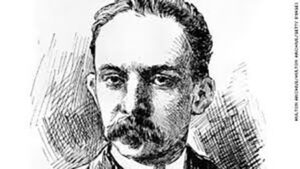 Spanish troops during the independence movement in Cuba.
Three years later, shortly before the Cuban independence movement was about to succeed, the U.S. declared war on Spain and sent troops to Cuba, forcing Spain to relinquish its rule of the island. However, no representatives of the Cuba people were signatories to the Treaty of Paris, which ended the Spanish-American war. (With the treaty, the U.S. took control of Cuba as well as other Spanish colonies, including Puerto Rico, the Philippines and Guam.)
In 1902 the U.S. transferred governance to the Cuban parliament under the condition that their constitution be amended to allow the U.S. to intervene militarily in the country’s affairs (which we did three times, occupying Cuba for a total of eight years prior to the failed Bay of Pigs invasion.)
§ § §
Benediction. “If violence and war is the way to peace, then Rome was right, and Christ died for nothing.” —Michael Gorman, Professor of Biblical Studies and Theology at St. Mary’s Seminary and University
Postlude. “In the thirst for life, the thirst for life / God offers you water of life, water of life / Come, come to me. / Freely, freely drink here. . . . / In cool dew you will bathe my branches, / I will be like a tree with fruits to give.” —translation of “En la Sed de la Vida” (“In the Thirst for Life”), a song written by Kim Christman for the 2020 New Song Festival at the Kairos Center in Matanzas, Cuba. A group of dancers at the Center choreographed the song.
P.S. For more background see “Bring Down the Wall in the Caribbean: A resolution in support of renewed diplomatic relations between the U.S. and Cuba,” a 2016 resolution I wrote for the Southern Conference of the United Church of Christ, later approved, with revisions, by the United Church of Christ General Synod.
If you want a deep dive in the history of US-Cuba relations (Thomas Jefferson wrote that the US “must annex Cuba at our earliest convenience”), read Louis A. Pérez Jr’s “Cuba in the American Imagination.”
# # #