

Ken Sehested
Prelude. “This world is so profane, / I can hear the earth screaming, / screaming in pain. / Everywhere; / There is not compassion left in us. / Why is it that so much pain is caused? / and so much injustice is done in the name of God? / Why have children stopped dreaming? / and why is it that mothers won’t stop crying; / I just ask myself how can God look at us.” —English translation of lyrics in “¿Porque?” (“Why?”), Yasmin Levy
Call to worship. “Eloi, Eloi, lama sabachthani?” —Aramaic phrase spoken by Jesus on the cross, translated to “My God, my God, why have you forsaken me?” Quoting Psalm 22:1, recorded in Matthew 27:46 and Mark 15:34.
§ § §
I had a waking dream last week, vacillating between rage and despair. In that heavy, hushed silence, an angel sidled up, put 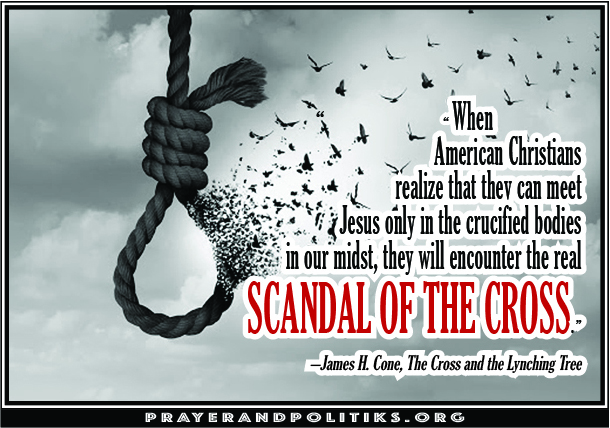 a hand on my shoulder, saying “OK?” Then, “you finished yet?”
Then the heavenly messenger said, “Here, have a snack; now take a nap.”
And I did, a deep sleep, then rudely awakened, hand pulling me up by the collar, a gruff voice saying, “Get up you whiney runaway. Get over yourself. We got a long walk ahead and a mountain to climb. There could be bandits, maybe beasts, and uncertain provisions; but beyond, a land that is fairer than day, every night’s fright banished.” And I swear the voice sounded like Elijah. (cf. 1 Kings 19:5-8)
§ § §
Hymn of mourning. “A sorrowful mother stood under the cross / She cried and spoke through the tears / Oh, sonny, my sonny, for what sin / You endure harsh time now / On the cross.” —translation of lyrics to “The Sorrowful Mother,” Ukranian Lenten Hymn
§ § §
While there are differences in detail among the Gospels’ account of Jesus’ final entry into Jerusalem—where he would be arrested, interrogated, tortured, and crucified (the most shameful form of Rome’s execution protocols)—the one common theme is that of confrontation between the competing assertions of power pitting Jesus against the coalition of Roman and temple aristocracy.
We in the US have rarely if ever had a clearer display of this contention, both arrayed in piety, than with our current political climate. The conflict hinges not merely on political vision but on idolatry and heresy.
Watch this brief (41 second) video of our cheer leading warmonger, secretary of defense Pete Hegseth, quoting the Lord’s Prayer while playing in the background is a montage of videos displaying US military prowess.
§ § §
Hymn of lamentation. “When in the dark orchard at night / The God Creator kneeled and prayed / Life was praying with the One / Who gave life hope and prayer.” —translation from “Wa Habibi” (“Mother’s Lament”), a Christian hymn of the Syriac/Maronite rite, performed by Fairuz. The hymn has been performed every year on Good Friday.
§ § §
As it happens, hope’s fertile soil lies in that spit of land between helpless despair and sentimental optimism. Our cultivating work, as the Welsh novelist and academic Raymond Williams wrote, “is to make hope possible, rather than 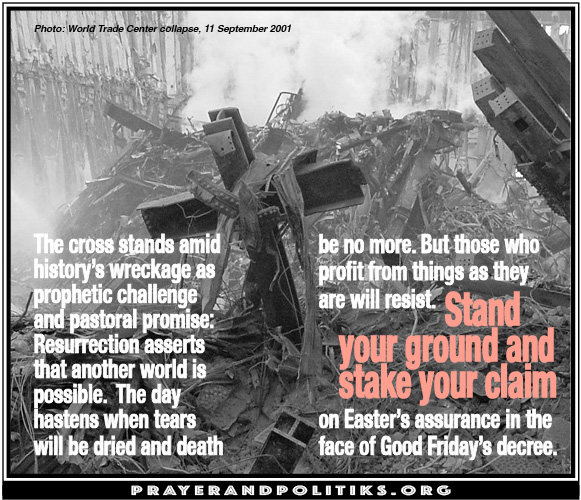 despair convincing.”
Hope is wider than optimism, believing everything will be fine; and deeper than pessimism, sensing all is doom, claiming only the strong survive. The latter, in fact, is a form of arrogant self-obsession, as if the world will unravel without our attention and muscular exertion.
Both optimism and pessimism are haphazard and fickle, providing unreliable compass readings for the living of these days. When one or the other knocks at your door, give welcome; but say, you’ll get neither bed nor board in this house.
How are the faithful to hold up in the face of mounting tragedy? This is the focal question as we practice our special disciplines—as means of attentive listening—in this liminal season.
The counsel of scriptures and the saints for faithful posture and animated hands is this: In the panic, be still; in the ordeal, take heart; in the night of sorrow, remember the promise of joy’s release, for more is at work than we imagine.
Hope is not hope absent the context of threat. Otherwise, what you have is distracting amusement. And as Kate Bowler has written, we are “too tired for tidy hope.”
“For the world has grown full of peril,” Galadriel said to Celeborn in Tolkien’s “The Lord of the Rings.” “And in all lands, love is now mingled with grief.”
Celeborn asks, “What now becomes of this Fellowship? Without Gandalf, hope is lost.”
“The Quest stands upon the edge of a knife,” said Galadriel. “Stray but a little, and it will fail, to the ruin of all. Yet hope remains while the Company is true.”
Trying days are here. Death’s pandemic is more palpable than usual; but it does not have the last word. Find your company and devote yourself to its sustenance.
§ § §
Word. “If the word hope doesn’t work for you, try ‘Never f**king surrender.’” —Rebecca Solnit
§ § §
Lent’s invitation is to ponder our own mortal limit. For 25 years I’ve had a pictorial reminder of Lent’s brush with mortal boundaries. After my dad’s funeral in 2001, Nancy and I discovered that both my mom and my sister wanted to be 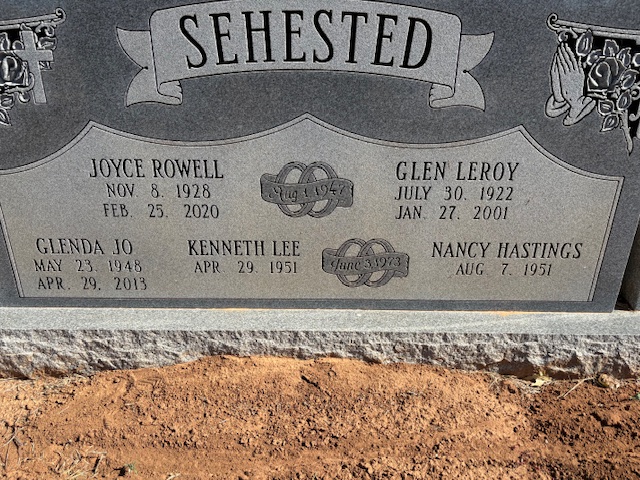 cremated when that time comes. As did we.
Years prior, Mom and dad purchased side-by-side plots in Marlow, Oklahoma’s cemetery, where they, my sister Glenda, and I were all born in that small town’s four-bed hospital. Together we decided to purchase a gravestone that would stretch across both plots: Dad’s casket in one, the other to hold the ashen urns for the rest of us.
Which means every Lent I have had an icon, with my name on it, to focus my attention on breathly life’s impermanence. The picture casts no morbid shadow over my imagination. Rather, it is a vivid reminder that death has lost its sting; the grave, its victory. This (to the degree I allow it) is the secret to living free of fear’s shackle and smothering hesitance.
§ § §
Benediction. “Good Friday is not about us trying to ‘get right with God.’ It is about us entering the difference between God and humanity and just touching it for a moment. Touching the shimmering sadness of humanity’s insistence that we can be our own gods, that we can be pure and all-powerful.” —Nadia Bolz-Weber
Postlude. “Soon it will be done / Trouble of the world / Soon it will be done / Trouble of the world / Going home! to live! with God! / No more weapin’ and wailin’ / No more weapin’ and wailin’ / Going home! to live with my Lord!” —“Trouble of This World,” Abbot Kinney & Lighthouse Choir
# # #