Ken Sehested
“I arise in the morning, torn between a desire to save the world
and a desire to savor the world. That makes it hard to plan the day!”
—E.B. White
Prelude. “Give me a word, give me a sign / Show me where to look / And tell me what will I find / What will I find / Lay me on the ground / Fly me in the sky / Show me where to look / And tell me what will I find / What will I find / Yeah, oh / Heaven let your light shine down, ohh . . . .” —“Shine,” Dolly Parton
§ § §
In his August 2026 column, Sojourners’ José Humphreys III introduced readers to Barbara Holmes’s notion of “crisis contemplation. . . . When the ordinary isn’t ordinary anymore and the crisis is upon us, the self can center in this refuge,” in the moment when there is “a cracking open, the rupture and shattering of self, community and presumptions about how the world works.” (“Preparing Our Spirits for Midterm Elections”)
Crisis contemplation is the place where hearts and minds need to center when things appear to be falling apart, when trauma erupts outside of emergency rooms or natural disasters, when the normality is shuttered in the calamities that threatens despair, when illusions are exposed, when the dream of a Beloved Community seems beyond the pale, when whole armies of animosity terrorize and mock every testimony of hope and expectancy of a new heaven and a new earth.
When ease lies crushed to dust; the promise of dawn, kidnapped and held for ransom.
Hope, outside the context of threat, is not hope, but rather a form of shallow optimism, a  kind of superstition, like the search for unicorns and juju beans and all manner of magical thinking. Hope requires a larger horizon, of being grasped by a transcendent vision which the “world” cannot admit and, in fact, tirelessly, relentlessly represses.
§ § §
Among the revelatory moments that shape my spiritual formation is one from my oldest daughter, Jessica, a professional bodyworker (an Ortho-Bionomy practitioner) in a group Pilates class as we practiced balancing exercises.
“The secret to balance is movement,” she repeated. Not stasis, as seems commonsensical. Learning to balance on one leg does not mean cessation of effort but the reliance on vast number of muscles working in tandem.
“Stillness”—a more familiar term in contemplative practice, and also another of Scripture’s reiterated appeals (“Be still and know that I am God.” —Psalm 46:10)—is not inactivity but a collaboration between initiative and receptivity: When to stand at the city gate relaying Heaven’s demand that justice flow like the waters and when to take shelter under the Beloved’s wings.
Squeezed between the deep Red Sea and Pharaoh’s war chariots, God told Moses: “Do not be afraid. Stand firm and you will see the deliverance the Lord will bring you today.” —Exodus 14:13
Not quite “know when to hold’em, know when to fold’em,” but you get the idea. There is a time for hallowed action and a time for holy idleness, for giving and for being given, for speech and for silence, for taking to the streets and for solitude’s sequestering.
There are grounds for lively debate on just how serious a threat President Trump (and minions) is to our constitutional order and basic human rights. He’s threatened to declare a national emergency on several occasions, for several reasons, in the past. Just recently, on 11 August, a headline in The Hill reported: “Trump on declaring national security emergency for elections: ‘Stranger things have happened.’”
Not to put too fine a point on it, I happen to believe that our republic is in deep doo-doo. (I strongly support small-d democratic governance because it is the means by which voters practice nonviolence.)
It’s up to you to make your own assessment. For my purpose, let me urge you to spend less than 10 minutes listening to three brief videos:
• Commentary (2:58) on where we in the US are currently situated, by Sarah Chayes, a former senior associate in the Democracy and Rule of Law Program at the Carnegie Endowment for International Peace, former reporter for National Public Radio, who also served as special advisor to the chairman of the Joint Chiefs of Staff.
• Eddie Glaude Jr., of Princeton University, eviscerates the US Supreme Court’s overturning of the Voting Rights Act this past April. —interview by Nicole Wallace, MS Now (2:38)
• Commentary (1:32) by famed political philosopher Hannah Arendt on the difference between ordinary tyranny and authoritarianism.
§ § §
“Tempted and tried we’re oft made to wonder, / Why it should be thus all the day long; / While there are others living about us, / Never molested though in the wrong. / Farther along we’ll know all about it, / Farther along we’ll understand why; / Cheer up, don’t worry, live in the sunshine, / We’ll understand it all by and by.” —“Farther Along,” Dolly Parton, Linda Ronstadt and Emmylou Harris
§ § §
Consider these four excerpts on the state of our future as a republic.
• “There are people I know and love — very smart people who are aligned with me 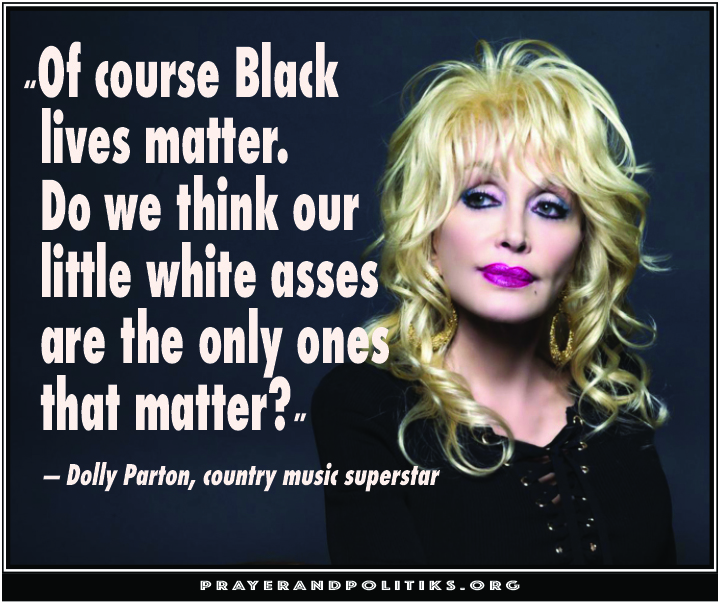 spiritually and politically — who still don’t believe (or don’t want to believe) the imminent threats to our democracy. They tell themselves any number of things to quell their anxieties about the moment: ‘It can’t be that bad.’ ‘Our institutions will hold.’ ‘Our courts will save us.’ ‘Both parties are corrupt, so what’s the point?’”
“It is time we all start having difficult conversations about authoritarianism and our democracy.” —first-hand account by Rev. Mara Richards Bim, Justice and Advocacy Fellow at Royal Lane Baptist Church, Dallas, TX
• From our neighbor to the north, Canadian Prime Minister Mark Carney:
“For decades, countries like Canada prospered under what we called the rules-based international order. We joined its institutions, we praised its principles, we benefited from its predictability. And because of that, we could pursue values-based foreign policies under its protection.
“We knew the story of the international rules-based order was partially false that the strongest would exempt themselves when convenient, that trade rules were enforced asymmetrically. And we knew that international law applied with varying rigour depending on the identity of the accused or the victim.
“This fiction was useful, and American hegemony, in particular, helped provide public goods, open sea lanes, a stable financial system, collective security and support for frameworks for resolving disputes.
“So, we placed the sign in the window. We participated in the rituals, and we largely avoided calling out the gaps between rhetoric and reality.
“This bargain no longer works. Let me be direct. We are in the midst of a rupture, not a transition.” —in his January speech to the World Economic Forum’s Annual Meeting 2026 in Davos, Switzerland
• From “A Call to Christians in a Crisis of Faith and Democracy,” joint statement in February 2026 from 400 Christian leaders in the US:
“We are facing a cruel and oppressive government; citizens and immigrants being demonized, disappeared, and even killed; the erosion of hard-won rights and freedoms; and a calculated effort to reverse America’s growing racial and ethnic diversity — all of which are pushing us toward authoritarian and imperial rule.
A significant component of this crisis is “a Christian faith corrupted by the heretical ideology of white Christian nationalism, and a church that has often failed to equip its members to model Jesus’s teachings and fulfill its prophetic calling as a humanitarian, compassionate, and moral compass for society,” adding that “In moments like this, silence is not neutrality — it is an active choice to permit harm.”
• From James Madison, often referred to as “The Father of the Constitution” for his role in drafting the US Constitution and the Bill of Rights:
“The means of defense against foreign danger historically have become instruments of tyranny at home.” —from his speech at the Constitutional Convention in Philadelphia on June 29, 1787
§ § §
In the mist of our mourning. “Farewell Dolly Parton.” —Miley Cyrus (Parton’s goddaughter)
§ § §
And so we existentially face the ancient question, “How then are we to live?”—how to live neither in passive resignation (which is, in fact, spiritually cancerous) nor in visceral, reactive outrage and murderous bloodlust?
There are numerous worthy responses to that question. But for us on the Way with Jesus, the wellspring is located in the recovery of our baptismal vows. It is in the buoyancy of stilled water, the catharsis that begins with a renunciation (“of the Devil and all his ways”) premising an affirmation (“nothing can separate”) which lead—over time and too many setbacks and missteps—to a disarming of the heart essential to any disarming of the nations, to the rejection of current norms (“the strong take what they can, the weak suffer what they must”) and the glorious affirmation of the Psalmist: “I believe that I shall see the goodness of God in the land of the living” (27:13).
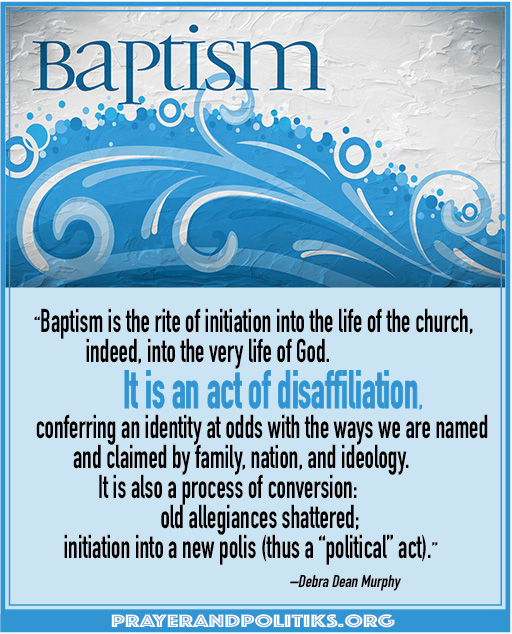
I love the way Debra Dean Murphy frames this: “Baptism is the rite of initiation into the life of the church, indeed, into the very life of God. It is an act of disaffiliation [emphasis added], conferring an identity at odds with the ways we are named and claimed by family, nation, and ideology. It is also a process of conversion: old allegiances shattered; initiation into a new polis (thus a “political” act).”
Then there’s this summary of baptism’s aftermath from Catholic theologian James Alison: “Faith [is] a habitual confidence given us by Another in whose hands we can relax. It means that what causes us to belong is a pattern of desire produced in us by someone we cannot see who is giving us the strength to live in the midst of this world as though death were not [emphasis added].”
And, of course, Alison knows that our practice of communion, of Eucharistic participation, serves as our repeated reminder that the Spirit’s presence “is designed to feed us with the capacity to work our way out of being moved by the winds of victim-aimed desire, and instead to teach us how to stand up against that and begin, however tentatively, another way of living together.”
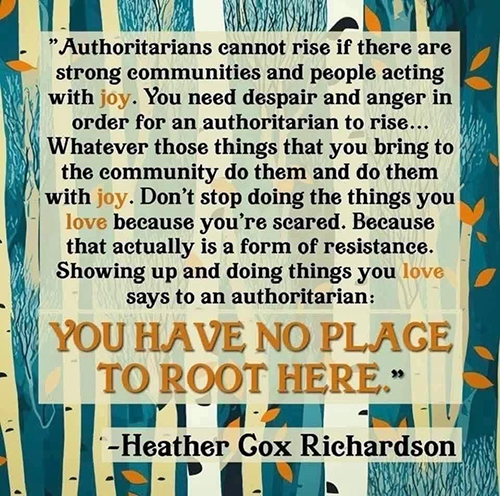
Baptism is the key (along with the baptismal reminder of the Eucharist) because baptism, at root, is about power. With our confidence in the Resurrection—God’s power over the realm of death— we can risk much, because we are safe, even in a despotic political climate. Not even death can take away anything important. This is the secret of our freedom and our joy. Nothing frightens imperial agents of any sort more than joyfully free, fearless people.
As the Prophet Zechariah records, “‘Not by might nor by power but by my Spirit,’ says the Lord” (4:6).
§ § §
Postscript. Nothing in this moment is complete without a grateful acknowledgement of the life and legacy of Dolly Parton, whose sum was so much greater than the total of her many exemplary parts. As has been said, in a world of Donald, be a Dolly.
§ § §
Postlude. “It’s been a long dark night / And I’ve been a-waiting for the morning / It’s been a long hard fight / But I see a brand new day dawning / I’ve been looking for the sunshine / You know I ain’t seen it in so long / But everything’s gonna work out just fine / And everything’s gonna be all right / That’s been all wrong / ‘Cause I can see the light of a clear blue morning / I can see the light of a brand new day / I can see the light of a clear blue morning / Oh and everything’s gonna be all right / It’s gonna be okay.” —“Clear Blue Morning,” Dolly Parton with Lainey Wilson, Miley Cyrus, Queen Latifah, & Reba McEntire
# # #