
Ken Sehested
“Cuba seems to have the same effect on U.S.
Administrations as the full moon once had on werewolves.”
—Wayne Smith, former director of the US Interest section in Cuba
Processional. “Mozart y Mambo.” Rondo alla Mambo, which combines the music of W.A.Mozart and Cuban Mambo, was featured in this flashmob on the streets of Havana, Cuba and was the grand finale of the Mozart y Mambo project. Inspired by W.A.Mozart and written by Joshua Davis and Yuniet Lombida Prieto, it is performed by Sarah Willis and the Havana Lyceum Orchestra.
§ § §
It was an ordinary day, 1985, interrupted by an unlikely phone call, leading to an extraordinary conversation, after which my time and attention would be profoundly altered.
The call was from a friend at the Southern Baptist Home Mission Board in Atlanta. Oscar, who served as liaison with that
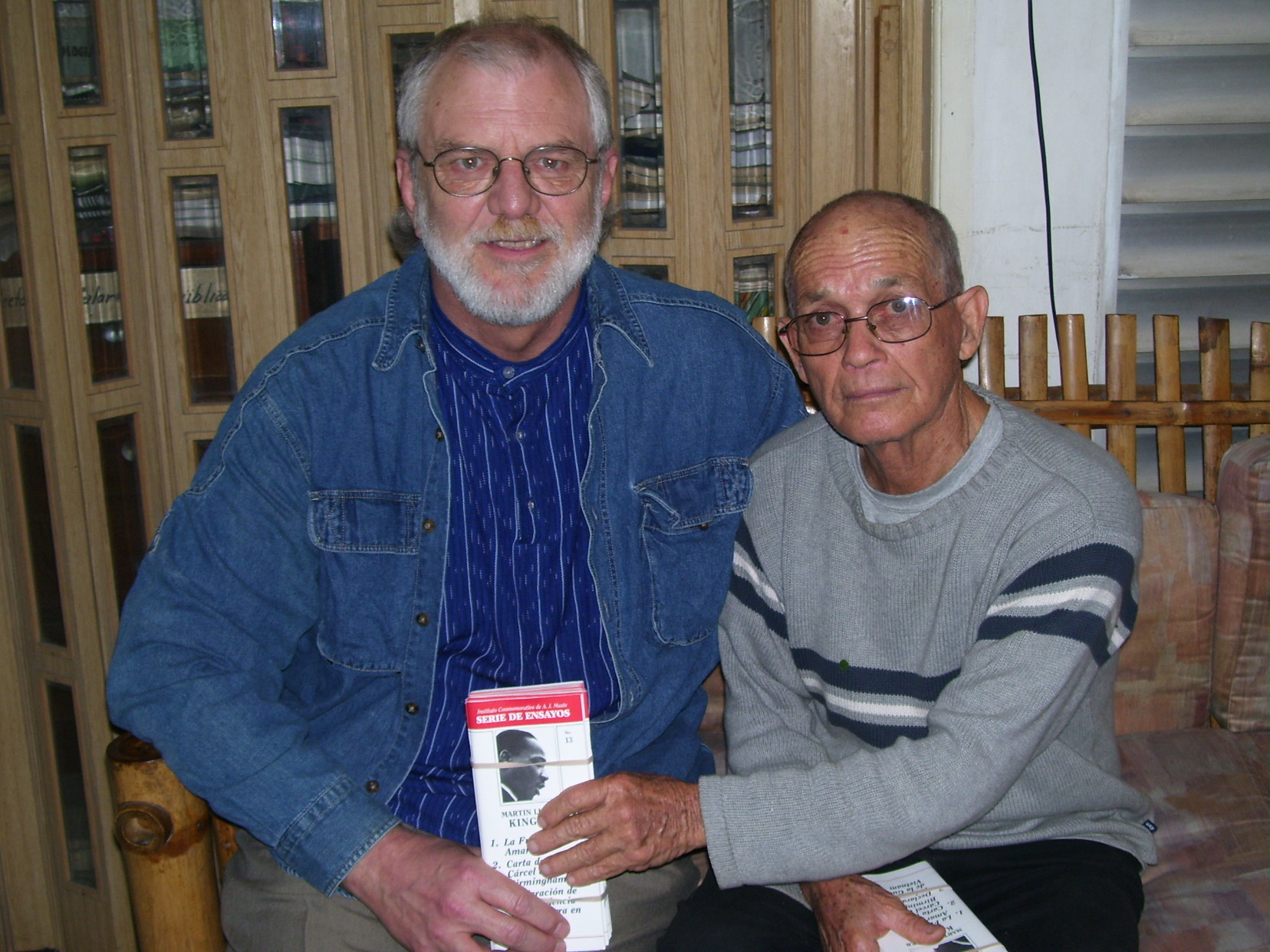
board’s Hispanic ministries, said “there’s someone here you may want to talk to.” That someone was Rev. Raúl Suárez, a Baptist pastor in Havana.
“I’ll be there soon,” I responded, and immediately called a bilingual friend to help with translation.
What unfolded was a two-hour conversation, which included Raúl quoting from memory long passages from the writing of Dr. Martin Luther King Jr. I knew King’s name had international currency, in part because of his Nobel Peace Prize. But I had no idea that a Cuban Baptist pastor would be so immersed, social and theological imagination so galvanized, in Dr. King’s work and witness.
At the time, Raúl represented his Baptist convention’s relationship with Southern Baptists. He was in the US because Cuba’s Western Baptist Convention ties were vested in a “home” mission agency. That fact alone provides lays out the historical backdrop to US-Cuba relations.
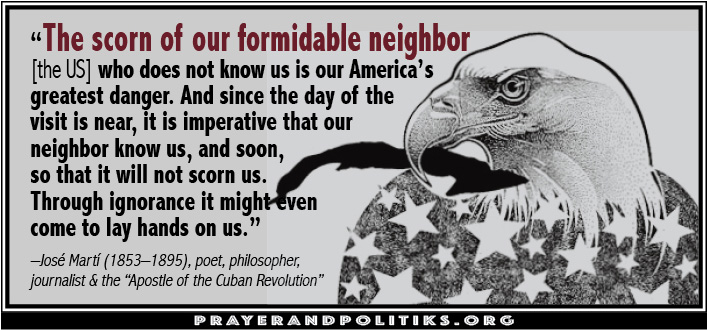
In the first decades of our nation’s independence, former President Thomas Jefferson wrote that the United States “ought, at the first possible opportunity, to take Cuba.” That impulse (with a few exceptions) has been a consistent current in US public policy ever since, including one failed invasion and dozens—some say hundreds—of Central Intelligence Agency attempts to assassinate Fidel Castro.
Starting in 1916, Milton Hershey owned 60,000 acres of sugarcane to supply the famous candy maker’s chocolate business. (The hamlet remains, renamed Camilo Cienfuegos, following the 1959 Cuban revolution which overthrew the US-backed dictatorship of Fulgencio Bautista, US mobsters’ gambling and prostitution industries, along with the grasp of US corporations.)
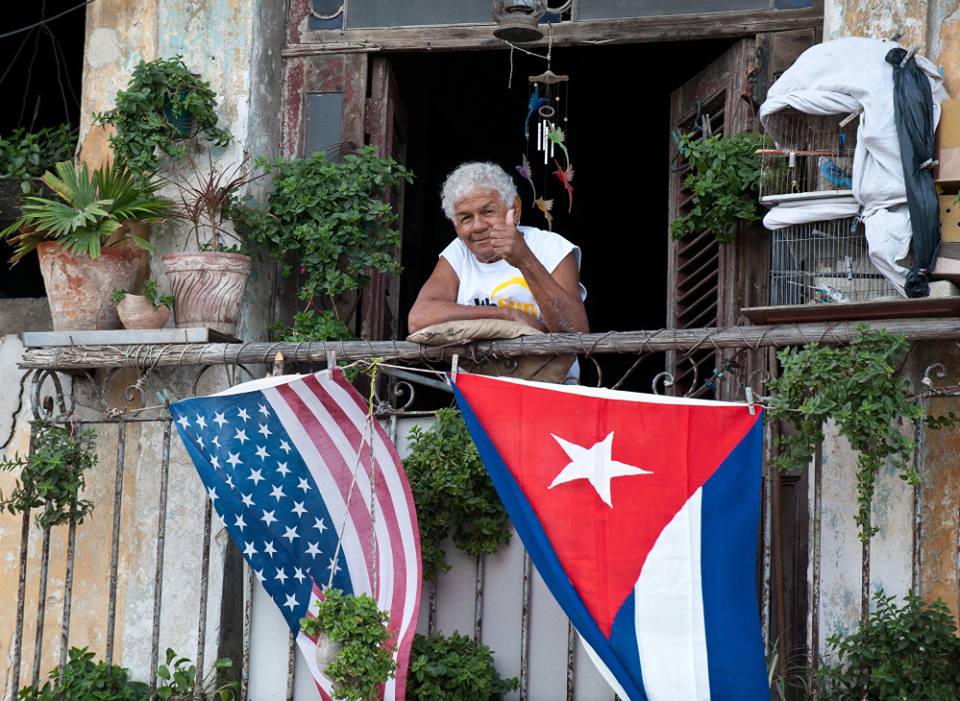
When medieval cartographers drew their maps of the known world, outside its border was written, “Here be dragons.” Or, variously, “Here be lions . . . or sea serpents.” This image is analogous to existing public perception of Cuba.
The US embargo of Cuba of nearly seven decades, and the more recent blockade of oil, is an act of sheer cruelty. Not only in
the slow strangulation of commerce, but also of information. For most in the US, Cuba is out of sight and out of mind. Communist China is the third largest owner of US debt. Communist Vietnam, where we waged a 20-year war, is now a brisk trading partner.
Our country’s embargo/blockade is the last remaining vestige of the Cold War. Our nation’s near three score and 10 years of hostility to Cuba is rooted in public humiliation: that a country in our “sphere of influence” would not submit to our political influence and economic manipulation.
A common comment by our Cuba friends is, “Cuba is neither heaven nor hell.” Whatever you think of their country’s achievements (there are many) or failures (no less than our own), US policy toward Cuba is utterly, indisputably draconian. And it is being done in my name . . . in your name . . . in the name of our nation’s sullied honor.
Posted below is a recently circulated open letter penned by an anonymous Cuban writer. I hope you will taste the salt in her tears, the growl of her malnourishment, the weariness of her emotional fatigue.
§ § §
Confession. “Because He came into the world and into history, / because He broke the silence and the agony, / because He filled the earth with His glory, / because He was light in our cold night. . . . / Because He bore the cross of our suffering / and because He tasted the bitterness of our ills; / because He accepted to suffer our condemnation / and thus died for all mortals.” —translation, “Tenemos Esperanza” (“We Have Hope”), Frederico Pagura & Homero Perea. Click the “show more” button to see the full lyrics in Spanish and in English. The final verse is incomplete—4 lines instead of 8—because as the author said, “This song must continue to be written among the ongoing struggle or justice.”
§ § §
Open Letter to the world
From Cuba, an ordinary woman denounces the crime no one wants to see
To all of humanity, to the mothers of the world, to Doctors Without Borders, to journalists with integrity, to governments that still believe in justice: My name is common, like that of millions. I have no famous surname or high-
ranking position. I am an ordinary Cuban woman. A daughter, a sister, a patriot. And I write this with a torn soul and trembling hands, because what my people are experiencing today is not a crisis. It is a slow, calculated murder, coldly executed from Washington. And the world looks the other way.
Speaking out for my grandparents: I denounce the fact that elderly people in Cuba are dying prematurely because the blockade prevents the arrival of medicines for heart conditions, high blood pressure, and diabetes. It is not a lack of resources. It is a deliberate prohibition. Companies that want to sell to Cuba are fined, persecuted, and threatened. Their governments remain silent. And meanwhile, a Cuban grandfather clutches his chest and waits. Death gives no warning. The blockade does.
Speaking out for my children: I denounce the fact that incubators in Cuba have had to be turned off due to a lack of fuel. That newborns are fighting for their lives while the United States government decides which countries can sell us oil and which cannot. That Cuban mothers have seen their children’s lives put at risk because an order signed in a Washington office matters more than the cry of a baby just 90 miles from its shores. Where is the international community? Where are the organizations that so staunchly defend children’s rights? Or do Cuban children not deserve to live?
Speaking out against intentional hunger: I denounce the fact that the blockade is engineered hunger. It is not that food is missing for no reason; it is that we are prevented from buying it. The fact is, ships carrying food are pursued. Bank transactions are blocked. Companies selling us grain, chicken, and milk are sanctioned. Hunger in Cuba is no accident. It is a state policy of the United States government—refined over 60+ years, updated by every administration, intensified by Donald Trump, and executed with malice by [US Secretary of State] Marco Rubio. They call this “economic pressure.” I call it terrorism through starvation.
A plea on behalf of my doctors: I denounce the fact that our doctors—the very ones who saved lives during the pandemic while the whole world was collapsing—now lack syringes, anesthesia, and X-ray equipment. Not because we don’t know how to produce them. Not because we lack talent. But because the blockade prevents us from accessing supplies, spare parts, and technology. Our scientists created five COVID-19 vaccines. Five. Without anyone’s help. Against all odds. Against the blockade and lies. And yet, the empire punishes us for having achieved it.
To the world, I say: Cuba does not ask you for handouts. Cuba does not ask you for soldiers. Cuba does not ask you to love us. Cuba asks you for justice. Nothing more. Nothing less. I ask you to stop normalizing the suffering of my people. I ask you to call the blockade by its name: a crime against humanity. I ask you not to be deceived by the narrative of “dialogue” and “democracy” while they have their hands around our throats. We do not want charity. We want to be allowed to live.
To the complicit governments that remain silent: History will hold you accountable. To the media outlets that lie: The truth always finds a way through the cracks. To the executioners who sign sanctions: The Cuban people neither forget nor forgive. To those who still hold humanity in their hearts: Look at Cuba. Look at what is being done to it. And ask yourselves: On which side of history do I want to stand?
From this small island, with a giant people, an ordinary Cuban woman who refuses to give up. If this text moved you, share it. It doesn’t matter if you have 10 friends or 10,000 followers. It doesn’t matter if your profile is public or private. It doesn’t matter if you never share anything. But this is different. This isn’t a photo of a sunset. This isn’t celebrity gossip. This isn’t just another opinion. This is a cry. And cries aren’t kept inside. They are heard. They are repeated. They become a multitude. Today, I’m not asking for a “like.” I’m asking you to use your thumbs for something bigger than just scrolling. Share. So the world knows that what is happening in Cuba isn’t just a crisis. It is a crime. So mothers in other countries know that here, babies are fighting for life in incubators shut down by the blockade. So grandparents in other lands know that here, the elderly are dying while waiting for medicines Washington won’t let in. So complicit governments feel shame. So lying media outlets have nowhere to hide. So the executioners know that we will not be silenced. One person sharing this won’t change the world. Thousands, millions—they will. Don’t keep this text to yourself. Don’t be complicit in the silence. Make this plea reach further than the blockade. Share. Now.
§ § §
I highly recommend this short 2023 article by Stan Dotson, “On Religious Liberty in Cuba.” Stan, along with his wife Kim Christman, currently serve as associate pastors at Ebenezer Baptist Church in Havana.
§ § §
Benediction. “May that hope never fade; may solidarity take the form of concrete actions in every home and every community; and may reconciliation be the path that allows us to recognize one another as brothers and sisters. May justice and dignity be more than just words—may they be a daily reality for all Cubans, both on and off the Island. And may peace—that peace born of respect and love—be the foundation upon which we build a future of shared happiness.” —translation of Rev. Idael Montero Pacheco, Ebenezer Baptist Church, Havana, Cuba. View the video of his (longer) message in Spanish.
Recessional. “Fe y esperanza viva.” —translation: “And we will move through the world with faith and living hope, / celebrating, singing, smiling, struggling for life. / And we will smile, together with the child and our brothers & sisters, / and to the one in need, we will extend our hand. / We will organize with strength and wisdom / and keep singing and struggling for life. / And we will walk with much faith and confidence / and keep singing praise to God.” — Enrique Sosa Rodríguez, performed by Circle of Mercy Congregation band
# # #