Ken Sehested
Hymn of invocation. “Creator of the Stars of Night.” —9th century hymn performed here by the St. John’s Compline Choir
§ § §
I don’t remember when I picked up this handy mental trick. Sixth grade, maybe seventh?
My first recollection of using it came during a world geography class. The teacher asked us to memorize the names of European countries’ capitals, many of which I’d never heard before. So I worked at creating a mental image using two different words or facts.
To this day, I recall the capital of Bulgaria as Sophia. Because I imagined a bull lying on a sofa.
It wasn’t until much later that I learned the proper words for this exercise: mnemonic device.
Neuroscientists have dozens of theories and countless technical words to describe how the mind works, particularly how memories are shaped, stored, altered, and retrieved. But the basic insight goes back to ancient Rome’s first century statesman-lawyer-orator, Cicero, who wrote “the eyes of the mind are more easily directed to those objects which we have seen, than to those which we have only heard.”
Some of my mental pairings are humorous, like the status of Sophia. But most are not. I recall more than a few Scripture verses because my “mind’s eye” has paired them with specific visual representations. Like the names and/or faces of specific people or historic moments.
For years I’ve had two such key associations with Advent. Last Sunday night I gained a third.
§ § §
Hymn of confession. “It’s been a long dark night / And I’ve been a waitin’ for the morning / It’s been a long hard fight / But I see a brand new day a dawning / I’ve been looking for the sunshine / You know I ain’t seen it in so long / But everything’s gonna work out just fine / And everything’s gonna be all right / That’s been all wrong.” —“Light of a Clear Blue Morning,” Wailin’ Jennies
§ § §
Every Advent, my first association has been with what would become the historic first week of December 1955 in Montgomery, Alabama. Rosa Parks refused to relinquish her seat to a white man on a segregated bus. Her frustration boiled over into a risky act of defiance on Monday of that week.
E.D. Nixon, key leader in the city’s National Association for the Advancement of Colored People, began urging the city’s 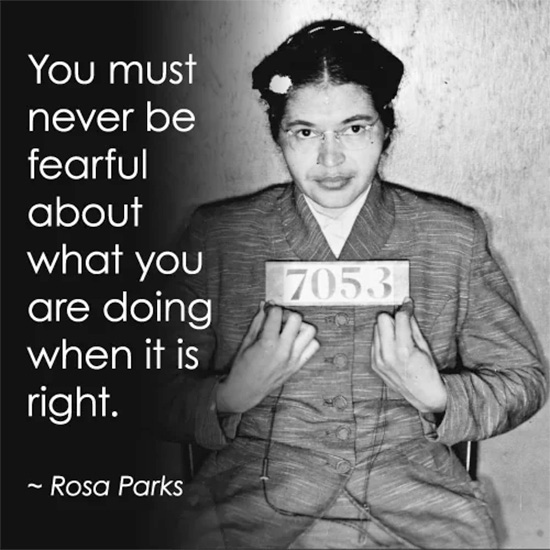 Black pastors to respond. The next day they gathered and formed the Montgomery Improvement Association (MIA). One of the city’s newest pastors, Rev. Martin Luther King Jr. (who was still at work on his Boston University School of Theology doctoral dissertation), was elected as its president.
The group voted to call a city-wide bus boycott for Friday 5 December. The Women’s Political Action took on the task of publicizing the event. (Illustrating a long history of men deciding to do something, the women actually making it happen.)
On Friday evening, 5 December, thousands jammed into Holt Street Baptist Church, filling the sanctuary, the basement auditorium, others spilling out into the street. Under the banner of the MIA, the assembled group voted to continue the boycott until the city met its demands.
Little did they know it would take 381 herculean days to accomplish the task.
Why this particular moment sparked a movement is unclear, for a half dozen other African American citizens had previously been arrested for violating the city’s bus segregation policies, including Dr. Vernon Johns, Dr. King’s predecessor at Dexter Avenue Baptist Church.
That week in Montgomery, during Advent’s risky remembrance, an array of historical factors conjoined with Holy Spirit mischief to crystalize what would become a world-reshaping movement.
§ § §
Hymn of petition. “Lord I’m Tired of Trying To Be Okay.” —Jelly Roll & Lady Gaga
§ § §
My second Advent reminder comes from the martyrdom of four Catholic missioners, three of them religious sisters, one a lay Catholic: Srs. Dorothy Kazel, Ita Ford, and Maura Clarke, plus Jean Donovan.
On 2 December 1980, the four were carjacked by Salvadoran soldiers on an isolated road, tortured, raped, and executed. 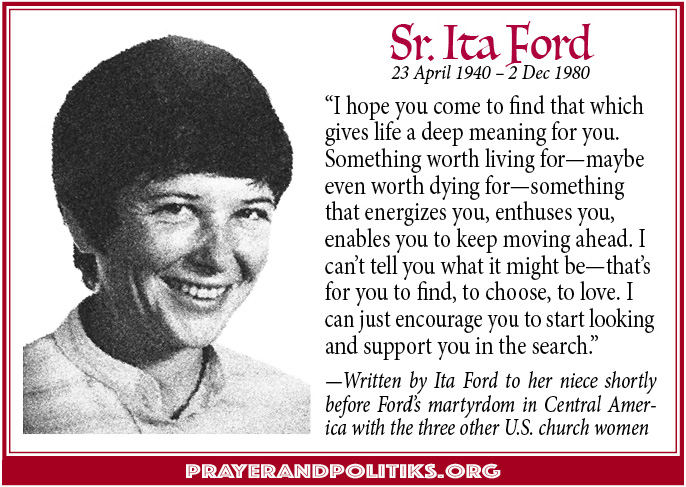 Their hastily buried bodies would not be found until two days later.
Their crime? Working with and advocating for the poor in El Salvador
US Ambassador to El Salvador Robert White was fired by the Reagan administration for refusing to manufacture a cover up of the Salvadoran military’s role in the massacre.
It took years of pressure from the US, which was funding Salvador’s dictatorial military government, to convict five low-ranking members of the military. But not those responsible for ordering the assassinations, including two generals who were later found living in retirement in Florida.
I encourage you to view a 12+ minute film about the four churchwomen, created in 2014 by the New York Times.
For more background, see “The four churchwomen murdered in El Salvador,” Tracy L. Barnett, Global Sisters Report
§ § §
Hymn of lament. “When you’re broken open.” —First of five movements in Anna Clyne’s cello concerto. Each of the movements is named for a five-line poem by 13th century poet Rumi.
§ § §
This past Sunday, I got a new Advent memory prompt.
At the close of our worship service, one of our folk—a member of an immigrant rights advocacy group in our congregation—passed out small whistles used to alert neighborhoods when someone spots agents from the infamous Immigration and Customs Enforcement agency. Each whistle was attached to a metal ring, making it possible to use this  as a key ring, conveniently available. Also offered were small brochures, in English and in Spanish, which provide practical advice on when, how, and why to use the whistles.
Probably like you, I have been gobsmacked by the uprising of homegrown actions, nationwide, challenging ICE agents’ campaign of terror, purportedly against violent immigrants, but in fact mostly those whose criminal rate is lower than natural born citizens.
For an excellent (and free, online) collection of articles by Christian leaders on the MAGA campaign against migrants, see the current issue of Christian Ethics Today.
If you want to dive deep into the details of the financial bonanza which undocumented workers provide the US economy via the taxes they pay (and to whom few federal resources are available), see “Tax Payments by Undocumented Immigrants.”
§ § §
Hymn of exultation. “Ring Them Bells.” —The Spirituals Choir
§ § §
You may think me overly somber to list these three trepidatious narratives as memory prompts for the blessed Nativity story. But consider the terror-filled context of a population occupied by ruthless Roman occupation and corrupt temple authorities.
The Gospel lections for this year’s Advent readings are filled with dangerous confrontation:
- The apocalyptic prospect of the “coming of the Son of Man” (Matthew 24:36-44).
- John the Baptizer’s verbal assault on the temple bouncers: “You brood of vipers!” and his warning that “even now the ax is laid at the root of the trees” which, if they fail to bear fruit, “will be cut down and thrown into the fire” (Matthew 3:1-12).
- Mother Mary’s threatened “public disgrace” which could have merited stoning to death under Jewish law (Matthew 1:18-25).
- The “terrified” shepherds to whom the angels brought the news of Jesus’ birth (Luke 2:1-14).
- The state-sponsored terror of Herod’s ordering the slaughter of male babies in Bethlehem, and the Holy Family’s frantic escape into Egypt as refugees (Matthew 2:13-23).
Most prefer Advent to be enchanting rather than contentious. We read the Nativity story by way of jingle bells, roasted chestnuts, and jolly St. Nick. (Who, 17 centuries ago, was a Middle Eastern bishop known for making anonymous gifts to the poor, without first checking whether they had been naughty or nice.)
Advent is no “sleep in Heavenly peace,” but a troublesome rereading of Creation’s covenant. What was previously presumed to be “law and order” is exposed for the façade of injustice it really is. There is turbulence in Nativity’s wake. Every Herod-heart is laid bare and flails, enraged by the manger’s insurgent proclamation.
Every Pharaoh, every Caesar, is put is put on notice. And they will not go down without a fight.
Advent’s affidavit warns of trouble at hand. Christmas morn is the inauguration of Mary’s previous declaration of praise—the scattering of the proud, the toppling of the mighty, the ascent of the lowly—signaling a divine beachhead on the shorelines of enmity.
Yet through this fog of war and wanton circumstance, the child of God’s promised re-creation breaks into history’s bleak midwinter. The season’s lections from Isaiah concerning the coming Rule of the Beloved are as jubilant as they are breathtaking:
The boots of trampling warriors will be burned as fuel for the fire. Swords will be beaten into plowshares; neither shall they learn war any more. The rod of oppression will be broken. Exultation will be multiplied. Deserts will rejoice and blossom. The lame, leap like deer; jackals, removed; grain and wine, plentiful; ruins, rebuilt. (Excerpted from chapters 2, 11, 35, 7, 9, 62.)
“And all the ends of the earth shall see the salvation of our God” (52:10).
Note, though, that these promises are made to people “who sit in darkness” and “in the shadow of death” (Isaiah 42:7, Luke 1:79). The risk-averse will not hear Mary’s Magnificat, will not notice the star’s ascendance, the shepherds’ awe, the Magi’s arrival. Nor the slaughter of the innocents.
Kindred, do not fear Advent’s tumult amid history’s turbulence. Improvise your own Advent mnemonic signals. Wait patiently, with open hands, hearts in repose—but on the edge of your seat. For unto us a child. . . .
§ § §
Benediction. “Let Love Melt Into Memory.” —National Lutheran Choir
# # #