

Meditation on Israel, Palestine, and the calculus of power
Ken Sehested
Prelude. “Adonai (Psalm 113:3).” —Hebrew and Arab voices, must by Nathaniel Bassey: “From the rising of the sun to the place where it sets, the name of the Lord is to be praised”
§ § §
The 15th of May is the anniversary of what Palestinians call al-Nakba, translated as “the Catastrophe,” in reference to the day following Israel’s formation as a state in 1948. Some 700,000 Palestinians were forced from their homes or left in fear of their lives. Four hundred Palestinian villages cease to exist. The heirs of the expelled now number five million, most living in refugee camps on the West Bank, Gaza, and surrounding countries.
I was in my 30s when I first heard the word al-Nakba, and the historical moment it represents, well into a career requiring broad knowledge of global affairs. In my experience, few here in North America know the word.
A more evocative translation of al-Nakba could be “the Humiliation,” since in English “catastrophe” is often associated with “natural” disasters. As such, no human agency is implied—only the brute hand of animus well beyond our control or even prediction.
al-Nakba was not natural, not beyond control, likely not even beyond prediction.
§ § §
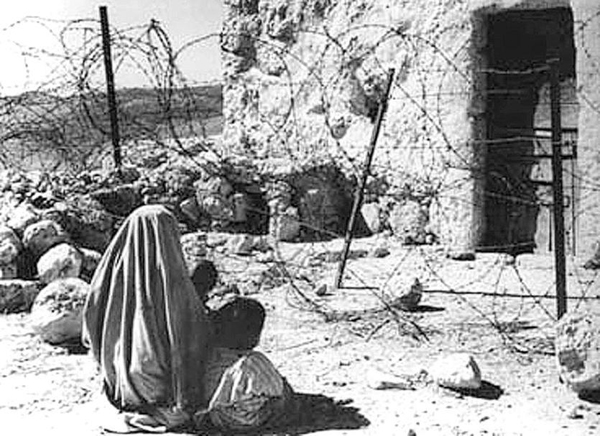
Above: A Palestinian refugee and her child separated from their home by the “green line”
establishing the 1949 newly-drawn border of Israel
The agonistic struggle among ancient Canaan populations of the Eastern Mediterranean trace back to BCE eras. Multiple empires, vying for invaluable trade routes, have transgressed and rearranged a host of governed borders, tossing and turning in the churning crossroad of European, African, and Asian influence.
But the events surrounding 1948 are pivotal in discerning the way forward in establishing its state of equitable accord, of how to mediate the demands of justice with the prerequisites of peace.
The only (vague) memory I have of this period in Palestine’s history is watching one of Paul Newman’s early films, Exodus (1960), based in part on Leon Uris’ book by the same title, loosely retelling the dramatic saga of Holocaust surviving Jews attempting to reach Palestine from France after the war.
I don’t remember that movie saying anything about Irgun and Lehi, Jewish terrorist groups, which carried out bombings and assassinations against British governance and military (during the “British Mandate” rule) and the predominantly Arab population.
Indeed, in my research I notice that Wikipedia prefers to speak of “Jewish paramilitary” groups who engaged in “Zionist political” military action during this period. The difference between terrorists and freedom fighters is almost always decided by whose future gains the upper hand.
§ § §
Hymn of lament. Azi Schwartz of the Park Avenue Synagogue recites the Jewish Kaddish as a tribute to the 11 victims of the Pittsburgh synagogue shooting. —NBC
§ § §
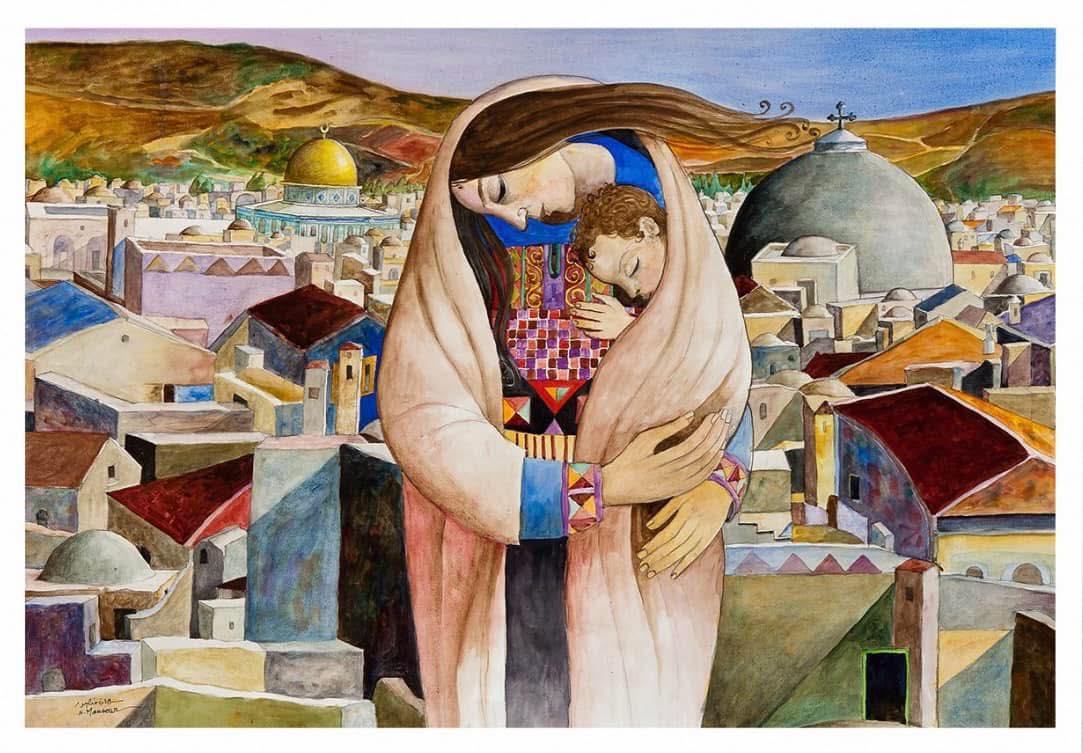 Above: Mother and Child by Palestinian artist Sliman Mansour, 2009
Among the vilest things I’ve ever heard about Jews came from the imam of a mosque in Basra in southern Iraq. Afterward our group quizzed our translator to make sure he wasn’t exaggerating. “Actually, it was a little worse,” he said.
And some of the most reprehensible statements about Muslims I’ve seen were scrawled on the closed shop gates of Arab merchants in Hebron, spray painted by residents of the surrounding Jewish settlement in the heart of that ancient West Bank city.
One of the good recent articles regarding the situation in Gaza is by Rabbi Edward Retting of Rabbis for Human Rights in Israel, an organization that does courageous work. “There is only one way toward peace,” he writes. “That is the recognition that our dispute concerns two just causes [that of Jews and of Palestinians] tragically thrown into opposition one to the other.”
Yes, I say in response. But one is an elephant, the other is a mouse. Without recognition of this premise, without clarifying the calculus of power, whatever conclusions emerge will only deepen the cycle of violence which now feeds on itself, like the record-breaking warmth of the Gulf of Mexico turning always-destructive hurricanes into monster storms.
§ § §
Hymn of encouragement. “Bella Ciao.” —Rana Choir, made up of Arab and Jewish women singing in Farsi, Hebrew, and Arabic, recorded as a gesture of solidarity with the courageous women in Iran
§ § §
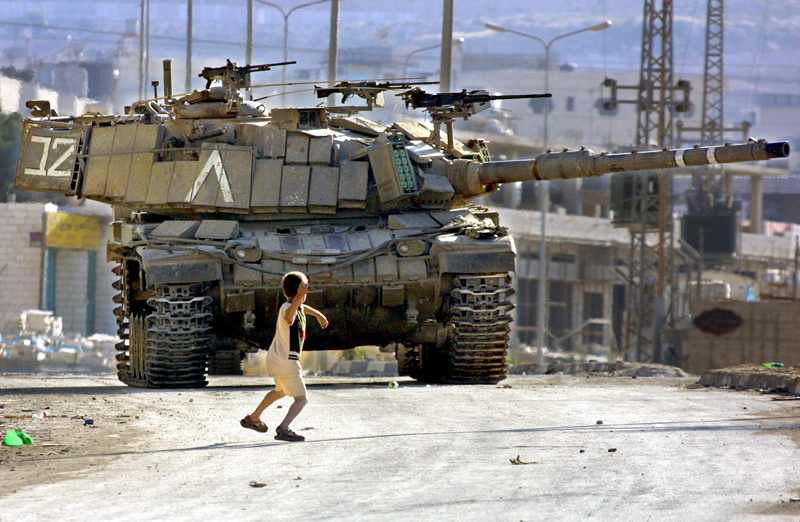
Above: Palestinian boy throws rock at Israeli tank-Musa Al-Shaer, Agence France-Presse
The work of reconciliation in the midst of conflict can never sidestep the question of power relations between conflicting parties. To illustrate that disparity, here are some figures from Israel’s 2014 invasion of Gaza.
Between 10,626 and 10,895 Palestinians were killed (including 3,374 children, of whom over 1,000 were left permanently disabled). Sixty-six Israeli soldiers, five Israeli civilians (including one child) and one Thai civilian were killed and 469 Israeli soldiers and 261 Israeli civilians were injured (the latter by rockets fired by Hamas into southern Israel). The Gazan casualty rate was 65%-70%. —“2014 Israel-Gaza conflict,” Wikipedia
[The bloody inventory of Israel’s crushing of Gaza, and incursion into its current raids into Lebanon, is reviewed below.]
Until recently I could see no way forward in addressing this conflict other than the so-called “two state solution,” with the nation of Israel and a newly-created Palestinian state residing side-by-side, with a negotiated land swap that would approximate the pre-1967 war’s border.
Everybody knows that Hamas, Gaza’s ruling party (chosen by democratic election), still refuses to recognize Israel’s legitimacy. Few know, however, that Israel’s ruling Likud Party, along with other parties in its governing coalition, are officially and adamantly opposed to any meaningful two-nation arrangement.
The US is hardly an honest broker in this conflict. Israel is by far the largest recipient of US foreign military aid, now at $4 billion per year. Before President Trump’s administration, US support for the Palestinians was a tiny fraction of that, almost all of which was routed through various UN agencies to support basic infrastructure and refugee provisions. Trump has canceled all humanitarian aid.
While it’s true that US recognition of Jerusalem as Israel’s capital does not affect any concrete structural changes; it does however give symbolic strength to Israel’s claim of sovereignty over all of Jerusalem, in contravention of United Nations’ mandates (which also make all of Israel’s West Bank settlements illegal under international law).
Just this past week, on Israel’s a state-sponsored “Jerusalem Day,” marking the anniversary of the city’s capture and annexation, thousands of Israeli and West Bank settlers rampaged through Palestinian East Jerusalem streets chanted “death to the Arabs,” “may your villages burn,” and “Gaza is a graveyard.” Some believe Southern Lebanon will soon be added to Israel’s annexation claim.
§ § §
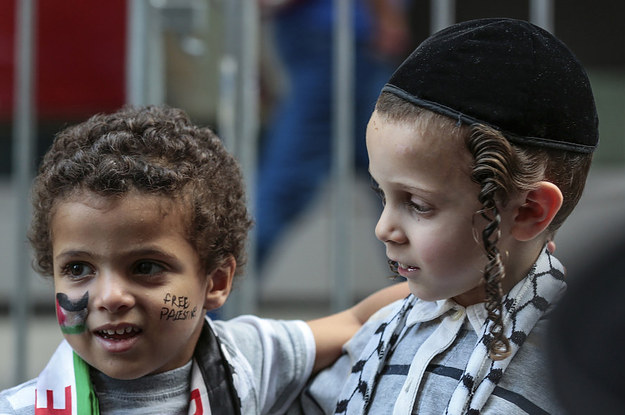
Above: Palestinian & Jewish boy greet each other at Hanukkah
There is a popular saying among visitors to Israel/Palestine: Stay for a week, and you think you can write a book. Stay for a month, and you think, well, maybe an essay. Stay for a year, and you don’t know what to say.
I do not pretend in these spare comments to offer policy guidance toward a different future. I do know, as the saying goes, that when you find yourself in a hole, the first thing you do is stop digging. And I do know, without a shadow of a doubt, that the dominant narrative in American political culture is not only shortsighted but also complicit with Israel’s brutal occupation of Palestine’s population.
The only genuine, lasting security is mutual security. At present, the West Bank and Gaza are more like maximum security prisons.
Truth be told, over the past hours of writing I have fought off my own heart’s numerous pleas to cease and desist any public comments on this topic. I am connected to several communities for whom conversation about sexual orientation is a breeze compared to discussions of Israeli-Palestinian relations. The volatility quotient is enough to shut down meaningful dialogue. In addition, for people like myself, who at this distance face little existential threat, the subject easily becomes a conveniently liberal parlor exercise. When there’s no blood on the floor, talk is cheap.
In the end, though, silence on the matter is both an abdication of liability (make it go away!) and a collaboration with infamy. We have the right neither to demand this conversation nor to abandon it. We sit, always, on a moral precipice—but that is exactly the proper posture of reverence. Shared reverence is our only hope.
§ § §
In the end, my political pessimism is held at bay because I know a few of the many Israelis and Palestinians (and there are more than you know)—Jews, Christians, Muslims, and other people of conscience—who arise each day, indefatigably and almost beyond imagination, to practice truth-telling and justice seasoned with mercy and compassion. And I know a few others, here in the US and elsewhere, who persevere in their support for these insistent, persevering agents of reconciliation.
What to do? At the very least, dig deeper for information and perspective on this topic beyond what our dominant media supplies. Hold your heart open to the possibility of connecting with the network of resisters, healers, and visionaries who dream differently, inspired by the vision spoken of by the Prophet Micah, for the day when all shall sit under their own vine and fig tree, with none to make them afraid (4:4).
§ § §
Hymn of petition. “Erev Shel Shoshanim” (“Evening of Lilies [or Roses”]). —Yuval Ron Ensemble. This song, a love song well known throughout the Middle East, is dedicated to the children of Jerusalem, the vision of peace between Jews and Arabs, and peace around the world.
§ § §
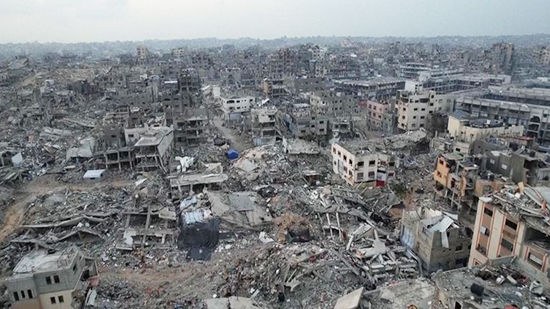
Above: desolation in Gaza
Gaza and Lebanon devastation
Numbers can be numbing; but they provide needed perspective
- As of 3 May 2026, nearly 74,000 Palestinians have been killed in the war in Gaza which began on 27 October 2023—70% of them women and children. Thousands more are believed to still be buried under the rubble of destroyed buildings.
- Scholars estimate that 80% of the Palestinians were civilians. These totals do not reflect the number who have died as a result for lack of health care, food insecurity, and inadequate water and sanitation.
- Among those killed were 270 journalists, 560 humanitarian aid workers.
- An estimated 83% of buildings in Gaza have been destroyed.
- Nearly all of Gaza’s 2.1 million residents have been displaced at least once. Included in that number is an approximately 1.85 million children under the age of 18.
- Slightly more than 2,000 Israelis have been killed, 1,200 of them during the 7 October 2023 Hamas-led attack, and another 253 taken hostage.
- As of mid-May, at least 2,882 have been in killed by Israeli Defense Forces in Lebanon and more than 1 million people internally displaced. Seventeen Israeli soldiers have been killed in combat, and 2 Israeli civilians in northern Israel.
- Minutes after the US and Iran agreed to a ceasefire on 8 April, Israeli air strikes hit 150 targets in Lebanon, some in densely populated residential neighborhoods, all within 10 minutes, killing more than 300. Hundreds are still buried under rubble. More than 1 million people have been displaced.
- A list of humanitarian and human rights organizations asserting that Israel is committing genocide in Gaza: UN Commission of Inquiry § Amnesty International § Human Rights Watch § International Association of Genocide Scholars § Lemkin Institute for Genocide Prevention § Euro-Mediterranean Human Rights Monitor § Two Israeli Human Rights Organizations: B’Tselem and Physicians for Human Rights-Israel § Oxfam International § Doctors Without Borders § Eight Global Quaker Organizations § Christian Aid
- The legislatures or executive officials of 68 countries assert that Israel is committing genocide in Gaza.
- Video (1:00) of destruction in Gaza City.
- Israeli finance minister Bezalel Smotrich “has vowed that ‘Gaza will be entirely destroyed’ as a result of an Israeli military victory, and that its Palestinian population will ‘leave in great numbers to third countries’, raising fears of ethnic cleansing in the occupied territory. . .” —The Guardian
§ § §
Postlude. “Psalm 135: Arabic Orthodox Chant,” —from St. George Church, Aleppo, Syria.
# # #
