Ken Sehested
Prelude. “And blessed are the ones who fight for justice / Longing for the coming day of peace / Blessed is the soul that thirsts for righteousness / Welcoming the last, the lost, the least.” —“The Kingdom is Yours,” Common Hymnal feat. JonCarlos Veez, Jamies MacDonald, Dee Wilson
§ § §
Some years ago I was invited to speak at a conference in Brazil. Three young pastors met me at the Rio de Janeiro airport. On our way into town, one pointed out we were about to pass close to the iconic, 124-foot tall “Cristo Redentor” (“Christ
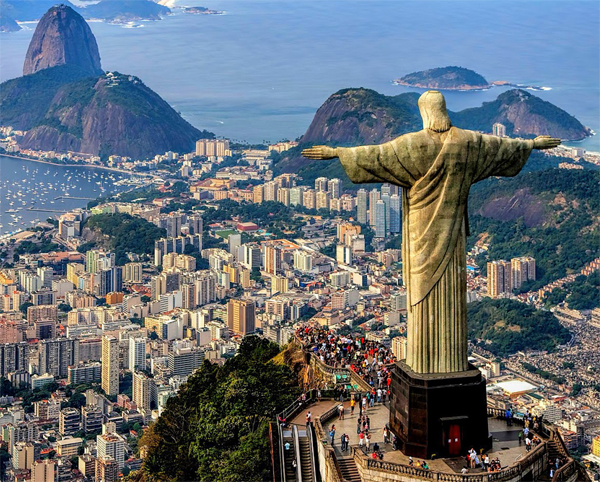
the Redeemer”) statue atop the towering Mount Concovado overlooking the city. You’ve probably seen it on television, if not in person.
As we approached, I craned my neck to look up and said, in a soft voice, “Don’t jump. Don’t jump.”
Whereupon the whole car broke out in laughter. I knew then I was with kindred folk.
The campaign to raise funds for the statue was organized in 1920 by the Roman Catholic Archdiocese of Rio de Janeiro, at least in part as a protest against the growing “godlessness” in the culture.
The protectors of godliness are, in every age and place, constantly warning against the impious, depicting them as chimeras: monsters who refuse to genuflect in the presence of reigning authorities, gnarled creatures who defy nature’s boundaries.
As was asserted by Scottish-English King James I, in responding to dissident pastor (later co-founder of the first so-named Baptist congregation) Thomas Helwys’ rejection of regnant religious authority, said “It would be only half a king who controlled his subjects’ bodies but not their souls.”
Helwys, who died in James’ Newgate prison in 1616, may have been the first martyr for religious liberty.
§ § §
Word. “Take a stand, take a stand, take a stand / If I never never see you anymore / Take a stand, take a stand, take a stand / I’ll meet you on the kingdom’s door.” —Blind Willie Johnson, “Take a Stand”
§ § §
The Solemnity of Our Lord Jesus Christ, King of the Universe, commonly referred to as Christ the King Sunday (aka Reign of Christ Sunday) is among the newer observances in the church’s lectionary calendar. It was promulgated by Roman Catholic Pope Pius XI in 1925, as a reaction to the perceived growth of secularism, escalating nationalism, and surging anti-clericalism. As it now stands, it is the final Sunday in the lectionary calendar, ushering in a new “year” beginning with Advent.
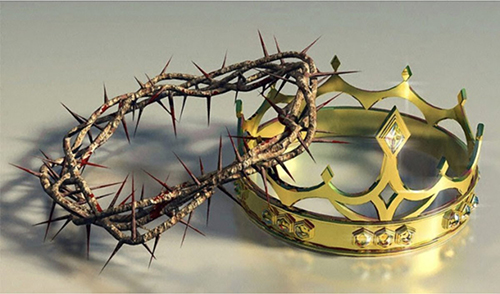
Numerous other denominations which follow the Revised Common Lectionary also observe the day as the culmination of the annual narrative of Jesus’ birth, life, death, and resurrection.
As is the case with most every liturgical observance, this Sunday’s focus has both redemptive and reactionary overtones and implications.
Obviously, all kingly and lordly language is problematic for upholding the legitimacy of feudal rule in human affairs and the historic subjugation of and indignity toward women. The absolute rule of kings and assorted other potentates is said to be divinely patterned and codified according to heavenly precedent.
As in heaven, so on earth, giving transcendent legitimacy to existing governance. By implication, the notion that “outside the church there is no salvation” became sanction for the church’s exclusive, domineering authority.
It would take many generations of discrimination, oppression, exile, torture, and martyrdom to bring about a democratizing of access to the Holy. Then of course, I’m remembering my conversation with my friend Fr. Gerry, a Glenmary priest, where I was grousing about some irksome statement by the Pope. He commiserated, but then said, “At least we only have one pope; you Baptists have them on every corner.”
Nevertheless, Pius XI’s stipulation of a “Christ the King” observance can also be interpreted in a way that bolsters, rather than hinders, resistance to monarchal privilege and virulent nationalisms of every kind. We can rightfully say that Jesus’ “lordship” undermines and destabilizes every form of lording.
Also in 1925 (when construction of the Christ the Redeemer statue was underway), Adolf Hitler published the first volume of his manifesto, Mein Kampf, where he lays the foundation of his racially supremacist views. This was also the year when 40,000 members of the Ku Klux Klan marched in Washington, DC. Thought at that time to be the largest fraternal organization in the country, they were already using the “America First” slogan, recently retrieved for political discourse.
In this same period Benito Mussolini assumed power as the fascist dictator of Italy. Joseph Stalin had succeeded Vladamir Lenin’s Bolshevik revolution in the Soviet Union. Francisco Franco was rising through the ranks of the Spanish military, on his way to establishing his militaristic dictatorship.
Nationalism was contagious, and authoritarian leadership was epidemic, prompted in part by the chaos and industrialized belligerence of World War I.*
§ § §
Hymn of supplication. “Jesus, Remember Me,” Taizé
§ § §
The lections for this Sunday’s motif include two barn-burner texts, one rarely read from Ezekiel (34:11-16, 20-24) and one much more familiar, Matthew (25:31-46).**
You know the corporeal details of this eschatological passage: the hungry, thirsty, stranger (the immigrant, in ancient Palestinian context), naked, sickly, imprisoned—all vulnerable, fleshly conditions. On Judgment Day, one’s eternal
standing in the eyes of God, in the very presence of the “Son of Man,” will be measured according to the history of one’s response to the needs of such “little” ones.
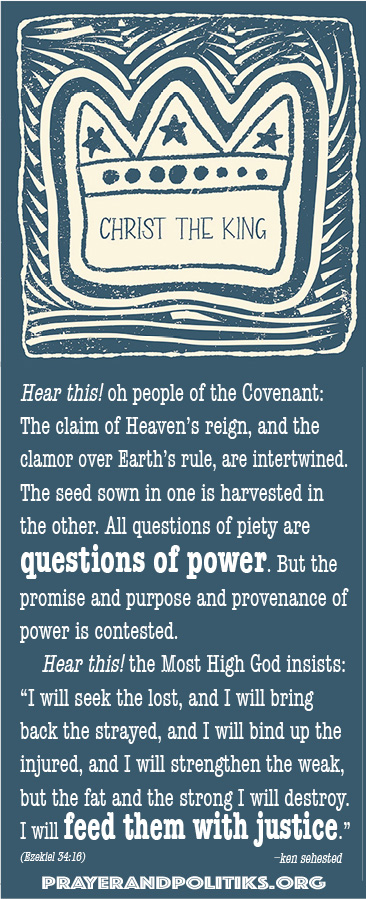
The other red-hot text, from Ezekiel, is summarized in v. 16 where the repeated use of “and” serves as an emphatic punctuation: “[Says the Lord God,] I will seek the lost, and I will bring back the strayed, and I will bind up the injured, and I will strengthen the weak, BUT the fat and the strong I will destroy. I will feed them with justice. (Italics and caps added)
The “end times” will feature an era of accountability. Indeed, the “day of the Lord” will not be a time for happy-clappy music. A number of texts echo his bleak note from Amos: “Alas for you who desire the day of the Lord! Why do you want the day of the Lord? It is darkness, not light” (5:8). According to Zechariah, on the day of the Lord “the feeblest among them shall be like David, and the house of David shall be like God.”
Can we wrap our heads around this divinely incarnate insistence?! The fate of the feeble reflecting the very glory of God?! The Blessed One more attentive to Earth’s agony than Heaven’s ecstasy?! A Lord whose kingliness banishes all lording and all hoarding?!
Such will be the Reign of Christ. In the anticipation of such do we pin our hopes, assess our choices, and reckon our path, keeping our eyes on the prize of this high calling to associate with and learn from the lowly in order to accurately discern the movement of the Spirit within this age of desecration. We are truly acquainted with grief, assaulted by despair, yet anchored in the hope disclosed in the shape of a manger-laid and swaddled babe, born amid destitution and soon to be on the run from Herod’s bloody rage.
Our next step is to draw near to that nativity pageant and then slowly, often awkwardly and waywardly, sometimes hesitantly—even fearfully—learn to follow that Way.
It is from the stable, not the throne, that we learn by Whom we are called and for Whose purpose we are bound to freedom’s promise.
*I am indebted to T. Denise Anderson for historical background from her “November 24: Reign of Christ Sunday,” Christian Century, November 2024.
**The New York Times recently pointed out that our midterm elections saw the rise of several Democratic “Matthew 25 Christian” candidates. See Lauren Jackson, “The Bible Chapter That Helps Explain the New Christian Left”
§ § §
Benediction. “We dissent — for the dream they sold and broke / For every word the liars spoke. / We dissent — for the truth they twist and bend / We won’t let the story end. / We dissent — for the love of this land / Not their greed not their command. / We dissent — ’cause freedom’s not their toy / And we won’t let them destroy.” —“We Dissent,” Pytor Kraznov, modern protest anthem for No Kings Day
# # #