
Debate over origins: Columbus Day vs Indigenous Peoples’ Day
From the vault, 2025, revised and expanded
Ken Sehested
 Processional. “If you heart is hurting for your loved ones who have gone to the other side camp, be encouraged that you will see them again! Dedicated to all the missing and murdered Indigenous women around the world and anyone who has lost a loved one!” —song by Theresa Bear Fox’s Sky World sung by Teio Swathe
Call to worship. “The first peace, which is the most important, is that which comes within the souls of people when they realize their relationship, their oneness with the universe and all its powers, and when they realize at the center of the universe dwells the Great Spirit, and that its center is really everywhere, it is within each of us.” —Oglala Lakota Chief Black Elk
§ § §
¶ To read about Indigenous Peoples’ Day, an alternative to Columbus Day—its history, where it is commemorated and why—see “Indigenous Peoples’ Day (United States).”
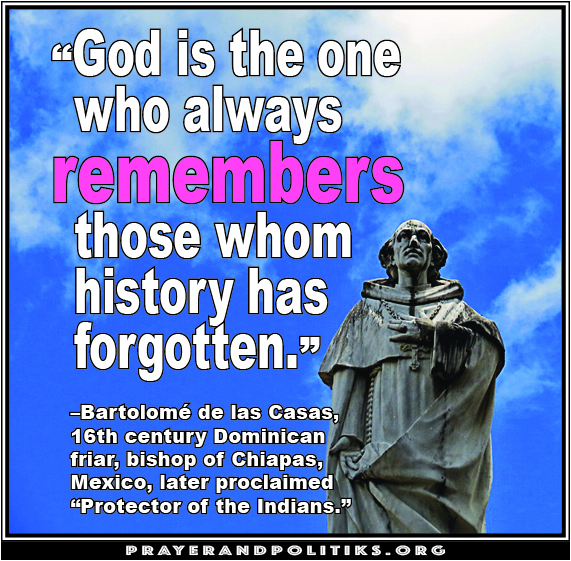
¶ “If you want to read about a European pioneer on Columbus Day, learn about Bartolomé de las Casas. His story is one of unfolding repentance over the course of his life in regard to treatment of the indigenous population of the Spanish conquest of the ‘New World.’” —continue reading “Witness to villainy: An excerpt from Bartolomé de las Casas’ documentation of Spanish conquest in the Americas“
¶ Colonial theological mischief. “Writing 1571 in opposition to Bartolomé de las Casas’ advocacy for indigenous citizens of the Americas, an unnamed Spanish church official in Peru penned the following parable as a theological rationale for conquest.” —continue reading “God acted as a father who has two daughters: A theological rationale for the conquest of the Americas”
¶ “Five hundred years ago we found a lost Italian on our shores. They came, we welcomed, they killed—not just humans, but all other things: animals, water, rocks, land.” —Susan Harjoe, a Native American, speaking to a National Impact briefing, quoted in PEACE ACTION, May 1990
¶ Reality, then and now. “To promote this disposition to exchange lands, which [Native Americans] have to spare and we want, for necessaries, which we have to spare and they want, we shall push our trading uses, and be glad to see the good and influential individuals among them run in debt, because we observe that when these debts get beyond what the individuals can pay, they become willing to lop them off by a cession of lands…. In this way our settlements will gradually circumscribe and approach the Indians, and they will in time either incorporate with us as citizens of the United States, or remove beyond the Mississippi.” —1803 letter from Thomas Jefferson to William Henry Harrison
¶ “In 1814, Gen. Andrew Jackson supervised the mutilation of the corpses of more than 800 Creek Native Americans killed at Horseshoe Bend in Alabama during the Creek War. The desecration of the bodies involved cutting off the tip of each Indian’s nose to count the number of victims, and taking long strips of skin from the dead to use as bridle reins. Americans have always been nice. But is it just a sham?” —Carrie Tirado Bramen, Washington Post
¶ Closer to home. “It was a fearful sight to see them thus frying in the fire and the streams of blood quenching the same, and horrible was the stink and scent thereof; but the victory seemed a sweet sacrifice, and [we] gave the 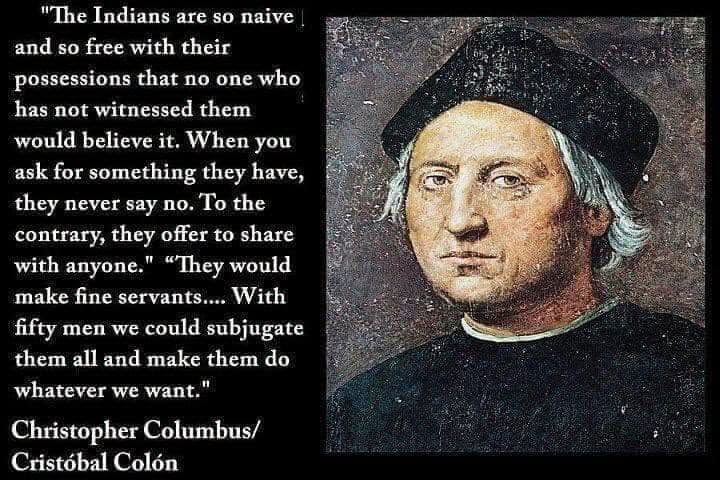 praise thereof to God.” —William Bradford, governor of the early Plymouth Colony, writing in 1637 of his Pilgrim community’s annihilation of a Pequot Indian village along the Mystic River
¶ Slave trader. It was Christopher Columbus who inaugurated the trans-Atlantic slave trade when he shipped two dozen native Taíno people of the Caribbean. In a 1494 letter to the Spanish monarchs, Columbus judged that his exploration of the “new” world could be financed by slaves’ value, these “who are so wild and well built and with a good understanding of things that we think they will be finer than any other slaves once they are freed from their inhumanity, which they will lose as soon as they leave their own lands.” —quoted in Bill Bigelow, “No Monuments for Murders”
¶ “On Jan. 6, as our family watched in real time, thousands of insurrectionists took over the U.S. Capitol, and the words of two 17th century Colonial Americans raced across my memory. Governor John Winthrop, arriving at Massachusetts Bay on the Arbella in 1630, invoked early American exceptionalism: ‘We shall be as a city set on a hill, the eyes of all people are upon us.’ Roger Williams, the quintessential Colonial dissenter, offered a different vision in his 1643 volume, ‘A Key into the Language of America,’ the first English lexicon on Native American tongues: ‘When Indians heare the horrid filths, / Of Irish, English Men, / The horrid Oaths and Murthers late, / Thus say these Indians then: / We weare no Cloaths, have many Gods, / And yet our sinnes are lesse: / You are Barbarians, Pagans wild, / Your Land’s the Wildernesse.’” —Bill Leonard, “Insurrection postscript: The church’s one foundation isn’t the USA”
¶ The nobidies. “Columbus’ world is not so different from the world we live in today. Big countries continue to dominate ‘lesser’ nations. The quest for profit is still paramount. The world is still sliced in two between the worthy — the owning classes, the corporate masters, the generals — and those the Uruguayan writer Eduardo Galeano called los nadies — the nobodies.” — Bill Bigelow, “No Monuments for Murders,” CommonDreams
§ § §
“I am an older woman now – and I will heed my own cries / and I will a fierce warrior be – ‘til not another woman dies.” —“Warrior,” Eastern Owl and Lady Cove Women’s Choir, combining Indigenous women’s voices from Newfoundland and Labrador
§ § §
¶ Heather Cox Richardson on Columbus Day
“The Columbus Day holiday began in the 1920s, when a resurgent Ku Klux Klan tried to create a lily-white  country by attacking not just Black Americans, but also immigrants, Jews, and Catholics. This was an easy sell in the Twenties, since government leaders during the First World War had emphasized Americanism and demanded that immigrants reject all ties to their countries of origin. From there it was a short step for native-born white American Protestants to see anyone different from themselves as a threat to the nation.
“The Klan attacked the Knights of Columbus, a Catholic fraternal organization. Klan members spread the rumor that one became a leader of the Knights of Columbus by vowing to exterminate Protestants and to torture and kill anyone upon orders of Catholic leaders.
“To combat the growing animosity toward Catholics and racial minorities, the Knights of Columbus began to highlight the roles those groups had played in American history. In the early 1920s they published three books in a ‘Knights of Columbus Racial Contributions’ series, including The Gift of Black Folk by pioneering Black sociologist W.E.B. Du Bois.” —continue reading her October 12, 2025 post on “Letters from an American”
¶ Of course, we now know that Viking explorer Leif Erickson and his Norse companions were likely the first to reach the Western Hemisphere, approximately in the year 1,000 CE, some 500 years before Columbus made landfall in what he thought was the East Indies (then construed as southern and eastern Asia), thus giving the name “Indians” to the indigenous people of the Americas.
¶ How the chaplain got her name “Kicking Doe” from a Native American prayer circle in a maximum security men’s prison.
“It had been a warm spring day after a particularly harsh winter. How wonderful it was to finally go outside to the [Native American] sacred circle without a heavy coat. As I watched the pipe ceremony begin to unfold, I noticed a regular participant sitting on the grass. I asked him why he was not joining the group. ‘My spirit is full of too many hurts and too much anger this week. I don’t want to infect the others,’ he explained. ‘But I need to hear the prayers.’
“I shuddered to think how many times I had contaminated groups with my agitated spirit. But that day the blue-canopied sky gave me a sense of peace.
“At the end of the prayers, Tokala, the pipe-bearer, offered an unusual invitation. ‘Come join us in the circle,’ he said gently to me. Surprised, I walked clockwise around the circle to the entrance. Waving a feather over a smoking seashell, Tokala smudged me with sage and motioned for me to stand close to the center.
“He swirled a dab of cornmeal and water in the palm of his hand. Then he marked my forehead with the paste. ‘Chap, we’ve decided to give you a new name today. We name you ‘Kicking Doe,’ to honor your fighting spirit and gentle heart.’” —continue reading Nancy Hastings Sehested’s “Kicking Doe” story, from Marked for Life: A prison chaplain’s story”
¶ “When the missionaries came to Africa they had the Bible and we had the land. They said ‘Let us pray.’ We closed our eyes. When we opened them we had the Bible and they had the land.” —variously attributed to South African Archbishop Desmond Tutu, to Kenyan leader Jomo Kenyatta, and to Chinua Achebe in his 1958 novel, Things Fall Apart
¶ Hautey, a chief of the Taíno people (in what is now the Caribbean region) led the first major resistance campaign against the Spanish conquistadors. Bartolomé de las Casas, a Spanish priest who witnessed and wrote 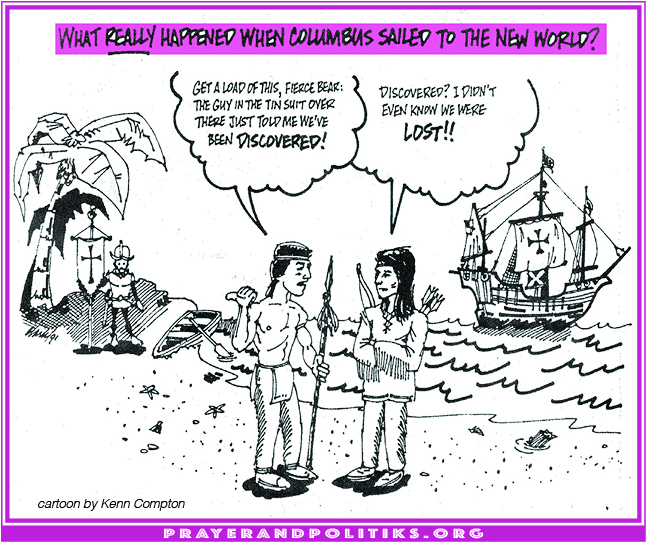 about the atrocities of the conquistadors, tells the story of Hatuey, who was captured by the Spanish in what is now Cuba. He was sentenced to be burned at the stake.
As Hatuey was bound to the stake and surrounded by brush, a Spanish friar attempted to covert this first Cuban national hero. The friar explained to him about conversion and baptism, noting the options of eternity spent either in heaven or hell. When offered the opportunity of baptism (to save his soul, not his skin), Hatuey asked for time to think it over.
Finally, he responded, requesting final clarification: “And the baptized, where do they go after death?”
“To heaven,” said the friar.”
“And the Spanish, where do they go?”
“If baptized,” the friar answered, “to heaven, of course.”
After weighing his decision, Hatuey concluded: “Then I don’t want to go there. Don’t baptize me. I prefer to go to hell.”
§ § §
Word. “And a child shall lead. . . .”
Benediction. “May the stars carry your sadness away, May the flowers fill your heart with beauty, May hope forever wipe away your tears, And, above all, may silence make you strong.” —Chief Dan George, Tsleil-Waututh Nation
¶ Recessional. “Why is one man rich and another man poor / Why we ain’t satisfied, why we gotta have more? / Why is suicide rates on the rez so high? / Why I tell you the truth, but you say ‘Don’t lie.’ / Why is being a good father at an all time low? . . . / Why it’s so hard to forgive and leave the past behind? / And if you did, then that’s divine / Why don’t you help your brother when you see him fall? / Why do we act like God don’t see it all? / Hanawena ha wen hey (Why) / Hanawena ha wen hey yo wa (Why).” —Supaman, “Why,” culture-scrambling indigenous (Crow Nation) hip-hop
# # #