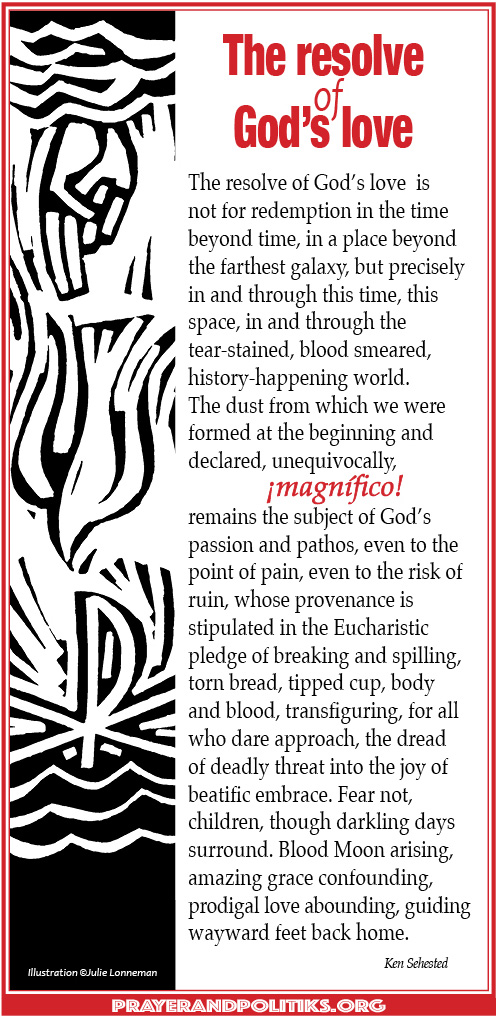

Ken Sehested
Processsional. “Lead me, O Lord, O great redeemer through the troubles of this world. Lord, I thank you for watching over me thus far. You are forever by my side.” —English translation of “Ndikhokhele Bawo,” University of Pretoria Youth Choir
Call to worship. “There are six things that the Lord hates, seven that are an abomination to him: haughty eyes, a lying tongue, and hands that shed innocent blood, a heart that devises wicked plans, feet that hurry to run to evil, a lying witness who testifies falsely, and one who sows discord.” —Proverbs 6:16-19
§ § §
Night owl that I am, these thoughts began composing in my mind at the stroke of midnight Tuesday, just as the US government closed (many of) its doors. I began imagining the anxiety, even panic, which hundreds of thousands federal employees are furloughed (and now, maybe, fired). Hundreds of thousands, considered “essential” to protect lives and property—and more than one million members of the military—now working without pay.
These fraught facts come just hours after the President, lecturing hundreds of military generals and admirals, said that our nation’s enemies “are within” our borders rather than from without. He urged military commanders to pursue “training exercises” within urban areas, using “full force.” Newly minted Secretary of War Pete Hegseth promised that the military’s “warrior spirit” would be “reawakened.” This, from a part time former Fox News anchor, frequently accused of drunken behavior on the job, who had to promise the Senate that he would become a teetotaler in order to receive their confirmation.
Both Hegseth and Trump promised to eliminate every vestige of the military’s “rules of engagement” protocols, which governed the extent of lethality needed to accomplish a mission. In other words: no more moral compasses, not even the pretense of wartime’s “justifiability” criteria. Think “kill them all and let God sort them out,” variation of the Latin phrase describing the rules of engagement in the 13th century Cathar Crusade.
The shutdown pivots on the soon-to-be abolished subsidies of the Affordable Health Care Act and a massive purging of the Medicaid roles. An estimated fifteen million people’s health insurance would either rise dramatically or disappear altogether. The downstream fallout will hit hospitals hard, particularly those in small town and rural areas. Republicans say these health care concerns can be remedied before year’s end. Democrats (correctly, I believe) are convinced no such remediation will occur in the time left before recent budget restraints take effect.
Scripture’s scrutiny of bootleg piety is never more unambiguous than this one sentence in John’s first epistle (3:17): “How does God’s love abide in anyone who has the world’s goods, sees a neighbor in need, yet refuses?”
The threats to our small-d democratic institutions, policies, and norms—and the headlong rush to authoritarian and oligarchic rule—are too numerous to summarize, too vast to even say grace over.
Just this week we learned that three in 10 US citizens now say that political violence may be necessary to get the country back on track. And that number has grown significantly since the previous poll in April 2024. And nearly two-thirds of citizens now say our nation’s political system is beyond repair. Which means tens of millions who, though not participating in political violence, would nevertheless not lift a finger to stop it.
If one change in federal data collection reflects the current administration’s character, it was the announcement last month of the US Department of Agriculture’s decision to cease issuing its annual Household Food Security Report. Why? Surely to hide the fact that, with the implementation of Congress’ “big beautiful budget bill,” approximately four million citizens already enduring food insecurity will become ineligible for receiving food stamps.
While that report rarely if ever was the cause of national repentance, it did, at least one day per year and one day’s news cycle, hold up a mirror displaying the results of our predatory economy’s grievous impact. In a nation where accumulated wealth is the standard of worth and value, being poor means being a sinner. Out of sight, out of mind.
So, what are we to do, how are we to respond? Here are seven commendations for your consideration.
 First commendation. Avoid practicing magical thinking, professions of unicorn sightings, cushioned parlor games of fantastical daydreaming, delusional reverie rising from hot tub bemusement.
Second commendation. Acknowledge that our desperation (whether occasional or constant) reveals how privileged we are, in relation to the unnumbered, both within our nation and without, who have lived in despondence long before now and still do. For those of us who do not fret about where tomorrow’s food will come, despair is a form of narcissism resulting in a self-imposed debility.
Third commendation. It’s time to get a grip, cast off the easy comfort of optimism, and welcome being roughly tutored by the Spirit as to the true and wasted places where hope emerges, where water flows from rock and manna appears in drought-impaired landscapes; where impossibilities are reversed, valleys of despair are raised and spirits restored, heights of arrogance are humbled and brought low.
Fourth commendation. It is our duty to be informed. But not consumed. Doomscrolling is a kind of self-mutilation which serves the interests of those who want us distracted, agitated, and frantic, unable to apply the modest weight of our convictions in campaigns of mass reconstruction.
Fifth commendation. It is essential that we be grounded in real world events, cognizant of the brute facts of seemingly incorrigible and corrupt patterns of power. But we are also called to practice what John Paul Lederach, in his book The Moral Imagination: The Art and Soul of Building Peace, calls “moral imagination” which is “the capacity to imagine something rooted in the challenge of the real world yet capable of giving birth to that which does not yet exist. . . . The moral imagination believes and acts on the basis that the unexpected is possible. It operates with the view that the creative act is always within human potential, but creativity requires moving beyond the parameters of what is visible, what currently exists, or what is taken as given.”
Lederach also writes, “Pessimism born of cynicism is a luxurious avoidance of engagement.”
Sixth commendation. As Wendell Berry counsels, it is not from ourselves that we learn to be better than we are. We need communities of conviction, starting with one that is locally grounded; but also to which we are connected at a distance. Such communities must facilitate boundary-crossing connections with those not of our caste, class, ethno-nationalities, etc. As Archbishop Hélder Câmara, outspoken critic of the US-backed military junta that ruled Brazil for more than two decades, we are called to throw off confusion “in order that we may be free to the point of being able to deliver ourselves from ourselves and be able to give ourselves to others.”
Seventh commendation. More than anything else, the Little Flock of Jesus’ vision and mission must sustain impervious resistance to imperial dominance. In these days, here and now—at historic levels—the community of faith in the Way of Jesus (and other communities of faith as well) is threatened by the corruption of its purpose, its promise, its provision. The source of our confusion is the assumption that we can ride out this storm on our own.
As has been said, there are fates worse than death. Should our small-r republication polity be superseded by unabated authoritarianism, those on the Jesus Road have historically been a resilient community. Attempted repression has often led to our thriving. Some would go so far as to say we are at our best on the run.
What is most fearful is the work of the Confuser (one alternative rendering of Satan, the Prince of Darkness, Deceiver, Father of Lies, etc.). There are those who believe Jesus would have been prudent to accede to the three wilderness promises of the devil. One who could turn rocks into bread would surely be universally hailed; could be crowned sovereign of all the kingdoms of the world; should be immune to physical threat and bodily harm.
As Jesus said later, those to be feared are not those who can kill the body but those who can kill the soul (Matthew 10:38).
§ § §
Prayer of the aggrieved. “For there is no truth in their mouths; their hearts are destruction; their throats are open graves. . . . because of their many transgressions, cast them out” (Psalm 5:9-10).
§ § §
Some months ago, Dr. Russell Moore, editor-in-chief of Christianity Today (who was exiled from the princely circle of Southern Baptists’ theological policing force for opposing Trump), has written, “Multiple pastors tell me, essentially, the same story about quoting the Sermon on the Mount, parenthetically, in their preaching — ‘turn the other cheek’ — (and) to have someone come up after to say, ‘Where did you get those liberal talking points?’ And what was alarming to me is that in most of these scenarios, when the pastor would say, ‘I’m literally quoting Jesus Christ,’ the response would not be, ‘I apologize.’ The response would be, ‘Yes, but that doesn’t work anymore. That’s weak.’”
The struggle for people of faith is not against unbelief but warped and wrenched faith. Atheism is not our problem. Idolatry is.
Before you read another word, pause and watch this 41-second video, posted the day before conservative provocateur Charlie Kirk’s hagiographic memorial service, of Department of War Secretary Pete Hegseth reciting the Lord’s Prayer interspersed with footage of American troops, tanks and stealth bombers.
And so on: The United States Department of War Rapid Response X account, on Sunday 7 September, posted a brief video showing military personnel completing outdoor training as the words “Be strong and of good courage. Do not be afraid, nor dismayed. For the Lord your God is with you, wherever you go” faded into the screen.
And so on: In August, the DOW posted another video on X captioned “We Are One Nation Under God,” a motto from the pledge of allegiance, showing military aircraft and soldiers in operations as “I pursued my enemies and overtook them; I did not turn back till they were destroyed” (Psalm 18:37) appears onscreen.*
I stayed in touch for years with my roommate, developing a friendship forged during my three weeks in Iraq shortly before the “shock and awe” massive bombing campaign that began the US invasion in 2003. One fall, as Advent season approached, including Matthew’s text accounting Herod’s slaughter of infants in and around Bethlehem, I sent a note to Ed, commenting, “There is agony in the air, and we must listen for the sounds of angel wings.” Ed responded, “Nor, alas, dare we ignore the flailing of devils’ tails.”
Both of these things are true; and both are attended in developing a life faithful both to Earth’s agony and Heaven’s jubilance.
I am committed to democracy not primarily for reasons of political philosophy but because democracy is how citizens can practice nonviolence in the public square. As previously stated, I do not fear for communities of faith should our nation devolve into despotism.
What I do fear—what keeps me up at night, what feebles my knees, clouds my sight, and threatens my breath—is that the Body of Christ becomes confused; becomes a chaplain to the empire; trades away its covenant vow and vision of a new Heaven and new Earth for a seat at Pharaoh’s table, or privileged recognition in Caesar’s court, or assure Herod’s good graces.
I shiver every time a public figure concludes remarks with this benediction: May God bless America. It almost always implies the conviction that our national righteousness is deserving of Heaven’s devoted, generous attention. As biblical scholar and activist Ched Myers writes in “Mixed Blessing: A Biblical Inquiry into a ‘Patriotic’ Cant”:
“Of the 41 appearances [in the New Testament] of the Greek verb eulogeoo (literally ‘speaking a good word’), only twice do we find it in the imperative mood. In neither case does it involve God. It does, however, involve us. In Jesus’ famous sermon he invites his disciples to ‘Bless those who curse you’ (Matthew 5:44 & Luke 6:28). These instructions are later echoed by the apostle Paul: ‘Bless those who persecute you, bless and do not curse’” (Romans 12:14).
The more relevant text for our nation comes from Deuteronomy’s dire warning to the Israelites, should they ever boast “My power and the strength of my hands have produced this wealth for me” (8:17). Centered in such hubris, God functions more as a totem; a national mascot; a magic lamp to be rubbed, summoning a wish-granting Genie.
Surely the most challenging confusion in modern culture is the illusion that we are on our own, accountable to no one, orientated to no horizon except the one we ourselves create, operating under no vow, no covenant, no discipline, only what the solitary self desires along with the transactions needed to obtain treasure and esteem and coercive dominance. In such a universe, might truly is the only thing that makes right, and despots of every sort take their victory laps using the heads of the defeated as stepping stones across a river of blood.
Therefore, kindred, every Little Flock of Jesus, fear not the sovereigns of this present age. They cannot take from you what is essential. Only fear the spinners of theological confusion, the weavers of deception, the conning shysters that peddle delusion—most especially those robed in pious pretense and cloaks of sanctimony.
Tell the truth, and shame the devil.
§ § §
Benediction. I’ve returned again and again—in times of anxiety, confusion, and feelings of not being sufficient for the work at hand—to this simple mantra. “I have come from God; I have lived in God (in my better moments); and I am going back to God: for Whom nothing is wasted; to Whom I am a delight, regardless of my foibles; with Whom is no regret; by Whom all trauma and failure and shame will serve as the fuel for the fire to cook feasts for our fiestas and joyful merriment.” —KLS
Recessional. “We / are not alone / we are not alone / we / are not alone / for God is with us.” —“We Are Not Alone,” Pepper Choplin, performed by the Oasis Chorale
*For more see faith-based commentator Brian Kaylor’s “The Bible According to the Department of War’ https://publicwitness.wordandway.org/p/the-bible-according-to-the-department-8b8. Kaylor’s new book, The Bible According to Christian Nationalists: Exploiting Scripture for Political Power, is coming soon. You can preorder here.
My former colleague, Dan Buttry, was asked by the Faith team at the national No Kings network to revise his older Bible Study Manual on Conflict Transformation in a shortened version to be focused specifically on the challenges of rising authoritarianism. Advance permission is granted download Resisting Authoritarianism Bible Study, copy, for group study.
# # #