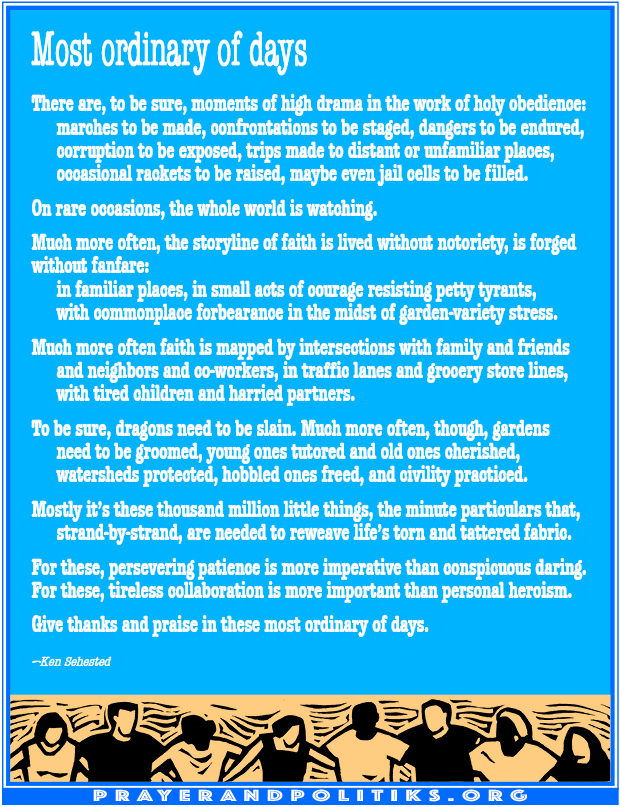

by Ken Sehested
Prelude. “Hold on, just a little while longer. Everything will be alright.” —The Kuumba Singers & Bobby McFerrin, “Hold On (Just a Little While Longer)”
Invocation. Watch this short (3:24) time lapse video of flowers blooming, from National Geographic.
§ § §
“He who would do good to another must do it in Minute Particulars.”
—William Blake
§ § §
Ordinary Time (Tempus per Annum) on the church’s liturgical calendar is so named not because they have been demoted, but rather they are ordinal, numbered, as the Sundays following Epiphany up to Lent, then the longer stretch from Pentecost to Advent. Taken together, there are 33 or 34 weeks of Ordinary Time, depending on the lunar dating each year of Easter.
Ordinary days are not mundane. But you could say they contain less drama than the festal 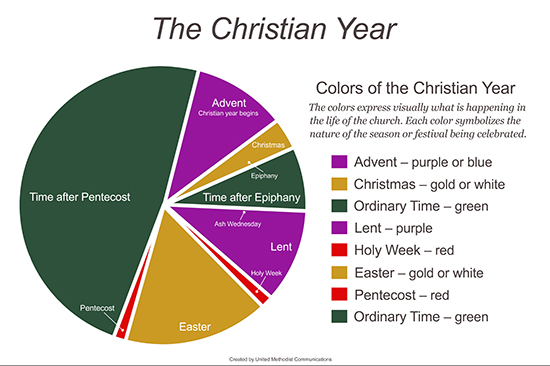 seasons. That’s because the bulk of life, liturgical and otherwise, is less dramatic—but not less important. This season is ordinary in that it is outside the pinnacle moments of Jesus’ life.
This interval represents the dailiness of life lived between the peaks. It includes the grit and grind and humdrum of living, with party clothes in storage—the casual days when no trumpets are sounded, no ecstatic visions are had, where shoulders are put to stubborn wheels.
This is quotidian time, where the smallest details matter. To the easily distracted, Ordinary Time is tedious. The watchful, however, are granted confidence in incremental growth, though progress seems imperceptible. Germination is largely out of sight. Faithfulness in small things sets the stage for the great (Luke 16:10).
I suspect Ordinary Time is what Jesus was referring to when, in his departing soliloquy, he told his disciples “I still have many things to say to you, but you cannot bear them now;” but that in the days to come the Spirit will provide further guidance (John 16:12-13). Wisdom accrues in Ordinary Time.
§ § §
“Some believe it is only great power that can hold evil in check. But that
is not what I have found. I have found that it is the small everyday deeds
of ordinary folk that keep the darkness at bay. Small acts of kindness and love.”
—Gandalf, the wizard and protagonist in J.R.R. Tolkein’s novels,
“The Hobbit” and “Lord of the Rings”
§ § §
When people of faith speak of God, and how the love of God leads to the flourishing of souls and soil alike, such language appears on the surface as something being done to us, as from the outside.
Merely being acted upon—being objectified—hints at coercion, manipulation, feeble dependency, indignity. As if we are to be kept in chains and, mo reover, taught to love those chains—lovely as they may appear, but chains, nonetheless. As if we are merely utensils in a cosmic drama. As if we are chess pieces on a divine board game.
Right: linocut art by ©Julie Lonneman
Such is not the case. Think of a time lapse video of a flower blooming, first in one layer, thenanother, then another, and yet another—as if from out of thin air. Prior to this there was merely a tiny bud. And before that, a roughly buried unseen seed. Pleasant enough, but without the slightest indication of what was to come—as if from nowhere, as if from outside and beyond and super-natural. As if being infused with what, originally, was not there.
Human life thrives only when surrounded by fertile humus, enriched soil generating life from decomposition. The fallen leaf does not regret its demise.
§ § §
“No matter how much one may love the world as a whole, one can
live fully in it only by living responsibly in some small part of it.”
—Wendell Berry
§ § §
The Blessed One is not the author and enforcer of transcendent patterns of creaturely co-dependency. The Gracious Host is not a giant Self, demanding subservience from petitioners. The Merciful One is not obsessive and in need of constant homage and ovation as a guarantee of kindly attention.
Rather, as mystics write, creaturely blooming is a growing into God and God into all.
Apotheosis—a growing into God—is the word used in Eastern Christian traditions. Frequently in Paul’s writing, the Apostle speaks of growing into Christ and being “filled with all the fullness of God” (Ephesians 3:19). Or as 2 Peter insists, we are called to “become participants of the divine nature” (1:4).
Such language is fragile and risky and easily manipulated, because it hints that creatures may thereby strap on the glory of the Creator and be freed to wield power to reorder the world in self-aggrandizing ways.
Does a self/soul even survive the Spirit’s transforming fire? Yes, and no.
Yes, understood developmentally, in history’s time and space, the self that is in Christ expands, step by gradual step, to include ever-larger circles of communion with others—even, potentially, with enemies. It’s not so much a matter of denying the self but a relaxing and uncoiling of the self. The self-forgetfulness that grows is not a self-debasement. Rather, it is like the bud’s tilt toward the sun’s radiance; like the arousal of the loved to the Lover.
No, however, if the self means the continued existence of a sniveling, whining ego needing constant assurance and reinforcement of its own value and performance. Such a self demands that if I’m special, you must be less so. Being self-possessed is, by definition, being separated from the Love that binds each to all without definition, degree, merit, or measure.
§ § §
“Hope is the ordinary things you stubbornly do every day!”
—Mitri Raheb, Palestinian theologian and pastor
§ § §
Because we humans, at least occasionally, require reassurance, comfort, and encouragement, we assume the same for the Beloved, creation’s author. And thus our worship becomes a form of commerce, offering praise in exchange for blessing, compliments in return for security safeguards. And when God’s honor is challenged, we—as divine lackeys—assume retribution, including bloodletting, is a sacred duty.
The annulment of such duty was accomplished in the cross, confirmed in the resurrection, and kindled at Pentecost. For people of The Way, swords have become plowshares in preparation for the bountiful harvest of peace, sown in justice, and harvested in mercy.
§ § §
“I long to accomplish a great and noble task, but it is my chief duty
to accomplish humble tasks as though they were great and noble.”
—Helen Keller
§ § §
It is in these days after Pentecost, Ordinary Time in the church’s calendar, that dreams are molded into deeds, that vision is mirrored in befriending habits, that yeast is unleashed, that struggle is ensued and peace is waged. The daily duties of covenant-keeping, the menial acts of fidelity, the chaste response to aggravating speech, the refusal of silence in the face of abuse, the encouraging word to the forlorn and offended—these are among the beads of your Ordinary rosary. Pray it even on faltering days and throughout restless nights.
Notice the unnoticed. Choose the less lovely for a dance partner. Keep your eyes shielded from shiny baubles, your ears from the marketers’ lure. Proclaim honor in the land of disrepute.  Approach all your pedestrian duties in the knowledge that future blossoms begin as dirt-covered seedlings jostling amid the mire, powered by unseen force to break through compressed soil until welcomed by the sun’s fecund radiance.
Right: linocut art by ©Julie Lonneman
Live the unvarnished life, susceptible neither to flattery nor mockery.
Don’t begrudge being little. Be like the yeast in the dough, not the flour.
Remember: there is no secular space or time; only sacred or desecrated. Train your eyes to spot reverential clues among sullied clutter. Shield them from cultural glitter and gaudy glamor.
Practice the kind of silence that allows you to notice the cries from the rubble above the clamor of barkers. Locate yourself in a community of conviction which trains attention spans away from the glitterati and toward the disregarded.
Acclaim the unadorned season, with its back alleys and broken asphalt and places google maps don’t go. Give praise to Ordinary days, such that—when all is said and done—more is done than said. Then be freed: to live large, to laugh often, and to love well.
§ § §
“My heart is moved by all I cannot save: so much has been destroyed.
I have to cast my lot with those who age after age, perversely,
with no extraordinary power, reconstitute the world.”
—Adrienne Rich
§ § §
Benediction. Gracious One, grant us the wherewithal to journey from Mary’s annunciation, to Christmas’ sedition, to Epiphany’s acclamation, through Lent’s interrogation, all the way to Easter’s exultation and Pentecost’s animation. May our Ordinary days be marked by both sweat and praise. Find us faithful in the ordinary work of clearing, plowing, planting, and watering, that those to come might winnow the grains of justice and reap the harvest of peace.
Postlude. “We Are Not Alone.” —The Royal Singers
# # #