Ken Sehested
Unlike traditional cultures (mostly of the past), Western modernity has few common “rites of passage,” typically during the transition of adolescence from childhood to adulthood. Getting a driver’s license is our substitute, along with school graduations. What follows are two pieces of adaptable commentary.
§ § §
Prelude. “Wide Open Spaces.” —The Chicks
§ § §
Advice on vocation to a young friend
Recently, a young, about-to-graduate friend wrote:
I felt recently a sort of calling to do something… I’m just not sure what that is. I think it may just unfold rather than me choosing it… If you have any thoughts about following a call and understanding how to hear its direction, I’m all ears!!
I responded:
There’s no magic to it. It will, indeed, unfold but may then require you to work your tail off. Your calling, like a wild animal, will not come close on your command. Wait patiently; coax it, sing to it, proclaim your love for it, pray for it. You will likely have to overcome some fear. Fear can be cruel master or a helpful servant.
Pay close attention. Let your head do whatever work it needs to do, but then let your heart have the final say so. Look in odd places. Turn your ears in unexpected, unfamiliar directions. Pay particular attention to options that cause your heart to leap. Prepare to be surprised.
There will likely be dead ends. Don’t fret the wasted time. Nothing, finally, is wasted.
No doubt you will make mistakes. And the ancient Deceiver will try to convince you that you are a mistake. This is the only appropriate time to issue a middle-finger salute.
Be prepared to have your heart broken, but you will heal and even be stronger. Locate those who have wisdom—the best are those who ask you insightful questions, not give you the right answers. Keep a diary of your questions. Each will be like a piece of a larger puzzle taking shape. Listen to those who call you by your true name: not the name you want, or the name that failed you in the past, or the name that others have required you to have.
Don’t take sh*t from anyone; plant a boot in their ass, if need be. The mandate to take up the towel of servanthood still applies today as much as when it was declared to those dumbfounded disciples. That doesn’t mean becoming a doormat for people to wipe their feet on.
But your default practice is kindness, especially to those who have no way to return the favor. Assess your past truthfully, especially the hard parts. But do not judge. Just notice. The past cannot be changed, but it can be remembered differently.
Find worthy companions. They will be part of your discernment, probably without even trying to. There is a Rwandan proverb that says, “If you want to go fast, walk alone. If you want to go far, walk together.”
And, finally, trust that you are beloved beyond your wildest dreams. Gravitate to those who reflect this back to you, for you, on you.
§ § §
Altar call. “So we took one on the chin fought a battle we couldn’t win / Until it all comes ’round again it’s welcome to the great unknown / So we’ll taste the bitter tears till the darkness disappears / While we’re leaning on each other it’s welcome to the great unknown / So we’ll taste the bitter tears till the darkness disappears / While we’re leaning on each till we can hold our own.” —“Go Light a Candle,” Rodney Crowell feat. Emmylou Harris & Lera Lynn
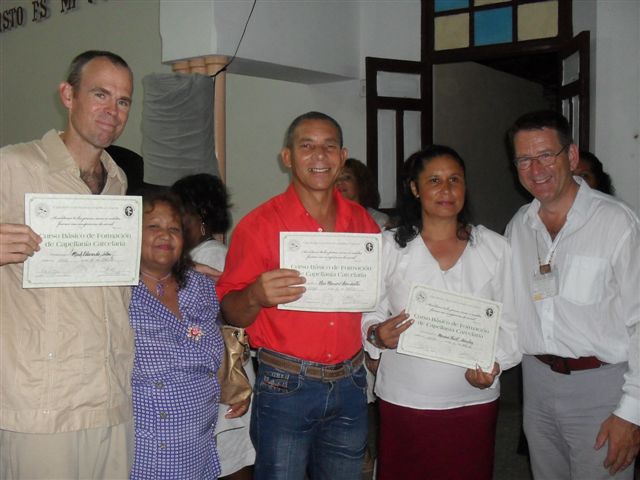
Above: Sixteen years ago my friend Mark Siler (left), a prison chaplain in the US, spent a year in Cuba assisted in the first class of volunteer prison chaplains in that country (pictures are but a few of that graduating class). Graduates went through 60 hours of intensive training, in retreats around the country, for chaplains—a project initiated by Rev. Francisco Rodés, pastor emeritus of Primera Iglesia Bautista in Matanzas (and my personal pastor). That work continues to this day.
§ § §
On the Flow of Tears
For my daughters (as they take their leave)
—from years past, when our first-born graduated from college, our younger graduated from high school
As each take your leave, now charting your own courses, I pause and ponder your upcoming absence with dreaded joy: joy that your wings have spread so far so fast, dread at the silence filling the air which your voices once stirred.
It wasn’t that long ago that I maneuvered surgeon’s scissors and severed the cord which tied you to your mother. That I did so— snip, then a brief spurt of blood— without fainting was a happy surprise. I took it as a hopeful sign, that I would not faint as a father.
The memory of those similar, separate exertions—the extent of my labor in bringing you to life so disproportionate to that of your mother’s—has occupied my thoughts with more than passing recollection in recent weeks. It is as if that rupture served, with each of you, as prophetic announcement of what was to come. It has taken many measured steps and years and come, no doubt, too slowly for you, too quickly for us; but now the significance of that severance is being fulfilled.
Each of you are occasions for delight, in ways unique to the wonder of your separate ways. The seeds I have sown in your life-soil (and that of your mother’s, but here I will speak for myself) will continue to sprout for countless seasons to come and mark you in ways of which I alternately rejoice and repent. It is up to you to cultivate, including pruning and plucking and uprooting, as needed.
But your leave-taking also prompts me to inventory the ways your lives have cultivated my own, beginning with your births.
I was a mere bystander in your gestation, of course. But I now know about the connection, on either end, between the passion and pain in every act of creation. All hopeful planting finally unfolds with tender shoots tearing their way through resistant ground. The earth must be disturbed; the womb must be rent; the cord must be cut.
Every birth is an act of dangerous hope: The cord which nourishes can also choke; the body which shelters can also poison; the tempestuous journey from watery womb to inaugural breath is subject to countless perils threatening giver and gift.
Why life should begin with a blood-soaked scream is a mystery. But such are the terms for the flow of milk.
One day, says the prophet, against overwhelming odds and much reliable evidence, the flow of tears will be dried and death itself will be undone. As it now stands, though, history’s outcome seems to favor those who turn lions loose on lambs, those who squelch every scream and rob the suckling of its breast, and plug birth canals with fists of fury and fits of ambition.
In their hideous vision every natal cord becomes a slaver’s chain; every spilling of blood, a grasping demand rather than a gratuitous gift. Even now, says the psalmist, their “eyes swell out with fatness,” gorged in assault against creation’s gestation and promised deliverance.
You, beloved daughters, serve as reminders that life cannot be had on the cheap; that every new future foreseen in joy will endure all tearful failures; that strength of hand and valiance of heart must be coupled with wombish welcome to that unnameable (and thus unmanageable) Promise that death’s ascendance will be crushed.
Such vision persists; such milk flows; and by it we are kept from perishing.
§ § §
Postlude. “I hope you still feel small when you stand beside the ocean, / Whenever one door closes I hope one more opens, / Promise me that you’ll give faith a fighting chance, / And when you get the choice to sit it out or dance. / I hope you dance.” —“I Hope You Dance,” Lee Ann Womack
# # #