
Ken Sehested
Prelude. “Were You There When They Crucified My Lord?” —Annie Moses Band https://www.youtube.com/watch?v=h9-1thLeoaI
Invocation. “. . . the world is erupting around us, Christ is very often offering us the scars in his side.” —Christian Wiman
Call to worship. “Isn’t there anything you understand? It’s from the ash heap God is seen. Always! Always from the ashes.” —Archibald MacLeish in “J.B.,” a play based on the Book of Job
§ § §
For many years the joy of Easter Sunday’s resurrection observance has been contested by the continuing powers of death. Easter’s portable feast (due to its lunar calculation) means it typically falls in the vicinity of Dietrich Bonhoeffer’s execution by the Nazis (9 April) and Dr. Martin Luther King Jr’s assassination (4 April).
This bloody history adds a note of realism to Jesus’ own nail-scared end followed by the central affirmation of our faith: the tomb’s immutable stone rolled away, unbeknownst to Rome’s own Praetorian guards and Caesar’s imperial pretense. Not to mention with the collusion of corrupt temple authorities. (Temples of every variety—big houses, white houses, church houses—have corrupting tendencies.)
The quote from Bonhoeffer about “reading history from below,” from his “Letters and Papers from Prison,” was a pivot 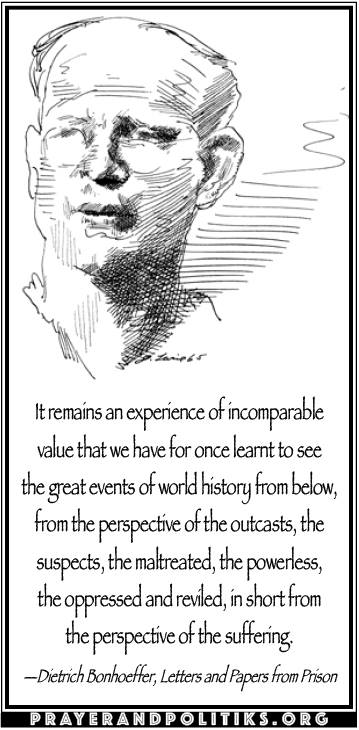 point in my tumultuous faith development, from the deconstruction of my childhood faith to its painful (and continuing) reconstruction. Dr. King’s lived speech gave clarified content.
By the way, the original German title for “The Cost of Discipleship” was a single word: Nachfolge, literally “following.” Indeed, “Nachfolge Christi” (following Christ) was the watchword of 16th century anabaptist movements, collectively referred to as the Radical Reformation.
In contrast to the so-called Magisterial Reformation leaders (e.g., Calvin, Luther, Zwingli) who stressed “faith alone,” anabaptists held that such a formulation was good as far as it goes, but didn’t go far enough. Rather, faith entails more than eulogizing Jesus. It entails a risky participation in his cruciform vision and announcement.
All four Gospels mention Thomas as among Jesus’ closest circle. But only in John does Thomas speak. Since then he has been dubbed “doubting” Thomas, because he initially did not believe his companions’ report of Jesus’ post-resurrection appearance. “I want to see the scars” Thomas responded. Then he got his wish, a week later, in another appearance, when Jesus invited him to touch his wounds.
Given my own experience with fluffy religious claims, I’m sympathetic to Thomas’ skepticism. Recall, though, that it was Thomas who earlier resisted the other disciples’ doubts, warning Jesus not to return to Judea, having just recently narrowly escaped arrest in Jerusalem, then fleeing “across the Jordan.” But Jesus’ friend Lazarus was ill, in Bethany, near the Mount of Olives, not far from Jerusalem. Thomas challenged the other disciples, saying “Let us also go, that we may die with him” (11:16).
Thomas’ faith was sturdy enough. And Jesus knew it, which was why he invited Thomas into the intimacy of fleshly wounds. Thomas’ faith, I am convinced, was grounded in a fleshly spirituality—as opposing to vacuous apparitions and sentimental chatter. Rather, a bodified faith. A faith demanding more than “believing,” more than cognitive assent and creedal affirmation. In John 1, when Jesus first invited two to follow, they asked where he lived. Jesus didn’t offer a compass reading or an abstract proposition. He said, “Come and see.” And in other enlistments, Jesus did not insist they “believe” in him, but to follow.
It is the following that matters. Jesus’ abode is on the road, not locked in philosophical argumentation. We forget that the root of the word “creed” is credo, which means “I give my heart to.” Thus, giving your “heart” to Jesus does not imply a particular religious emotion. It is an embodied risk of security, the very security which imperial agents always demand in return for their protection.
True adoration will grab you by the seat of your pants.
The Way of Jesus is, in his most concise assertion, that which requires withdrawing from the security of mammon: money, power, influence. Following Jesus does not teach you how to “win friends and influence people,” in the words of industrialist John Carnegie’s popular self-help book by that title—unless your friends happen to be the kind that Jesus most frequently associated with: those on the underside of bridges, the short side of markets, the wrong side of the tracks, the inside of refugee camps. The light of heaven is promised only to those who dwell in such shadows, where fear is endemic, threat is pervasive, and bodies shiver with terror.
In other words, following Jesus requires some skin in the game. It risks potential deprivation, bruised feet, maybe encounters with bandits and beasts.
By and large, though, the history of the church has substituted all manner of other criteria as essential for faithfulness: 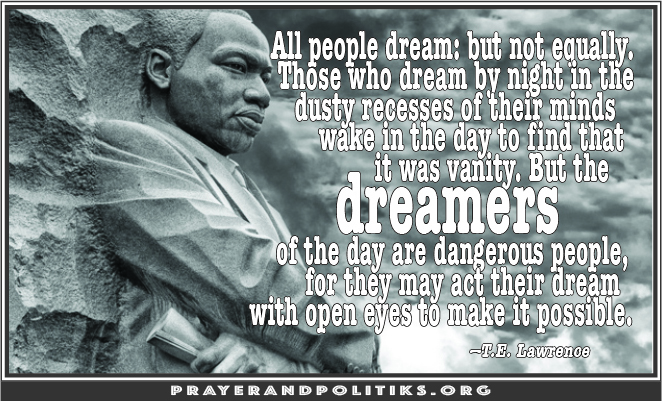 doctrinal rigor, vigorous piety, moral purity, liturgical precision.
Imagine with me. Jesus mounts a hill for his “sermon” to his disciples and the assembled crowd just above the Sea of Galilee. And he says (anticipating the language of the Nicaean Creed):
“I believe in one God, the Father almighty, maker of heaven and earth, of all things visible and invisible. I am the Lord Jesus Christ, the Only Begotten Son of God, born of the Father before all ages, God from God, Light from Light, true God from true God, begotten, not made, for I am consubstantial with the Father; through me all things were made. For you and for your salvation I came down from heaven, and by the Holy Spirit I was incarnate of the Virgin Mary, and became human. For your sake I will be crucified under Pontius Pilate, suffering death and burial, and I will rise again on the third day in accordance with the Scripture. Then I will ascend into heaven and be seated at the right hand of the Father. I will come again in glory to judge the living and the dead and my kingdom will have no end. . . .”
Disembodied faith, owing more to Aristotle than the hunted one from Nazareth. This very one who has become little more than a mascot, a totem, a necklace adornment, in gold or silver, worn prominently by pop stars and celebrities. We may genuflect in the presence of a crucifix but then go on about our business shorn of any cross-bearing mandates.
The Apostles Creed (not fully shaped and acknowledged until the seventh-or-eighth century) declare Jesus was “conceived . . . born . . . suffered . . . crucified and buried . . . rose again.” No dust gathered on his feet. No wedding wine produced. No healing ascribed. No table with sinners. No beatitudes or parables.
In the Chalcedonian Creed (451) Jesus didn’t even breathe but was a metaphysical formula: “One and the Same Christ, Son, Lord, Only-begotten; acknowledged in Two Natures unconfusedly, unchangeably, indivisibly, inseparably; the difference of the Natures being in no way removed because of the Union, but rather the properties of each Nature being preserved, and (both) concurring into One Person and One Hypostasis.”
In his “Geneva Catechism” (1545), the Magisterial Reformer John Calvin stated explicitly what the early creeds assumed:
“Question 55: ‘Why do you leap at once from [Christ’s] birth to his death, passing over the whole history of his life?’
“Response: ‘Because nothing is treated of here but what so properly belongs to our salvation, as in a manner to contain the substance of it.’” This formulation begs the question of what properly belong to our salvation.
Jesus jumps from crib to cross to crown of glory stripped of his actual teaching and practice, sterile as a mathematical formula. He retained his lordly title but was stripped of his defining character and sacramental agenda. He has been reduced to a cipher, an algorithm for decrypting Heaven’s salvific mystery in the midst of Earth’s misery.
Following Jesus, on the other hand, is a bet-your-assets proposition, rather than a passive consumer of providence. As Paul and Timothy wrote to the church at Philippi, God “has graciously granted you the privilege not only of believing in Christ, but of suffering for his sake” (1:29). What does his “sake” imply? Matthew 25 offers a sampling of the various destitute whose destiny is bound up with his own.
On the Jesus Road, the logic of existing power relations is upended.
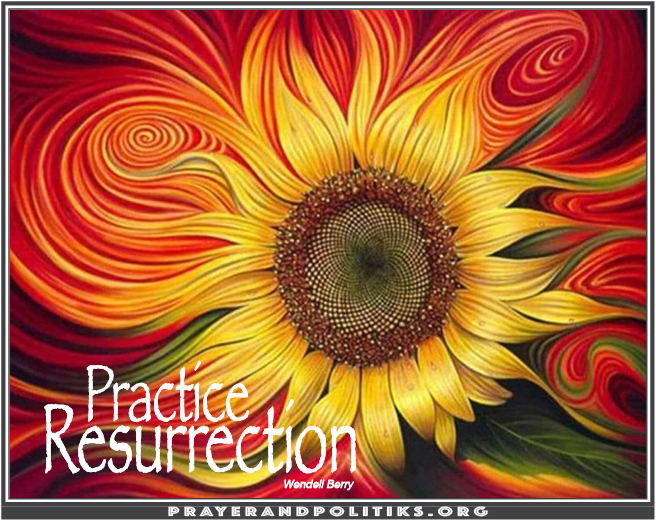
Serious talk about Jesus emerges on the road in his promised Presence; and our testimonies of life that unfold, particularly in our troubles, are the first draft of our theological positioning. Resurrection, as Wendell Berry so eloquently reminded us, is a practice, not a possession. And the bones of all the saints—including, maybe, your grandmother—have yet to be sinewed. The Prophet Habakkuk (2:1-4) counsels: if the vision tarries, persevere.
The tribulation of Egyptian slavery, Babylon’s captivity, and Jerusalem’s Roman occupation endlessly resurrect. Good 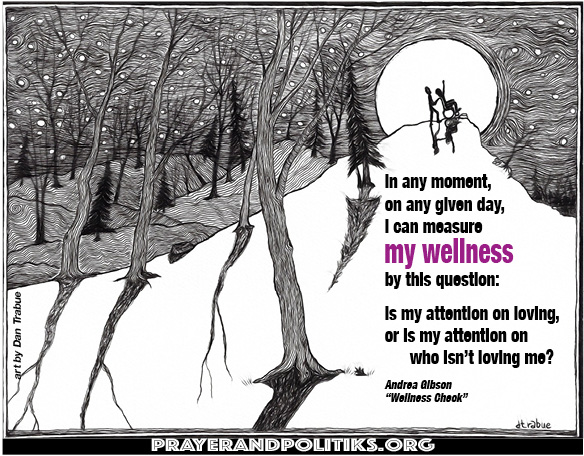 Fridays appear endemic, as are the martyrdoms of witnesses like Dietrich Bonhoeffer and Martin Luther King Jr. The Kinship of God is unleashed but not yet unrivaled. Spring’s floral seeds are still buried; but blossoms are promised. Creation’s own travail, as in a woman’s laboring birth pangs, still cries out “for the redemption of our bodies” (Romans 8:19-23).
It is precisely in our troubles—as “incendiaries of the commonwealth,” as the Massachusetts Bay Colony leaders referred to the dissent pastor Roger Williams—that Jesus urged his Little Flock (John 16:33) to “take courage, be of good cheer,” for the world’s seeming inevitable spiral of violent greed and conceit is unraveling. And the reraveling of the Beloved Community, in their testimony that “my flesh will live in hope” (Acts 2:26), is beheld by those privy to the beatific vision of a New Heaven and a New Earth.
For “all flesh shall see the glory/salvation of our God” (Isaiah 40:5, Luke 3:6). Thus the message of Eastertide is the scandal, in the word of Thomas Keating, that “God is not attached to being God.” Such is the Apostle’s Gospel “foolishness.”
Thereby we are freed from the world’s habit of lording and hoarding, all claims of holy malice and redemptive violence, all justification of conquest and manifest destiny and colonial authority.
Nevertheless, even as Resurrection’s joy ascends, so, too, its detractors. Many tombs await new crucified bodies. But their days are numbered.
§ § §
Benediction. Practice resurrection!
Postlude. “I’d rather be dancing at the edge of my grave. / I’d rather be holding you close as we march forward loving and brave. / I’d rather be singing in the face of my fear. / I’d rather be dancing in front of the guns as long as I’m here.” —Libby Roderick, “Dancing in Front of the Guns”
# # #