
Ken Sehested
 Prelude. “May the power of your love, Lord Christ, / fiery and sweet as honey, / so absorb our hearts / as to withdraw them from all that is under heaven. / Grant that we may be ready to die for love of your love, / as you died for love of our love. Amen.” —“The Absorbeat (Prayer of St. Francis), a medieval prayer much loved by St. Francis, put to music by Heather Hall, TSSF,” performed by Phoenix Consort
Invocation. “Praised be you, my Lord, with all your creatures, especially Sir Brother Sun,
who is the day and through whom you give us light. And he is beautiful and radiant with great splendour; and bears a likeness of you, Most High One.” —from St. Francis’ “Canticle of the Sun”
§ § §
If the anniversary of St. Francis of Assisi’s death on 3 October (1226), or his feast day on 4 October, slipped by your attention (as they did mine), not to worry. No less than Pope Leo has declared all of this October as his dedicatory month. Even more, on this eight hundredth anniversary of Francis’ Transitus (death), the entire year which began on 10 January 2026 devoted to his memory.
That he was a mere 44 when he breathed his last is a fitting numerical fluke of the eight centuries from that moment.
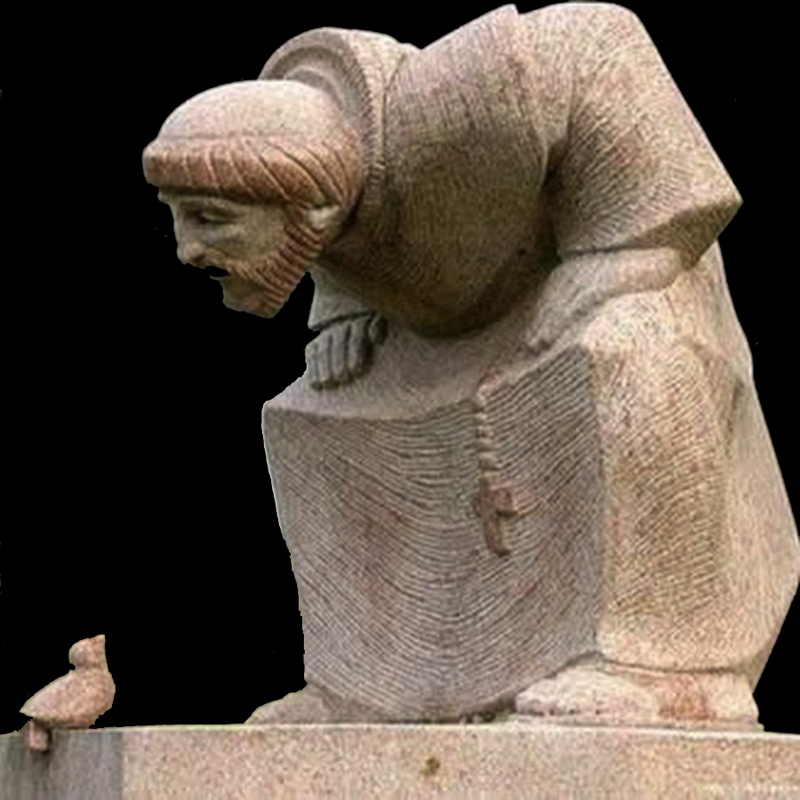
But of course, to remember is ambiguous in and of itself. The personage of St. Francis of Assisi is easy to venerate and nigh impossible to emulate. As Fr. James Martin wrote, we often summarize Francis’ life as little more than this: “he renounced his father’s wealth, founded the Franciscans, loved nature, sang songs, wrote some poems” and, surely “died a happy death.”[1] The common site of a lawn statue of a man in simple tunic, bending low as if speaking to a bird (or cradling one), is part of the sentimentality that has surrounded his memory ever since. The nostalgia of simplicity belies the actual experience of “Lady Poverty” of life without shoes, panhandling for one’s daily bread, severe ascetic practices.
The most common remembrance of the modern church to Francis’ legacy is limited to an annual “blessing of the animals” ritual event—a delightful practice, as long as the dogs don’t chase the cats. But hardly sufficient to report his testimony.
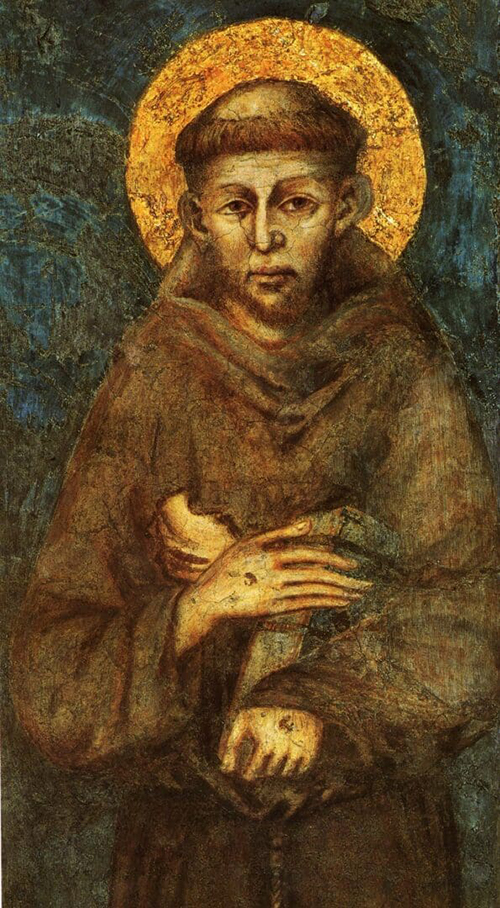
A brief sketch of Francis’ life—he was baptized as Giovanni, but called Francesco by his father—begins with youthful frivolity, supported by his father’s wealth. His sobering experience of being taken prisoner during a war between Assisi and nearby Perugia led, upon his release, to resolving to be a knight. Soon, however, an encounter with a nobleman reduced to penury prompted him to give the man his expensive cloak. A consequential corner was turned.
§ § §
Francis would have been ecstatic if he could have watched this nighttime time lapse, star gazing video (1:20) on a clear night sky.
§ § §
Later, during a ride in the countryside, Francesco encountered a man with leprosy. Though revolted by the sight, he nevertheless found himself dismounting and embracing the man. In her book, Salvation, Valerie Martin imagined a generous account of the encounter.
“Tenderly he takes the lepers’ hand, tenderly he brings it to his lips. At once his mouth is flooded with an unearthly sweetness, which pours over his tongue, sweet and hot, burning his throat and bringing sudden tears to his eyes. The tears moisten the corrupted hand he presses to his mouth. His ears are filled with the sound of wind, and he can feel the wind chilling his face, a cold, harsh wind blowing toward him from the future, blowing away everything that has come before this moment, which he has longed for and dreaded, as if he thought he might not live through it.”[2]
Soon would unfold the dramatic account of his infamous undressing scene, in the town square, having been brought up on charges by his father demanding he repay all the money Francesco has siphoned. In literal assent, he completely disrobed, handing over all his garments, standing naked before the crowd. Shortly thereafter, his dramatic vision in which he heard Christ telling him “go and repair my house,” which Francesco assumed was a local church that had fallen into disrepair. As Fr. Martin notes, he did not realize that the directive was not repair of a church but the church.
Subsequently, in a Mass in Assisi, the Gospel story of Jesus instructing his missionaries to “take nothing with them for the journey,” Francesco gives away his shoes, tunic and staff, and chose the plain garment of a shepherd. He had already drawn to his side 12 followers. Within a few years Francesco formally petitions Pope Innocent III to found a religious order, which is granted. Thereafter his Franciscan flock scattered through central Italy, preaching, mendicant, performing works of mercy.
 § § §
§ § §
Imperative. “Start by doing what’s necessary; then do what’s possible; and suddenly you are doing the impossible. —attributed to St. Francis
§ § §
His latter years brought crippling illness, to the point where he relinquished the order’s oversight, which caused it to flounder a bit with the withdrawal of his founder. Lamentably, even the most treasured of our institutions have a habit of devolving into rivalry, confusion, and misappropriation.
Upon his death, one of his closest brothers secretly buried his remains, knowing that sacred relics were often stolen by one cathedral from another, because such relics meant more visitors which meant more donations.[3]
Two decades ago I groaned at reading where two of the six Christian bodies that currently manage parts of the Church of the Holy Sepulcher in Jerusalem got into a fistfight when the Franciscans failed to keep a door locked of the Orthodox space.[4]
§ § §
“Prayer of St. Francis” by Sarah McLachlan & students from the Sarah McLachian School of Music
§ § §
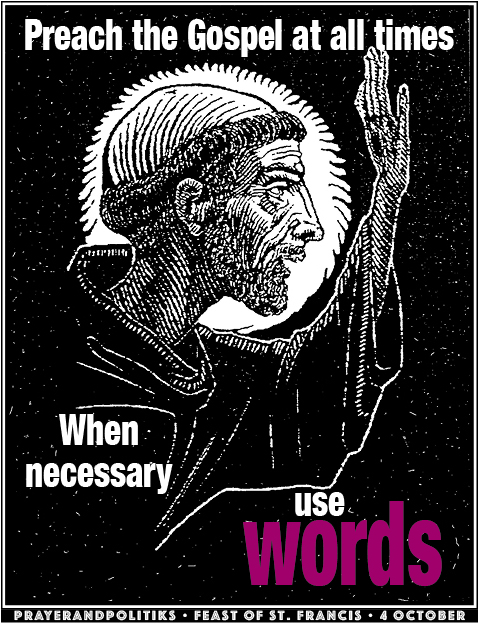
Despite history’s sullied misuse, Francis’ legacy is still potent. Audacious, bold, and provocative. He did not write the popular “Prayer of St. Francis.”[5] Or (my favorite), “Preach the Gospel at all times. When necessary, use words.” But his papal namesake, Pope Francis, troublesomely reminded us all of the rapacious nature of modern predatory capitalism:
“It is increasingly intolerable that financial markets are shaping the destiny of peoples rather than serving their needs or that few derive immense wealth from financial speculation while the many are deeply burdened by the consequences.”[6]
In his 2015 “Laudato Si” (“Praise be to you,” from the St. Francis’ “Canticle of the Creatures [or Sun]”[7] by St. Francis), the Pope composed a letter to the world confronting the looming calamity of human impact on Earth and ourselves. “It is one of the most ambitious and revolutionary papal statements in history and outlines the most critical environmental and social issues that we collectively face.”[8]
Crucially, particularly to those who believe the modern church itself needs evangelizing, Pope Francis lifts up the axial moment in his namesake’s conversion, in our need for direct engagement with the least, the last, and the left-behind in order to faithfully comprehend and proclaim the Gospel vision:
“Openness to God makes us open towards the marginalized of this world, and gives us the courage to leave the confines of our own security and comfort to become bruised, hurting and dirty as we joyfully approach the suffering other in a spirit of solidarity.”[9]
Francis personified his desire to be rid of self-possession as his wooing of Lady Poverty. This, too, is highly relevant for those of us living amid a consumer-obsessed society. We have become recklessly obese in our security demands; and our sheer wealth performs like kudzu covering a stand of trees: it looks beautiful to the eye, but that vine is killing all it covers.
To be sure: Romanticizing poverty is a travesty. Indigence is neither virtuous nor admiral. It maims, pains, shames, and kills. But the poverty to which Franciscans testify is not destitution but simplicity. God is not a sadist and we are not masochists. But as Jesus warned over and again, wealth reduces our capacity to sense the movement of the Spirit—and thereby blinds and deafens our capacity to see and hear those who are being crushed by Mammon’s devotees. Post Creation, the first mobilization of God’s attention—the first time God self identifies (“I am who I am”)—was prompted by the cries of Hebrew slaves.
Ah! but you say, didn’t Jesus say the poor are blessed? Yes indeed. Yet not because of their virtue, but their vulnerability. (He was applying the same logic when saying we must become like children to enter the Kinship of God.) This subjugation is to be lifted in the Age to Come—IS being lifted as grace does its work on us, Spirit-powered, slowly loosening the grip of hoarding appetites, allowing us to slip out of the noose of “worldly” attachments to take on, little by little, the insecurity of the poor (an expansive word also meaning the shut-outs, the shamed, the woe begotten).
Such is the work of reparations—in the Talmud, tikkun olam, “repair of the world”)—of the “ministry of reconciliation,” not as virtue-signaling in sight of the Throne of Grace, but as the inevitable overflow of joyous compassion which we have experienced, always, always, like water, flowing to the lowest point: to the underside of bridges, the short side of markets, the wrong side of the tracks, the inside of refugee camps.
The light of Heaven is promised only to those who dwell in such shadows, where fear is endemic, threat is pervasive, and bodies shiver with terror. Such is the geography of faith.
Ours is a transcendent (i.e., unavailable to flattery, manipulation, or intimidation) Presence that tracks cries and bottles tears, a Habitation that frees us, from fears’ consuming threat, to follow, come what may.
The Way of Jesus has no precise response to the question of “how much is enough?” The Bethlehem Star to which I orient myself, however imperfectly, is this: “. . . give me neither poverty nor riches; feed me with the food that I need, or I shall be full, and deny you, and say, ‘Who is the Lord?’ or I shall be poor, and steal, and profane the name of my God” (Proverbs 30:8-9).
Ours is a transcendent (i.e., unavailable to flattery, manipulation, or intimidation) Presence that tracks cries and frees us, from fears’ consuming threat, to follow, come what may.
The Way of Jesus has no precise response to the question of “how much is enough?” The Bethlehem Star to which I orient myself is this: “. . . give me neither poverty nor riches; feed me with the food that I need, or I shall be full, and deny you, and say, ‘Who is the Lord?’ or I shall be poor, and steal, and profane the name of my God” (Proverbs 30:8-9).
§ § §
Benediction. “Praised be you, my Lord, through our Sister, Mother Earth, who sustains and governs us and who produces various fruit with coloured flowers and herbs” —from St. Francis’ “Canticle of the Sun.” Read the entirety of that devotional prayer.
Postlude. “The Canticle of the Sun.” —St. Francis’ text set to music by Tony Wright
# # #
6 October 2026
Endnotes
[1] “A Meditation on the Life of St. Francis of Assisi,” America Magazine, October 4, 2010
[2] Quoted in ibid
[3] “Display of St. Francis of Assisi’s bones confirms enduring appeal of relics for Christians,” National Catholic Reporter
[4] “Punch-up at tomb of Jesus,” The Guardian
[5] https://www.cathedralstm.org/about-our-catholic-faith/expressing-our-faith/treasury-catholic-prayers/prayer-st-francis-assisi-prayer-peace/
[6] 16 June 2014 address to the Mendoza College of Business at Notre Dame University
[7] https://franciscanfriarscresson.org/the-canticle-of-the-sun/