Ken Sehested
Processional. “Botho,” University of Johannesburg Choir, arr. Mbuso Ndlovu: “Humanity begins with gratitude and respect.”
Invocation. “Come ye fearful people come / Cast your sighs to highest heav’n / Yet—though terror’s harvest spread, / Casting sorrow in its stead— / Still the Promise doth endure / Life abounding to secure / Come, ye thankful hearts, confess / Mercy’s lien o’er earth’s distress.” —Ken Sehested, new verse to “Come, Ye Thankful People, Come”
§ § §
The topic of gratitude has become a marketing trend in publishing in recent years—exemplified in Diana Butler Bass’ best-selling Grateful: The Transformative Power of Giving Thanks. Not to mention a score of books written by and for the “positive psychology” school of authors and readers. For instance, see this short article from the American Brain Foundation, “Neuroscience Reveals: How Gratitude Rewires Your Brain to be Happier.”
I just did a web search for “gratitude” and got 322,00,000 results in two-tenths of a second.
§ § §
Hymn of thanksgiving. “Count Your Blessings.” —Rosemary Clooney
§ § §
Yet the history of formal Thanksgiving declarations in the US has a dark side.
The first official declaration of a Thanksgiving Day did not come in 1621, when the Plymouth Puritans sharing an impromptu feast with the local Wampanoag natives, who had taught these undocumented immigrants how to fish, farm, and generally fend for themselves.
Rather, it wasn’t until 1637 that Plymouth colony Governor William Bradford officially declared an annual day of thanks. And he did so in direct response to the Pilgrims’ massacre of some 500 men, women and children of the Pequot tribe (survivors were sold into slavery) along the Mystic River.
He wrote, “the next 100 years, every Thanksgiving Day ordained by a Governor was in honor of the bloody victory, thanking God that the battle had been won.”
He then went on to record details of the event that was to be annually commemorated.
“It was a fearful sight to see [the Pequot] thus frying in the fire and the streams of blood quenching the same, and horrible was the stink and scent thereof; but the victory seemed a sweet sacrifice, and [we] gave the praise thereof to God.”
President George Washington, in his first terms of office, declared a “day of thanksgiving and prayer” in 1789, months after the US Constitution was formally approved. But the observance did not come by way of perpetual declaration until October 1863, declared by President Abraham Lincoln, who announced an annual observance of the holiday, on the last Thursday of November, weeks after the Union’s pivotal victory at Gettysburg during the Civil War.
Then there’s the flip side of Thanksgiving, “Black Friday,” so named by Philadelphia police, back in the 1960s, “to describe the chaos that resulted when large numbers of suburban tourists came into the city to begin their holiday shopping and, in some years, attend Saturday’s annual Army-Navy football game. The huge crowds created a headache for the police, who worked longer shifts than usual as they dealt with traffic jams, accidents, shoplifting, and other issues.” (For more see “Why Is It Called Black Friday?”)
§ § §
“Come, Ye Thankful People, Come.” —Leigh Nash
§ § §
Public thanks for blessings can be a disguise for gloating and triumphalism. Think of the common piety of elected officials closing speeches by saying “God bless the USA.” There is an unstated assumption of privilege. A kind of God-loves-you-but-thinks-I’m-special assertion. Such thankfulness is fictive virtue. No obligations arise, only profit banked. No reverence is expressed, only tribute demanded.
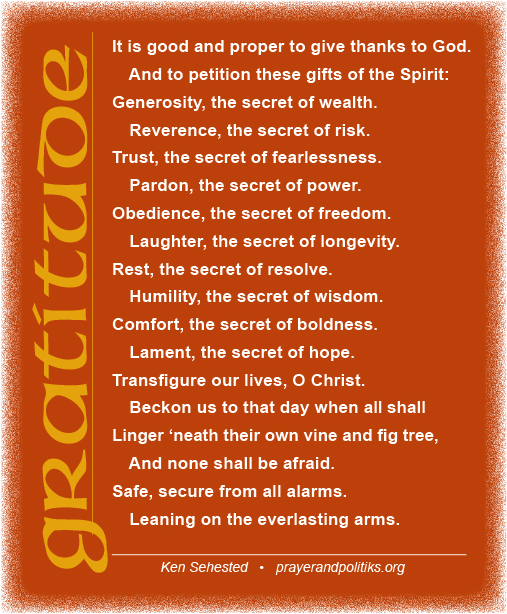
Whereas gratitude issues from the bowed, not the endowed. Whereas gracious living is gratuitous; is transparent, receiving and bestowing without keeping account; generating and strengthening the social bounds required for a beloved community.
“Gratitude,” as Beverly Novak writes, “is an ascending reflection of a descending grace.” Gratitude arises from the conviction that, despite the evidence, Earth’s arias of agony will be met with Heaven’s oratorios of amnesty and history’s reprieve.
Nevertheless, the ritual observance of Thanksgiving meals remains the calendar’s most common occasion for the gathering of scattered families. In a highly mobile culture, with weakened familial bonds, and even with the threat of contentious political conversations during the slathering of giblet gravy, this cultural habit is no small thing.
The Black Friday gods and their fashionista agents are relentless in their assurance that you need more—more goods, second helpings, more esteem and recognition. Surround yourself with a community that says otherwise. And nurture the spiritual gift of expressing gratitude, of saying thanks, bearing words of encouragement. These habits are more than self-help habits for a happier, healthier, more holistic personal life. These are pastoral practices which bolster prophetic presence in the world.
§ § §
Benediction. “Gratitude for the gift of life is the primary wellspring of all religions, the hallmark of the mystic, the source of all true art.” —Joanna Macy
Recessional. “Grateful: A Love Song to the World.” —Nimo Patel feat. Daniel Nahmod
And now a word from our sponsor.