
Ken Sehested
“Between the wish and the thing the world lies waiting.”
—Cormac McCarthy, “All the Pretty Horses”
Invocation. “Keep your lamps trimmed and burning . . . / the day is drawing nigh. / Darker midnight lies before us . . . / the day is drawing nigh. / For the morning soon is breaking . . . / the day is drawing nigh. / Children, don’t get weary / till your work is done.” —“Keep Your Lamps,” arr. André Thomas, combined choirs of Florida State University
§ § §
The photo below is not an award-winner, like those of the Natural History Museum’s annual wildlife winners. Or those on the “Religious Feeling Photo Contest Winners” site. Or the comedy wildlife photo awards. Or the Smithsonian magazine’s “Breathtaking Space Images.”
But it will from this day forward shape my Advent imagination.
This picture below features Wanda Hernández Murga, coordination of the Kairos Center, a ministry of Primera Iglesia Bautista in Matanzas, Cuba. She is standing, arms raised in the posture of jubilation, exultant smile, standing in the midst of a gutted building. The atmosphere appears dank, architecture of wreckage, in a building razed back to its decrepit walls and load bearing arch.
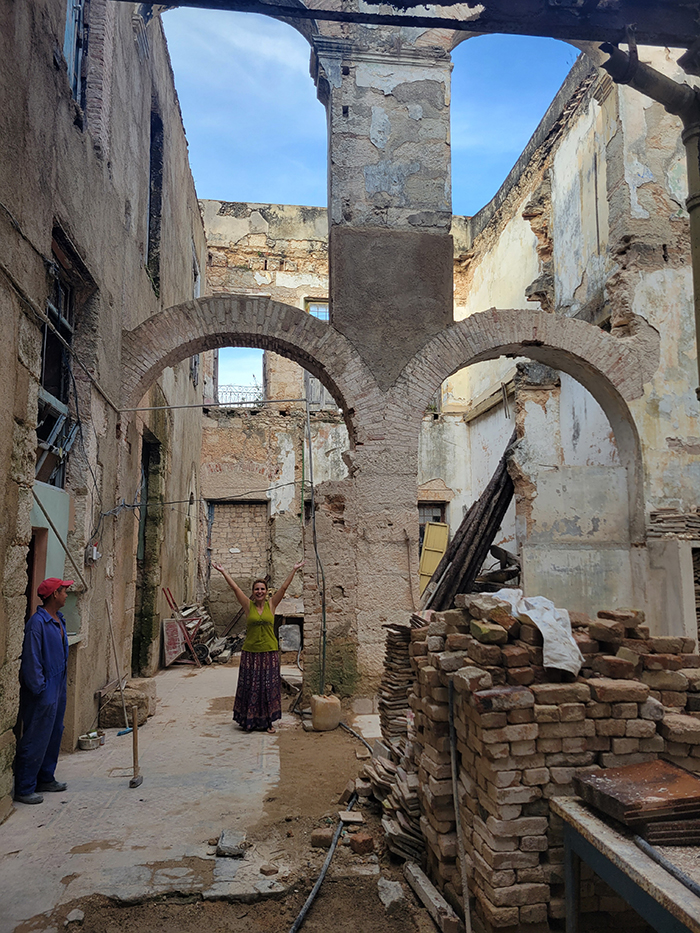
The scene instinctively makes you want to gasp and whisper, oh, that’s not a safe place to stand.
Ah, but you would be wrong. What you’re looking at is a long-held dream in an early stage of being materialized, in the midst of what seems to be rubble, of a building about to be rehabbed to house a music school, liturgical arts laboratory, and social services center on the edge of one of Matanzas’ poorer neighborhoods.
The rubble I witnessed there on a trip last fall has been removed (except for the stack of rescued bricks and slate ready to be recycled). I marveled at the architect’s sketches depicting the building’s resurrection. I had previously seen the constant flow of children and youth (regardless of religious affiliation) pouring into Primera Iglesia’s building, next door to this new site, arriving for music lessons, along with the influx of pensioners coming for freely-offered communal meals.
I’ve seen photos of the Center’s orchestras in holiday marches throughout the city streets. The creative liturgy workshops, incorporating all manner of drama, dance, readings and music, flow directly into the congregation’s worship and influencing liturgical practice in churches across the nation.
As it is, the Center’s activities share cramped space with the congregation’s programs. The dream of having its own dedicated space has persevered over a decade. Locating options—and the funds to purchase such a site—has required much patience. Last year, solicitation here in the US raised the funds to purchase the building. (Real estate is surprisingly cheap in Cuba.) And now acquiring the funds to renovate the building is underway. (Building materials are scarce, and expensive.)
The patient perseverance, the waiting and longing, of these friends in Matanzas is an Advent parable. The patience is not nonchalance. Waiting is not inertia. Longing is not wistfulness. This kind of waiting is the on-the-edge-of-your-seat, ever ready, hands readied for the labor to come. Not resignation, but a long deferred dream which will allow the Center’s creative craft to be expanded—all in the context of a community of faith which affirms that, in Mary’s words, the day approaches when the Spirit will “scatter the proud in the imagination of their hearts.”
We cannot engineer miracles; but we can prepare for them.
§ § §
Hymn of petition. “Now we who mystically represent the Cherubim, / And chant the Thrice-Holy Hymn to the Life-giving Trinity, / Let us lay aside all worldly cares, / That we may receive the King of all, / Who comes invisibly escorted by the Divine Hosts. / Alleluia, Alleluia, Alleluia!” —English translation of the first verse of “The Cherubic Hymn” by G. Lvovsky, performed by the Choir of the Sretensky Monastery
§ § §
I doubt novelist Cormac McCarthy ever pondered Advent, but he provides a succinct sentence pointing to the heart of the matter.
“Between the wish and the thing the world lies waiting.”
You may already know that McCarthy’s novels contain a great deal of violent conflict. In a 1992 interview with the New York Times, he commented, “There’s no such thing as life without bloodshed. I think the notion that the species can be improved in some way, that everyone could live in harmony, is a really dangerous idea.”
As if history is utterly fixed, the universe irreparably fated in its endless spinning, not progress but degress, a de-Creation, if you will, from its original delight to a spiral of entropy, random fracturing, no Center to hold, oriented only to exhaustion and utter ruination, no world-without-end-amen, only a terminus ad quem without rhyme or reason, absent transcendent verity or moral apogee.
The Nativity story in first century Palestine was just such a dangerous idea. As a child in Nazareth, Jesus most certainly heard of the butchery in nearby Sepphorus, four miles north, when an estimated 2,000 Jews were crucified, hung along the streets and highways in that area, following a failed rebellion against Roman rule after Herod’s death in 4 CE. It’s a historical fact that needs to be processed in our Nativity recollection.
Advent’s announcement of incarnation is not an invasion, nor merely an accretion to Creation’s original blessing, an added element to repossess a terminally incorrigible world. Rather, it is a dessoterramento, a Portuguese word that signifies an uncovering of what has been buried or repressed. It is not Creation that is sanitized and sucked up into Heaven; it is the announcement that the Most High has pitched a tent among mortals (cf. John 1:14 & Revelation 21:3) whose minds have been righted to reverential posture.
As William Sloan Coffin Jr. noted, only reverence can restrain violence: because it, and it alone, can constrain self-centered living.
§ § §
Hymn of consolation. “Away from the manger they ran for their lives / The crying boy Jesus, a son they must hide / A dream came to Joseph, they fled in the night / And they ran and they ran and they ran / Ooh / No stars in the sky but the Spirit of God / Led down into Egypt from Herod to hide / No place/ for his parents no country or tribe / And they ran and they ran and they ran / Ooh / Stay near me LORD Jesus when danger is nigh / And keep us from herods and all of their lies / I love the LORD Jesus, the Refugee King / And we sing and we sing and we sing / Alleluja.” —“Refugee King,” Liz Vice
§ § §
Advent’s call to patient perseverance, what my seminary professor Dorothee Sölle called “revolutionary patience,” is penitential in nature: penitential not in feeling bad about ourselves, but in reawakening, of being recalled, resituated and recentered from the cacophony of life lived outside covenant vows; rescued from the omnipresent governing values that assure the strong take what they can and the weak endure what they must; generosity not-for-gain but due to the simple facts that blessed people bless people. It’s who we are (or, more precisely, who we are becoming, season by season, occasionally falling back into self-centered stupor) being born again (and again and again) into our high calling in Christ Jesus.
It is the Holy Spirit slapping our face, saying “SNAP OUT of it!”
Some years ago I attended a service where the bulletin cover depicted a gentle-flowing stream, over which were imposed the “Peace, be still” refrain which shows up in various forms throughout the biblical narrative. I kept it as a reminder that the original “be still” phrase was spoken by Moses to the Hebrew people when their backs were against the sea with Pharaoh’s ruthless army bearing down on them (Exodus 14:13-14).
Peace . . . fear not . . . be still. These are admonishments in the context of conflagration–and not on a nice, sunny-day picnic on warm, green grass, champagne flute in hand, with the gurgling mountain stream in the background and butterflies all around.
Rather than a recommendation to leisure (much less, passivity), “be still” is actually a war-cry, only the terms of engagement are nothing like what we usually associate with soldierly action. The psalmist’s image of standing “beside still waters” is in the context of “the valley of the shadow of death,” where the Lord’s table is spread “in the presence of my enemies.” The issues are those of life and death.
This is what Dr. Sölle (blessed be her memory) meant by practicing “revolutionary patience”—an utterly impatient posture which nonetheless refuses the idolatrous resort to violence, even emotional violence, because of an abiding confidence, that despite much evidence, death itself will be undone. We are but participants and witnesses, not engineers, to this promised new world order, to God’s Kinship which first gathers up “the alien, the widow, and the orphan,” not because of their moral worth but simply because they have been left behind, left out, leftover—surplus in the world’s ordering of power.
To be sure, calluses can grow on fretful rubbed hands. Disappointments are not uncommon. Sometimes, in prayer, we need to stomp our feet and issue curses into the ether. Like our friends in Cuba, we plan, and we wait; we intercess, and we wait; we dream, and we wait; we plead, and we wait; we engage, across the spectrum from random acts of kindness to public acts of civil disobedience, and we wait—because even when we “win,” the winning is always incremental.
Nevertheless, we confess, with Mother Pollard, resident of Montgomery, Alabama, who walked to work during the year long bus boycott, my feets is tired but my soul is rested.
Unfortunately, few if any can experience this stillness, can generate this peaceful still point amidst the storm, on our own. It’s almost always mediated by the fleshly presence of others and the vibrant memory of saints gone before. Which is why pastoral ministry–fostering communities oriented to this vision–is so crucial in cultivating the seedbed’s soil from which prophetic action blooms.
Which is why memory is essential. Which is why I stay in touch with people like my friend Wanda, who can look past dilapidated history to a farther horizon where joy emerges. They help me keep my lamps trimmed and burning.
“Tribulation” is the normal circumstance for Still Ones in a fractious world whose currency is the power to exclude and dominate. But “be of good cheer . . . take heart . . . have courage,” for this “world” is being dismantled (cf. John 16:33), a new heaven and new earth are on their way (cf. Revelation 21:1ff).
§ § §
Benediction. “My body groans for Your redemption / My spirit waits for Your day / My heart longs for consolation / On You we wait, for You we wait . . . / Do not tarry, Lord / On You we wait, for You we wait.” —“Do Not Tarry,” Rachel Colman
# # #