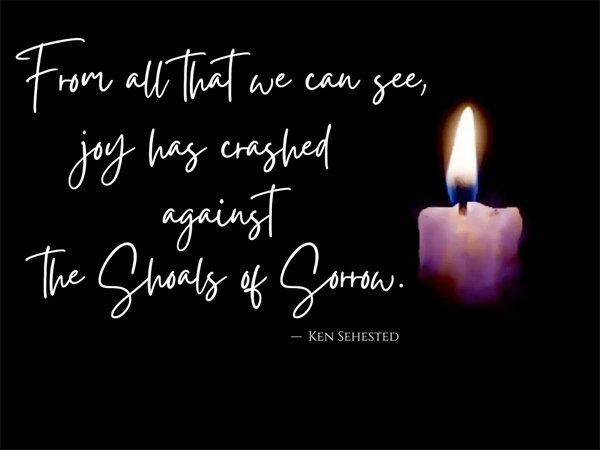

Ken Sehested
The major holidays can be sad occasions for some who have lost a loved one: “Blue Christmas” services of sorrowful remembrance, Easter when resurrection day did not return your beloved, Thanksgiving when there is a painfully empty seat at the table of bounty.
Not to mention the fact that the Nativity story’s context included a state-sponsored terror campaign (cf. Matthew 2:16). And in the US, 27 November is a “National Day of Mourning” commemorated by Indigenous peoples of the ongoing struggle to recognize the historical atrocities committed by European undocumented immigrants in the colonial era and its aftermath.
To mark such occasions, I’ve made a (somewhat random and totally subjective) collection of blues music—not only from that musical genre, but songs of sorrow and lament from many different styles.
Sample the selections below as needed and desired.
§ § §
¶ “Sometimes I get so sad / Sometimes you just make me mad / It’s a sad and beautiful world / It’s a sad and beautiful world.” —“Sad and Beautiful World,” Mavis Staples
¶ “Psalm 23 in Blues.” —1950s Gospel Soul Version
¶ “When it thunders and lightnin’ and when the wind begins to blow / There’s thousands of people ain’t got no place to go.” —Bessie Smith, “Back Water Blues”
¶ “I am a pilgrim, a pilgrim of sorrow / I’m left in this wide world, this wide world alone! / Ain’t got no hope, got no hope for tomorrow / trying to make heaven my home.” —Liberty High School Chamber Singers, “City Called Heaven”
¶ I’ve been in the storm / Too long / Lord, too long / Ooh-ooh-ooh / I’ve been in the storm / Too long / Lord, too long / Lord, please heal me / I need a little more time / I need a little more time to pray (a little time to pray) / Ooh-ooh-ooh.” —“I’ve Been In the Storm Too Long,” Mighty Clouds of Joy.
¶ “I got no big name and I ain’t no big star / I play the blues for you on my guitar / All your loneliness I’ll try to soothe / I ‘ll play the blues for you.” —“I’ll Play the Blues for You,” Joe Bonamassa
¶ “Lead oh Father / Lead me my savior / in all the sorrows of this world Father . . . / for you still protect me.” —English translation of “Ndikhokhele” (Lead me), Mzansi Youth Choir of South Africa (singing in Xhosa)
¶ “Lord, do not rebuke me in Your anger / or discipline me in Your wrath. / My guilt has overwhelmed me / like a burden too heavy to bear.” —“Psalm 38–Lord, Do Not Rebuke Me,” Brotherhood of the Hallelujah
¶ “How Blue Can You Get.” —B.B. King
¶ “Let us pause in life’s pleasures and count its many tears / While we all sup sorrow with the poor / There’s a song that will linger forever in our ears / Oh Hard times come again no more / Tis the song, the sigh of the weary / Hard times, hard times, come again no more / Many days you have lingered around my cabin door / Oh hard times come again no more.” —“Hard Times Come Again No More,” Mavis Staples
¶ “In the midst of pain, I choose love. / In the midst of pain, sorrow falling down like rain, / I await the sun again, I choose love.” —“I Choose Love,” Lindy Thompson & Mark Miller, performed by Voces Aged. The song was written in response to the 17 June 2015 mass murder at Emanuel African Methodist Episcopal Church in Charleston, SC.
¶ “Tooth for tooth, eye for an eye / Sell your soul just to buy, buy, buy / Begging a dollar, stealing a dime / Come on, can’t you see that I / I’m stranded / Caught in the crossfire.” —“Crossfire,” Stevie Ray Vaughan
¶ “I’ve got the joy, joy, joy, joy, down in my heart.” —“Joy,” Latifah Phillips, performing the well-known praise song, but in a sober mood and minor key, adding a new refrain, and splices “It Is Well With My Soul” as a coda.
¶ “Lamb of God, who takes away the sins of the / world, have mercy on us, who takes away the / sins of the world, grant us peace.” —Translated lyrics to “Lament for the Valley,” one song in Karl Jenkins’ “For the Children” cantata, written to mark the 50th anniversary of the 1966 Aberfan disaster in Wales, where a mountainside coal slurry damn broke sending the sludge down the mountain into Aberfan, crushing a school and nearby houses. One hundred sixteen children were killed, along with 26 adults.
¶ “Long Way Home.”
¶ “Give me a mighty oak to hold my confusion / Give me a desert to hold my fears / Give me a sunset to hold my wonder / Give me an ocean to hold my tears.” —Holly Near, “I Am Willing”
¶ “Forsaken.” —The Many: Lament for Black Lives Lost
¶ • “O troubled dust concealing / An undivided love / The Heart beneath is teaching / To the broken Heart above.” —“Come Healing,” Leonard Cohen
¶ “Dear Refuge of my weary soul, / On Thee, when sorrows rise, / On Thee, when waves of trouble roll, / My fainting hope relies.” —18th century hymn by Anne Steele, performed by Sandra McCracken
¶ “I hoped I’d never ever have to know / What it’s like to let you go / And I can’t turn back but it’s hard to forget / Getting over you is the hardest thing / I haven’t done yet / Why does the wind cry the blues / Every time I think of you / How do I face another day / How will I find a way?” —“Wind Cries the Blues,” Teresa James
¶ “God don’t hate the Muslims / God don’t hate the Jews / God don’t hate the Christians / But we all give God the blues / God don’t hate the atheists / The Buddhists or the Hindus / God loves everybody / But we all give God the blues.” —Shawn Mullins, “Mercyland: Give God the Blues”
¶ “Wayfaring Stranger.” —Johnny Cash
¶ “In every life / There’s heartache and pain / Some live with sorrow / Some live with shame / Regret and worry / Forever can last / So lay down your burdens / Put them in the past / And rise and shine.” —Balsam Range, “Rise and Shine”
¶ “This Is to Mother You.” —Sinead O’Connor
¶ “Every face is in you / every voice, every sorrow, in you / every pity, every love / Every memory woven into fire.” —Stephen Paulus, “Hymn to the Eternal Flame,” performed by the Kantorei Summer Choral Institute
¶ “Stand By Me.” —traditional hymn by Charles Albert Tindley, performed by Darrell Adams with new lyrics by Ken Sehested
¶ “I am a poor pilgrim of sorrow / Cast out in this wide world to roam / My brothers and sisters won’t own me / They say that I’m weak and I’m poor / But Jesus father the almighty / Has bade me to enter the door.” —“Stand By Me Father,” Lou Rawls & The Pilgrim Travelers
¶ “Walk Me Home Lord.” —by Thomas A. Dorsey
¶ “Stand By Me.” —Bruce Springstein & Friends
¶ “I got stones in my passway / And my road seem dark as night . . . / I have pains in my hearts / They have taken my appetite / I have a bird to whistle.” —Eric Clapton, “Stones In My Passway”
¶ “Merciful Jesus . . . / Father, who takes away the sins of the world / Grant them rest. . . / Merciful Jesus. . . / Father, who takes away the sins of the world / Grant them rest . . . / Lamb of God . . . / Father, who takes away the sins of the world / Grant them rest . . . / everlasting . . . / Rest.” —English translation of “Pie Jesu” (“Merciful Jesus”), Andrew Loyd Webber, performed by Sarah Brightman, Paul Miles-Kingston. The music accompanies actual film footage from World War I’s “Battle of The Somme” where more than 1 million men were wounded or killed.
¶ “When a man has got the blues and feels discouraged / And has nothing else but trouble all his life / But he’s just an honest man like any other / Living in a world that’s tearing at his mind / If he’s sick and tired of life and takes to drinking / Do not pass him by don’t greet him with a frown / Do not fail to lend your hand and try to help him / Always lift him up and never knock him down.” —Old Crow Medicine Show, “Lift Him Up”
¶ “Blessed Is the One (Psalm 1).” —Brotherhood of the Hallelujah
¶ “Listen, smith [artisan] of the heavens, / what the poet asks. / May softly come unto me / your mercy. / So I call on thee, / for you have created me. / Most we need thee. Drive out, O king of suns, generous and great, every human sorrow from the city of the heart.” —English translation of “Heyr himna smiður” (“Hear, Heavenly Creator”), 12th century Icelandic poem, put to music by Thorkell Sigurbjornsson, performed by Eivør Pálsdóttir (click the “show more” button to see all the lyrics)
¶ “Heaven Knows — Deep Gospel Blues Testimony.”
¶ “David, the king, was grieved and moved, / He went to his chamber, his chamber, and wept; / And as he went he wept, and said, / “O my son! O my son! / Would to God I had died, / Would to God I had died, / For thee, O Absalom, my son, my son.” —“David’s Lamentation,” Second Ireland Sacred Harp Convention 2012
¶ “Ain’t No Storm Wild Enough to Break Me.” —Bertha Mae Lightning
¶ “No more, my Lord, / No more, my Lord, / Lord, I’ll never turn back no more. / I found in / Him a resting place, / And He have made me glad. / Jesus, the Man I am looking for, / Can you tell me where He’s gone? / Go down, go down, among flower yard, / And perhaps you may find Him there.” —“No More, My Lawd,” Negro Prison Blues and Songs
¶ “Feelin’ Bad Blues.” —Ry Cooder, covered by Resonator93
¶ “How many times / Have I stood / By the river / And could not see / To the other side / Hoping like moses / The clouds / Would be lifted / Stretch out my hand / The waters divide / Lay back the darkness / Let in the light / Take all the wrongs / Make them all right / And if I could / Lay down these blues / For good.” —Kate Campbell, “Lay Back the Darkness”
¶ “Your labor is not in vain.” —The Porter’s Gate feat. Paul Zach & Madison Cunningham
¶ “Nobody out here / at a point of no return / I’m just a desolated man / my poor heart burned / Seem that everybody left me / but a devil by my side / Never felt so broken down / ain’t got no place to hide.” —Bill Will & The Bluesmen, “Hard Times”
¶ “Jesus’ blood never failed me yet . . . / This one thing I know, that he loves me so.” —Gavin Bryars & Tom Waits
And, as an encore, close with this one:
¶ “Lento e Largo.” —from Henryk Górecki’s Third Symphony, Opus 36 (“Symphony of Sorrowful Songs”), second movement
“No, Mother, do not weep, / Most chaste Queen of Heaven / Support me always.” This is the opening line to the Polish prayer to the Virgin Mary. The prayer was inscribed on wall 3 of cell no. 3 in the basement of “Palace,” the Nazi German Gestapo’s headquarters in Zadopane, Poland. Beneath is the signature of Helena Wanda Blazusiakówna, and the words “18 years old, imprisoned since 26 September 1944.”
You can listen to the entire symphony here. (56:13)
# # #