

by Ken Sehested
I have a vivid memory of the exact moment. I was in seminary, having fled my native South to New York City to finish college and then seminary, embarrassed at being a Baptist, at being a white Southerner, and not entirely sure if I was a believer. But the God question wouldn’t go away.
A mighty wrestling match was underway in my soul, trying to come to terms with my adolescent “youth revival” preacher days. Neither the Civil Rights nor the anti-Vietnam War movements had disturbed my piously-furrowed brow.
One Saturday during high school, starting a Saturday 12-hour shift pumping gas, washing cars, and changing oil, I was transferring product displays and stacks of new tires outside as we prepared to open shortly before dawn. I overheard the radio saying something about Martin Luther King Jr.
“That Martin Luther King, he ain’t no Christian,” the station owner growled toward the radio. “Ever’where he go they’s trouble.”
It would be years before it occurred to me the same was likely said about Jesus.
Entering seminary, I became a voracious reader of Civil Rights Movement history, the gritty details and the many figures, making a timeline and a map in my mind.
Then came that vivid moment. I had purchased one of those over-sized books of photos of Dr. King and other civil 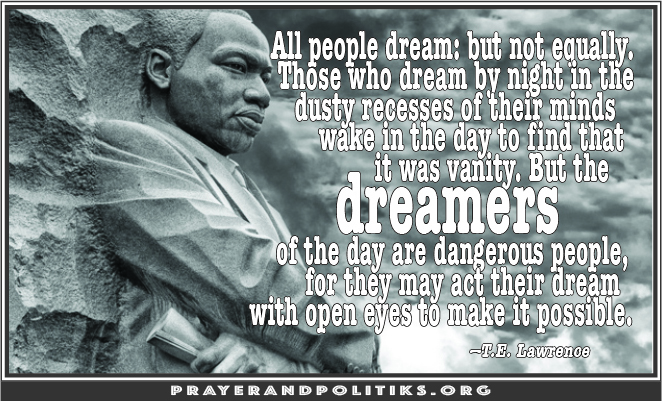 rights moments and luminaries. Flipping through, I turned to a photo showing Dr. King and his wife Coretta sitting at a piano, their infant daughter Yolanda perched on Martin’s lap as he and Coretta sang from an open hymnal.
The cover title was clear. It was the Broadman Hymnal! The hymnal I grew up with. Published by the Southern Baptist Convention (the same body whose Executive Committee voted down a resolution of sympathy to members of Birmingham’s Sixteenth Street Baptist Church, one day after the terrorist bombing in 1963 that killed four young children).
At one time I could quote from memory the page number of dozens of titles in that hymnal. As I came to discover, a good many Black churches that hosted Civil Rights Movement mass meetings—churches that were threatened by cross-burning Klan torches—did their singing from the Broadman. And I also learned that terrorism on American soil has a long history.
That moment—that photo—stands among my life’s greatest epiphanies. I came to realize that the language of faith can have many different, even competing meanings, just as any chemical compound, minus even one element, turns into something else altogether.
I had long since comes to despise the refrain from that popular hymn, “What a Fellowship.” Leaning, leaning, safe and secure from all alarm. Leaning, leaning, leaning on the everlasting arms.” By this time the sound of that song felt in my ears something like someone raking their fingernails across a chalk board!
Until I saw the first episode of that special Public Broadcasting Service series, “Eyes On the Prize,” and learn that the first song sung at the first mass meeting called to considered continuing their one-day bus boycott in Montgomery, Ala., on 5 December 1955 at Holt Street Baptist Church was “What a Fellowship”! The meaning of that music was suddenly transformed in my mind.
Of course! When you can’t depend on the police, or the court system, the government or the business community—not even the white churches (including the liberal ones)!—leaning on Jesus was an audacious, even revolutionary act.
Faith has a way of being clarified in the midst of turmoil, in the face of threat.
The annual commemoration of Dr. King’s birthday provides a perennial occasion to remember the dream that still beckons both church and civil society. And not just in the US.
I’ve listened to children in Baghdad sing “We Shall Overcome” in Arabic, and read similar accounts of its being sung during the collapse of the Berlin Wall in Germany, and demonstrators in Tiananmen Square in Beijing , and in protest marches in South Africa’s Soweto Township. A comic book style telling of the Montgomery bus boycott, first published in 1958, was translated into Arabic in 2008 and circulated widely during the “Arab Spring” democracy movement in North Africa.
Yet Dr. King was not assassinated because he was a dreamer, or a promoter of “race relations Sundays.” The Montgomery Improvement Association (MIA) strategically focused on integration. Though the MIA’s first demand from the bus company did not include full integration. Black riders would still have to sit at the back, whites at the front. Only no Black person would have to give up their seat to a white person. It was an incremental goal that would soon lead to more substantial demands.
Over time the Movement would recognize that integrated seating at lunch counters and water fountains and bus terminals was not nearly—not nearly—enough. In time they would become clear that to achieve changes in fundamental economic systems, equitable pay, and housing policies, voter registration in the Black community would need to change, too.
Remember, the 1963 March on Washington was name “The Jobs and Freedom March.”
Since the legislation making Dr. King’s birthday a national holiday—approved by Congress in ’86, first commemorated in ’88 (as a day of service to communities, not picnics), national holiday-makers, in concert with commercial interests, have gradually domesticated and smoothed over the threat he represented. (“The most dangerous negro in the country,” according to the FBI’s assessment.) During my years in Atlanta, several Black civil rights groups seriously discussed, but then chose not to protest that city’s Martin Luther King Jr. holiday parade because of its corporate sponsorship and military presence.
We forget that by the time King was assassinated, his favorable public opinion polling had plummeted to 33%. We forget that his last major speech, “Beyond Vietnam,” when he openly condemned the U.S. war in Vietnam, he charged that our nation was “the greatest purveyor of violence in the world.”
After prophets die, we mold their memory to suit our purposes. We ladle praise on them and put them on pedestals—as a way to distance ourselves from them. There is some truth in that old canard: A conservative is someone who admires a dead radical—because they could not climb down from their pedestals to challenge us.
Admiring Martin Luther King Jr.’s dream is not the same as being captured by it. It is not only possible but common to respect the man but relinquish the mission, to revere the dreamer but renege on the dream . . . such that it turns into something else entirely. As with the Christian community, admiring Jesus substitutes for following him.
The biggest mistake we make is using the King Birthday observance as the occasion to heap accolades on his memory. Diane Nash, one of the many unheralded leaders in the Civil Rights Movement, says it well:
“If people think that it was Martin Luther King’s movement, then today they—young people—are more likely to say, ‘gosh, I wish we had a Martin Luther King here today to lead us.’ If people knew how that movement started, then the question they would ask themselves is, “What can I do?’”
# # #