

(resurrectus contagio)
Ken Sehested
Prelude. “Easter Oratorio, BWV 249 ‘Adagio.’” —J.S. Bach, performed by Alexei Ogrintchouk & Sinfonietta Rīga
Invocation. “Coax us back to Jerusalem’s turmoil, where Heaven contends with Earth’s remorse, where the promise of forgiveness confronts the knots of enmity, where danger’s threat is met with the Spirit’s assurance that one day public good shall supplant private privilege, when the tyranny of might over right will end, when all tears will be dried and death itself comes undone.” —excerpt from “An Emmaen prayer”
§ § §
We have entered Eastertide, the liturgical season beginning with Easter and ending 50 days later on Pentecost (aka Whitsunday). The formulation of this season parallels the period in Judaism between the first day of Pesach (Passover, marking their liberation from Egypt) and the feast of Shavu’ot (Feast of Weeks, both a harvest festival and a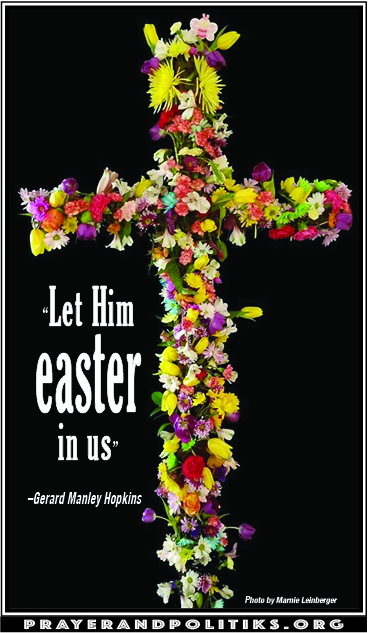 commemoration of the giving of Torah at Mount Sinai). Parallel resurrection moments, setting the stage for resulting resurrection movements.
Freedom’s announcement is not a spectator sport. Neither the parting of the sea, nor the rolling of tombstone, is part of some kind of divine service economy. God is not a personal attendant, working for tips (aka piety). God is the Ringleader, the Chief Inciter of the rebellion against the reign of every cruel and merciless force.
There is no resurrection by proxy.* It’s a bet your assets kind of involvement. The baptismal waters are troubled and troublesome.
Eastertide was the period when the early followers of Jesus were forced to recalibrate their messianic expectations. Good Friday’s execution was a crushing blow to their hopes. Despite Jesus’ repeated teachings to the contrary, the apostles still presumed Jesus would be the leader of a divinely-inaugurated coup d’état that would expel Roman occupiers and restore King David’s regal dynasty.
Hadn’t the Hebrew prophets predicted this messianic outcome—confirmed in Matthew’s and Luke’s birth narratives?
We, even today, are not exempt from the same kind of disorientation caused by the resurrection’s disarranging announcement.
Eastertide as cognitive dissonance
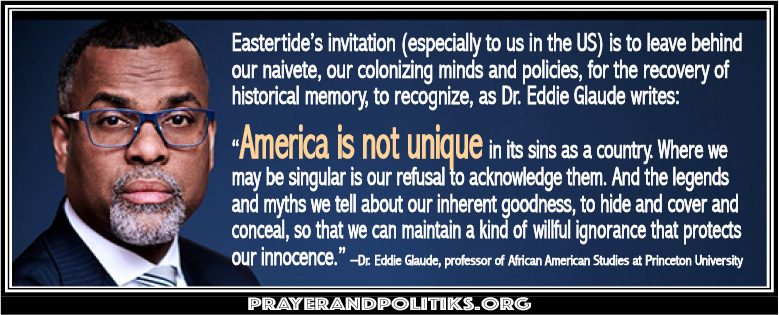
Eastertide is the season for Jesus’ followers to undergo a complete reimagining of the nature of power. It demands a decolonization of the mind and a regeneration of the heart: conception, conviction, and practice operating in tandem, each shaping, correcting, and reinforcing the other. A certain deconstruction is at work, and it is often discomfiting, for we are being stretched and refitted to become suitable couriers of the news that is disturbing before it is good. —continue reading “Eastertide: The outing of the church”
§ § §
Hymn of lament. “This Too Shall Pass.” —music by Farya Faraji, ney by Ali Farbodnia, lyrics from a 14th century poem by Saif Farghani
Word. In a recent news conference, House Speaker Mike Johnson criticized the Pope Leo’s opposition to the war in Iran: “A religious leader can say anything they want, but obviously if you wade into political waters, you should expect some political response. Frankly I was taken a bit aback by him saying something about ‘those who engaged in war, Jesus doesn’t hear their prayers’ or something. There’s something called the ‘just war’ doctrine.”
In fact: The Pope was quoting God, cited in Isaiah 1:15.
§ § §
From the vault
excerpt from “Made Known in the Breaking of Bread,”
a 2014 sermon on Emmaus Road story in Luke 24
In recent weeks I’ve been able to get back to stonework. I’m rebuilding a retaining wall in our yard. Several years ago I learned the trade working with a stonemason and discovered the beauty of putting together different shapes and colors and sizes of rock into aesthetically pleasing patterns. Nancy says I never got over tinker-toys, only in this case the pieces can weigh up to 100 pounds.
Physically it’s very demanding work, and I’ve had reason to remember a curious fact from my previous years doing this work. Particularly when working in summer’s heat, I remember how when my legs began to tire in late afternoon, my eyes 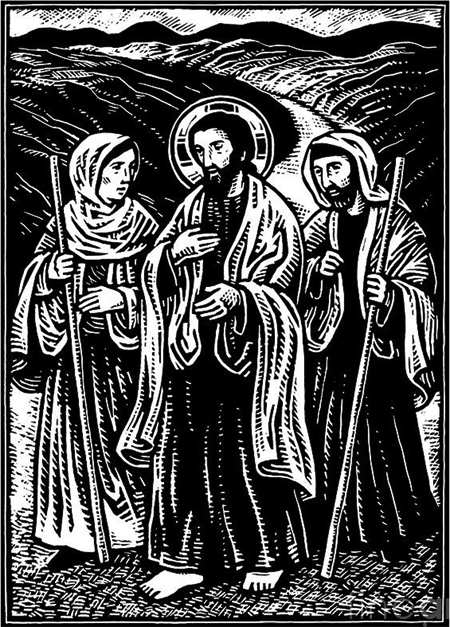 got tired in the same degree. When I say “tired eyes” it’s not like I was getting sleepy. It really wasn’t my eyes that were tired; the weariness was in my capacity to see clearly—or more precisely, to “read” clearly. When tired, I had more trouble reading the rocks.
Right: “Road to Emmaus,” Julie Lonneman linocut
Maybe the greatest skill in stonemasonry is spatial vision: looking at the contour of the next space in the wall that needs filling, then looking at the pile of rocks available, and in that massive pile spotting the stone that most nearly fits. Stones are not bricks. They don’t have uniform shapes. They have unique angles and bulges and sizes and silhouettes.
The experience I’ve been remembering recently is the way tired legs result in tired vision. The longer the day, the slower I’d get at finding the right rock to fit into the intricate pattern of a finished wall.
The question posed to us by the text—as much now as it was in the original story—is the question of how when our legs are tired, our eyes are kept from recognizing what we most desire, the purpose and promise we seek, the Presence of the One for whom we long more than any other.
The recitation of the length and breadth of Scripture’s story of redemption accounted to the Emmaen travelers by the unrecognized, resurrected Jesus is summarized by saying that God is irrevocably involved with us. Part of that story is surely delightful, because of the intimacy that comes with being loved so thoroughly, so immeasurably. It is a love that gives true rest. “Come to me,” Jesus told his followers, “and I will give you rest.” St. Augustine said it so well in his famous line, “Thou hast made us for thyself, O Lord, and our hearts are restless until they find their rest in thee…” St. Augustine
But God’s love is not only intimate, is not only to make us feel good, feel safe, feel secure. When appropriated, God’s love can also make us feel turmoil, feel threatened, feel insecure. There is an intimacy, to be sure. But there is also an insurrection at work, an insurrection against a system of domination and turmoil that now, by every bit of available evidence, appears to have the upper hand in creation.
Part of God’s involvement with us can be painful, disruptive and disorienting. There is always a kind of dying involved in finding the life authentic life. Our intimacy with the Beloved is more than God whispering sweet nothings in our ears. There is often a “get up and go” quality to this relationship, much like the Emmaen travelers who, after recognizing Jesus, got up and went back to Jerusalem, back to the city swarming with Roman soldiers and their priestly collaborators. No matter that you, like they, are tired. No matter than you aren’t fully trained and funded. No matter that others could do a much better job. No matter that it’s raining, or it’s dark outside, or it’s not practical, or there’s only so much that one person, or one church, or one organization can do.
Our life together is the rhythm of intimacy and insurrection. There is for us, like with the early church, a rhythm of waiting and walking. There is a time to be still, and a time to be stirred.
§ § §
Word. At his Pentagon monthly worship service this week, Secretary of Defense Pete Hegseth told military leaders what they hear in worship should “inform” their war decision. Then he read a prayer calling for “great vengeance and furious anger,” purportedly from Ezekiel. Except it wasn’t. It was from a 1994 movie, “Pulp Fiction,” lines from a fictional professional assassin who’s about to execute an unarmed man.
“The path of the righteous man is beset on all sides by the inequities of the selfish and the tyranny of evil men. Blessed is he who, in the name of charity and good will, shepherds the weak through the valley of darkness, for he is truly his brother’s keeper and the finder of lost children. And I will strike down upon thee with great vengeance and furious anger. And you will know my name is the Lord when I lay my vengeance upon thee.”
Hymn of invitation. “The Road to Emmaus.” —Jason Upton
§ § §
Easter’s aftermath
Easter resurrection is never as assured
as the arrival of Easter bunnies.
Clothiers and chocolate-makers alike yearn
for the season no less than every cleric.
And yet, in my experience, the Spirit
rarely blows according to the calendar,
much less on demand.
We live with ears open, eyes peeled,
hands and feet nimble, ready for
jolting news and a dash to one tomb
or another.
And this, apparently, is the purpose
of wakeful attention during the transition
from Good Friday’s darkness
to Sunday sunrise:
training in the art of vigilance,
as maidens with well-trimmed wicks.*
One empty tomb poses no threat
to present entanglements,
any more than annual and
specially-adorned sanctuary
crowds encroach on Easter morn.
It’s Easter’s aftermath
resurrectus contagio,
contagious resurrection
that threatens entombing empires
with breached sovereignty.
The Lamb Slain sings
of tribulation annulled,
of death undone,
of heaven reraveling the
sinews of soil and soul.
Humus and human alike,
“the earth and all that dwell therein,”
inherit the promise intoned
on that first dawn.
Breath on truculent waves:
be still, be still.
Wind on Emmaen travelers:**
Fear not, fear not.
Ken Sehested
*cf. Matt 25:1-13. **cf. Luke 24:13-32
§ § §
Benediction. “He said not ‘Thou shalt not be tempested, thou shalt not be travailed, thou shalt not be dis-eased’; but he said, ‘Thou shalt not be overcome.” ―Julian of Norwich, Revelations of Divine Love
Postlude. “Satan, we’re gonna tear / Your kingdom down / Oh, Satan, we’re gonna tear / Your Kingdom down / You’ve been building your kingdom / All over the land / Satan, we’re gonna tear / Your kingdom down, down.” —“Satan, We’re Gonna’ Tear Your Kingdom Down,” Shirley Caesar and The Young People’s Institutional Choir of Brooklyn
# # #