Pastoral and prophetic resources
Ken Sehested
Prelude. “Lullaby.” —Together for Palestine
Invocation. “The War Prayer,” by Mark Twain, presented as an animated film by Markos Kounalakis. Twain’s work is a short story written in the heat of the Philippine-American war of 1899-1902 offering a poignant reflection on the double-edged moral sword implicit to war. (14:02 video.)
Call to worship. “You just need to look at what the gospel asks and what war does. . . . The gospel asks us to take up our cross. War asks us to lay the cross on others.”
§ § §
 Passion week
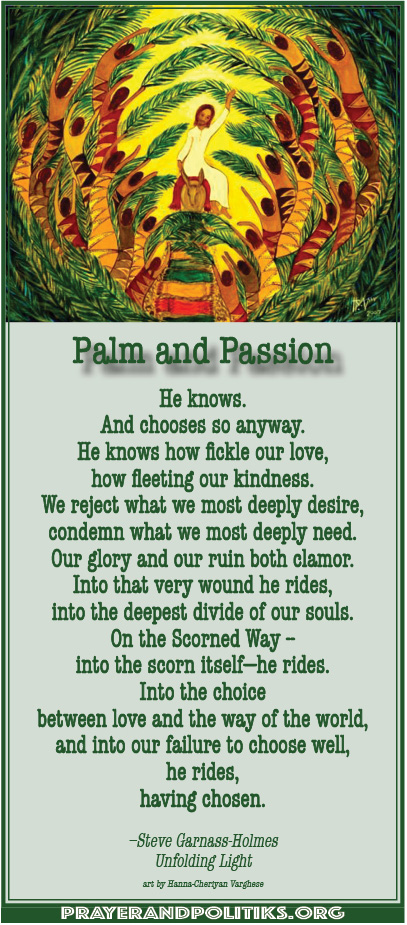
In the coming week, we face Maundy’s mandate and Friday’s calamity . . . and, well, Saturday’s betwixt-and-between daze and discomposure of Jesus’ disciples and revelers. Then and now, the dominant culture remained confident in the security of the tomb’s immovable stone and the legionnaires’ vigilance over its irrevocable seal.
Best not bank on resurrection’s circumvention of death’s ascendance and terror’s reign. Few doubt the market’s ruleenforced by the sword’s regime.
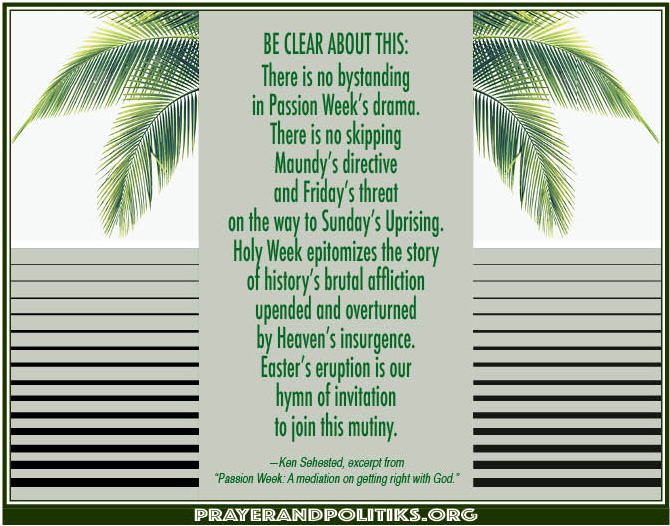
Be clear about this: There is no bystanding in this drama. There is no skipping Maundy’s directive and Friday’s threat on the way to Sunday’s Uprising. No leap from crib to cross to Crown of Glory.
In prosperous cultures like ours, voyeurism is the great pretender as an agency of spiritual formation. Titillation substitutes for texture and substance. The quest for emotional novelties, intellectual baubles, and experiential souvenirs displacing incarnation’s fleshly ordeal.
In my native West Texas idiom, a pretend rancher would be described as “all hat and no cows.” You can dress the part without engaging the reality. “Spirituality” as levitation from history’s crucifying peril. The luxury of hope’s assurance severed from the context of threat. Singing the blues without paying the dues. The pretense of faith despite no back against any wall.
Holy Week epitomizes the story of history’s brutal affliction upended and overturned by Heaven’s insurgence. Good Friday is good not because of what it displays but because of what it foreshadows.
Easter’s eruption is our hymn of invitation to join this mutiny. There is no “getting right with God,” there’s only getting soaked. Only the passion opens onto the Spirit’s efficacy. In a suffering world, only a suffering God is believable. The Way is enjoined by imitating the One we adore.
Let this be our adoration. Let this be our testimony to Heaven’s insurrection for Earth’s reclamation. In the words of an old proverb, let this be our eulogy: They tried to bury us; they didn’t know we were seeds.
—excerpt from “Passion week – A meditation on getting right with God,” Ken Sehested
§ § §
Word. “Unfortunately, it has become increasingly common to drag the language of faith into political battles, to bless nationalism, and to justify violence and armed struggle in the name of religion. Believers must actively refute, above all by the witness of their lives, these forms of blasphemy that profane the holy name of God.” —Pope Leo XIV in his 1 January 2026 “World Day of Peace” message
Liturgy. “Lament Together.” —“The Many,” highly recommenced 41-minute video of poignant music and timely readings for marking Holy Week
§ § §
Holy hell week
As it happens, hope’s fertile soil lies in that spit of land between helpless despair and se ntimental optimism. Our cultivating work, as the Welsh novelist and academic Raymond Williams wrote, “is to make hope possible, rather than despair convincing.”
Hope is wider than optimism, believing everything will be fine; and deeper than pessimism, sensing all is doom. The latter, in fact, is a form of arrogant self-obsession, as if the world will unravel without our attention.
Both optimism and pessimism are haphazard, sometimes fickle. When one or the other knocks at your door, give welcome;but say, you’ll get neither bed nor board in this house.
How are the faithful to hold up in the face of mounting tragedy? This is the focal question as we practice our special disciplines—as means of attentive listening—in this liminal season.
The counsel of scriptures and saints for the living of these days is this: In the panic, be still; in the ordeal, take heart; in the night of sorrow, remember the promise of joy’s release, for more is at work than we imagine.
Hope is not hope absent the context of threat. Otherwise, what you have is distracting amusement.
“For the world has grown full of peril,” Galadriel said to Celeborn in Tolkien’s The Lord of the Rings. “And in all lands, love is now mingled with grief.”
Celeborn asks, “What now becomes of this Fellowship? Without Gandalf, hope is lost.”
“The Quest stands upon the edge of a knife,” said Galadriel. “Stray but a little, and it will fail, to the ruin of all. Yet hope remains while the Company is true.”
Trying days are here. Death’s pandemic is more palpable than usual; but it does not have the last word. Find your company and devote yourself to its sustenance.
—excerpt from “Holy hell week: In the panic, be still; in the ordeal, take heart,” Ken Sehested
§ § §
Week’s worth of music. “A few (somewhat unconventional) music suggestions for Holy Week and Easter”
Benediction. “I would like to see every single soldier on every side just take off your helmet, unbuckle your kit, lay down your rifle, and set down at the side of some shady lane and say nope, I ain’t gonna kill nobody. Plenty of rich want to fight. Give them the guns.” —Woodie Guthrie
Postlude. “Al-Fatiha.” —Byzantine-Gregorian Chant
# # #