Recent

Where do you put the anger?

Anger and the animating presence of God

Ken Sehested

Invocation. “Inspired by Love and Anger.” —Iona Community

§  §  §

Given the state of public affairs in these riven United States, I too frequently find myself in a foaming-at-the-mouth froth of anger. Utter disgust, flinging foul imprecations and anathemas (mostly under my breath). I catch myself, with James and John (Luke 9:54), beseeching Jesus for permission to rain down fire from Heaven on the unrighteous, the villainous, the unscrupulous racketeers who pantomime as public servants.

And I am pressed, at the old hymn puts it, to “take it [this urge] to the Lord in prayer.”

Few topics are as ambiguous for people of faith as anger. All of us get angry from time to time. But something inside us tells us we’re not supposed to be angry—even though sometimes it feels utterly righteous.

Mostly, we are taught that anger is wrong, a temptation to vengeance. Think of the Star Wars movie Emperor Palpatine taunting Luke Skywalker: “Give in to your anger. With each passing moment you make yourself more my servant.”

The Bible itself seems to be ambiguous. Jesus appears to forbid it when he says “every one who is angry with his brother shall be liable to judgment.” (Matthew 5:22—although a textual note adds: “Other ancient authorities insert ‘without cause’ in this verse. The rest of this text involves Jesus’ warning about insulting behavior.)

God surely gets angry. A lot. The first time in Scripture where God threatens divine wrath is promised against the Israelites should they mistreat migrants, widows, and orphans (Exodus 22:21-24).

How come God gets to, and we don’t? The Psalms, in particular, are packed full of angry statements, though we almost never read those in polite company. (For more, see “Angry words in the Psalms: A collection of texts” https://prayerandpolitiks.org/articles-essays-sermons/angry-words-in-the-psalms/.

§  §  §

One Saturday evening a church member called my wife about worship the next morning. She had assigned him a text for reading in the service.

“I made a mistake and wrote down Psalm 109,” John said.

“That’s the one,” Nancy replied.

“Are you sure?” he said in a puzzled voice. “This one’s not very nice—and you want me to read this in church?”

§  §  §

Declaration of faith. “We are a gentle, angry people, and we are singing, singing for our lives.” —“Singing For Our Lives,” Holly Near and Ronnie Gilbert

§  §  §

Sometimes we muster the will power to “swallow” our anger. Doing that, however, is like swallowing a mouth-full of nails. It usually produces serious digestive problems. (Have you ever heard someone described as “eaten up with anger”?)

Psychologically speaking, swallowing anger leads either to depression (when internalized) or aggression. I am convinced you can no more stamp out anger than you can destroy energy. It simply assumes another form.

I probably have as many questions about anger as anyone. But I know four things for sure.

  1. If you’re never angry, you’re not paying attention. Conflict is constitutive to life as we know it, and transforming such conflict, envisioning and practicing redemptive response, is the heart of faith.
  2. Anger is the appropriate response to every form of abuse and injustice. It is, in fact, the animating presence of God; for life as we know it is not finally fated to destruction and will be transformed. This is the promise on which faith is formed and engaged.
  3. Yet anger’s sway easily becomes a cover to act out our own fears and vanities—and is especially brutal when invoking religious identity and transcendent justification. There is no vengeance quite as brutal as when one claims divine authority.
  4. As with all such weighty matters, talking about the appropriate use of anger is immeasurably easier than practicing it. We remain acquainted with failure; it is risky; and sometimes bruising. But from such disturbances—when we learn how to enter into and transform conflict without picking up a stick—is how faith is developed.

A good friend once shared an anecdote about the dilemma of handling anger as depicted in a favorite episode of an old television show, “Hill Street Blues.” Ramona wrote:

“The show dealt with the ugly realities of daily life in the inner city. I watched the show faithfully and considered the characters portrayed as friends—people who understood the violence of poverty and the drug culture, realities that characterized my rough neighborhood.

“In one episode, one of the young police officers was being praised by his sergeant for how well he had handled a series of conflicted encounters—a case of domestic violence, an arrest of a drug dealer, and a confrontation with a quarrelsome prostitute—all in a night’s work. The officer thanked him for the encouragement and then asked him, ‘But, sir, where do you put the anger?’”

All of us, virtually every day, in small, personal ways or in large public ones, encounter conflict and wrestle with the question about where to “put” our anger. Every episode is an exercise in faith development and the occasion for deepening grace, grace that calms our fretful habits, provides buoyancy amid the storms, and unleashes imagination and energy for building bridges across walls of enmity.

Faith formation and the ministry of reconciliation are interwoven in the drama of redemption. Getting to that place of recognizing how the bile of anger poisons our spirits, we come back again and again to face the challenge Jesus put to James and John; and here the King Jimmy language seems most eloquent: “Ye know not what manner spirit ye are of.”

Becoming conscious of that (unholy) spirit, acknowledging its sweet craving, facing the fact that this, too, must be rejected, must be put aside, its lustful allure laid down, to face the fires of our own purification: these are the terms of forgiveness. For we do not often “know not what spirit ye are of.”

One of my favorite quotes is from the legendary migrant farmworker organizer (and devout Roman Catholic), Cesar Chavez, who wrote: “I am a violent man learning to be nonviolent.” None of us is exempt from the tantalizing allure of enacting angry vengeance: in opposition to the rule of greed, in protection of the vulnerable. In truth, people shaped in the Way of Jesus are called to do both of these things. The work of disarming the heart, and the call to disarm the nations, intersect and work in tandem.

The work of salvation is always personal but never private. Lives lived in penitential concession—walking humbly with God—is the fulcrum whereby we leverage the work of doing justice and loving mercy. In the concise, startling syntax of Luke, “The one to whom little is forgiven, loves little” (7:47).

It is disorienting, and frightening, to confront the ways our self-justifying lies and twisted hearts and confounded minds have been caught up in the world’s tragic spiral of vengeful and suppressive malice.  Only the work of grace is strong enough to loosen these knots. Only then can the fire-refining work of the Spirit thereby instruct us in expressing the love of God for all of creation as a flame that heals and reveals but does not scorch or consume.

§  §  §

Benediction. “While I’m alive / Let there be peace / Let these cries / Of anger cease / Far and wide / Before I die / Let there be peace.” —Ruth Moody, “Far and Wide

#  #  #

For more on this topic, see “How do you deal with anger? Pastoral commentary.”)

Declare yourself

Drawing near to the heart of God in a world of heartache

Ken Sehested

Invocation. “Lord dear Lord I’ve loved / God almighty, God up above / Please, look down and see my people through / God dear God I’ve loved / God almighty, God up above / Please, look down and see my people through / He’ll give peace and comfort / To every troubled mind / Come Sunday, oh come Sunday / That’s the day.” —“Come Sunday,” Duke Ellington featuring Mahalia Jackson

§  §  §

You may have seen this social media meme. It’s a painting, of a woman in Victorian style dress, and the caption reads: “These days most of my exercise comes from shaking my head.”

Any of you been doing this kind of exercise lately?

Without a doubt, we’re in a rough patch as citizens in this republic. Clearly moving toward an extreme autocratic (or oligarchic) federal government. Depending on your definition, you could also say fascist. Reminds me of Jeremiah’s scathing criticism in his age: “Were [the rulers] ashamed when they committed abomination? . . . (No) they did not know how to blush” (Jer. 6:15). Or recall the judgment of Amos, who complained that the rich sell the poor for silver, and barter the needy for a pair of shoes (8:6). We are millennia removed from the ages of these prophets, but their sharp accusations are as relevant as ever.

There have always been times when some in power have exercised cruelty and deceit. But never have the majority in all three branches of our government displayed such cold hearts, cruel minds, calloused hands and feet. A time when empathy, a vigilant attention to suffering, has been explicitly repudiated. As our recently-exiled shadow president, Elon Musk, said recently, “The fundamental weakness of Western Civilization is empathy.”

Many economists believe that the current state of our ruthless economy and politics of fraud are worse than it was in the Gilded Age, during the latter part of the 19th and early 20th centuries, when robber barons amassed their wealth at the expense of workers, when political corruption was rampant—or, as the title of my sermon says it, quoting Paul’s letter to the small Christian community in Philippi, “their god is their belly.” And I’m not just talking about stomachs or culinary habits—it was (and is) a gluttony of twisted desires and rapacious appetites, where might most certainly, and most ruthlessly, makes right.

I’m remembering, too, the Prophet Micah, who warned of the judgment to come of those, as he puts it, “who devise evil deeds on their beds!” And can’t wait until the sun rises to seize the property of others, who covet fields and oppress householders (2:1-2). Those who, like our golden-dyed hair-of-a-president, resurrects our nation’s colonial past by his intention to seize the Panama Canal and Greenland, ethnically cleansing Gaza to establish it as a massive tourist resort—even to the point of annexing Canada, all to satisfy his insatiable quest for personal gain and coercive plunder.

We are witnessing as never before the transforming of common wealth into private equity. Filling his unquenchable belly, and those of his parasitic patrons.

§  §  §

Hymn of intercession. “Speakers are crying like a forest in the rain / I was so alone with my thoughts and my pain / And the darkness closed like a mouth on a wire / And night, I’ll never be free / Ooh, in this darkness / Please light my way / Light my way. “—Moby, “This Wild Darkness

§  §  §

Now, put on your seatbelt because I’m going to make a hair turn maneuver to ask what in the world does this have to do with drawing near to the heart of God—which is, for us as a worshiping community, the crux of the matter.

One of the unheralded theologians of the 20th century was Charles Schultz and his serial “Peanuts” cartoons. In one day’s panel, Snoopy the dog declares he’s going on a hunger strike. The next day’s sequel has Snoopy banging at Charlie Brown’s back door, food bowl in mouth. Charlie Brown opens the door and says, “Your hunger strike didn’t last very long, did it?” To which Snoopy replied, “The brain may be important, but the stomach is still in charge.”

Though we’ve all recognized this fact over and over, we’re still surprised when our consciences are overruled by our exaggerated appetites. Long before Karl Marx’s claim that money is the prime factor in human decisions, Jesus said it much more concisely: “You cannot serve God and mammon.”

The brain may be important, but the stomach’s in charge.

The work of worship—the practice of praise, penitence and absolution, intercession, hearing and responding to the Word declared and our response in eucharistic practice—is designed to give devoted time to our own hearts and minds; to examine the work of our hands, the paths of our feet; to inquire into the orientation of our eyes and our ears; to audit our speech, whether we have been true and truthful, whether we have said too much—or too little; to scrutinize our longings and desires to see if any have breached their healthy boundaries, if some need retraining of retracting—or reviving.

But hear this! Our liturgical practice is not for our self-absorption or flagellation, which can be yet another form of narcissism, of pride, of conceit. The work is not a spotlight on ourselves, much less a despairing obsession with our own failings. It is the work of triangulating our attention, in alignment with and yoked to the Work of the Spirit, in a world that has forgotten its origin, its promise, its purpose.

Our liturgical work, in regularly-gathered assembly, is to revivify, to recollect, what Latin American liberation theologian Johann Baptista Metz called “the dangerous memory” of Jesus and all who have traveled in his steps. There is risk involved in declaring our allegiance to such reflection-practice. Such remembrance is not merely reminiscence, much less nostalgia. It is more than keeping a diary of names, dates, and events; but rather, a commitment to walk in ways that reflect such values and directives; to travel in the direction of those whom the world considers expendable; to position ourselves in compassionate proximity with the least, the lost, the lowly, not as virtue signaling but as the very means by which we tune our ears and focus our eyes to what and where and how the Spirit is redemptively moving over the landscape of wreckage and ruin.

Our preparation for and participation in eucharistic observance is simply the recognition, followed by corrective measures, that (in one’s own life) pipes can get clogged; moving parts need lubrication; bodies, in need of medical intervention; cracks exposed and rot replaced.

Remembering that you are dust (a Lenten image with open ended application) is not an insult, for such is the very stuff of the universe, ordered and animated in God’s own good pleasure. Do not grovel! Simply allow your compass to be adjusted, as needed.

When we do this, we begin to gravitate toward the most essential question: What does it mean to draw near to the heart of God? It means to be inserted into the heartache of a world overflowing with denuded souls, devoured bodies, and desecrated mountains and meadows, forests and fields, rivulets and seas. Drawing near to the heart of God blossoms from the seeds sown in the cracks of a crucifying world announcing the coming of a resurrected Earth marked by Heaven’s joyful, unending delight.

Now that the prayers have been said, the hymns sung, the texts read and spoken witnesses concluded, the hymn of invitation is repeatedly offered: Declare yourself, from this moment on. Choose whom you will serve. Declare the holiness of the One True God in the practice of iconoclasm aimed at every false god.

As the liturgy ends and the service begins, let this be our parting benediction, from poet and spoken word artist Andrea Gibson, (who this week passed much too early):

“In the end, I want my heart to be covered in stretch marks.”

§  §  §

Benediction. “If ye love me, keep my commandments.” —Thomas Tallis, “If Ye Love Me,” performed by Vox Luminis

#  #  #

July 2025


Sodomy in the House (and in the Senate)

Critical assessment of the president’s “One Big Beautiful Bill”

Ken Sehested

Processional. “Lift Every Voice and Sing.” —aka the Negro National Anthem, James Weldon Johnson, performed by the Howard Gospel Choir

Call to worship. “Beware of those who pray pretty, but live ugly. Who drink in Jesus, but spit out hate. Who pursue a Christian nation, but not the Sermon on the Mount. Who boast of faith, but rely on fear. And who hear God’s promises of abundance, but not God’s cries for sacrifice, servanthood, humility, and compassion. Jesus is not there.”  —Chris Kratzer

§  §  §

Competing moral assertions

“The fundamental weakness of Western Civilization is empathy.” —Elon Musk, the world’s richest human who, in decimating the US Aid for International Development, has taken food out of the mouths of the world’s poorest children

“The death of human empathy is one of the earliest and most telling signs of a culture about to fall into barbarism.” —Hannah Arendt, after coverage of the Nuremberg Trials of Nazi war criminals

§  §  §

Just days before US President Donal Trump left office at the conclusion of his first term in office, a “1776 Commission” he created in 2020 issued its report, calling for “patriotic education” designed to counter what he claimed was a “twisted web of lies” of systemic racism being taught in public schools, calling it “a form of child abuse.”

Though President Joe Biden abolished that commission shortly after winning the 2020 election, Trump has reinstated the work’s agenda and its goal of getting rid of “wokeness” across the spectrum of US institutions, including a “radicalized view of American history” which “vilified [the US’] Founders and [its] founding.”

In the months following his resuming office in January 2025, he has ruled mostly by way of 166 executive orders, 44 memoranda, and 71 proclamations.

Now, his first legislative initiative, what he calls his “One Big Beautiful Bill” (formally, H.R. 1, a budget reconciliation bill), is a done deal. The House of Representatives largely left intact the Senate’s version, though a number of House members received unspecified concessions to secure their votes.

The president pressed Republican congressional leaders to get the bill to his desk by July 4th, the date of our nation’s birth, in order to sign it into law amid the national fireworks displays—to supplement his personal vanity project begun with the recent military parade on his birthday.

§  §  §

The Congressional Budget Office, a nonpartisan federal agency tasks with tallying the costs of federal budget initiatives, assesses that H.R. 1 will have dramatic economic impacts on the distribution of wealth in the US.

Overall: If approved, this legislation will create the largest transfer of wealth from the nation’s poorer economic classes to the wealthiest.

Among the findings (largely verified by the analyses of other similar private firms) are the following:

  • Americans who comprise the bottom fifth of all earners would see their annual after-tax incomes fall on average by 2.5 percent within the next decade, while those at the top would see about a 2.4 percent boost, according to the analysis, which factors in wages earned and government benefits received.

On average, that translates to about $560 in losses for someone who reports little to no income by 2034, and more than $118,000 in gains for someone making over $3 million, the report found.

  • A person making $217,000 or more annually would receive about a $12,500 tax cut, on average, according to a new analysis released Monday by the Urban-Brookings Tax Policy Center, which did not factor in last-minute changes to the legislation. But a person making $35,000 or less would see only about a $150 average tax cut, the group found.
  • Medicaid, the government’s health care program for lower income households, will be cut more than $1 trillion ($1,000,000,000,000), forcing somewhere between 12-17 million off its roll.
  • More than three million would lose food stamps and other nutritional-related programs, including more than 17 million children.
  • The bill will increase the national debt by $3.4 trillion ($4.1 trillion, counting cumulative interest) over the next decade.
  • Hundreds of rural hospitals, in particular, will be hard hit; the American Health Care Associates estimates that one-quarter of nursing care facilities will close.
  • Bonus to big pharma. HB1 allows more medications to be exempt from Medicare’s price negotiation process, keeping prices high.
  • A potpourri of other cuts will result as well. Especially hard hit will be the tax incentives for alternative energy companies (the same kind of incentives long provided to fossil fuel companies), likely wiping out the tremendous gains those businesses have made in reducing deadly carbon emissions.
  • HR 1 quadruples funding for border security: $60 billion on top of the existing $17.1 budget. The US Immigration and Customs Enforcement agency will now be bigger that the Federal Bureau of Investigation, Bureau of Prisons, Drug Enforcement Agency, and others combined.
  • The tax cuts will come into effect almost immediately. But the cuts to safety net social spending will not take effect until after the 2026 midterm elections. (Surprise. Surprise. Which is probably why Sen. McConnell said critics “will get over it.”)

“A budget can reveal many things: priorities, values, and ambitions.  It also reveals character. When we look closely at this one, we see a form of social violence disguised as governance. A turning away. A coldness settles in when power no longer feels accountable to suffering,” says Gayle Rose of The Institute for Public Reporting, Memphis. “They talk about financial efficiency, but what they offer is moral bankruptcy.”

Keep in mind that before this bill was proposed, the bottom 50% of US citizens held just 2.4% of the country’s wealth (down from 3.5% in 1990). The top 50% owned 97.6%.

It’s possible, of course, that recent history—a late June opinion poll indicated that the public opposed HR 1 by a 2-to-1 margin—may undermine the bill’s legitimacy. But the damage to our democracy could take a long time to recover.

§  §  §

Claims and counter claims on President Trump’s “One Big Beautiful Bill”

“We are all going to die.” —Senator Joni Ernist (R-IA), in a town hall meeting, responding to one participant’s concern that people will die as a result slashing Medicaid coverage and food assistance programs. She then went on to make a snarky faux apology filmed in a graveyard.

“. . . they’ll get over it.” —Sen. Mitch McConnell (R-KY), in a meeting with Republican colleagues, admitting their constituents will face political blowback over Trump’s proposed cuts to Medicaid and food assistance

Draconian cuts to Medicaid insurance coverage and nutrition assistance to lower income citizens are “immaterial” and “minutiae” compared to the additional immigration enforcement funding in Trump’s bill. — Vice President J.D. Vance

“This is a deal with the Devil.” —Rep. Alexandria Ocasio-Cortez (D-NY), referring to Trump’s megabill

This is the “most deeply immoral piece of legislation I have ever voted on.” —Sen. Chris Murphy (D-CT)

“It’s a strange feeling to see people work so hard to hurt so many people.” —author unknown, responding to the marathon sessions needed by the House and Senate to establish HR 1

§  §  §

Anyone having been exposed to Sunday school lessons immersed in biblical texts knows what happened in the twin cities of Sodom and Gomorrah, along the Jordan River plain in ancient Canaan.

Genesis 19 accounts the arrival in Sodom of two “angels,” where they encountered Lot, Abraham’s nephew, who invited them to dine and lodge with him. As night fell, men of Sodom surrounded the house and demanded that Lot turn over to them the two guests so that they “could have sex with them.”

Being the one righteous man in the city, Lot refused. Although my teachers and preachers failed to mention that Lot offered his two virginal daughters to the rapists, saying “Let me bring them out to you, and you can do what you like.”

Then Lot’s angelic visitors “struck blind” the marauders, and Lot and his family escaped. Having been warned not to look back on Sodom’s destruction, Lot’s wife did so and was turned into a pillar of salt.

Since that time, “sodomy” laws have proliferated, criminalizing homosexuality and other taboo sexual practices. (It wasn’t until 2003 that the US Supreme Court invalidated state laws in this regard.)

Nevertheless, consider this: Of the many time the sin of Sodom and Gomorrah is mentioned in both the Older and the Newer Testaments, only one text, from the Prophet Ezekiel, specifies the precise nature of that sin.

“This was the guilt of your sister Sodom: she had pride, excess of food, and prosperous ease, but did not aid the poor and needy.” (16:49)

§  §  §

If you’ve not read it recently (or at all), I strongly encourage you to listen to a short speech by the great abolitionist Frederick Douglass, “What To The Slave Is The Fourth of July?”, originally delivered on 5 July 1852. This rendition is by his descendants (6:59 video).

§  §  §

“The natives, they are all dead of small Poxe,” wrote Massachusetts Bay Colony governor John Winthrop in 1630. “The Lord hathe cleared out title to what we possess.”

§  §  §

The US Declaration of Independence was issued on 4 July 1776. It included these extraordinary lines: “We hold these truths to be self-evident, that all men are created equal, that they are endowed by their Creator with certain unalienable Rights, that among these are Life, Liberty and the pursuit of Happiness. That to secure these rights, Governments [derive] their just powers from the consent of the governed.”

That latter phrase represents a profound change in political philosophy, testily emerging from the ancient assumption of the divine right of kings and potentates. The idea was not novel to the British colonial intelligentsia—it was already a minority movement in Britain. But it was a radical change in governance theory. And it was still a suspicious notion to most colonists.

Having been launched in the Declaration of Independence, then incarnated more fully with the 1777 approval of the US Constitution (not ratified until 1778), this nascent revolution was fragile and hotly contested in its administration.

On 30 October 1787, a New York newspaper carried a front page ad for an almanac which, for the first time, printed within its covers the Constitution of the US, the document which contains this soaring language:

“We the People of the United States, in Order to form a more perfect Union, establish Justice, insure domestic Tranquility, provide for the common defense, promote the general Welfare, and secure the Blessings of Liberty to ourselves and our Posterity. . . .”

But in that same almanac was this ad: “TO BE SOLD. A LIKELY young NEGRO WENCH, 20 years of age, she is healthy . . . and has a small child . . .” and “remarkably handy at housework.”

So while our nation’s founding held forth a bold promise of freedom, it also carried a pernicious caste prejudice. There was no way to square these two characteristics—freedom and enslavement—until the ideology of race was invented to justify displacement and genocide of the indigenous population and enslavement of dark skinned people judged short of full humanity.

When President Trump celebrates our nation’s birth with the signing of a sodomizing budget bill—at his Resolute Desk, situated in the grand national seat of government built by Black slaves, on land where the Piscataway, Pamunkey, the Nentego (Nanichoke), Mattaponi, Chickahominy, Monacan, and the Powhatan cultures thrived prior to European unauthorized immigration—he will be oblivious to this history.

This is not an option for people of faith and conscience. Dissidents to such abominable policy need to hear, and memorize, and teach to our children, one of the final statements Pope Francis made on Good Friday of this year, three days prior to his passing, in an implicit criticism of the Trump Administration’s migration policies:

“Today’s builders of Babel tell us that there is no room for losers, and that those who fall along the way are losers. Theirs is the construction site of Hell. God’s economy, on the other hand, does not kill, discard or crush. It is lowly, faithful to the earth. . . . It cultivates, repairs and protects.”

§  §  §

Benediction. “for god is now where god has always been: / bunkered down with those in the ditch / raising fountains from the cracking dirt / and raising a feast for the hollow unheard / unheard, unheard / while the powerful who reign / dissolve into the grave / the eternal one will shade / the ones they cast away / until the coming of the day / when all this is remade / praise be the lord of all / who’ve nowhere to belong / for the kingdom is drawing near.” —Jameson McGregor, “Liturgy Stuff”

Recessional. “Oh, I’ve been smilin’ lately / Dreaming about the world as one / And I believe it could be / Some day it’s going to come / ‘Cause out on the edge of darkness / There rides a peace train / Oh, peace train take this country / Come take me home again.” —”Peace Train,” by Yusaf/Cat Stevens, performed by vocalist Keb’ Mo’ and Rhiannon Giddens and instrumentalists from around the world, produced by Playing for Change

#  #  #
Sources consulted for this essay

Chris Stein, “What’s in Trump’s major tax bill? Extended cuts, deportations and more,“ The Guardian

•Ezekiel Kweku, “This Is the Birthright Reckoning That America Needs,” New York Times

•Howard Gleckman, “The Pending Senate Budget Bill Is Even More Regressive Than The Finance Panel’s Version,” Tax Policy Center

•“Information Concerning the Budgetary Effects of H.R. 1, as Passed by the Senate on July 1, 2025,” Congressional Budget Office

•Kayla Zhu, “Charted: US Wealth Held by the Bottom 50% (1989-2024),” Visual Capitalist

•Daniel Costa, Josh Bivens, Ben Zipperer and Monique Morrissey, “The US benefits from immigration but policy reforms needed to maximize gains,” Economic Policy Institute

•Gayle Rose, “Abandon the Rest,” The Institute for Public Reporting Memphis

•“Trump Administration Live Updates: House Passes Sweeping Bill to Fulfill President’s Domestic Agenda,” New York Times

•“1776 Commission,” Wikipedia

•Tim Romm, “Poorest Americans Dealt Biggest Blow Under Senate Republican Tax Package,” New York Times

•“Senate Approves Unprecedented Spending for Mass Deportation, Ignoring What’s Broken in our Immigration System,” American Immigration Council

•Alicia Parlapiano and Margot Sanger-Katz, “9 Questions About the Republican Megabill, Answered,” New York Times

•Jill Lapore, “These Truths: A History of the United States,” W.W. Norton & Company, 2018.

 

You cannot understand the US bombing of Iran apart from Israel’s scorched earth policy in Gaza

Ken Sehested

Invocation. “Generals gathered in their masses / Just like witches at black masses / Evil minds that plot destruction / Sorcerer of death’s construction / In the fields, the bodies burning / As the war machine keeps turning / Death and hatred to mankind / Poisoning their brainwashed minds / Oh, Lord, yeah / Politicians hide themselves away / They only started the war / Why should they go out to fight? / They leave that role to the poor, yeah / Time will tell on their power minds / Making war just for fun / Treating people just like pawns in chess / Wait ’til their judgement day comes, yeah.” —”War Pigs,” Black Sabbath

§  §  §

“An Israeli government minister has vowed that ‘Gaza will be entirely destroyed’ as a result of an Israeli military victory, and that its Palestinian population will ‘leave in great numbers to third countries’, raising fears of ethnic cleansing in the occupied territory. . .

“The declaration on Tuesday by the finance minister, Bezalel Smotrich, came a day after Israel’s security cabinet approved a plan for Operation Gideon’s Chariots, which an Israeli official said would entail ‘the conquest of the Gaza Strip and the holding of the territories’”.

“Smotrich, speaking to a conference on Jewish settlement in the occupied West Bank, went further, making clear that many Palestinians would be driven out of the territory altogether, as part of a scorched earth offensive.

“‘Gaza will be entirely destroyed, civilians will be sent to … the south to a humanitarian zone without Hamas or terrorism, and from there they will start to leave in great numbers to third countries,’ the minister said. Israel’s neighbours Egypt and Jordan have said they will refuse to allow an exodus of refugees on their territory, arguing that would make them party to the ethnic cleansing of Gaza.” The Guardian

“More than 50,000 children reportedly killed or injured in the Gaza Strip.” —United Nations Children’s Fund

Few US citizens know that in 1953 the US Central Intelligence Agency planned, funded, and directed the overthrow of the democratically-elected Prime Minister Mohammad Mosaddegh of Iran and installed shah (king) Mohammad Reza Pahlavi, in the interests of maintaining bargain-rate access to Iran’s oil reserves.

The shah’s brutal reign lasted until his overthrow in 1979 during the Iranian revolution. (We remember the US hostages taken, but not the triggering cause.)

—for more information, see “Itching for a brawl: To interpret the latest round of US-Iran tension, here is some history you need to know

§  §  §

Benediction. “Gaza.” —The March Family, searing but beautiful song protesting Israel’s war

Recessional. “Bomb, bomb, bomb, bomb Iran.” —Vince Vance & The Valiants

#  #  #

In praise of the undazed life

A personal recollection about my Dad, slightly revised from 2015

by Ken Sehested

“Why stand ye gazing . . . ? (Acts 1:11)

Invocation. As my soul slides down to die. / How could I lose him? / What did I try? / Bit by bit, I’ve realized / That he was here with me; / I looked into my father’s eyes. / My father’s eyes. / I looked into my father’s eyes. / My father’s eyes.” —Eric Clapton, “My Father’s Eyes

§  §  §

My Dad wasn’t the least bit athletic; nor were others in his family. (Though my mom played for a year in a semi-pro women’s basketball league, her team sponsored by Phillips 66 petroleum company—she worked as a secretary in their corporate office by day and played b-ball by night.)

Other than her influence, we’re not sure where my sporting interest and coordination came from. I played every kind of ball available, whether organized or ad hoc sandlot. (Last I heard, I still own my high school’s track and field discus throw record.)

Dad found a way to stay connected with my love of sport by volunteering as an assistant coach of my Little League baseball team. It required little experience—or skill, for that matter. Only attentiveness. (There’s a lesson in there for us all.) It certainly wasn’t for the glamour.

The demands of his job meant he arrived late to practice—straight from work in his grease-smudged overalls and steel-toed boots, having wrestled large diesel engines all day. No one noticed his attire, though, since most of us came from blue-collar homes.

Our practice field was a baked dirt lot on the edge of a Mexican American neighborhood in our small West Texas town. It would be a few years before African Americans were integrated into our schools and cultural institutions (like Little League baseball). But Chicanos were school-and-playmates from an early age. My earliest Spanish language tutoring involved schoolyard cuss words.

On the field, two-handed catches were stressed. Anyone failing to do so had to run to the railroad tracks in the distance, through patches of tumbleweed and prickly pear cactus. From time to time foul balls grazed passing autos. Cracked bats were heavily taped and reused.

Local businesses sponsored different teams in the league, providing bats and balls and game uniforms—though I don’t recall them using our jerseys to advertise. The “Mad Men” ad culture hadn’t yet infected backcountry regions like ours. Moms repaired the occasional uniform tears. Our head coach bought us hotdogs and colas after every game, win or lose.

We were taking infield practice one afternoon when, from the corner of my eye, I was startled to see Dad sprinting toward the road paralleling our field, yelling “Hey! Hey!” The rest of us stood gazing, frozen in shock—focusing now on a young boy rumpled on the pavement, having fallen from the back of a passing pickup truck. (Pickup bed passengers were a common sight in that era.)

Whether it was Dad’s yelling, or other pickup passengers, I don’t know; but the driver quickly screeched to a halt.

Luckily the boy suffered no serious injury, though the pavement took a layer of skin from parts of his face, arms and hands and knees. Likely some lingering frightful memories, too. The whole affair was over as quickly as it began. And we got back to play, nursing dreams of dramatic game-ending catches and big league walk off home runs.

Even so, to this day when the memory arises, it plays in slow motion: Dad running. Yelling. The rest of us gazing like deer-in-a-headlight daze.

I want to live undazed like my Dad. Ready to run as needed; yell when appropriate; always attentive; never merely dazed, sleep-walking through history as though it were but a testing ground for life in the sweet bye-and-bye.

More than any other, this is the injunction under which I live, sometimes joyfully, sometimes in complaint: drawn back, through and from beatific gaze, then toward Jerusalem’s deceit; back toward skinned children; caught up anew to the innumerable sites of Heaven’s assault on Earth’s duress.

§  §  §

Word. “I didn’t come out to [my Dad] for many years because I feared what he might do and say, how he might dismiss and punish me. I had absolutely no evidence to fuel this fear. And when I finally did come out, extremely awkwardly, he said, ‘OK. Great. I’ve been preparing for this for years. Thanks for catching up. Now, go live your life.’

“And then he went on to shepherd his congregation into becoming the first UCC congregation in Cincinnati that is Open & Affirming of LGBTQ folk. He talks the talk and walks the walk and waits for us to catch up. That’s the definition of a Dad.” —Rev. Micah Bucey, on the occasion of his Dad’s birthday

§  §  §

Bonus track. Should an occasion arise, be like this dad (2:55 video).

§  §  §

Benediction. “A note that bears repeating each year: I am thinking of all of you who are not fathers but want to be, all of you who have lost a child, all of you whose fathers have left this Earth, all of you whose fathers weren’t/aren’t who you needed them to be, all of you who may have or have had a complicated role as a stepfather, all of you who have chosen not to be fathers and have felt pressure to choose otherwise. This weekend may be tough for you. Please remember that you are loved and you are not alone.”  —Courtney Walsh, wise woman and my favorite midwife

Recessional. Malakai Bayoh, sings “O Mio Babbino Caro” (“O My Beloved Father”).

#  #  #

photo below: me and Dad c. 1952

Our land is fraught with trauma

Ken Sehested

Processional. “I’m gonna tell you fascists / You may be surprised / The people in this world / Are getting organized / You’re bound to lose / You fascists bound to lose / Race hatred cannot stop us / This one thing we know / Your poll tax and Jim Crow / And greed has got to go / You’re bound to lose / You fascists bound to lose.” —”You Fascists Bound to Lose,” Woody Guthrie, performed by Resistance Revival Chorus with Rhiannon Giddens

Call to worship. You may have seen this social media meme. It’s a painting, of a woman in Victorian style dress, and the caption reads: “These days most of my exercise comes from shaking my head.”

Any of you been doing this kind of exercise lately?

Without a doubt, we’re in a rough patch as citizens in this republic. Clearly moving toward an extreme autocratic (or oligarchic) federal government. Depending on your definition, you could also say fascist. Reminds me of Jeremiah’s scathing criticism in his age: “Were [the rulers] ashamed when they committed abomination? . . . [No] they did not know how to blush” (6:15). Or recall the judgment of Amos, who complained that the rich sell the poor for silver, and barter the needy for a pair of shoes (8:6). We are millennia removed from the ages of these prophets, but their sharp accusations are as relevant as ever. —kls

§  §  §

Sorrow follows most waking hours
A personal testimony

Our land is fraught with trauma. Sorrow follows most waking hours, even haunting sleep’s dreamland.

Light returns and mornings arise, and the best we can do is throw off the covers, throw our legs over the bed’s edge, and sit for a moment to allow blood’s flow to our feet before attempting to stand.

A decision stands before us: Dare to stand, to move, to break fast and enter the day’s adventure—or lie back and hope for the bliss of the quieted breath of torpid slumber.

Some days, you’re tempted to toss a coin. Heads, rise up, Tails, lie back. In most cases, though, biology itself makes the call. By this time, bladders are squealing.

So decide again, despite the odds, that life is stronger than death; love, stronger than fear; gratitude, more enduring than complaint.

For all who have warm beds, food without anxiety, beloveds who call you by name, no threats hounding you by day, no thievery by night, count your privilege: Those who lack such resources need your attention. But more so—so much more—do we need their presence. The tables are turned, for even now the proud are to be scattered, thrones toppled, the lowly lifted, the hungry sated, the rich sent into exile.

And we, the exiled, can only hope for mercy from the lowly—an absolution that, while it cannot erase the past, can animate the work of repair that opens on to a new, healed future.

We are supplicants, with the prophet, asking, pleading, half-way fearful, bracing ourselves for a frightful conclusion, “Can these bleached bones yet live?” And with the psalmist, “Can justice and peace embrace?”

And in its varied but parallel contexts, we ask, here and now, in the bosom of our own native soil, our own republic, our own beloved-but-now-bedeviled nation, “Who can deliver us from this body of death?”

Linger in prayer, pilgrim: But lounge unencumbered, vigilant, open-handed. Soften the furrow of your brow. Align your whereabouts with those whose voices cry out for Heaven’s incursion upon Earth’s revulsion, aligned against Creation’s promise and Re-Creation’s consummation.

Behold, the Holy City! If it seems slow, wait. It will surely come; and all flesh shall see the salvation of our God. —kls

  • §  §


News of Walter Brueggemann’s passing causes many of us to rise up and bless his name and prompts gratitude for his labors. I highly commend to you “Walter Brueggemann: A Remembrance (March 11, 1933 – June 5, 2025), by my friend Rev. Bill Wylie-Kellermann, an author, activist, pastor, and a Detroiter (whose most recent book is Celebrant’s Flame: Daniel Berrigan in Memory and Reflection).

https://radicaldiscipleship.net/2025/06/10/the-radical-power-of-the-poetic-word/ From my own recollection, see “A remembrance of Walter Brueggemann.” https://prayerandpolitiks.org/articles-essays-sermons/a-remembrance-of-walter-brueggemann/

§  §  §

Benediction. We are, slowly and inexorably—though faster now than I’ve ever noticed before in my life—turning toward the dark side, an arena of life as certain and palpable as that reality characterized, and as compelling, as the beatific invitation of the Beloved Community. The truth of the matter is, as Tolkien’s Galadriel says, “The Quest stands upon the edge of a knife. Stay but a little, and it will fail, to the ruin of all. Yet hope remains while the Company is true.”

§  §  §

Recessional. “When the rain is blowing in your face / And the whole world is on your case / I could offer you a warm embrace / To make you feel my love / When the evening shadows and the stars appear / And there is no one there to dry your tears / I could hold you for a million years / To make you feel my love.” —“May You Feel My Love,” by Bob Dylan, arranged by Anna Lapwood and performed by the Pembroke College Chapel Choir, Cambridge, England

# # #

A remembrance of Walter Brueggemann

11 March 1933 – 5 June 2025

Ken Sehested

There’s never an appropriate time to die. But if there was, Walter Brueggemann’s passing was well timed: In the last week of Eastertide (he was an Easter man if ever there were one, though never out of sight of the crucifixion) and days before Pentecost’s outburst. I can imagine the Heavenly chorale jumping the gun just a bit to offer an exuberant rendition of Jerry Lee Lewis’ “Great Balls of Fire” as Brueggemann passed through the Pearly Gates:

“You shake my nerves and you rattle my brain / Too much love drives a man insane / You broke my will but what a thrill / Goodness gracious, great balls of fire.”

A noted biblical scholar who could footnote with the best of them, he was also, in my opinion, the leading readable theologian for the Little Flock of Jesus who knows itself to be in exile amid the empire—but in an exile where liberation plans are surreptitiously passed from house to house, water well to market stall, whispered in Caesar’s sanctuary. Never trivializing the threat stalking the land, he nevertheless kept us eyes-forward to a larger horizon where death itself was to come undone.

Like many, his book The Prophetic Imagination was a before-and-after marker in my spiritual formation. Later, his short book, Living Toward a Vision: Biblical Reflections on Shalom” (later reissued as Peace: Living Toward a Vision) was the book that made me realize for our called-out role, “peacemaker” is a better word than discipleship, because of its comprehensive mandate to transform every arena of life, from the most workaday circumstances to the most ambitious and global.

One year I was lucky enough to take his course on the Psalms, offered at Columbia Theological Seminary in Decatur, Ga., where he taught for many years. He began every class with a prayer. I have never in my life felt more certain that I was listening to a person actually talking to God that very moment. The class also brought my attention to what I later realized was the most neglected theme in Christian liturgies and prayers: the urgent need to create space for lament.

His book Sabbath As Resistance provided me with a whole new framework for thinking about sabbath, particularly as a counter-practice to racism, consumerism, militarism, and nationalism.

When I put together a collection of litanies, prayers, and poems I’d written, in hopes of finding a publisher, I marshaled all the hutzpah I could muster and asked him if he would be willing to write an introduction. To my utter shock, he agreed.

He was generous to a fault with his time, all the while managing to write dozens of books and unnumbered essays and book reviews. And he stayed in touch with the news. I wrote him notes occasionally, once remarking on the dust I’d stirred after writing an article on Israel/Palestine. He responded by saying how he had become persona non grata at a number of institutions after his Chosen?: Reading the Bible Amid the Israeli-Palestinian Conflict.

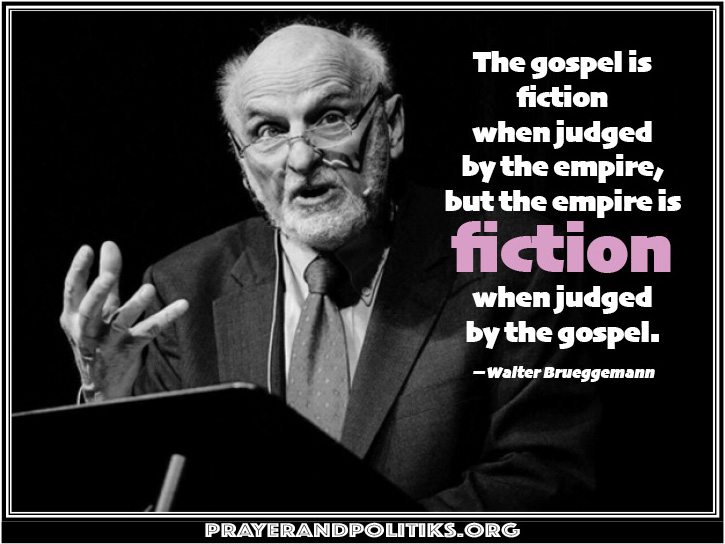
I have dozens of his quotes in my file, and a shelf full of heavily highlighted books of his. Maybe my favorite, most concise sentence from him is: “The gospel is fiction when judged by the empire, but the empire is fiction when judged by the gospel.” His constant theme was that our true doxology is not dissipated in the sanctuary but animated into the heart of a world that has lost its way; that those of us on the Jesus Road are called out—not for conquest or privilege but for truth-telling, standing alongside the belittled and the besmirched, getting up in the faces of the exploiters, pestering them for however long it takes. And standing firm against the repercussions, which are sure to come.

I can imagine Brueggemann asking Jerry Lee Lewis for a private concert, with red Pentecost streamers flying in the wind and actual flaming tongues darting about and festal joy erupting in the aisles. And then he suddenly hits the pause button, turns around, cupping his hands around his mouth and, with an indomitable voice repeating the psalmist’s assurance to those of us earth-bound, struggling exiles: “weeping endures for the night, but joy comes in the morning.”

5 June 2025, on the date of Walter Brueggemann’s passing

#  #  #

Feminine images for God in Scripture and tradition

—compiled by Ken Sehested

Language matters

  • “El Shaddai” is one of several “names” given to God in Scripture. El Shaddai is a feminine noun, which can be translated “God of the breast,” conveying the quality of nourishing, satisfying and supplying needs. It is used seven times in Scripture (see Genesis 17:1).
  • The English translation of “El Shaddai” as “God Almighty” is misleading, because “almighty” suggests omnipotence, the capacity to overpower or destroy. Whereas “Shaddai” infers sufficiency and nourishment (i.e., “blessings of the breasts and of the womb”) and implies a certain fecundity.
  • Also in Hebrew, the divine presence(“Shekhinah”) of God is feminine.
  • From the word “womb” (rehem) comes the verb “to have compassion” (raham), and the phrase “Yahweh’s compassionate (rahum) and gracious” repeatedly appears in the Hebrew scripture to describe the merciful and saving acts of God in history.

Biblical texts

  • Deut 32:18; Ps 90:2; Prov 8:24-25; Isa 43:1,7,15; 44:2, 24; 45:9, 11; 51:13; 54:5 – The Creator God of Israel is also imaged as the shaper, maker and mother God who formed Israel in the womb and birthed Israel with labor pains. 
  • Deut 4:31; 2 Chr 30:9;  Neh 9:17; Ps 78:38; 86:16; 103:8; 111:4; 112:4; 145:8; John 4:7 – images of God who demonstrates “womb–like compassion” for her child Israel.
  • Exodus 33:19 and 34:6 – In Hebrew the words for “compassion” and “womb” derive from the same root. God of compassion use the Hebrew word “rehem” which can be translated “womb-love.
  • Num 11:12 – “Was it I who conceived all this people, was it I who gave them birth that you should say to me, carry them in your bosom like a nurse with a baby at the breast?”
  • Prov 7-9 –“Wisdom” (“Sophia”) who was present before the foundations of the world were created; and announces (Prov 1) Heaven’s judgment on “scoffers” and “fools.”
  • John 7: 38 – From his breast shall flow the fountains of living water.
  • Gen 1:2 – God as a nesting mother.
  • Is 42:14 [Thus says the Lord], “For a long time I have held my peace; I have kept still and restrained myself; now I will cry out like a woman in labor; I will gasp and pant.”
  • Ex 19:4 & Deut 32 :1-12 – God as a mother eagle.
  • Hos 13:8 – “I will fall upon them like a bear robbed of her cubs.”
  • Ps 17:8, 36:7, 57:1, 61:4 – Refuge in “the shadow of [God’s] wings.”
  • Job 38:28-29 – “Has the rain a father, or who has begotten the drops of dew? From whose womb did the ice come forth, and who has given birth to the hoarfrost of heaven?”
  • Luke 15:8 – A woman tirelessly sweeping for her lost coin, for what is important to her.
  • Luke 13: 34 (Matt 23:37) – “How often I desired to gather your children together as a hen gathers her brood under her wings.”
  • Gen 2:7, Ps 104: 29; John 3:8 – “Ruah” presence gives life; feminine Hebrew word meaning breath, wind, inspiration or spirit.
  • Gen 3:21 – God as a seamstress.
  • Isaiah 66:13 – “As a mother comforts her child, so I will comfort you.”)
  • Isa 4:4, Ps 51:7 – God as a washerwoman.
  • Ps 22:9-11, Ps 71:6; Isa 66:9 – God as a midwife.
  • Matt 13:33 – God as a woman baking bread.

 A few post-biblical texts

  • Clement of Alexander (c.150 – c. 215 CE) spoke of Christ as the breast of God supplying the milk of love.
  • “Just as God is our Father, so God is also our Mother.” And also, “The mother can give her child to suck of her milk, but our precious Mother Jesus can feed us with himself, and does, most courteously and most tenderly, with the blessed sacrament, which is the precious food of true life. . . .” —Julian of Norwich (1342–1416)
  • “We are all meant to be mothers of God.” —Meister Eckhart, 13th century mystic
  • “A mother is one to whom you hurry when you are troubled.” —Emily Dickinson

  • “In the divine economy it is not the feminine person who remains hidden and at home. She is God in the world, moving, stirring up, revealing, interceding. It is she who calls out, sanctifies, and animates the church. Hers is the water of the one baptism. The debt of sin is wiped away by her. She is the life-giver who raises men [sic] from the dead with the life of the coming age. Jesus himself left the earth so that she, the intercessor, might come.” — Jay G. Williams, “Yahweh, Women and the Trinity,” Theology Today 32 (1975) 240.

  • “You, beloved daughters, serve as reminders / that life cannot be had on the cheap; / that every new future foreseen in joy / will endure all tearful failures; that strength / of hand and valiance of heart must be / coupled with wombish welcome to that / unnameable (and thus unmanageable) / Promise that death’s ascendance will / be crushed. / Such vision persists; such milk flows; / and by it we are kept from perishing.” —Ken Sehested, “On the flow of tears

Eastertide –The outing of the church

Ken Sehested

Invocation. “Satan, we’re gonna tear / Your kingdom down (Lord, Jesu’) / Oh, Satan, we’re gonna tear / Your Kingdom down (oh Yes) / You’ve been building your kingdom / All over the land / Satan, we’re gonna tear / Your kingdom down, down (yes).” —“Satan, We’re Gonna’ Tear Your Kingdom Down,” Shirley Caesar and The Young People’s Institutional Choir of Brooklyn

§  §  §

We have entered Eastertide, the liturgical season beginning with Easter and ending 50 days later on Pentecost (aka Whitsunday). The formulation of this season parallels the period in Judaism between the first day of Pesach (Passover, marking their liberation from Egypt) and the feast of Shavu’ot (Feast of Weeks, both a harvest festival and a commemoration of the giving of Torah at Mount Sinai). Parallel resurrection moments, setting the stage for resulting resurrection movements.

Freedom’s announcement is not a spectator sport. Neither the parting of the sea, nor the rolling of tombstone, is part of some kind of divine service economy. God is not a personal attendant, working for tips (aka piety). God is the Ringleader, the Chief Inciter of the rebellion against the reign of every cruel and merciless force.

There is no resurrection by proxy.* It’s a bet your assets kind of involvement. The baptismal waters are troubled and troublesome.

Eastertide was the period when the early followers of Jesus were forced to recalibrate their messianic expectations. Good Friday’s execution was a crushing blow to their hopes. Despite Jesus’ repeated teachings to the contrary, the apostles still presumed Jesus would be the leader of a divinely-inaugurated coup d’état that would expel Roman occupiers and restore King David’s regal dynasty.

Hadn’t the Hebrew prophets predicted this messianic outcome—confirmed in Matthew’s and Luke’s birth narratives?

We, even today, are not exempt from the same kind of disorientation caused by the resurrection’s disarranging announcement.

Eastertide as cognitive dissonance

Eastertide is the season for Jesus’ followers to undergo a complete reimagining of the nature of power. It demands a decolonization of the mind and a regeneration of the heart: conception, conviction, and practice operating in tandem, each shaping, correcting, and reinforcing the other. A certain deconstruction is at work, and it is often discomfiting, for we are being stretched and refitted to become suitable couriers of the news that is disturbing before it is good.

Near the very end of Luke’s Gospel, the text records this odd command from Jesus as he prepares to end his resurrectionary appearances to ascend to the Abba.

“I am going to send you what my Father has promised [i.e., the paraclete or Holy Spirit]; but stay in the city until you have been clothed with power from on high” (24:49, emphasis added).

Before the community of the resurrection could mobilize, before its power could be unleashed, it first had to undergo formation and instruction—something parallel to the Israelites’ confused wandering prior to receiving the Torah at Mt. Sinai.

Why? Because cognitive dissonance—the attempt to hold on to two opposing ideas at the same time—is a very real thing. One conviction has your heart (which means, in biblical terms, your pocketbook); the other is just for public relations.

Former Senate Majority Trent Lott, a faithful, lifetime Southern Baptist, was asked in 2004 about the breaking news of brutal torturing of Arab prisoners at Abu Ghraib prison. He responded, “This is not Sunday school . . . this is rough stuff.” The Jesus story largely has no real traction in public life. As that line in Greg Brown’s song puts it,  “Oh, Lord, I’ve made you a place in my heart, and I hope that you leave it alone.”

Two decades before, in the U.S. Supreme Court’s Lynch v. Donnelly decision, Chief Justice Warren Burger ruled that a city-sponsored Christmas nativity display is “a passive symbol,” that it “engenders a friendly community spirit,” and “serves the commercial interests” of merchants. I can think of no greater expression of disdain for the “high calling” by which we set our compasses.

The judicatory reign of worldly dominion will never voluntarily cede its sovereignty. Which is why the colonial Massachusetts Bay Colony authorities judged a dissenter like Roger Williams as an “incendiary of the commonwealth.”

Eastertide as reorientation

In “the world” (the warped and disordered affliction of Creation), we are constantly being offered counterfeit assurances: You get what you deserve; you are what you own; the strong take what they can, the weak suffer what they must; only the strong survive; eat or be eaten. The assertions of the Beatitudes are contradicted at every turn: the poor are shamed; the mourners, taunted; the meek, mocked; the merciful, victimized; the peacemakers, disparaged.

The thing that must be rectified before power “from on high” (i.e., not susceptible to manipulative human authority) can be granted, the discrepancy between what our eyes have been trained to see, our ears schooled to hear, must be tutored. Our minds, says the Apostle, must be “righted.”

In other words, we have been brainwashed. Or to use another metaphor: Before we can comprehend the beatific vision by which we have been called, the contorted neural pathways in our brains need to be disentangled in order to see where the Spirit is breaking out, to hear what the Spirit’s is declaring, to comprehend our marching orders.

As Mark Twain put it, “You can’t depend on your eyes when your imagination is out of focus.”

Like all of the church’s liturgical seasons, Eastertide is not one and done. As with the formation of our faith, we learn bit by bit, by repetitive effort, a process that is not characterized by gallant effort as by perseverance.

In Luke’s story, after Jesus was baptized, the Divine Breath descended on him “as a dove” and as a “voice from heaven.” Then the text offers a lengthy genealogy, tracing Jesus’ lineage and career back to Creation’s story of origin. In his storyline, something distinctive is occurring; but it is not novel. The narrative traces back to “in the beginning,” when the first Breath of God “swept over the face of the waters.”

After that came the desert’s confirmation class, where assumptions about power were clarified. The wilderness was his catechesis. Not until those lessons were learned was Jesus’ anointment completed with his being “filled with the power of the spirit”—a power contradicting every earthly supremacist claim.

That indwelling led to Jesus’ inaugural sermon. The congregation’s initial response was admiration over a hometown boy made good, who recited venerated lines from the revered Prophet Isaiah. In his commentary, however—in bringing the text to bear on history’s context—Jesus veered from assumed Israel-first piety by telling a story of God’s privileging the needs of those in sh*thole countries. Hearing that, the crowd’s mood got ugly, and they were “filled with rage.” It was an affront—then as now—to hear that being chosen does not entail exclusive claim to Heaven’s affection.

Pentecostal preparation

Eastertide is the season when we learn to tell a different story about a different configuration of power, inside out, upside down, the envisioning of a commonwealth that flips the script of every predatory claim of entitlement. Jesus’ lordship upends and overthrows lording of every sort.

Pentecost is when we take Easter to the streets, and the streets are still mean. But the Apostles’ power—with the granting of fiery nerve and inspired breath upon earth’s turbid disorder—inaugurates the Spirit’s incursion against every affront to Creation’s intent and the Beloved Community’s surety.

Eastertide’s preparation is for the Spirit’s outing of the church at Pentecost. There will be scandal; indeed, the world’s current innkeepers will declare “no room” and will demand that we keep our noses out of its business.

The Way of the Cross still leads home, sisters and brothers; but we are not left bereft. Attend to Eastertide’s tutoring. The tomb’s seal has been broken. The Comforter is present to sustain, to animate, to inform, and to incite the little flock of Jesus—not for exclusionary claim to the Beloved’s deference but for extravagant announcement of Mercy’s mending power, restoring the maimed and shamed (and all who find no “home” in the world’s present ordering), readying the table of refuge and bounty for the age to come.

Alas, sorrow’s governance remains. In the ordinary days that follow in the wake of Pentecost’s tide, the names of additional martyrs will be added to our All Saints’ Day recitals. The rule of terror continues, by state and statute and commercial decree and xenophobic clamor. Zion’s true songs of praise are heard as threat since angels’ good tidings and joy’s insurgence cannot be brokered or patented or rationed.

If left to our own resolve, the weight of woe would overwhelm even the strongest. But the Spirit has smuggled provisions through enemy lines. The attentive will spot clues of their whereabouts. The virtue of hope and the victual of sustenance have been readied. The supply chain, though constantly harried, has not been broken.

The facts on the ground do not have the last word, though this cannot be verified by existing calculus. Cheating death is what we do—not by means of moral heroism but because joy’s embrace is more resilient than grief’s restraint.

Be joyful, friends, though you have considered the facts.** Come out, you Little Flock of Jesus. Be seen. Pitch your tent in compassionate proximity to the disdained. Let them evangelize you. In learning their names you will discover your own; and from their voices, discern what needs doing.

Be converted; be commissioned. The high prize awaits.

§  §  §

Benediction. “Christos Anesti (Χριστὸς ἀνέστη).” —Greek Orthodox Easter Chant of Resurrection, sung joyfully during Pascha [Resurrection Sunday] to proclaim Christ’s resurrection

*the phrase is from Vincent Harding
**line from Wendell Berry

#  #  #