Resilience Mojo for the Bonobo Year

A bleak midwinter sermon

by Abigail Hastings
Text: Jeremiah 31:31-34

I bring greetings from my home church, Judson Memorial in New York City, a sister Alliance and UCC church with deep Baptist roots as it’s a memorial to Adoniram Judson, missionary to Burma in the early 1800s. One thing I love about Judson is that it’s always full of surprises—always swimming upstream with the unexpected. I was at a church last month that had a humongous cross up front that reminded me of the 18-footer we had at Judson over 50 years ago. Then we decided it was more authentic to desacralize the space, to recognize the deep marriage of sacred and secular when you see it embodied, literally for example, in our space with the dancers and artists of the time (Judson is generally regarded as the birthplace of postmodern dance). So in that tradition of “guess what we’re doing now?” — Judson’s been having Bible study, ya’ll!

And not the easy parts—we’ve been muckin’ around with major and minor prophets, and recently studied today’s passage, Jeremiah 31. It’s a familiar prophetic playbook: basically, clean up your act, O Israel, or Yahweh will go elsewhere. What the Lord required was pretty basic: treat others fairly, don’t exploit the stranger, the orphan and widow, don’t shed innocent blood, and knock off following other gods.[1]

Read more ›

When grief sits with you

A call to worship

by Abigail Hastings

The poet Ellen Bass talks about
when grief sits with you, “an obesity of grief,”
and asks, 
            How can a body withstand this?

“Then you hold life like a face,” she instructs us—
“and you say, yes, I will take you
I will love you, again.”

Read more ›

News, views, notes, and quotes

Signs of the Times  •  21 January 2016  •  No. 55

Processional.Africa,” by Toto, by the Angel City Chorale, which begins with hand percussion mimicking a passing thunderstorm. (Thanks, Naomi and Geoff.)

Invocation. “Fill my heart with song and / Let me sing for ever more / You are all I long for / All I worship and adore.” —7-year-old Angelina Jordan, from Norway, singing “Fly Me to the Moon

Read more ›

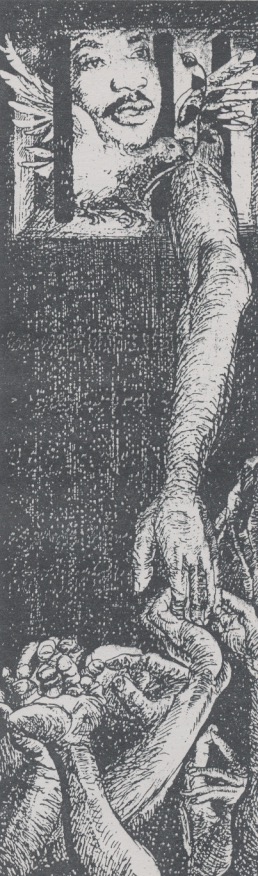
When the Wine Runs Out

Sermon on Martin Luther King Jr.’s birthday

by Nancy Hastings Sehested
Text: John 2:1-11, the wedding at Cana

It was Martin Luther King Jr. weekend and I was preaching at the prison. There was a shortage of officers that day, so I was on my own with 70 inmates for the worship service.

All was going well. The choir singing. The prisoners praying. The chaplain preaching. The gang members whispering.

Read more ›

Mercy’s requite

A litany for worship inspired by Jeremiah 1:4-10 & Psalm 71

“I am but a child!” you say.
“What business do you have with people of no claim,
of no clout, of no clue about the road to repentance
and the return from exile?”

Aahh, O clueless one, of no claim and no clout,
you know not that of which you speak!
Before your mother’s maiden life, I knew you;
before your father’s toddling feet,
I planned your sinews and mapped your countenance.

O child of consecrated lips and covenant voice,
      relinquish your fear!
            You shall not be put to shame.
                  Your Refuge is secure.
It is you, O child of destined grace,
      who will utter the Word that will shatter all enmity.

Read more ›

Realm of earth, rule of Heaven

Bodified faith and environmental activism

by Ken Sehested

        The greatest failure in the history of Christian thought is the separation of souls from bodies, spirit from soil, the wrenching of hearts from habitation—all representing the abdication of the realm of earth from the rule of Heaven. It is the great anthropomorphic heresy: that redemption is for humans alone, and then only for some ethereal essence: no bodies, no biology, no hills or dales, neither minnows nor whales.

        As Tom McMillan has noted, for 200 years we've been conquering nature. Now we're beating it to death. To be saved we must cultivate a bodified faith.

Read more ›

News, views, notes, and quotes

Signs of the Times  •  14 January 2016  •  No. 54

Processional.Wana Baraka,”  by The Festival Singers of Florida. This popular Kenyan religious song expresses a message similar to that of Psalm 128: “They have blessings (and, in subsequent verses, “peace,” “joy,” and “well-being”), those who pray.”
Right: Photo by Alexey Kljatov. See more of Kljatov’s macro photos of snowflakes’ impeccable designs.

Invocation. “Who is this Christ, who interferes in everything?” —Rainer Maria Rilke

Read more ›

Faithful Witness

The testimony of Scripture and of Martin Luther King Jr.

Peace through nonviolent means is neither absurd nor unattainable. All other methods have failed. Thus we must begin anew.

Then justice will dwell in the wilderness, and righteousness abide in the fruitful field. And the effect of righteousness will be peace. . . .” —Isaiah 32:16-17

The ultimate weakness of violence is that it is a descending spiral, begetting the very thing it seeks to destroy. Instead of diminishing evil, it multiplies it. Through violence you murder the hater, but you do not murder hate. In fact, violence merely increases hate.

Read more ›

Blessed intention

A litany for worship inspired by Psalm 19

by Ken Sehested

Throw off the covers of earth’s darkened slumber! Unplug your ears, you creatures of flesh! From deepest sigh of tear-stained eye, set your sight on Heaven’s resolve.

For the sky’s bright luster, alive with motion, shows the wonder of Blessed intention.

Read more ›

News, views, notes, and quotes

Signs of the Times  •  7 January 2016  •  No. 53

Processional. Berzeit University (Ramallah, Palestine) performing the Palestinian Dabka folk dance. (58 seconds) (Thanks, David.)

Right: A ring of fire—the aurora borealis (“northern lights”) as photographed from a NASA satellite. It is caused by the interaction of charged particles from the sun with atoms in the upper atmosphere.

Invocation. “To be hopeful in bad times . . . is based on the fact that human history is a history not only of cruelty, but also of compassion, sacrifice, courage, kindness. What we choose to emphasize in this complex history will determine our lives. If we see only the worst, it destroys our capacity to do something. If we remember those times and places — and there are so many — where people have behaved magnificently, this gives us the energy to act, and at least the possibility of sending this spinning top of a world in a different direction.” —Howard Zinn, “You Can't Be Neutral on a Moving Train: A personal history of our times”

Read more ›