This unpublished paper was drafted in 1992 in preparation for the Baptist Peace Fellowship board of directors’ consideration of several projects related to US-Cuba relations. Though dated, this material nevertheless provides useful background information related to the topic, including the thaw in church-state relations in Cuba.
by Ken Sehested
During a recent flight I took out the airline magazine to look at the map. Just before returning it to the seat pocket, something on the map jumped out at me. My eyes had wandered down through the Caribbean, especially the strong of Lesser Antilles islands, many of whose names serve as Columbian memorials to so many saints. (Who were those guys?) And there were the larger islands: Puerto Rico, the world’s oldest colony. (It’s still under U.S. “protectorate” status.) There’s Hispaniola, cohabited by the Dominican Republic and Haiti (site of the first successful African slave revolt and much in the news of late); the Bahamas; and . . .
It wasn’t immediately evident, but the anomaly finally dawned on me: the biggest island (by far) wasn’t even named. On a map.
A capitalist, imperialist conspiracy? Well, no. Further scrutiny revealed that all locations named on the map corresponded to scheduled flight destinations of this particular airline. A logical explanation—no evidence of pernicious intent. Just the impersonal logic of an economic order which measures the common good in quantities of consumer goods.
This casual anecdote, triggered by traveler’s boredom, is revelatory. It serves as a fitting metaphor for our generation’s perception of Cuba. It is there but not named. It is known but not acknowledged. Like medieval European maps which inscribed “Here Be Dragons” in that space beyond the edges of the known world.
Here Be Dragons is an appropriate mythological metaphor for the U.S. public’s image of our nearest offshore neighbor. Preoccupation with Cuba was a terrifying experience barely a generation ago. One result of the terror—both shaping and being shaped by U.S. foreign policy—was the locking of public perceptions in a time warp.
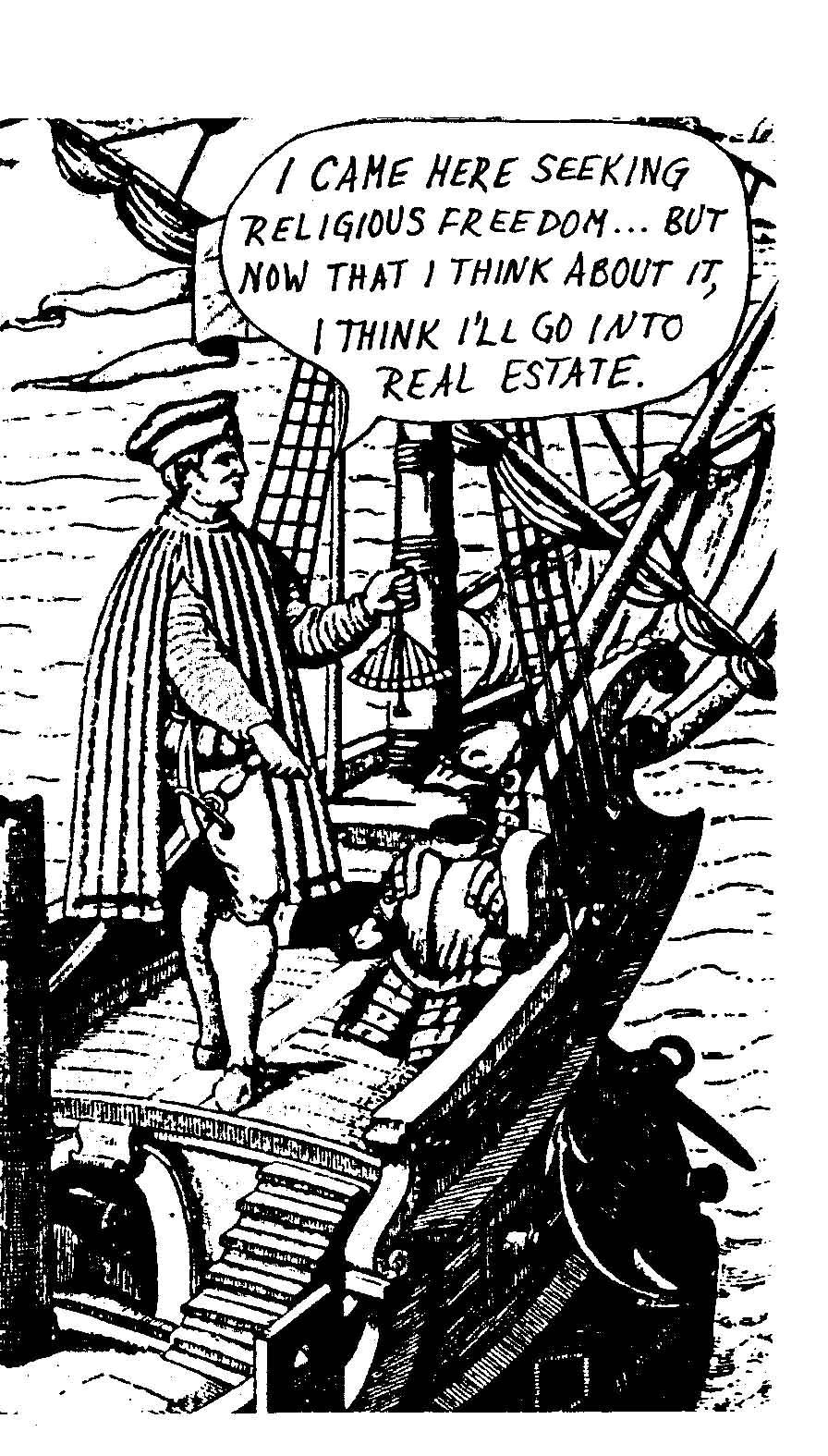
Rarely have perceptions and realities been so out of sync. But there is historical precedent: It was while anchored off the shores of what we now call Cuba that Columbus, in his second voyage to the Americas, required the men under his command to sign an oath swearing that this land mass was a peninsula of Asia. Commenting on this incident, one biographer notes “Columbus has reached the limits of the imagination and could no longer distinguish it from reality.”
Similarly, to paraphrase, I would argue that the U.S. has reached the limits of imagination and can no longer distinguish it from reality. We, too, attributed this land mass to Asia, inasmuch as the Soviet empire stretched from the reaches of the East to the Western Hemisphere.
Why? For at least three reasons. First, a long-standing impulse in U.S. foreign policy to maintain control over the affairs of all the Americas. Second, a trade, travel and communication embargo (verging on a blockade) which radically constricts information and thus deforms public opinion. And, third, a huge and powerful Cuban-American lobby—wielding power out of proportion to its actual constituency—intent on turning back the clock to the days when Havana was known as “America’s playground” and was frequented by people like Robert Redford’s character in the commercial film named after the city.
The initial reason for my own increased attention to Cuba is personal. My first encounter with a citizen of Cuba was with Rev. Raúl Suárez, past president of the Ecumenical Council of Cuba, whose congregation, Ebenezer Baptist in Havana, houses the ecumenically-sponsored Martin Luther King Center. We came in contact as a result of correspondence with members of the Coordinación Obrero Estudiantil Bautista de Cuba, an ad hoc Baptist peace and justice network. Our first face-to-face meeting came during his 1985 trip to the U.S. Near the end of our conversation (which includes his quoting from memory long passage from the writing of Dr. Martin Luther King Jr.), he said: “I know for you [in the U.S.] that the prospect of nuclear war is a very serious preoccupation. It is a very serious issue. But you must remember that, for those of us in Latin America, the war began in 1492.”
My own ignorance and innocence was more fully exposed during a 1991 visit to Cuba with a delegation from the Progressive National Baptist Convention, an African-American Baptist body in the U.S., which recently established formal relationships with a Baptist Convention in Cuba.
I was assigned the task of preaching in a Saturday night service at William Carey Baptist Church in Havana. It was an experience I shall never forget. The modest sanctuary was packed, with the standing-room-only crowd spilling out from the doorways into the adjoining hallway. Cuban television and print media were present, filming and recording the service. Prior to the start, each member of the delegation was hustled into corners for interviews.
Traditionally, the sermon is the focal point for Baptist services. But before I rose to speak, the national chorale of Cuba rose to sing several selections, all but one of them spirituals from the African-American church tradition. Here was the state-supported choir of an officially atheistic country singing gospel tunes as if they had each been reared in Ebenezer Baptist Church in Atlanta, Georgia! The next day clips from the service and our interviews were seen on Cuban television. Several in our delegation were recognized—and applauded—when the broadcast appeared in a hotel shop where we were browsing.
The point of this article is this: It is time for the progressive movement in the US to devote significant attention to US-Cuba relations? With the exception of a handful of patient but vigilant Cuba solidarity groups, most have given only passing attention to this issue. The “wall” has fallen in Europe. It’s time to bring it down in the Caribbean.
To consider the point, ponder these three premises:
First, U.S.-Cuba relations, presently locked in a spiral of political animosity, are emerging as a vortex of U.S. foreign policy considerations. While never forgotten, Cuba has for 30 years been mostly a diplomatic sideshow.
Second, there are emerging hints of hope—both in the U.S. and in Cuba—which the rust jamming this political lock may be loosening. Certainly not during the 1992 election frenzy. And maybe not for several years to come. Despite the very real obstacles to rapprochement, it’s time to get ready for that ripe moment.
Third, an unusual flurry of activity focused on U.S.-Cuba relations has begun within progressive organizations in the U.S. Numerous groups, independently of each other, have come to similar conclusions about Cuba’s growing significance.
Evidence of growing significance
There are multiple reasons for the heightened significance of Cuba as a major agenda item for the progressive movement.
1. Cuba is becoming a focal point of U.S. foreign policy. Long a frustrating nuisance to the hegemony of U.S. influence in the Western Hemisphere, Cuba has now lost the counter-balance of Warsaw Pact backing. Provocations could easily be engineered, allowing pent-up hostility in the U.S. to overflow. To illustrate: Presidential candidate Pat Buchanan, in a recent campaign speech, baldly claimed “Fidel Castro would not survive a Buchanan presidency.” President [H.W.] Bush has made similarly inflammatory remarks. Earlier, after the demise of the Sandinistas in Nicaragua and the “successful” U.S. invasion of Panama, U.S. State Department spokesperson Margaret Tutwiler quipped: “Two down and one to go.” The unspoken reference was not hard to miss. Increasingly, Cuba looks like easy pickings. Few places in the world would offer as much domestic political support for over or covert interference. (Though the former is not likely, it cannot be ruled out.) And we already have a military base on Cuban soil.
2. Cuba can be viewed as a prism of U.S. foreign policy. Understanding the historical relations between the U.S. and Cuba opens the door to understanding U.S. foreign policy more generally. Nicaragua was such a prism in the ‘802. Progressive movements gave an inordinate amount of attention to Nicaragua not because there was quantitatively greater suffering than in other places; but because it provided an effective lens for seeing and understanding U.S. foreign policy generally.
3. It is evident that the Cuban economy is in severe trouble. The country’s financial crisis has been triggered by the loss of traditional trading partners and sources of aid from the former Soviet Union and their Eastern European allies. Soon after those alliances were formed, the Cubans, encouraged by the Soviets, chose to maintain high levels of export crops (especially sugar cane) as barter for other essentials, rather than develop its own self-sufficient agricultural economy. Terms of such bartered trade were set independently of world market prices. The resulting collapse of this artificial arrangement has left Cuba in the lurch, without the capacity to trade sugar for oil, and to do so at favorable rates. The result is, in effect, a double embargo.
Almost overnight Cuba has gone from annual consumption of 13 million tons of petroleum to five million tons. Shortages of basic necessities are a new phenomenon; and such shortages make the political landscape fertile for increased internal dissent and resulting political crackdown—both reactions stemming from bare survival instincts.
4. It is hard to overestimate the widespread ignorance of Cuban affairs in the U.S. On top of the generally hostile political posture of U.S. authorities, the usual mechanisms of communication between citizens are severely constructed by the ongoing trade, communication and travel embargo. For instance, AT&T calculates that some 60 million calls are attempted from the U.S. to Cuba each year. Of these, less than one percent—500,000—gets through. Earlier this year the Bush Administration announced it would allow the installation of an upgraded telecommunications system. But Cuba balked when the terms were disclosed—minimal improvement in terms of volume of calls and payment escrowed in a U.S. account (in compliance with the embargo).
The general media image of Cuba is a photo of Castro, clad in military fatigues and untrimmed beard, with face contorted in what looks like a scream. When was the last time you saw a photo of him smiling? And the fact is, Castro has long since quit smoking cigars. After my 1991 trip to Cuba, I took an informal poll with people here to ask if they knew anything about an economic embargo against Cuba. Most could remember having heard something about it, somewhere, sometime. Not a single person knew it was still in effect.
Evidence supporting political optimism
Though I do not suggest that a thaw in our relations with Cuba is underway, there are several indicators suggesting that some open space is being created. These represent small but potentially significant shifts, both in the U.S. and in Cuba.
1. The political opening symbolized by the dismantling of the Berlin Wall in Germany provides a precedent and momentum of its own. Many of the structures, institutions and thought patterns of the Cold War are beginning to unravel. Now it’s time for another wall to fall, this time in the Caribbean.
2. Every rationale given by the U.S. for the embargo has now been satisfied. During arguments in a 1983 Supreme Court case challenging the travel restrictions of U.S. citizens, the Administration stipulated three grievances against Cuba: (a) that it was an outpost for the Soviet Union; (b) that it was supporting revolution in Third World countries; and (c) that it’s army’s presence was a threat in southern Africa. Each of these grievances has irrefutably been removed. According to our government’s own criteria, there no longer exists any foreign policy rationale for the embargo. Even mainstream figures like former Secretary of Defense Robert McNamara are calling for a new posture. After a recent conference in Cuba, where scholars and key players on both sides of the 1962 Cuban missile crisis met to compare notes, McNamara went out of his way to note that Cuba should no longer be considered a threat to the security of the U.S. Moreover, Cuba was strangely absent from the recently-announced Pentagon assessment of seven potential global hot-spots.
3. Although the virulently anti-communist Cuban American lobby is still a powerful force in U.S. politics (indeed, it impacts many domestic elections), the generational effect is beginning to show. The emotionally-charged experiences of that generation of Cubans who fled the revolutionary movement in Cuba are starting to fade. The second generation may still be opposed to Castro, but usually not with the same ferocity. Lacking the first-hand historical memories of their parents, they are open to less emotive analysis and to more pragmatic solutions. It’s also becoming evident that the passionate, personalized hatred for Castro (for instance, within the politically powerful Cuban American National Foundation) is not shared by the larger Cuban American community. Alternative voices are beginning to emerge.
4. The same demographic force is affecting the general population. In February the results of a very significant poll on U.S. citizens’ attitudes about Cuba were released. A collaboration by two polling firms (with respective ties to the Republican and Democratic Parties), commissioned by the Commission on United States-Latin American Relations, indicated that “Americans no longer see Cuba as a security threat and are willing to consider closer ties to the Castro regime. . . . Nearly two-thirds (63%) of those surveyed no longer view Cuba as a serious threat to the U.S. . . .”
Several factors within Cuba are also forcing the consideration of new policies.
5. The sheer weight of economic forces is pressing the Cuban government beyond its rigid political and economic policies. In recent years Cuba has gingerly experimented with venture capital partnerships with foreign companies (e.g., promoting tourism, oil exploration, etc.). During a recent meeting with religious leaders, Cuba’s ambassador to the U.N. freely admitted that his country’s economic crisis was forcing it to become more pragmatic in economic policy.
6. The country’s political system is also subject to forces of change. At present, neighborhood representatives are elected by popular vote. These representatives then select provincial representatives, who in turn elect the members of the country’s top ruling body, the National Assembly of People’s Power. A proposed change would have the National Assembly directly elected by popular vote.
Clearly, the country is still a one-party state and exhibits the highly centralized, bureaucratized features of such systems. Yet in 1990, in an implicit recognition of such weaknesses, it began a program of “rectification” in the attempt to confront encrusted habits of lethargy, corruption and lack of motivation by public servants.
7. Nowhere is Cuba’s emerging future more dramatic than in the area of church-state relations. (Though it should be noted that church attendance figures are the same now as before the revolution.) {Author’s 11.3.06 insertion: Shortly after the writing of this paper, news began to surface of dramatic growth in Cuba’s Christian community.} Symbolically, the change was dramatically illustrated by the October 1991 vote of the Communist Party to admit creyentes (“believers”) to Party membership for the first time. {Author’s 11.3.06 insertion: About one year later, Rev. Raúl Suárez, mentioned earlier in this article, was the first Christian so selected.} Conceivably, Christian identity in Cuba has begun to heal from its original planting, when the cross of Christ came forged as a sword.
Bartolomé de las Casas, a Spanish priest who witnessed and wrote about the atrocities of the conquistadors, tells the story of Hatuey, a resistance leader of the Taino people, who was captured by the Spanish in what is now Cuba. He was sentenced to be burned at the stake.
As Hatuey was bound to the stake and surrounded by brush, a Spanish friar attempted to covert this first Cuban national hero. The friar explained to him about conversion and baptism, noting the options of eternity spent either in heaven or hell. When offered the opportunity of baptism (to save his soul, not his skin), Hautey asked for time to think it over.
Finally, he responded, requesting final clarification: “And the baptized, where do they go after death?”
“To heaven,” said the friar.”
“And the Spanish, where do they go?”
“If baptized,” the friar answered, “to heaven, of course.”
After weighing his decision, Hautey concluded: “Then I don’t want to go there. Don’t baptize me. I prefer to go to hell.”
In revolutionary Cuba, the shift from policy deeply antithetical to religion to one at least cautiously tolerant of religious institutions has its roots in Castro’s awareness of the Sandinista revolution in Nicaragua that overthrew the Somoza regime. (Few U.S. citizens know that the U.S. installed the father and son Somoza dynasty that ruled Nicaragua from 1936-1979; or that U.S. Marines had earlier invaded and occupied the country: in 1909, 1912 and again in 1926.)
Unique to the Sandinista coalition was the active presence of Christians. Maybe for the first time in Latin American history, leading Christian voices were allied against, rather than with, the rule of repressive elites. In 1984 Castro made his first trip (since childhood) to church, as a courtesy to Rev. Jesse Jackson, who was preaching during his visit to Cuba on the anniversary of Dr. Martin Luther King Jr.’s assassination.
Early in 1985 the U.S. Catholic Bishops’ Conference made an historic visit to Cuba, which included a meeting with Castro. Later that year two million copies of Fidel and Religion, a book drawn from extensive interviews with Castro by Frei Betto, were printed and sold by the Cuban government.
In April of 1990 some 70 ecumenical leaders held an unprecedented five-hour conversation with Castro, pressing him especially on the issue of discrimination against Christians. The meeting was taped and broadcast in its entirety on Cuban television. Subsequently, in November, the government granted broadcast rights to Protestants. Most recently, Rev. Raúl Suárez (mentioned earlier) preached the first sermon to be heard on Cuban radio in 28 years. It was broadcast on Christmas Day 1991.
It is obvious that the image of religion held by Cuban authorities is changing. Marx’s comparison of religious faith to an opiate, and Lenin’s postulating atheism as a metaphysical necessity for socialism, have come in for serious questioning. R.J. Suderman, a Canadian Mennonite, reports that in a 1986 interview Castro joking noted “either the church has changed a lot or I’m getting old.” Just this past December, during a similar meeting with religious leaders from across the Americas, Castro is said to have repeated the following comment four different times: “Atheism has been the traitor of the revolution.”
For a country which was never impacted (even prior to the revolution) by the Judeo-Christian heritage the way most of Latin America was, it is curious that its most revered patriot would use a biblical metaphor in describing his vision. In a letter to a friend just before being killed in 1895, shortly after the outbreak of Cuba’s independence struggle against Spain, José Marti wrote a line still in circulation in Cuba: Mi Honda es la de David (“My sling is that of David”). In prophetic anticipation of subsequent history, Martí sensed that the real “Goliath” would not be Spain but the United States.
Obstacles to normalized relations
Obstacles to normalization of relations between the U.S. and Cuba are numerous. U.S. rapprochement with the now-named Commonwealth of Independent States (formerly the Soviet Union) has occurred in large measure because of their embracing of market-based economies. While the People’s Republic of China has not followed suit, the market possibilities there are so massive that the U.S. has been willing to swallow principle for the sake of even tiny openings for commerce. {Author’s 11.3.06 insertion: The situation is China is now obviously different.} Short of Castro’s untimely death and massive upheaval in Cuba, there is little prospect of Cuba’s repudiation of basic socialist principles. (Even Castro’s critics, both within and without, admit that he still maintains powerful power loyalty among the majority of Cubans. On the other hand, many of his critics, and some of his supporters, suspect that the strength of his personal charisma is at the same time his greatest weakness. They argue that such domineering leadership will inevitably create a power vacuum, and the risk of political chaos, once he is no longer present.)
I can easily imagine the reaction within our constituency to advocacy for a new U.S. policy on Cuba. Conversations would probably go something like this:
“They’re comanists [as my high school football coach would pronounce it], aren’t they.” Yes, but. . . .
“They don’t get to vote for the party of their choice, do they?” No, but. . . .
“Castro’s run that country into the ground! I saw the pictures of rundown buildings in Havana when they broadcast the Pan American games.” No . . . yes . . . but. . . .
For decades Fidel Castro has been vilified in the U.S., much the way Saddam Hussein has been since last year’s war in the Persian Gulf. Thus, animosity toward all things Cuban (except for their prized—and contraband—cigars and rum) has become part of the cultural atmosphere. It qualifies as a virtually phobia in the average American consciousness. Mention Cuba and rational discourse disappears.
As noted earlier, the formal stipulations for ending the embargo have been met. However, the Bush Administration, reflecting and enhancing popular perceptions, now posit another reason for continued antagonism. It is the issue of human rights in Cuba.
The discussion surrounding this issue tends to be falsely polarized between those who continue to demonize Cuba’s human rights record and those who, in reaction, engage in romanticizing Cuba.
It is true that respected human rights organizations, like Americas Watch and Amnesty International, have documented cases of human rights abuses in Cuba. Through our own sources we are aware that as recently as 1985 a group of Christians was arrested and briefly detained for having a home Bible study group.
On the other hand, it is also true that both Americas Watch and Amnesty International have active files documenting human rights violations in the U.S. And in December 1990 the International Tribunal on Political Prisoners in the U.S. ruled that “within the prison and jails of the U.S. exist substantial numbers of political prisoners.”
The majority of U.S. citizens are unfamiliar with the differing definitions of “human rights” that lie at the root of most such arguments. In the U.S., human rights are conceived in more individualistic terms, such as freedom of personal expression. In addition, multi-party elections are seen as the touchstone of freedom. In Cuba, the human rights emphasis is on social welfare, is conceived in more communal terms, and is more likely to include basic economic factors like health, literacy and employment. There is, in short, a fundamental disagreement over what constitutes proper “quality of life” factors.
Advocacy here on Cuba’s behalf surely must point to this discrepancy and must also underscore Cuba’s enormous gains in areas of economic human rights. But we must move beyond the polarized argument—which means we must refuse to romanticize Cuba. (Many of my own Cuban friends frequently make this statement: Cuba is neither a heaven nor a hell.)
The tendency to romanticize Cuba is itself a dehumanizing impulse. It represents the failure to take seriously the very human project involved in constructing a humane society. Anyone who’s assumed a leadership role in even a small organization knows that the journey to solidarity, even with a self-selecting group, is fraught with difficult decisions and requires choices among uncertain options.
Cuba’s ruling authorities have their own internal contradictions to confront. There are areas where they have not lived up to the founding ideals of their revolution. Needless to say, the same can be said of the U.S.
A parallel story provides some illustration. On a trip to Nicaragua in the mid-‘80s, our delegation spent one evening at a community center run by the Baptist Convention of Nicaragua. The center, located in one of Managua’s barrios, offered classes and training on a variety of topics and trades. This particular evening we held conversations with young people supplementing their high school educations.
The director of the center, who doubled as a Baptist pastor, was openly pro-Sandinista. In no uncertain terms he indicated that he would immediately take up arms should the U.S. directly invade his country. But he was also certain that there were a variety of opinions among the people of Nicaragua with respect to the Sandinista government, and he invited our group to engage in conversation with members of the class.
Most were quite willing to speak freely; and each who spoke expressed opinions supportive of the revolution, though most included in their comments some level of criticism as well. One young man told of discrimination in the army. During his obligatory service his commanding officer had demanded he remove the crucifix he wore around his neck. The rationale given was that such was not proper attire for soldiers, though the young man was convinced that it had more to do with religious discrimination.
After the young man finished telling his story, the center director followed up with his own commentary. Our translator paused long enough to say, “I’m going to translate quite literally here. The director has just said that, ‘Yes, there are some shitheads in our government. We know that and we are trying to change them or get rid of them.’”
All of us know this to be true. No movement, however laudable, has ever been free of “shitheads.” In fact, if honest, most of us know there are times when the term applies to us as well.
Polarized debate over political values always forgets this most basic dynamic: the distinction between revolutionary values and the particular administration of those values. Under the Sandinistas, Nicaragua had its share of “shitheads.” And so does Cuba. Neither heaven nor hell.
Our principal contacts among Cuban Baptists understand this. They are, by and large, very supportive of the values expressed in the Cuban revolution and believe there are significant overlaps between those values and Christian values. They are also critical at several points of the current administration of those values. Because of their support of the former they have been marginalized by the more dominant Baptist institutions in Cuba, whose political vision is typically falls along a spectrum from apolitical to anti-Castro. In this and other ways, the enduring imprint of U.S. mission agencies is easy to see.
The issue of human rights in Cuba is a legitimate one. But the U.S. has consistently used the issue as a cover for its own aggression. Moreover, we have blatantly hypocritical double standards in our application of such judgment. Criticism, on this or any other issue, is only appropriate and effective in a relationship of mutuality and respect. As a nation, we have not yet admitted Cuba’s right to exist, to decide its own future without our interference. Until that happens, discussion of human rights is little more than political manipulation.
Our dream for a new day in U.S.-Cuba relations is that, somehow, an opening could be created that would force both sides to the bargaining table, probably under the auspices of the United Nations, to forge a political agreement that would lead to an easing of tensions, a normalization of diplomatic relations, an end to the U.S. embargo and a lifting on both sides of travel and communications restrictions. This would not resolve all the disagreements between our nations. There are very real and legitimate differences of opinion on social, economic and political issues. But it would provide a means of addressing the conflicts in ways that encourage genuine communication, understanding and respect. These are Gospel values which have potent political relevance in the world at large.
It seems almost a fantasy to imagine such possibilities. Which is why it’s important to recall the truly fantastic political changes that have occurred in very recent days in various parts of the world.
©Ken Sehested @ prayerandpolitiks.org.


 Roman Catholic community to which he was admitted on 13 December 1941 as a postulant at the Abbey of Gethsemani in Kentucky. Few if any figures in Christian history have more effectively rewoven the torn fabric of faith segregating personal from public, salvation from liberation, prayer from politiks. It remains a supreme irony that a monk—especially one vowed to an order known for its discipline of silence—would become at mid-20th century in the US among the most articulate commentators on a host of social concerns, as well as an enduring spiritual guide to generations since, here and elsewhere, among a wildly diverse group of Christians and other people of faith.
 ¶ February is Black History Month in the US. “Unbought and Unbossed. That was the slogan of maverick politician Shirley Chisholm (D-NY), who shattered barriers, spoke her mind, stood up for the disadvantaged, and in 1968 became the first black woman ever elected to Congress. After her election to Congress, Chisholm scored another historic first in 1972 when she declared her candidacy for the Democratic nomination for President.” —US Postal Service, on the issuance of a commemorative stamp in Chisholm’s honor
 Archbishop Oscar Romero of San Salvador, El Salvador, is to be considered a martyr, murdered in odium fidei (Latin for “hatred of faith). This step pushes forward an 18-year process to have Romero named a saint. Romero was assassinated by right-wing death squads while celebrating Mass in March 1980, one day after his radio broadcast sermon calling for soldiers to lay down their guns and end the repressive government’s rule. The Plough Publishing House published The Violence of Love, a marvelous collection of Romero quotes. They also offer a free ebook download and audio book.
 shots of black men at their target shooting range. After an Evangelical Lutheran Church in America (ELCA) Facebook group took up a conversation about this news, a group of ELCA pastors began sending their own photos, in clerical garb, to the police department with the message “Use me instead.”
 ¶ GUNS, GOD, GRITS, and GRAVY. That’s the title of a new book by former Arkansas Gov. Mike Huckabee who may again join the Republican presidential nominee parade. (The more common version of that traditional aphorism is “Guns, God, and Guts and sometimes Glory.”)
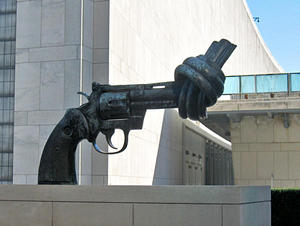 Reuterswärd learned his friend John Lennon had been murdered, he immediately began work on this sculpture, which was purchased by Luxembourg and donated in 1988 to the United Nations.
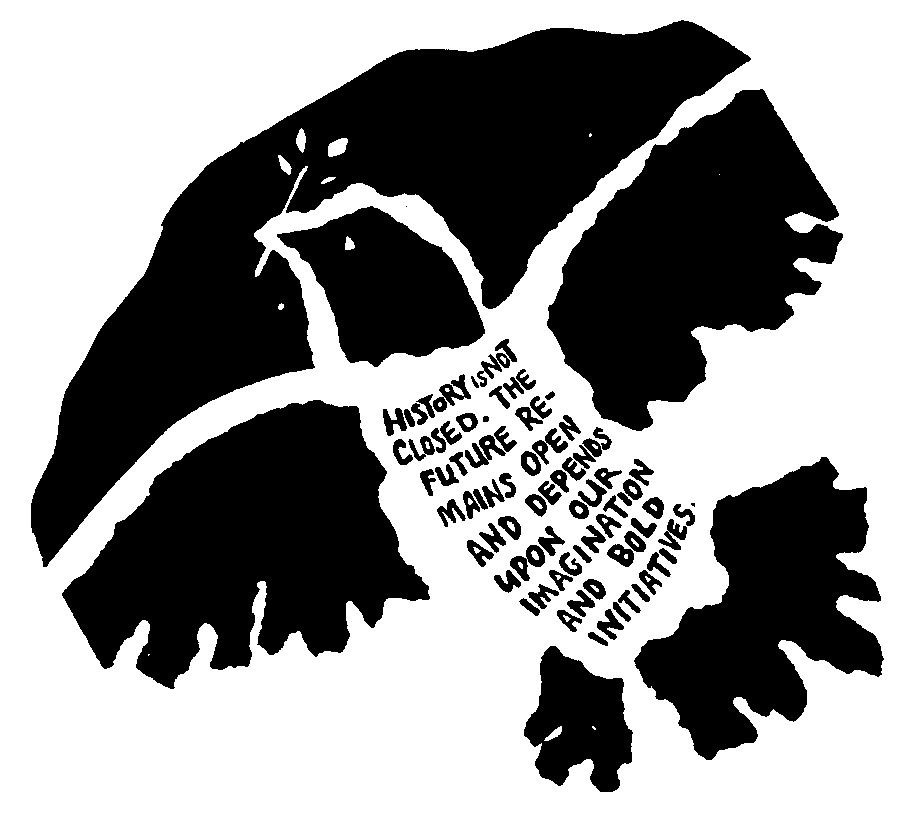 well-known 23 year-old Egyptian activist, who hanged herself last November, sending shockwaves through the dissident community. Mahdi marched in Tahrir Square in 2011 against the dictatorship of Hosni Mubarak (whose government, at the time, received 25 percent of all US foreign aid). A member of the Muslim Brotherhood, she renounced the party’s corruption after its president, Mohamed Morsi, came to power in 2012 following the country’s first democratic election. Then, in July 2013, the Egyptian military overthrew Morsi. (Listen to Ahmad Amar’s haunting “Requiem for Zainab Mahdi”.)
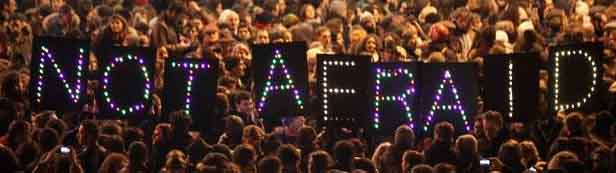 ¶ Though if I were in France I would have been among the 4 million marchers last Sunday, publicly declaring “not afraid,” for principles are not bound by personal preferences.
 fear if we refuse to look, we may never grasp this backdrop of terror which impinges on us still.) In 1908 sending postcards with photos of lynching victims (some with the caption “Wish you were here”) became so common that the US Postmaster banned the cards.
 ¶ Drone terror. “‘Drones [which can hover for hours, even days, over a potential target] may kill relatively few, but they terrify many more,’ Malik Jalal, a tribal leader in North Waziristan, told me. They turned the people into psychiatric patients. The F-16s might be less accurate, but they come and go.” The sound made by Predator and Reaper drones can be heard from the ground like a flat buzzing noise. —Steve Coll, “The Unblinking Stare: The drone war in Pakistan, The New Yorker
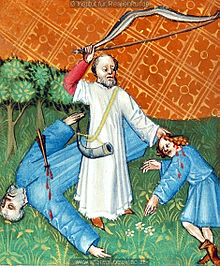 ¶ Arguably the first terrorist threat came from Lamech, sixth generation descendent of Cain (who committed the first murder recorded in Hebrew Scripture): Lamech said to his wives: "Adah and Zillah, hear my voice; you wives of Lamech, listen to what I say: I have killed a man for wounding me, a young man for striking me. If Cain is avenged sevenfold, truly Lamech seventy-sevenfold" (Genesis 4:23-24). Do you see how violence easily becomes a self-perpetuating cycle?
 ISIS’ beheading of 15 people) make this more tolerable?
 legal test. And when the group of prominent African American ministers gathered to discuss what to do, it was Nixon (an “ordinary” layperson) who shamed them into having the courage to go public with the plan.
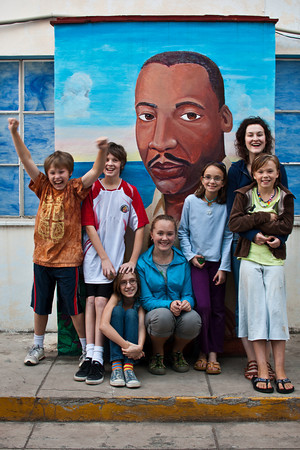 drunken escapade), like Moses (even though he was a murderer), like King David (even though he was both an adulterer and a murderer), and like the Apostle Peter (despite his repeated and cowardly denial of his association with Jesus) and the Apostles John and James (despite their pompous argument over which would occupy the more prestigious seat in the Kingdom of God).
 •The US has spent some $1 trillion in waging this war. (For perspective: A million seconds is 12 days. A billion seconds is not quite 32 years. A trillion seconds is 31,688 years.)
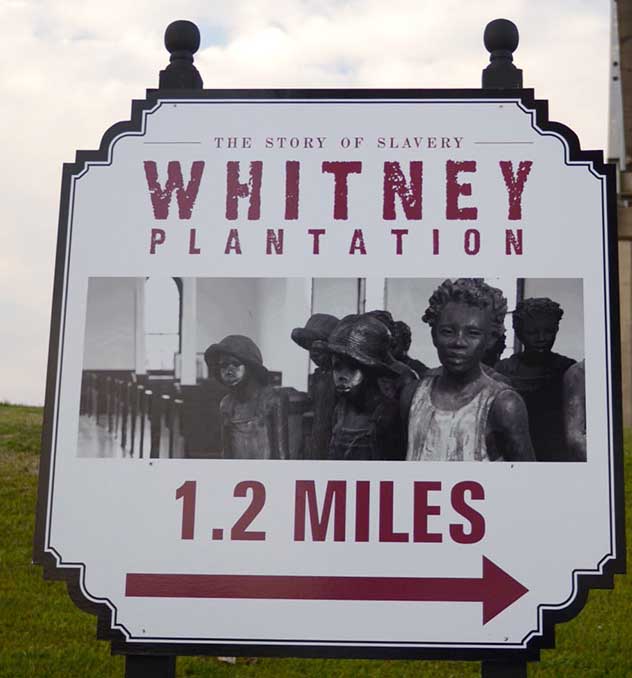 ¶ Trauma healing. John Cummings spent 16 years turning an old plantation in Louisiana into a slavery memorial. On 7 December 2014, the Whitney Plantation, located between New Orleans and Baton Rouge on the west bank of the Mississippi River, opened its doors to the public for the first time in its 262 year history, as the only plantation museum in Louisiana with a focus on slavery. He hired the Senagalese scholar Dr. Ibrahima Seck to trace the lives of slaves at the plantation, and he's commissioned statues and artifacts to make visitors feel the presence of those ghosts, especially the ghosts of the children held captive there. Read

¶ 
¶  ¶ 17th century colonial Christmas culture war. “The Puritans of New England frowned upon the celebration of Christmas and outlawed it for more than half a century. They believed it was necessary, as Christians pursuing pious living, to separate themselves from the sinful behavior associated with the way the holiday was celebrated in jolly old England. And since few of these Christian American forefathers had anything good to say about materialism or commercialism, it is likely they would have similar feelings about the way we celebrate Christmas today.” —John Fea, “Was There a Golden Age of Christmas in America,” Pacific Standard, December 2013
 ¶ “Cuba seems to have the same effect on U.S. administrations as the full moon once had on werewolves,” said Dr. Wayne Smith, former director of the US Interest Section in Havana, Cuba, currently senior fellow at the Center for International Policy’s Cuba program.
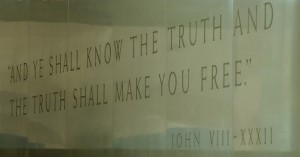 ¶ More language abuse. When the Central Intelligence Agency’s original building was erected in 1959, a verse from John’s Gospel (8:32) was inscribed on a wall in its lobby: And ye shall know the truth and the truth will make you free.
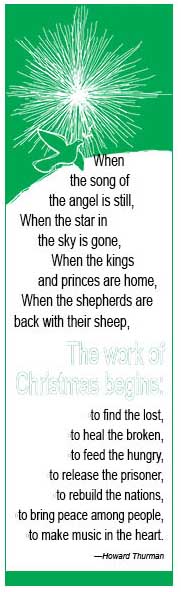 ¶ Opening monologue, in the HBO miniseries “The Pacific,” by a Marine commander to a group of non-commissioned officers shortly before Christmas 1941: “Those of you who are lucky enough to get home for Christmas, hold your loved ones dearly. Join them in prayers for peace on earth and good will toward all men. And then report back here ready to sail across God’s vast ocean, where we will meet our enemy and kill them all. Merry Christmas.”
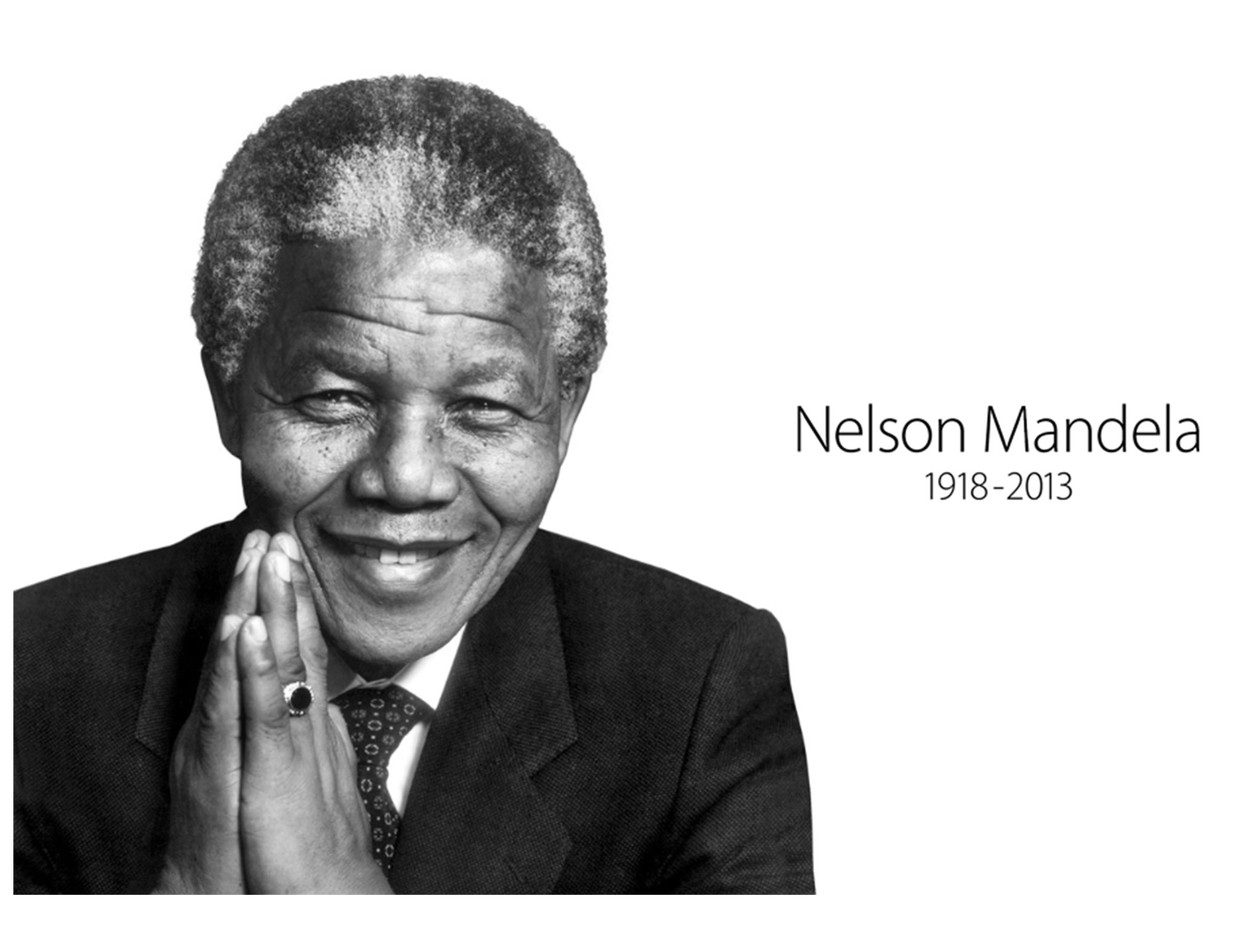 ¶ AWEsome. To mark the first anniversary of Nelson Mandela’s passing, Yes! magazine posted a grocery-store flash mob video honoring the occasion in music. This is three minutes of ecstasy: http://www.yesmagazine.org/people-power/video-remembering-nelson-mandela-and-his-reconciliation-process
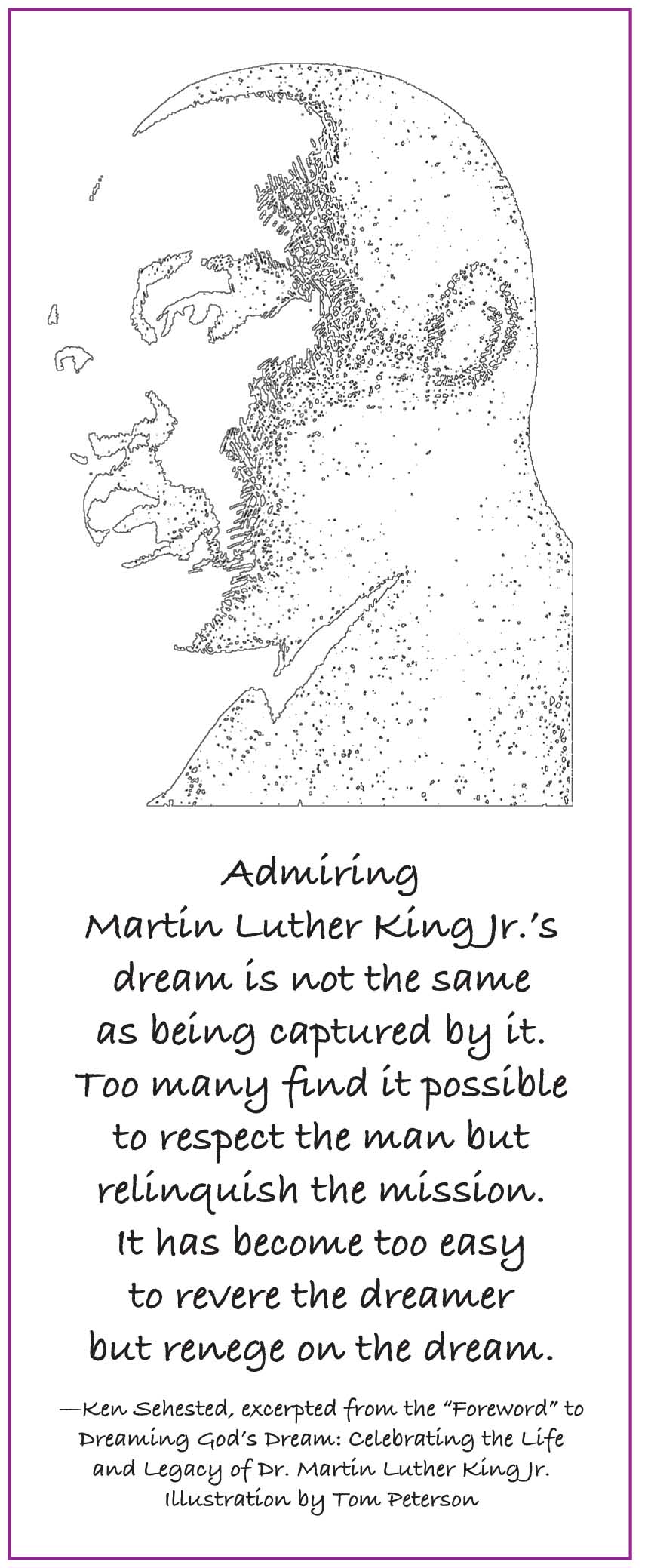
 ¶ Youth ministers. Starting preparing for Martin Luther King Jr.’s birthday anniversary. There are many videos of his 18-minute “I Have a Dream” speech on the web. But then tack past the “dreamy” piety that has tamed King’s vision. One idea: The A.J. Muste Memorial Institute <ajmuste.org/litlist.htm> has attractively published pamphlets containing three of Dr. King’s most famous sermons: “Loving Your Enemies,” “Letter from a Birmingham Jail,” and “Declaration of Independence from the War in Vietnam.” Order enough for each of your youth. Maybe partner with a youth group from another congregation whose racial makeup is different from yours. Plan a discussion of these sermons sometime around the holiday.

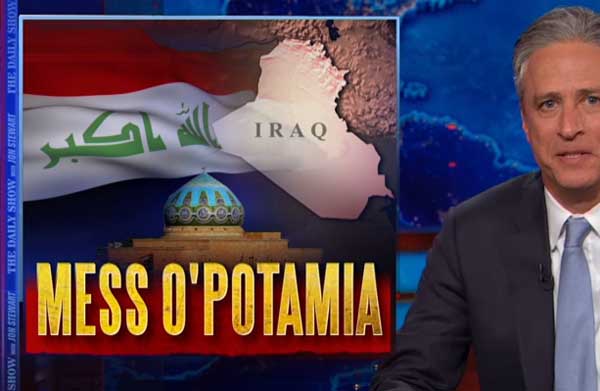
 Jon Stewart’s Daily Show opening comments on these cases were as sober as I’ve seen. “If comedy is tragedy plus time,” Stewart said, “I need more f•••king time.”