

On the 40th anniversary of the founding of La Coordinacion Obrero Estudiantil Bautista de Cuba (COEBAC, Coordination of Baptist Students and Workers in Cuba)
10-11 October 2014, Iglesia Bautista Enmanuel, Ciego de Avila, Cuba
by Ken Sehested
People of faith are continuously in the process of asking and deciding “what time is it?” and “who are my people?” When I ask, “what time is it?” I’m not asking you to look at your watch. I’m not asking you to check your calendar. Rather, I’m asking “what is the Spirit doing in our day, in this place and in this season?” How we live and bear witness to the good news of the Gospel always hinges on this question. And every age, every generation, every specific location must renew its response to this question.
In my comments today I will say some things about what time it is in my own social location in the United States. It is important, I think, for people in different locations to share their insights across boundaries and borders, and across generations. The past is never dead and finished, and the future is never fully settled. To know where we want to go requires us to investigate where we have been.
Obviously, the conclusions I reach about my own location do not determine the conclusions you reach here in this place and in this time. But I do think there is history we share as Baptists that are instructive even across boundaries and across the ages.
In the framework of our two questions—What time is it? and Who are my people—I specifically want to focus on what it means to be a Baptist follower of Jesus. This question was brought into focus eight years at the Second Encounter of Baptist Theologians in Central America and the Caribbean, held at the King Center in Havana. There were 38 people from a dozen countries present. I had the privilege of being an observer at that meeting. During our days of discussion, one of the participants raised a very astute question: “We have spoken much about the need for renewed theological vision. But we have yet to say what it is to be a Baptist theologian.”
 Does that adjective—Baptist—mean anything for us? More than a few of us have been shunned by Baptist institutions in our respective countries. One Baptist seminary in the United States specifically prohibits me from being on campus in any capacity. One Baptist convention in the US formally cut its ties with the Baptist Peace Fellowship when I was the director. Some of you who were present at the founding of COEBAC remember being criticized. A few of you were actually expelled from your denominational body.
Does our identification as Baptists have any significance? I have many friends—especially women clergy—who long ago decided being identified as Baptist wasn’t worth the trouble. In the United States, public perceptions of Baptist are not always a good one. The name is often associated with right-wing politics, with sentimental piety, with judgmental and arrogant attitudes, with a spirituality that gives little attention to the widow, the orphan and the immigrant. [ACT OUT with face in Bible] It is a spirituality like this—with faces buried in the Bible, oblivious to those who have no place at the table of bounty, all the while spouting religious-sounding phrases. The Bible, however, should not be a blindfold but the lens through which we see history with clarity.
I believe that the emergence of each denomination, each confessional tradition within the Body of Christ over the past two millennia, was originally given as a gift of the Holy Spirit for the whole church. You remember the analogy Paul wrote to the church at Corinth, the one about many members of the body, all of which are needed (1 Cor. 12)? No one body part, however large, can say to the smaller parts: You are not important.
Unfortunately, most of these eruptions of the Spirit in history thought of themselves as having privileged access to God’s plans and purposes. They did not understand that the special insight and inspiration they had been given were not simply for themselves, but for the whole church. And so much of their energy went into constructing their own isolated fortresses and making exaggerated claims about their own righteous convictions and practices—even to the point of expelling those who wandered too far from the castle gate.
There was a time when I was deeply embarrassed at being identified as a Baptist, especially because the largest body of white Baptists in the United States supported the institution of slavery in the 19th century. Being a Baptist can be a confusing enterprise. Martin Luther King Jr. was a Baptist pastor, but so are many of the leaders in the Religious Right in the U.S. I suspect there are a great diversity of Baptists here in Cuba as well. But over the years I have done considerable historical research on the question, and I am convinced that the founding convictions of the early Baptist movement is significant and has a very urgently needed role to play in the world at precisely this moment in history. The significance is not so much particular doctrines needing to be upheld, or patterns of piety to be taught, or moral programs to be championed. It is more accurate to refer to Baptist impulses[1] in spirituality—impulses that help us understand God’s redemptive plan and purpose in the world.
I have five specific reasons why the Baptist-flavored vision of faith needs to be brought to bear in the life of the church. Taken together, the faith-based innovations of 17th century English colonial Baptist emergence—characterized by their convictions about “soul liberty” or liberty of conscience, the separation of church and state, “regenerate” or convictional church membership—represent an impulse of the Spirit, a certain framework to interpret the work of the Spirit and order the life of the church.
1. I’ve already highlighted the first of these Baptist impulses: that our historical tradition cannot be asserted in an arrogant or exclusive way. Ours is but one gift of the Spirit among many others. All of us have been profoundly influenced by non-Baptist traditions. When I finished seminary, it occurred to me that half of the most important books I had read were authored by Roman Catholics! Claiming Baptist identity is not a form of imperialism which seeks to override all other theological traditions. Rather it is more like an inheritance to be cultivated, a particular angle of vision to be shared, a distinctive voice needing a hearing within the larger tribe of Jesus and in the larger world.
2. Second, the Baptist impulse insists on “democratizing access to the holy.” Which is to say, the Word of God need not be filtered through the authority of any hierarchy. Baptism is the first and foremost authority to understanding and following Jesus. [2]
Much of the history of the church is the story of who gets to say and do what in the life of the believing community. It is the story of an increasingly complex bureaucracy detailing who gets to approach God on behalf of the people and approach the people on behalf of God. The early Baptist impulse was to say that the unlettered and the unwashed also testify to the work of the Holy Spirit. The unanointed, the unlettered, the non-ordained also have access and also are called to speak to the difficult choices involved in following Jesus.
We forget that Baptists in England and in its American colonies were met with brutal repression by the politically-established churches of their time. One court case in the Massachusetts Bay Colony referred to Baptists as “incendiaries of the Commonwealth.”[3] Now having become a majority people in the United States, many Baptists no longer remember that our forebears were harassed, jailed and sometimes hung by the religiously-backed state authorities.[4]
Whenever Baptists have been at our best, there is a kind of erosion of established sanction as to who can testify to the Spirit’s presence in the church and in the world. Over and over again we discover that the Spirit erupts from below rather than trickling down from above. It is from the margins of power, not from the centers, that God acts to save and to liberate. Which is why we must locate ourselves in proximity to those margins if we are to hear what the Spirit is saying.
3. Third on my list of Baptist impulses which need conserving is this: The denial that membership in the state and membership in the church are not the same thing. That’s a fancy way of saying that being a citizen does not make you a believer. The interests of the imperial authorities (whether state, church or other hierarchy) and the interests of the believing community are not always parallel and harmonious. They’re often in conflict. It was the English King James I, who left founding Baptist pastor John Helwys to rot in prison, who complained, “It would be only half a king who controlled his subject’s bodies but not their souls.”[5] Make no mistake about this: Every king, every imperial authority, longs to control both bodies and souls of all citizens.[6] Every such authority wants to limit what is possible to what is available. Roger Williams, founder of the first Baptist congregation in the American hemisphere, wrote that people in power are seldom willing to “hear any other music but what is known to please them.”[7]
This, of course, is one of the ways our context in the US is very different from your context here in Cuba. Here the life of the church has sometimes been marginalized by the state. There has been discrimination against Christians seeking full participation in political life.
This historical experience, however, is actually one of the great strengths of the church in Cuba. Here you have been forced to learn to live without the kind of privilege and protection by the state which so often seduces the church in North America. Here you have had to learn that God’s blessing and the state’s blessing are not the same. Being “disestablished” is a painful process. But I am convinced that the church will not discover its true calling unless it undergoes this kind of conversion.
4. The fourth reason we should shepherd and sustain Baptist convictions is because delegitimizing violence done in the name of God is among our most challenging tasks in the modern era. This work of delegitimizing sacred violence is the most effective organizing principle of interfaith dialogue and action. Such work allows people of faith and conscience, in all our diversity, to make common cause without the silly (and counterproductive) attempt to homogenize our distinctive traditions.
 What we often fail to note in our celebrations of the legacy of religious liberty pioneers is that some of these very advocates were themselves the least willing to grant liberty to others. In my own country’s colonial history, William Bradford, governor of the early Plymouth Colony, wrote of his Pilgrim community’s battle with the Pequot Indians at Mystic River, beginning with the torching of the Pequot village: "It was a fearful sight to see them thus frying in the fire and the streams of blood quenching the same, and horrible was the stink and scent thereof; but the victory seemed a sweet sacrifice, and [we] gave the praise thereof to God."[8]
The most bloodthirsty jihadists in our day are nothing new in the history of purported divine sanction of slaughter.[9] Roger Williams insisted that it is “directly contrary to the nature of Christ Jesus . . . that throats of men should be torne out for his sake.”[10]
Where some of us in the United States still grieve over the fate of the Pequot nation (among hundreds of other nations of indigenous people), some of you here in Cuba still grieve over the fate of the Taíno people.
One of the most egregious examples of state bribery of religious freedom comes from 1962. A group of 200 business executives and university presidents in the United States formed what was called the Committee for Economic Development. The report they issued from their deliberations is titled “An Adaptive Program for Agriculture.” One of the recommendations from that report is this chilling statement: "Where there are religious obstacles to modern economic progress, the religion may have to be taken less seriously or its character altered.[11]
5. My final agenda for Baptist-flavored believers is likely the most controversial, at least within the United States. In this instance, the contexts of the United States and of Cuba are very different. I offer this so that you may overhear an urgent discussion going on in our context:
We must find a way to undertake a vigorous critique of the meaning of the word “freedom” itself.
It has been said that “patriotism is the last refuge of scoundrels” [Samuel Johnson]. Nowadays, it is the language of “freedom” that more commonly disguises the license of greed and self-interest. I seriously doubt freedom language can any longer carry the freight we intend. Let me tell you a story about Francisco Rodés, one of the founders of COEBAC. Many of you know him.
On one of Paco’s first visits to the US, he told me he needed a kitchen cabinet handle to replace a broken one at his home. No problem, I said, and I drove him to one of those large “home improvement” stores. Some of you have been to the United States, and you know what I’m talking about—these are enormous stores, with aisles stretching on almost as far as the eye can see.
Paco had never been in such a store. You can imagine his eyes as we drove into the parking lot—such a massive building. And then all the more so when we stepped inside its cavernous interior.
I wasn’t sure where the cabinet handles were kept, so we walked up and down several aisles before we rounded the corner and, sure enough, there was what we were looking for. Actually, there were hundreds of different shapes, colors and designs of cabinet handles—a whole wall of them.
Paco stared in disbelief at first. But then he turned to me, with a sly grin on his face, raised his arms and jubilantly announced, “FREEDOM!”
In our era and in our communities, the freedom language so precious to Christians—especially Baptist-flavored folk like us—has been hijacked, disemboweled and repackaged in fraudulent and frightful ways. Militarily, in the United Stated, freedom is now represented by the legal justification of preemptive war, first articulated in President Bush’s 2002 National Security Strategy declaration and now assumed by President Obama. Never before in our history has our government explicitly stated the right to wage discretionary war. All the president has to do is say someone, or some entity, is a threat to national security. This is what freedom come to mean.
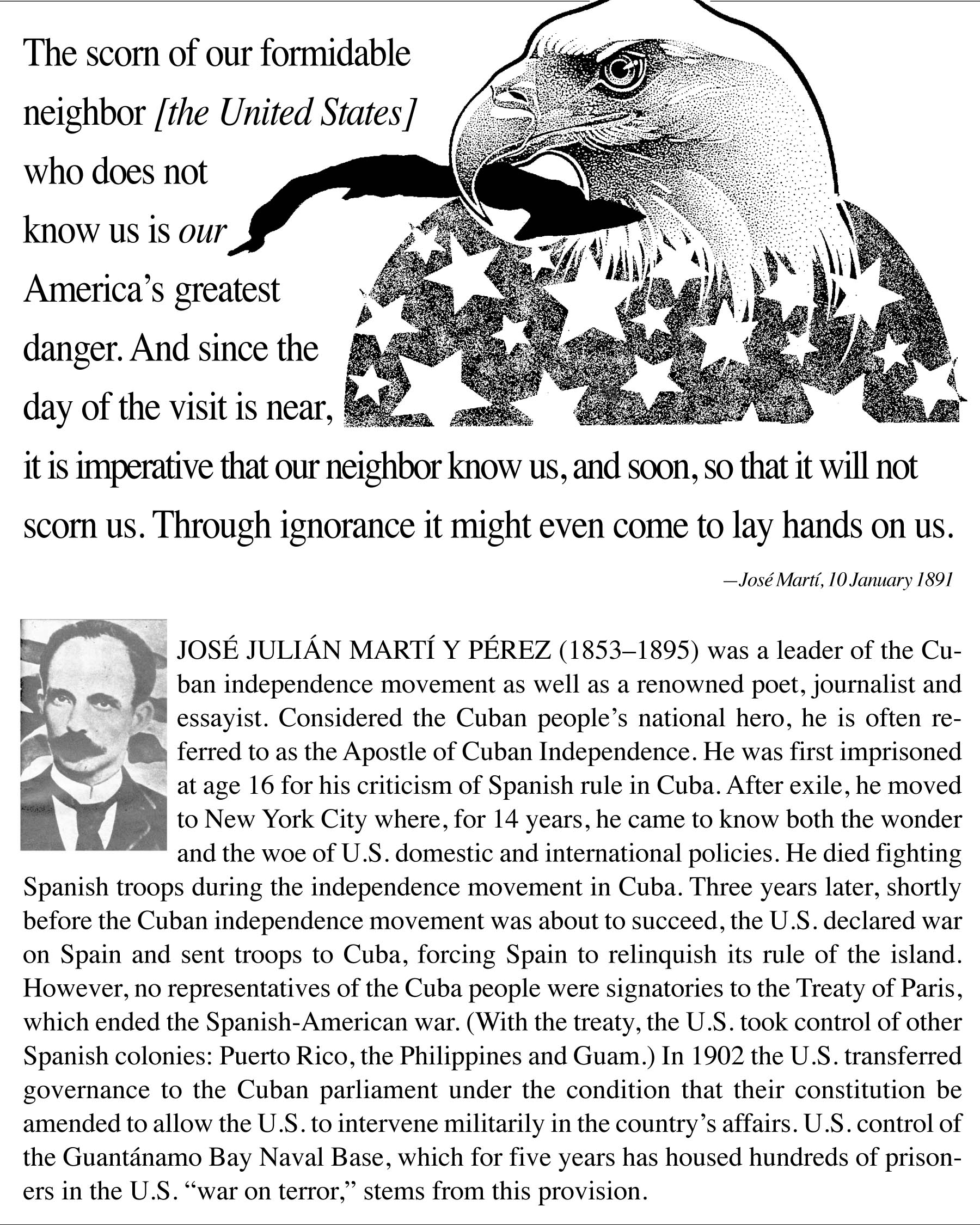
Economically speaking, “freedom” is the descriptive adjective we use to justify our nation’s economic institutions’ goal of penetrating and controlling the economies of other countries. This is the root cause of the U.S. embargo against Cuba. The US is afraid that other countries in Latin America would refuse to participate in a market economy whose terms are set by the wealthiest countries.
Four years ago the United States’ Supreme Court issued a ruling on a case commonly known as “Citizens United.” With that judicial decision, the highest legal authority in our country asserted that corporations can, for legal purposes, be considered human beings. The effect of that ruling eliminates restrictions on contributions to political candidates and parties by large corporations. We are quickly moving to a nation with—literally speaking—the best government money can buy. It makes mockery of the notion of participatory democracy. This is done, of course, under the guise of freedom.
Unfortunately, the language of freedom is also corrupting our church life. In many Baptist congregations in my country—especially the more liberal congregations—if you asked members what was most important, they would say “freedom.” What that means, though, is that if freedom is my highest value, then I do not need to make serious commitments.
Many years ago a friend of mine who is a cartoonist drew a scene where two church members were talking. The caption, where one is responding to the other, is this: “The Kingdom of God first? Really first? How inconvenient.” In other words, to be free in Christ has come to mean that faith has few if any serious consequences, that spiritual disciplines and costly missions are no longer expected or required.
An author in the U.S. wrote this bit of sarcasm about such religious “freedom”: "I would like to buy $3 worth of God, please, not enough to explode my soul or disturb my sleep, but just enough to equal a cup of warm milk or a snooze in the sunshine. I want ecstasy, not transformation; I want warmth of the womb, not a new birth. I want a pound of the Eternal in a paper sack."[12]
So these are my five reasons why I believe the “Baptist” accusation is worth the embarrassment. First, because the Baptist impulse is not chauvinistic, but is meant to be a distinctive contribution to all traveling the Jesus Road.
Second, the Baptist impulse involves democratizing access to the holy. The educated, the sophisticated, the articulate and socially acceptable do not have copyright authority on the Holy Spirit.
Third, membership in the state and in the church are not the same.
Fourth, we must delegitimize violence done in the name of God.
And finally, the Baptist impulse demands that we critique the contemporary use of freedom language.
A discussion about the nature of freedom, and especially what it means to be “free in Christ” as Paul exhorted the church at Galatia,[13] could occupy all our time. There is of course the kind of freedom that resists all imperial authority: where ecclesiastical or cultural or economic or political. These are urgent topics, and the implications of such impulses here in Cuba will be different than for us in the United States.
Nevertheless, there is a different kind of freedom which all of us, in whatever circumstances, need to learn. And with this I will close.
One of my mentors in the faith is Will Campbell, an author in the United States. Here’s how he describes the kind of freedom we most need to learn. "[F]reedom is not something that you find or someone gives to you. It is something you assume. And then you wait for someone to come and take it away from you. And the amount of resistance you put up is the amount of freedom you will have."[14]
The singer-songwriter Kris Kristofferson wrote: “Freedom’s just another word for nothing left to lose.”[15] There is no greater threat to imperial powers of every sort than people who are so free they have “nothing left to lose.” We, as people of the Resurrected One, know that not even death can threaten us. We are free to risk much, for we are safe. We are empowered to live in the face of mortal threat because we know, as the singer Johnny Cash said it, “Ain’t no grave can hold my body down.”[16]
©Ken Sehested @ prayerandpolitiks.org. An earlier version of this address was originally delivered to the Coalition for Baptist Principles breakfast, American Baptist Churches USA Biennial, 21-23 June 2013, Overland Park, Kansas.