Recent

Hallelujahs and heartaches, too

On the 50th anniversary of Rev. Francisco Rodés’ ordination

by Ken Sehested

What a day! What a day! Not to
mention a year, fifty of them piled
head-to-toe, some of them a bit
fuzzy now (thank God!), others
like constellations whose radiance
still guides during dark nights
of the soul. Little did you know,
a half-century ago, what your
profession would involve,
where your convictions would
take you, the joys then unimaginable,
the sorrows ruthless beyond belief.
And the "ordinary" days, the days
for which songs are never
composed, for which cakes are
never baked, for which poems
are never rhymed nor hymns
inspired, for which hardly anyone
but the Beloved took note.

Scores upon scores of hallelujahs
and heartaches, too. Cares that kept
you up at night and joys that set
you moving at the first sight
of dawn’s light.

If you could have known then
what you know now, would
you have allowed those
authorizing hands to be laid
on your head? Would you,
instead, have run screaming
from the room, faster than Jonah
in a speed boat, further than
Tarshish multiplied many
times over? Bemoaning the day
of your birth, more bitterly than
Jeremiah? Cursing God more
boldly than Job, demanding
a grand jury indictment for
the Most High?

Might you have sought an easier
Gospel to declare—a softer,
more digestible—
thus recommendeth the Lord?—
Would you have preferred a cool
breeze and votive candle to
Pentecost’s raging wind and
flaming tongues of fire? Maybe
a luxury hotel room to the
Nativity’s barn-yard stable?
Did another life, of air-conditioned
ease in los Estados Unidos, tempt
your fate? Or a leather-seated,
power-windowed Mercedes
instead of el burro?*

Wouldn’t it all have been easier
if Jesus had turned those rocks
to bread. Or cut a deal with the devil
in order to accomplish salvation’s end?
Or to undertake a few magical feats
to pack the sanctuary and grow
the budget? What harm could that
have done?

But, no. Nooooo. You knew, down
in your toes if not in your head,
that there is no skipping
from the crib to the cross to the
Crown of Glory. No shortcuts to
bypass those ordinary days. No
passing the cup of those agonizing
experiences. No surge protection
against joy’s electrifying arc.

For there is no ordinary in
ordination’s destination. In this
bondage, and this alone, does
freedom break out. In this
submission, does liberty emerge.
In such precarious life does
restlessness encounter the
peace that passes all understanding.

Be still. Fear not. The Promise
endures, even on those days when
you think your work’s in vain.
Live large, my friend.
Laugh often, and love well.

#  #  #

©ken sehested @ prayerandpolitiks.org, 2 June 2014, to commemorate the 50th anniversary of Francisco Rodés’ (now pastor emeritus, Primera Iglesia Bautista, Matanzas, Cuba) ordination to the Gospel ministry.

*My friend’s nickname for his 30 year-old Lada, a cheap Russian car. On one trip together he repaired a leaky radiator gasket with chewing gum.

The spokes of grief spin on the axis of hope

by Ken Sehested

These are most surely the days to trace the shape of
hope in the swirl of despair: to reassure children, to
encourage harried parents, to tip big-time, to speak out
loudly against vacuous leaders, to praise medical
professionals, to acknowledge teachers who are
working harder than ever (with exponentially less
notice), to celebrate cleaner air (a foretaste of what
could be if together we were to rigger the needed will
for weaning from fossil fuels). And on and on. (Add here
your nominees for concerted public attention.)

Nevertheless, do not forsake the labor of lament, of
public rituals naming the anguish, of the singing of sad
songs. The very spokes of grief spin on the axis of hope.
No one grieves aloud except for the deep down
awareness that life has come off the rails of gracious
accord, of promised bounty, and the practice of
neighborliness embedded in our DNA.

Only the silenced bear the weight of hushed
abandonment. So pay attention to the silence, not the
noise. This is where you are needed. Ask permission to
come alongside their discomfort. Be a parable of shelter
and comfort; let the taste of salt fill your mouth as you
regard their tears; shine light on their circumstances;
champion their fate.

The road to Heaven is trod in the company of silenced
companions and strangers unaware. Only on such
journeys are hearts aligned in tune with Everlasting
rapport, its gates swung wide, with the sound of festal
procession and Joy’s consummation.

#  #  #

©ken sehested @ prayerandpolitiks.org
Written as a prayer of mourning over my mother’s recent passing; and in intercession for one of my favorite poets, John Prine—among countless others—whose lives have been cut short by the pandemic’s vicious pulse. Listen to his recording of “Hello In There”.


Holy hell week

In the panic, be still; in the ordeal, take heart

by Ken Sehested

“Look out over the prow; there are millions of boats of righteous souls on the waters with you.
Even though your veneers may shiver from every wave in this stormy roil, I assure you
that the long timbers composing your prow and rudder come from a greater forest.
That long-grained lumber is known to withstand storms, to hold together,
to hold its own, and to advance, regardless.”
—Clarissa Pinkola Estes

I once did dawn patrol in the high desert mesa country of northern New Mexico, with the only theologically trained cowgirl I know. It was during winter’s ragged end. Several inches of snow fell overnight. This being calving season, we had to check the pastures and spot signs of distress in the newborns. We did find one, lying still in the snow, steam still lifting from its small body, mama still licking clean the mucus. I carried it to the pickup hoping the heat would revive.

It didn’t. It lay there at my feet until we finished our rounds. Not since my two bedside vigils with my wife in labor have I ever felt so useless. None more than women know that birth is dangerous and threat is camped nearby. Hope is attested in such encampments.

In fact, when you descend into the deep mines of Holy Week’s labor—where its augurs bore away at human illusions and presumptions—one of its targets is the delusion that human value is calculated on usefulness and productivity. Having that fantasy stripped away is especially painful for those of us raised in a ethical universe shaped by capitalism. The makers find it impossible to believe we don’t get extra cookies; and that we don’t get to disparage the takers. What kind of moral mismanagement is this!?!

It’s enough to drive the monetizers mad.

§  §  §

There is an uncanny, discomforting coincidence at work this week, Holy Week for Western Christians. This is also the week leading scientists say may be, here in the U.S., the worst week of the COVID-19 pandemic, with infections, hospitalizations, and deaths mounting exponentially.

Surgeon General Jerome Adams said Sunday that the US should brace for levels of tragedy never so widespread as the emotional impact to the nation from the bombing of Pearl Harbor in 1941 or the 9/11 attacks in 2001. Dr. Anthony Fauci, director of the National Institute of Allergy and Infectious Diseases and a key member of the president’s Coronavirus Task Force, said “things are gonna get bad” this week and the public needs to “buckle down.”

Both Heaven and hell are on full display during Holy Week, and we are not allowed to ignore the latter while siding with the former. Our duty is to sit with the onslaught of grief and prepare for the upsurge of hope. To refuse the first is to reduce hope to pleasantry; to refuse the second is complicity with despair.

Holy Week was hell week for Jesus’ small band of followers. They knew being in Jerusalem was dangerous, both for Jesus and for them—particularly during Passover season, when Jewish affront at Rome’s occupation was at its peak.

The disciples could not understand why Jesus had made this strategically disastrous move to confront the religious authorities on their own turf.  Hopes for a more muscular liberation and Jerusalem’s return to royal sovereignty were fading among Jesus' close associates.

Their worst fears were soon confirmed. It was as if the world were ending: Certainly their own dreams and visions, possibly their lives as well. Distress is no less contagious than a virus.

§  §  §

As it happens, hope’s fertile soil lies in that spit of land between helpless despair and sentimental optimism. Our cultivating work, as the Welsh novelist and academic Raymond Williams wrote, “is to make hope possible, rather than despair convincing.”

Hope is wider than optimism, believing everything will be fine; and deeper than pessimism, sensing all is doom. The latter, in fact, is a form of arrogant self-obsession, as if the world will unravel without our attention.

Both optimism and pessimism are haphazard, often fickle. When one or the other knocks at your door, give welcome; but say, you’ll get neither bed nor board in this house.

How are the faithful to hold up in the face of mounting tragedy? This is the focal question as we practice our special disciplines—as means of attentive listening—in this liminal season.

The counsel of scriptures and saints for the living of these days is this: In the panic, be still; in the ordeal, take heart; in the night of sorrow, remember the promise of joy’s release, for more is at work than we imagine.

Hope is not hope absent the context of threat. Otherwise, what you have is distracting amusement.

“For the world has grown full of peril,” Galadriel said to Celeborn in Tolkien’s The Lord of the Rings. “And in all lands, love is now mingled with grief.”

Celeborn asks, “What now becomes of this Fellowship? Without Gandalf, hope is lost.”

"The Quest stands upon the edge of a knife,” said Galadriel. “Stray but a little, and it will fail, to the ruin of all. Yet hope remains while the Company is true."

Trying days are here. Death’s pandemic is more palpable than usual; but it does not have the last word. Find your company and devote yourself to its sustenance.

#  #  #

©ken sehested @ prayerandpolitiks.org

Things are not getting worse—just getting uncovered

COVID-19 and apocalyptic imagination

by Ken Sehested

The root meaning of “apocalyptic” is not “catastrophe” but “unveiling.” That which was hidden is now revealed. It is not the brutal, final flourish of history, but the opportunity for renewal, the chance to begin anew.

Simply typing the word—apocalypse—makes my fingers feel awkward, clumsy, hesitant, requiring uncommon coordination. “Apocalypse” is a tricky word. It evokes memory of the surreal 1979 film (“Apocalypse Now”) by Francis Ford Coppola and the mind-bending roles of Brando and Sheen and Duvall. Not to mention the glut of more recent dystopian movies and television shows featuring zombies and the trail of gore they dramatize.

“Apocalypse” is one of those “don’t-go-there” words for me and mine. Its associations are best left to the Left-Behind crowd, quarantined behind their cruel glee at the prospect of getting to cut in line among the lucky few refugees escaping the final sadistic revenge of a ghoulish god.

But we cede too much to that crowd—among other crowds, of various sorts, who plunder our narrative treasures, stealing our vocabulary for mischievous purpose.

In the wake of every new disaster, some within the community of faith—some who speak the name of Jesus with our same accent—describe this present and frightful moment of history in apocalyptic terms. And they are right. It is. But not, I think, in the way they propose.

Apocalyptic moments are often catastrophic ones. As the Levitical author put it, “If you defile the land, it will vomit you out” (18:28). But, for biblical people, the accent is not on catastrophe but on the unveiling and uncovering of truth, the dispelling of delusion, of evaporating fantasy, and forsaking presumed innocence. From Genesis to Revelation, the evil one is often dubbed as the deceiver.

Most importantly, this disclosure, disquieting and upending as may be, opens the portal to repentance and ushers us to the occasion for conversion, the movement from despair to hope. Apocalyptic moments bare the heart to “Godly grief” that “brings no regret” (2 Cor. 7:10), guiding the hands to repair and redeem.

For us, now, is offered the moment to grasp the truth about what the fires have unleashed abroad, what the floods have uncovered at home, what the pandemic has disclosed about what Dr. Martin Luther King Jr. named as our “inescapable network of mutuality” and “single garment of destiny.” These realities are intimately connected.

Reality, of course, is in the eye of the beholder. Conflicting claims are made. You may remember the character played by that fabulous actor, Maggie Smith, in her role as Countess Violet Crawley, matriarch of the clan featured in the popular TV series, “Downton Abbey.”

The countess displayed the sharpest of tongues and got more than her share of the best lines, including this one: “Hope is a tease designed to keep us from accepting reality.”

Conflict over the direction of the human legacy is most fantastically portrayed (at times frustratingly obscure) in the book of Revelation. Listen to this adaptation of the drama in chapter 12.

“A great portent appeared in heaven: a woman clothed with the sun, with the moon under her feet, and on her head a crown of twelve stars. She was pregnant and was crying out in birth pangs.

“Then another portent appeared: a great dragon, with seven heads and ten horns. His tail swept down a third of the stars of heaven and threw them to the earth. Then the dragon stood before the woman to devour her child as soon as it was born.

“And she gave birth to a child who is to rule all the nations. But her child was snatched away and taken to God; and the woman fled into the wilderness, where she has a place prepared by God.

“War broke out in heaven; Michael and his angels defeated the dragon and his minions. That ancient serpent, who is called the deceiver of the whole world—was thrown down to the earth along with his flock.

“Then the dragon pursued the woman who had given birth. But the woman was given the wings of the great eagle, to fly from the serpent into the wilderness, where she is nourished.

“Then from its mouth the serpent poured water like a river after the woman, to sweep her away with the flood. But the earth came to the help of the woman; it opened its mouth and swallowed the river.

“Then the dragon went off to make war on the rest of the woman’s children, those who keep the commandments of God and hold the testimony of Jesus.”

Brothers and sisters, the self-serving sovereigns who now rule have been issued an eviction notice. The realm of earth is destined to be sheltered under the wings of the Beloved. (cf. Revelation 11:15) “Look,” the Revelator proclaimed, “God’s dwelling place is among the people” (21:3).

“Thy kingdom come,” Jesus implored, “on earth as it is in heaven” (Matthew 6:10).

Apocalypse is not earth gone to hell in a handbasket by means of a bloody conflagration. It is the confidence in the promise, provision and possibility of a new beginning.

This is indeed a frightening time. But if we persevere in the promise implanted in us by our baptismal vows, we may live to see that the floods, the scorching, and the pandemic do not have the last word.

“Things are not getting worse,” the poet adrienne maree brown wrote. “They are getting uncovered. We must hold each other tight and continue to pull back the veil.”

#  #  #

Postscript: I can think of no better way to observe Lent than to watch this short (3:42) video, “An Imagined Letter from Covid-19 to Humans,” from Films for Action.

©ken sehested @ prayerandpolitiks.org

St. Patrick and his Day

Connecting the saint to his Irish context, especially the 19th century "Great Famine," a very human and political disaster

by Ken Sehested

Commemorative Issue
St. Patrick

St. Patrick Day festivities are many and varied. Even in my distance from all things Irish while growing up in a small tex-mex town in West Texas, and a slightly larger town down the Cajun swamps of South Louisiana, wearing green was a thing on 17 March.

            Elsewhere, though, St. Patrick’s Day is a happening. In Chicago, since 1962, the Plumber’s Union has dumped green dye in the city’s Chicago River to commemorate the day. —watch this time-lapse video (1:36) of the river’s dyeing

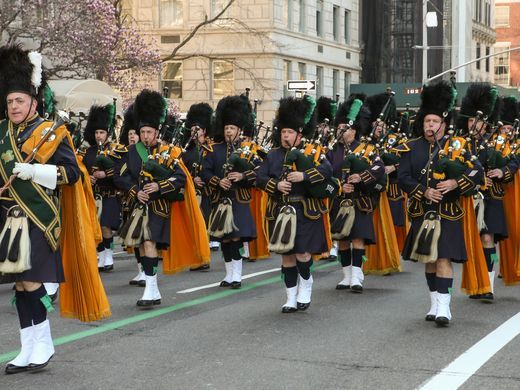
            New York City hosts the granddaddy of St. Patrick’s parades which traces its history back to 1762. This year some 400 marching groups will participate and likely draw 2 million spectators.

            See Susan B. Barnes’ “17 St. Patrick's Day celebrations for March 17 and beyond” for a summary of St. Patrick’s Day events around the US.

Hymn of praise. Among my all-time favorite recordings is “The Deer’s Cry,” aka “St. Patrick’s Breastplate.” —Performed by Rita Connolly with the Curtlestown Choir directed by Evelyn Deasy, accompanied by Shaun Davey on pedal harmonium, Gerry O'Beirne, Mathew Manning, Moya O'Grady and David O'Doherty at Powerscourt House, 2009. Shaun Davey adapted the words of St Patricks Breastplate as translated by Kuno Meyer in 1990.

St. Patrick (5th century) wasn’t Irish, didn’t expel snakes from Ireland, has no “miracle” attributed to him (which now is required for sainthood), and didn’t write the poem “St. Patrick’s Breastplate” (which was likely penned 3-4 centuries after he died in the late 5th century). Ironically, though, his fame was sufficiently established in his lifetime that his followers waged a war for custody of his body. Relatively little is known for certain about his life, but this much is documented: He was likely the first early church leader to speak out against the abuse of women.

See “Who Was St. Patrick?” on History.com for a biographical summary.

Whether or not you indulge in green beer for the occasion, don’t neglect the historical context. The “Great [Potato] Famine” in Ireland (1845-1852) claimed the lives of a million people and prompted the migration of another million, reducing the country’s population by nearly 25%.

            And it wasn’t just a natural disaster—it was also a very human one; indeed, one of modern history’s most cruel political escapades, During the famine, British landowners in Ireland exported £17 million work of foodstuffs of all sort. The Irish starved, or fled to other countries, because of British-sponsored colonial forces and choices. The potato blight (which happened across Europe as well in the 1840s) was an historic disaster; but what made the period catastrophic were very human financial policies.

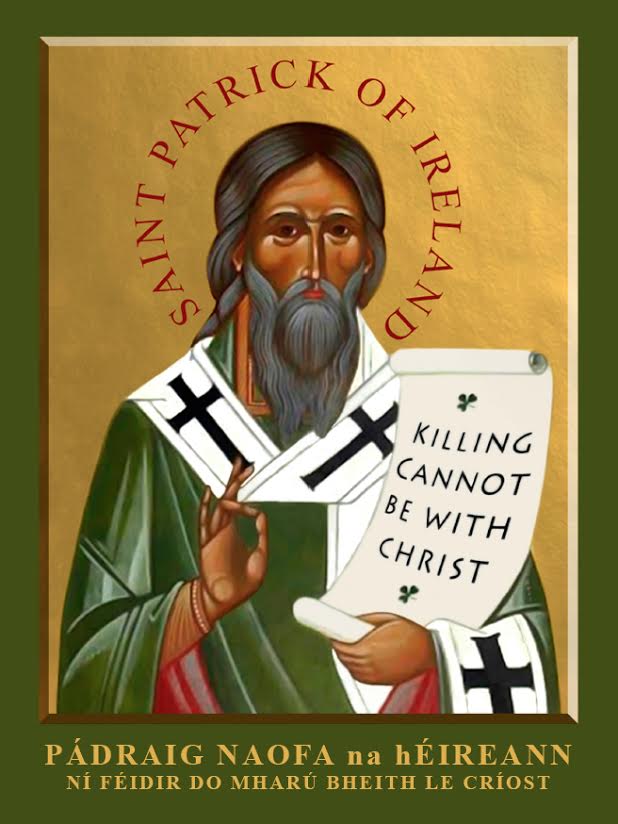
Right: St. Patrick icon is by Hamish Burgess. Visit his Maui Celtic site for more St. Patrick history and legends.

¶ See Bill Bigelow’s “The Real Irish-American Story Not Taught in Schools”  for more background on how this “disaster” is still mis-remembered. Current Irish-British relations can not be understood apart from this period of history. And the memory of St. Patrick cannot be properly honored apart from this context.

Hymn of lament. “Oh it’s well I do remember, that bleak / December day, / The landlord and the sheriff came, to drive / Us all away / They set my roof on fire, with their cursed / English spleen / And that’s another reason why I left old / Skibbereen.” —listen to Sinéad O’Connor’s haunting rendition of this Irish folk song

Listen to the complete version (with lyrics—click the “show more” button) of “Skibbereen” by Michael C. O'Laughlin.

Tomie dePaola’s children book, Patrick, is my favorite on that genre.

¶ “St Patrick's Day 2017 pictures: Reenacting patron saint's landing in Downpatrick, Northern Ireland: Celebrated on 17 March, St Patrick's Day recognises the arrival of Christianity and Irish culture. A reenactment of the first landing of St Patrick on Irish shores took place at Inch Abbey in Downpatrick, Northern Ireland on 12 March, ahead of St Patrick's Day.” Alex Wheeler, International Business Times

Benediction.

“I arise today.

“Through the strength of Heaven / Light of sun / Radiance of moon / Splendour of fire / Speed of lightning / Swiftness of wind / Depth of the sea / Stability of earth / Firmness of rock

“I arise today / Through God’s strength to pilot me / God’s eye to look before me / God’s wisdom to guide me / God’s way to lie before me / God’s shield to protect me

“From all who shall wish me ill / Afar and anear / Alone and in a multitude / Against every cruel / Merciless power / That may oppose my body and soul / Christ with me, / Christ before me, / Christ behind me, Christ in me

“Christ beneath me, Christ above me / Christ on my right, Christ on my left / Christ when I lie down, Christ when I sit down / Christ when I arise, Christ to shield me

“Christ in the heart of everyone who thinks of me / Christ in the mouth of everyone who speaks of me / I arise today.” —"The Deers Cry," aka "St. Patrick’s Breastplate," anonymous poem of the 8th century, translated from old Irish by Kuno Meyer

#  #  #

©ken sehested @ prayerandpolitiks.org

Trouble is where we go

A sermon for Lent, following the death of my Mom

by Ken Sehested
Circle of Mercy Congregation, first Sunday of Lent 2020
Text: Matthew 4:1-11

(The first draft was written late night of 25 February 2020, Shrove Tuesday, following the death of my Mom early that morning.)

“Isn’t there anything you understand?
It’s from the ash heap God is seen.
Always! Always from the ashes.”
—Archibald MacLeish in “J.B.,” a play based on the Book of Job

My Mama died today, in the wee hours before dawn. Nancy and I went and sat by her beside for a season of mourning and thanksgiving—in silence, though Mom’s favorite hymns were playing.

         Some months ago Dale Roberts figured out how to implement what I wanted—which turned out to be a bluetooth device, with a built-in speaker, on whose memory chip he downloaded 10 hours of instrumental renditions of old hymns, the ones Mama knew well, playing in a repeating loop on a table near her weak ears.

         The medical staff in the nursing facility where she lived—the past year in palliative care, mostly morphine—said the music had a calming effect, just as I had hoped.

Right: Linocut art by Julie Lonneman.

         When I hear traditional hymn music, it’s Mama’s voice I hear. My Dad couldn’t carry a tune in a bucket; and he knew it. Sometimes we would quietly hum—always off key. And sometimes he would mouth the words. So it’s Mama’s voice I hear in my head.

         Without planning, Nancy and I ended our vigil as the closing bars of “Great Is Thy Faithfulness” played, followed by a prayer from Missy who joined us. Then I kissed Mama’s cold forehead and said my last goodbye.

         Needless to say, my heart and mind and bones have roiled throughout the day, much of which was spent attending the multitude of details all surviving beloveds must do. By this evening, some clarity emerged.

         There is a liturgical significance to the fact that Mama died on Shrove (from the root word for “absolve”) Tuesday, “Fat Tuesday,” Mardi Gras in southern US coastal towns, Carnival in countries like Brazil. You may have wondered why, in some Christian traditions, pancake suppers are held on Shrove Tuesday, the day before Ash Wednesday, inaugurating the Christian season of Lent.

         By the Middle Ages, many in Christendom cooked pancakes to use up butter, eggs, and fat, before doing without those items during Lent. In Mardi Gras towns, the day is for extravagant partying, on the eve of the ashen season beginning the following day.

         Mama would have enjoyed the fact that she died on Mardi Gras, which she knew about, since the second half of her life was lived down the bayous, southwest of New Orleans.

         But Mama didn’t know what “liturgical” meant. She spent her life in deep-water, Southern-flavored, Baptist congregations, which didn’t acknowledge things like Lent and Advent. (And we downplayed Pentecost Sunday, since the Pentecostals made such a racket.)

         Shrove Tuesday—“fat Tuesday” in Carnival’s lingo—is a day for fat-saturation and festivity. Followed by Ash Wednesday, when many in the believing community submit to ash smeared foreheads and penitential posture, for all the world to see.

         For-all-the-world—or a good bit of the Western world, even some in the believing community—interpret the day as an act of self-imposed suffering. Which is why a good many view the day, and the season of Lent, with much skepticism, if not disgust.
         Why would modern, civilized people—having been freed from the bonds of poor self-image—submit again to the servitude of crippling dependency? Does it not end in glorifying the obscenely brutal act of Jesus’ lynching? Of a cancellation of human liberty and freedom from medieval autocracy and serfdom? Some even argue the cross was divine child abuse.

         You want to revoke the Enlightenment with Lent?

         That’s where for-all-the-world is blind to the drama of Ash Wednesday and Lent’s invitation to penitence.

         The promise of absolution for the penitent is what makes starting over possible. Think of the ghostly voice on your GPS announcing “recalculating” when you make a wrong turn.

         The act of penitence is powered by the acknowledgment of grace. While the past cannot be undone, it need not determine the future. The fact that we make mistakes does not make us a mistake. The ability to acknowledge our weakness is in fact what makes us strong.

         This is the alchemy of forgiveness: in knowing it, we are able to practice it. And in practicing forgiveness, our knowing grows wider and deeper.

         The invitation to imposed ashes is not an act of subservience but of liberation from our disordered desires, from the market’s insistence that we are what we consume, that we are each on our own—no promises, no covenants, no communal bonds; only desires, interests, and accumulations.

         In the real world, we are told, might makes right; only the strong survive; you own what you can take and keep. We are told, relentlessly, as one bumper sticker puts it: Those who beat their swords into plowshare will plow for those who don’t.

         But there is another story.

         My most vivid Lenten season occurred 25 years ago. For three years the Baptist Peace Fellowship board of directors devoted part of every meeting to engage in conversation about sexual orientation. We operated on a consensus model of decision-making. At least three members of the board were willing to do welcoming but not affirming to the presence of lgbtq folk in our midst. We were stuck.

         Finally, though, in our February 1995 meeting, a fully-affirming vote was cast. It surprised us all.

         As it happened, I was scheduled to begin my first-ever sabbatical at the end of that meeting, which was in Ft. Worth, Texas. I drove from there to a ranch in northeast New Mexico to begin my leave. But when I arrived, the first thing I had to do was get on a conference call with the board’s executive committee to plan a response to the firestorm of reaction to our board’s statement. Baptist publications which had never before mentioned our name were now printing full-page editorials of condemnation.

         Long story short, I knew in my heart that this controversy could very well prove to overwhelm of our little organization. A good number of our own members and contributors were upset with the board’s decision. I spent untold hours walking the high desert pastures and climbing the mesas, dodging cow patties and watching pronghorn antelopes in the distance.

         I sensed that my dream job was coming to an end. And I kept repeating in my mind all the good work we had done—and were doing, and would be doing—and asking why this should be lost. I was convinced what the board had decided was the right thing to do. But I also sensed that it would prove to be our undoing. There was no turning back now. It felt for all the world like an impending death.
         I can’t say where exactly, or when; but my hopes for hanging on finally “died,” so to speak. I finally got to the place of accepting what seemed to be inevitable: that I would have to administer the end of our work—work which I had a key role in creating—and find a new career, not to mention a different source of income.

         It was only that relinquishment, that apparent end of my personal dream—which felt like death—that I fell into the arms of a restful peace, which is what we call hope.

         Lent’s call to penitential living is not feeling bad about yourself for some mistake you’ve made. It’s not punishing yourself, which somehow makes God happy. Lent’s penitential invitation is to an orientation acknowledging that we come from God, that we live in God, and that we return to God.

         Lent’s invitation is to recognize that nothing—not even our failures, not even the ending of our most noble dreams—not even death—can separate us from the love of God. It’s to recognize that nothing is wasted. It is to recognize that there is a buoyancy in the world that we do not create, that we do not manage, that we do not fund. There is, in the lyrics to that old hymn, a great faithfulness which we can count on, whereby “morning by morning new mercies I see.”

         This is the freedom to which Lent invites us. Having been freed from the presumption that we have to make the world right, we are able to relinquish the need to use violence—physical or emotional—to maintain breath. As we are released from being consumed with our own safety and security and applause, that’s when we are freed to pay attention to the ash heaps, to mingle with those who cannot do us favors or help us get ahead or bolster our reputations.

         Lenten works takes us into the wilderness with Jesus, where resources are scarce. Lent demands that we take a hard look at the compromises we’ve made, the temptations to which we have succumbed, to secure our place in the world. Lent invites us to consider how our desires have become disordered and dangerous; our days cluttered and anxious; our relations strained and destructive.

         I won’t take time to fully unpack the text from Matthew about the temptations Jesus’ faced while in the desert. Just remember this: every one of those offers the devil made to Jesus includes a veiled reference to a text in the Bible. The devil, too, can quote Scripture. Or, as William Sloan Coffin put it: “Like any book, the Bible is something of a mirror: if an ass peers in, you can’t expect an apostle to peer out!” Or as the Bible itself says, “There are some [texts] which the ignorant and wicked twist to their own destruction” (2 Peter 3:16b)

         Jesus’ refusal to don the robe of royalty, the power to own and dictate and assume the presumption of power—this was the key to his freedom, the kind of freedom that enabled him—and enables us—to move toward the world’s ash heaps, to stand in resistance to the forces of shame and injustice.

         It’s from the ash heap God is seen. Always, always from the ashes. Ash Wednesday, and the Lenten days that follow, is God’s program of theological education.

         I love the way singer-songwriter Kris Kristofferson puts it: “Freedom’s just another word for nothing left to lose.”

         This freedom work involves immersion in prayer—in honest transparency and correction and self-surrender to a purpose greater than our own skin. For us, that purpose looks like Jesus.

         This self-surrender of prayer then propels us into self-surrendering, reconciling work in a world of hurt.

         Several years ago I lived in South Dakota for eight months, taking care of my sister during her dying days, as well as Mom, who lived with her, Mom frequently looked at me and said, “I’m sorry you have to go to so much trouble, son.” And I would respond, “Mom, when you’re family, trouble is where you go.”

         When you combine that with the way Jesus completely revised what “family” means—when you learn that family is more than tribe or clan, more than race or class or nation-state or any of the others ways we divide up who’s in and who’s out—you can see how Jesus’ vision threatened those who believed Almighty God had anointed them to ration grace, to enforce a quota on mercy, to demand a ransom for justice.

         Stingy hands only know how to suppress trouble by coercive means. But Ash Wednesday’s smudge allows us to risk trouble, because trouble is where we go.

         There’s a reason we celebrate Mardi Gras festivals and the sweet goodness of maple syrup on Shrove Tuesday, before we put on our Lenten crash helmets for the trials and tribulations to come. Trouble is where we go because underneath it all is a Great Faithfulness and the promise of new mercies to come. Keep this in mind in the troublesome days to come.

         Sorry you have to go to such trouble, Circle of Mercy. But trouble is where we go.

#  #  #
 

On the character of persistence

Elizabeth Warren and the schooling of US politics

by Ken Sehested
5 March 2020

I’m glad that Senator Elizabeth Warren did not cry in her press interview outside her home this afternoon, announcing she was dropping out of the race for the Democratic nominee for president. Because I was already on the verge of tears.

I have supported more losing candidates for political office than I care to admit. The immediate, sensory evidence of victory—for those pursuing the Beloved Community—is typically piecemeal and prelude.

But hear this: Electioneering is not the same as politics, in the larger sense of pressing forward for the common good.

Therefore, if you lose electorally, do not give up. More is at stake; and more is possible. One of Lent’s disciplines is training the eye to see and ear to hear what, and who, is buried beneath the rubble.

None can escape the need to make electoral preferences—while sometimes holding your nose. On this, Bro. Niebuhr was correct. He called it “political realism.” We are always offering applause for a child’s first wobbly steps (knowing falls will come); for a baptismal candidate’s initial vows (knowing doubt will encroach); for lovers’ marital pledge (knowing toil and trials will unfold).

Electoral decisions are made in favor of fallible brokers of public trust, for both reasoned and intuitive considerations.  To be earnestly realistic about such choices, bridle your expectations, and orchestrate more forceful insistence for public character and righteous governance. As Bro. Douglass warned, power concedes nothing without demand.

Right: "Lenten Rose," linocut by Julie Lonneman.

Casting ballots is such a small part of civil engagement.

The basis for hope—beyond the coarse limitations of realism—is chosen not because of optimism but because of a beatific vision. Beauty, more than duty, will sustain resolve and sharpen clarity. Such hope remains steadfast—however buffeted, reviled, vilified, or scorned.

Devote yourself to a measurable acre. Conserve it, clear it, till it, plant it, protect it. Then rejoice in the bounty to come, even if the harvest arrives beyond your years. Be in the world, on the Way, buoyed by Spirit-heralds, living and dead, who blaze the trail “to that bright land to which we go.”

No doubt you will be “warned,” by lofty authority and credible threat, as Sis. Warren has been and likely will continue to be. Nevertheless, she persists. We can, too.

#  #  #

©ken sehested @ prayerandpolitiks.org


14 tentative conclusions on the U.S. presidential primary process

by Ken Sehested

1. Save us, Lord Jesus.

2. We reap what we sow. We have not sown righteously. Looking through a wide lens, we citizens really do get the politicians we deserve. We need to prepare for the possibility that things will get worse before it gets better—regardless of November’s election results.

3. We invest far too much in what happens in Washington, DC, or state capitols, or county seats, or city commissions. Long-term change begins with grunt work in neighborhoods. All politics—as former House Speaker Tip O’Neill said a lifetime ago—is local. Systemic change is dependent on the patient, persevering work of shifting the conversation in nearby streets.

4. Systemic change requires new direction both in public policy and in public consensus. Getting re-elected (in the next election) is almost always a politician’s top priority, though there are some brave ones willing to risk riling major donors’ economic interests. Even our best know they can’t buck prevailing policy without significant demand from constituents.

5. Public policy, like the weather, is rarely the result of an electoral hurricane; rather, it is dependent on a gazillian on-the-ground changes in atmospheric conditions. You can’t expect to gather a thousand or a million people, tell them to blow real hard, then expect a windstorm.

6. As an old white man, it troubles me greatly that the three most-apparently viable candidates are old white men. (Repeat #1.)

7. There is so much more to politics than elections. Voting is the least time-consuming duty of engaged citizens. If you don’t devote time to building communities and constituencies—both within your principle interest group, and crossing boundaries and making allies with other groups and interests—voting is pretty futile.

8. In terms of specific policy proposals, I align clearly with Bernie Sanders. But I swear to God, he seems unable to speak in a way that doesn’t sound like he’s scolding children—literally, lowering his head and punching the air with his forefinger, as if thumping someone’s chest. Every significant electoral movement needs to say clearly what they oppose. But a movement based on mutual abhorrence will not have sustaining power

9. Martin Luther King Jr. didn’t rise to prominence saying “I have strategic plan.” Rather, he said “I have a dream.” We all long for candidates who are at least as articulate about what they hope for as about what they oppose.

        "If you want to build a ship,” Antoine de Saint-Exupery wrote, “don't drum up people together to collect wood and assign them tasks and work, but rather teach them to long for the endless immensity of the sea."

        But don’t do binary thinking. Articulating a vision is not the same as daydreaming. Dr. King would not have gotten far without Ella Baker and Bayard Ruston. The 5 December 1955 mass meeting in Montgomery, Alabama, which voted to extend the one-day bus boycott, might not have attracted many participants if the Montgomery Black Women’s Council hadn’t stayed up all night mimeographing publicity leaflets.

        We certainly must demand that justice flow like the waters (Amos 5:24); but we’ll also need a committed company of plumbers.

10. It pains me to think that Joe Biden will become the Democratic Party nominee for president. He is a cold warrior and will wink at the looting of our nation’s wealth by major financial institutions. He is as beholden to them as Trump is to racist, nationalist, misogynist forces. The thing is, Trump can’t help himself; Biden, on the other hand, can help himself but chooses not to.

11. Personally, I voted for Elizabeth Warren, for a variety of reasons. The most important is that, of all the Democratic candidates, she has the closest direct ties to folk in small towns and rural areas, and others abused by large financial companies. (But Liz, compañera, your presidential prospects are fading. Please, please, please continue your devoted Senate career. Get more converts. Endorse minority candidates in Senate races around the country. Use every chance you get to opening a can of whoop-ass on Majority Leader M O’Connell’s thuggish grip on Senate gatekeeping.

12. Pete Buttigieg has, far and away, been the most articulate campaign voice on the intersection of religious values and public policy. I’m pleasantly surprised that, as a married gay man, he got this far. Mayor Pete, can you devote time tutoring our nation’s faith leaders? (And won’t you rethink your uncritical support of Israel’s apartheid policies?)

13.  Like many, your preferred candidate may lose. Do not drown in regret. As the Mexican proverb says: “They tried to bury us. They didn't know we were seeds.”

14. Finally, remember this: “Nobody made a greater mistake,” wrote Edmund Burke, “than he who did nothing because he could only do a little.” Pay attention to the big picture. Survey all the many things needing to be done. (There will be more needs than you can see; pay no mind to that.) Assess what you can do. Then do it with all your heart, within one or more communities of conviction.

A postscript:

My commitment to (small “d”) democratic governance is not rooted in political philosophy but theological conviction. Democracy is an important way we practice nonviolence.

        To be clear, voting does not = democracy. Votes can be bought, manipulated, disappeared, and repressed. The mechanisms are constantly under threat. The examples in our own nation (and many others) are too innumerable to list—and more than a few are in the news even now. Vigilance is demanded . . . and demanding.

#  # #

Prepping for Ash Wednesday

A supplication

by Ken Sehested

Return to your heart, O you transgressors,
and hold fast to the One who made you.
Stand with the Beloved and your footing
shall be firm. Rest in the Merciful One
and you shalt be buoyed.

Where do you go along these rugged
paths, pilgrim, so far from home yet so
winsomely loved? Be clear about what
you seek, and where you seek, for the
beatific life cannot be found in the land
of illusion.

But do not despair, for life is stirring
in cracks and clefts and barren terrain.
Train your eyes to see through the tangle
of disordered desire.

Resist, even to death, that which bedevils
the common good. Welcome and foster
all that shields the battered, that restores
harrowed fields and forests, that reclaims
despoiled waters and all creatures great
and small.

In these lie your spiritual duty: the
performance of your praise and the
practice of your baptismal vows. By
such does your heart’s delight align
with your hand’s valor.

Thereby you shall you go out in peace
and be led back in joy, the hills bursting
in song, the trees in applause.

#  #  #

Borrowing from St. Augustine and Isaiah 55:12


What to do when your grandchild’s Sunday school teacher is arrested?

by Ken Sehested

“Oh Lord, I’ve made you a place in my heart,
and I hope now you leave it alone.”
—Greg Brown, sung by Dar Williams, Richard Shindell & Lucy Kaplansky

It’s not what you think. (The arrest.) Nothing salacious or seedy here. My friend BJ was handcuffed for committing an act of civil disobedience to call attention to our worsening climate crisis.

Betty Jane Crandall is an unlikely lawbreaker. An 80-year-old retired elementary school teacher, mild mannered, host of one of our congregation’s two ongoing weeknight Bible study groups focused on the Sermon on the Mount, widow of a Presbyterian minister, and Sunday school teacher for our preschoolers—not to mention a source of constant encouragement to me personally.

After a video of the march in downtown Asheville, NC was posted online, one of BJ’s nieces called to celebrate her “badass aunt.”

The march gathered in front of the National Center for Environmental Information (NCEI), which archives and monitors global climate data for the federal government, was organized by the local chapter of Extinction Rebellion, an international movement now active in 56 countries. Local organizers specifically chose Valentine’s Day “to express love and support for NCEI scientists who . . . tell the truth about climate change.”

Right: Betty Jane Crandall, arrested 14 February 2020 during a march calling attention to the climate crisis, Asheville, NC. Photo by Marc Mullinax.

In all, nine of our members took part in the protest (from the Latin, “publicly witness”), including three of the 16 arrested. The Valentine’s Day theme of love and support for climate scientists is amazingly appropriate. In the first two years of our current administration, more than 1,600 scientists have left their federal posts. Twenty percent of high-level appointee positions are vacant. Some 700 scientists have left the Environmental Protection Agency.

§  §  §

Though rooted in stories of undue suffering by an early Christian saint, Valentine’s Day is now reserved for arousing romance, expressed in mawkish sentiment, and marketed in all manner of sugar and cocoa products. Chubby cherubs, shooting arrows of love at the heart, are featured on flirty cards professing affection. Fine dining reservations are hard to get that evening.

Tons of candy go on sale the next day. This season’s romance is flighty. It’s more fling than vow. The calories are empty.

The confusion of “heart” and “romance” in modern usage is a sign of our spiritual affliction and relational crisis. For us, the heart represents moodiness, volatile attention, impulsive emotion—parallel to the biological effect of sugar highs followed by lethargy and indifference.

§  §  §

In the pietist-revivalist tradition of my rearing, “giving your heart to Jesus” was often associated with intense emotion. The fickle results require equal emphasis on “rededicating your life to the Lord” as part of the hymn of invitation appeal.

In Scripture, though, the heart is the steady organ of the human body, and decisions made there are life-determining. The heart is the location of sturdy conviction and strenuous choice. Decisions made in the heart shape all other arrangements and warrant endurance in the face of conflict.

In Hebrew thinking, the heart represented the deepest level of a human personality, representing the true picture of the person. The Latin word credo, from which we get the word "creed," comes from two words which together mean "I give my heart to."

The Psalmist sings: "It is well with those who deal generously and lend, who conduct their affairs with justice . . . Their hearts are steady, they will not be afraid" (112:5-9).

In Matthew, Jesus makes this striking claim: "Where your treasure is, there will your heart be also" (6:21).

The Acts of the Apostles reports: "Now the company of those who believed were of one heart and soul, and no one said that any of the things which they possessed were their own, but they had everything in common" (4:32).

And do you recall Zacchaeus’ “confession of faith in Jesus Christ as his personal lord and savior”? “Here and now I give half of my possessions to the poor, and if I have cheated anybody out of anything, I will pay back four times the amount.” To which Jesus responded, "Today, salvation has come to this house" (Luke 19:8-9).

The heart is not the seat of fantasy. It is where questions of trust and allegiance and power are negotiated and sealed. The heart is where bet-your-assets decisions are settled—in particular, the kind that will get you in trouble with the world.

No doubt there are innumerable ways, among a myriad of circumstances, to do justice, to love mercy, and to walk humbly in the Way of Jesus. Holy obedience comes in many forms. One of them might include civil disobedience. And handcuffs.

#  #  #

See photos from the Extinction Rebellion march in Asheville.

Watch this 20-minute video of the march.

Ken Sehested is curator of prayerandpolitiks.org, an online journal at the intersection of spiritual formation and prophetic action.