
Recent

“Beloved” is where we begin the journey through Lent

Ken Sehested

Mardi Gras processional. “Jubilee Stomp.” —Tuba Skinny

Ash Wednesday invocation. “When Love Meets Dust—Alana Levandoski

§  §  §

A couple years ago I had an email exchange with my friend, Phillip. He ended with:

And today we wear the ashes. I’m always humbled. Especially when I as pastor “impose the ashes” on people I love. (Impose? Really? Oh God)

And I replied:

Oh, great insight re. the word “imposition,” whose root meaning is “inflict, deceive.” It’s an unfortunate word to be associated with Ash Wednesday’s ritual.

Except . . . maybe . . . if the imposition is actually “the world’s” demand that we recognize the authority of and justification for crucifixion—and to be intentionally marked with ash is a sign of resistance to that imposition. It is a holy act of defiance: “I, too, am a follower of this Way! Take me if you dare, if you must; do your worst. I will not renounce. Your threat of imposition will not deter me.”

And then, in my imagination, we repeat these lines from Daniel 3, addressed to the Babylonian ruler, who threatened the non-compliant with being tossed into a fiery furnace:

“Shadrach, Meshach, and Abednego answered the king, ‘O Nebuchadnezzar, we have no need to present a defense to you in this matter [of bowing down to worship your golden statue].  If our God whom we serve is able to deliver us from the furnace of blazing fire and out of your hand, O king, let him deliver us. But if not, be it known to you, O king, that we will not serve your gods and we will not worship the golden statue that you have set up.’”

It is the great nevertheless of faith. The defiant come-what-may. The provocative we-shall-not-be-moved. . . except when our moving is out of Pharaoh’s bondage; moving out of Herod’s reach and Caesar’s interdiction; out of step with every royal assumption; and moving on in disobedience to every hierarchy of race and class, gender and caste; ever refusing to back down in the face of these pretenders claiming divine right or historical necessity.

All of these refutations accompany the great affirmation which is Ash Wednesday’s mark of rebellion against every despot who seeks to annul Heaven’s intention for Earth’s reclamation. Such is the terror of God sounding in the tyrannical ears of all who believe death has the last word.

§  §  §

Biblical anthropology

Some in the community of faith are repulsed by the Ash Wednesday smudging. It’s not hard to imagine why, as if what God demands of us is self-abasement (if not self-mutilation—do a web search for images associated with the word penitence and a great many show people literally lacerating their own bodies).

No doubt a good bit of this theological mischief is due to notions like original sin or The Fall or its escalation in the Protestant Reformation to total depravity. You would think the sola scriptura folk would reject such language since none of these words appear as such in the Bible.

The history behind original sin theologizing is a labyrinthine jumble of complex conjugations piled this way and that, abstractions galore, tortured logic and hair splitting around every corner, littered with obscure, exotic rhetoric amid a cascade of mutual condemnations between its defenders. Shakespeare himself might apply his famous line of “full of sound and fury signifying nothing” to this hot mess of specious tomfoolery.

Nevertheless, it is true that Scripture doesn’t shy away from documenting the scale of brutality humans are capable of. Sometimes in grisly detail—read the story of the unnamed concubine in Judges 19 or the petitions in Psalm 139. And in the Newer Testament, one of Jesus’ closest confidants betrays him, and another, allegedly upon whom the church is built, flagrantly denied even knowing Jesus three times before breakfast.

We are a shaky lot. Rare the exemplar, common the culprit. Our collective, bloodstained trail of infamy goes all the way back to the first family in creation, when Cain slew his brother Abel. Scripture’s opinion on humanity’s character is tangled.

For sure, on the one hand, it is recorded that “The Lord saw that the wickedness of humankind was great in the earth, and that every inclination of the thoughts of their hearts was only evil continually” and “for the inclination of the human heart is evil from youth” (Genesis 6:5 & 8:21). On the other hand, “God created humankind in [God’s] own image” (Genesis 1:27).

On the one hand, it says “Indeed, I was born guilty, a sinner when my mother conceived me” (Psalm 51:5).  On the other, “I praise you [O God], because I am awesomely and wonderfully made” (Psalm 139:14).

On the one hand, The heart is devious above all else; it is perverse—who can understand it” (Jeremiah 17:9)? On the other, “You have made [humans] a little lower than angels, and crowned them with glory and honor” (Psalm 8:5).

On the one hand, “None are righteous; no, not one” (Romans 3:10, echoing Psalm 14:3). On the other, “The Lord your God rejoices over you . . . exults over you with singing” (Zephaniah 3:17) and “The dwelling place of God is among humankind (Revelation 21:3).

 Therefore, how, and in what way, are we to welcome our ashen mark as the inauguration of Lent’s observance?

§  §  §

Consider these instructions for the onset of Lent’s journey

The work of Lent involves both how we allow ourselves to be shaped by, and how we participate with, the power of the Spirit in a world that has lost its way. The Lenten season is traditionally understood as our own metaphorical venture into the wilderness of our own hearts, where we wrestle with demons, and are waited on by angels.

The journey into and through our own heart circles back into the wilderness of history’s wayward affairs as agents of healing worldly wounds and wastrel dispositions. The foretaste of Love makes us lovers, and such belovedness thereby incrementally interrupts the spirals of disdain and violence that flow from inherited trauma, affliction, and misery.

The trek through Lenten practice is not comfy and may test our limits. It is not for our affliction but to clarity our affection. Our annunciation is that of Mary’s, whose exclamation of praise doubles as a denunciation and indictment of the present world’s disorder.

Jan Richardson writes a blessing based on Jesus being baptized, hearing God call him “Beloved,” and then the Holy Spirit immediately driving him into the wilderness for forty days. In her blessing, she reminds us that during this journey, it is crucial to remember our identity as God’s Beloved:

“If you would enter into the wilderness,
do not begin without a blessing.
Do not leave without hearing who you are:
Beloved, named by the One
who has traveled this path before you.”

Add to this a primordial memory: The first doctrine of Scripture is God’s absolute delight with Creation. That original blessing has certainly been obscured the first couple’s expulsion from the Garden and history’s subsequent wreckage; but the blessing has never been retracted. We are imago dei, made in the image of God.

So, find an honored place in your soul, where you pass by frequently, to display this admonition. Put a flashing neon light as its background. Enclose this reminder as in a mezuzah on your doorpost, touching it in your goings out and your comings in. Wear it around your neck as an amulet, pressed against your skin, leaching its reminder directly into your bloodstream: fear not, fear not!

Then lace your heart with its heavy-duty boots as you venture into this wild terrain of your own soul, unvexed at the prospect of danger and fear, hunger and thirst, scorching sun and the night’s dark threat. All the while, expect that you are being tracked by the Hound of Heaven who will guide you at the edge of every precipice, who will find you, and remind you, who and Whose you are.

Live in the bare nakedness of your incompleteness, reclothed by this assurance: The Loveliest One’s own heart palpitates with delight at the very sound of your name.

So let this Word be heard among you, the Word that was present from the beginning, who now awaits to be born anew in every human heart, whose promise of deliverance stretches across the cosmos, who journeys with you in the midst of tribulation, light’s eclipse, and hope’s frailty, even to and through death’s dominion, whose demise is sure, world without end. Amen. Amen.

§  §  §

Benediction. “Jesus I trust in You, / I love You, have mercy. / Deep from Your wounded heart, Pour out Your grace and mercy.” —Benedictines of Mary, Queen of Apostles “My Mercy: A Lenten meditation

Recessional. “God Almighty here I am / Am I where I ought to be / I’ve begun to soon descend / Like the sun into the sea / And I thank my lucky stars / From here to eternity / For the artist that you are / And the man you made of me.” —Kris Kristofferson, “Feeling Mortal

#  #  #

Ashen interposition

Ash Wednesday call to worship

Ken Sehested

Dearly beloveds,
the ashen interposition stakes its claim upon us
in this midweek assembly, and
the Word is announced by trumpet’s blast
rather than a piccolo’s peep.
We approach the hour of trembling.

But the Beloved One – who nestled with us
even in our gestation—this One has a
reprimand to announce.
In the midst of our modern conveniences –
in our sheltered presumptions,
our decent good order,
our fashioned attire, and our
tamed and housebroken piety –
we have all but lost the capacity for trembling.

Ash Wednesday is when
we are confronted anew that
the faith we espouse is consequential;
that there are convictional repercussions
for this assembly’s profession.

If there is no skin in the game,
then the sanctity we display is all for show;
the offerings we make,
all smoke and no fire

If our ascetic practices fail to include
loosening the bonds of injustice,
freeing the oppressed, feeding the hungry and
relieving the agony of the aggrieved,
then our reverence is all wax and no wick.

We have no claim on the promises of God
short of the practices of life immersed
in the pathos of God
in a world beset
by ruin and predicated on violence.
But blessed are we in doing the truth in compliance
with Heaven’s appeal and the Spirit’s bias.

Then shall our light break forth like the dawn
then shall a river of mercy flow and
a garden of abundance grow;
our wreckage, mended;
our breaches, repaired;
our streets, restored.

Let the ashen stain announce
our confidence that
dust is not the last word.

#  #  #

Calls to worship-Advent 2024

Ken Sehested

In Memory of Rosa Parks’ refusal to relinquish her bus seat, leading to her arrest,
1 December 1955, Montgomery, Alabama, a small act of defiance which
prompted the modern Civil Rights movement.


Processional (this is how Advent begins). “I see the bad moon a-rising / I see trouble on the way / I see earthquakes and lightning / I see bad times today / I hear hurricanes a-blowing / I know the end is coming soon / I fear rivers overflowing / I hear the voice of rage and ruin.” —Credence Clearwater Revival, “Bad Moon Rising

§  §  §

First Sunday

Do not bow in the face of fear, O Little Flock of Jesus. Though
be vigilant, for there is reason to quake. Before Jesus was so
described in the Gospels, it was Roman Emperor Caesar Augustus
who was proclaimed as “savior” and “redeemer” who brought
“salvation” to the world, and citizens were to have “faith” in their
“lord.” Scripture’s nativity stories have grown sentimental in our
telling, but not so for the original accounts. Then and there, a
head-to-head conflict was narrated as to whose peace was more
reliable, whose promise more trustworthy, whose Word would
endure beyond the heavens’ rending and the mountains’
trembling. Regardless the stumble, do not slumber. Despite
history’s grimaces, do not shield your eyes nor stop your ears, lest
you miss an angel’s announcement of hope’s incursion. Stay
awake!

§  §  §

Hymn of yearning. “We are waiting” (for that Gloria in Excelsis Deo). —The Many 

§  §  §

Second Sunday

Be clear about this, O Little Flock of Jesus: Fear is a liar and a
cheat. It will bargain its bag of trinkets and baubles and plastic
shiny objects for the world-blessing power with which you have
been vested. When fear comes knocking, open the door and say,
“Come in; stay as long as you like, but you’ll get no bed or board
here.” Do not trouble yourself over fear’s sneers. Though tossed
on the waves of dread and cast onto the shoals of distress, take
heart. Though the wilderness be your portion, remember that the
Light of Life has been promised specifically to those who dwell
there. Though that great gettin-up-morning tarries, the day will
come when righteousness and peace will kiss. Fear not, stand still:
for such is the war-cry of the nonviolent people of God.

§  §  §

Hymn of adoration. “Rejoice, O virgin mother of God, / Mary full of grace, the Lord is with thee: / blessed art thou among women, / and blessed is the fruit of thy womb, / for thou hast borne the saviour of our souls.” —English translation of “Bogoroditse Devo,” Sergei Rachmaninoff, performed by Chicago Chorale

§  §  §

Third Sunday

Fear the Lord, O Little Flock of Jesus, for only such holy fear has
the power to displace the sway of every mortal life’s dread and
dismay. Indeed, the fear of God liberates the fretful, whimpering
self that demands its privilege and exemption from covenant
ties—the very things that ruin life’s verdant provision. The One
who claims you thereby frees you to be the oil of gladness, an oak
of righteousness, repairer of ruined cities. This claim does not
maim but authorizes you to declare good news to the oppressed,
bind up the brokenhearted, proclaim liberty to the enslaved and
exoneration to the incarcerated. Fear’s murmuring shrivels the
soul and desiccates the heart. Though weeping o’ertake, sow your
tears trusting in the day when shouts of joy shall break out.

§  §  §

Hymn of petition. “Before the ending of the day, / Creator of the world, we pray / That with Thy wonted favour Thou / Wouldst be our guard and keeper now.” —English translation of first verse of “Te Lucis Ante Terminum,” Advent, Compline, performed by St. Martin’s Chamber Choir

§  §  §

Fourth Sunday

Practice fear displacement, O Little Flock of Jesus. Resist any who
proclaim the politics of panic. Live in the blessed assurance that
the world—despite much evidence to the contrary—is in God’s
hands and is promised to the meek who know their true source of
security is the One who fashioned the earth in an act of sheer
delight. “Fear not!” was the angel’s greeting to Mother Mary. And
her response to this incredulous announcement? “Let it be. Let it
be with me according to your Word.” Let it be with thee as well,
barren pilgrim, every settler who will not settle for less than the
coming new heaven and new earth, every weary traveler who
awaits Christ’s disclosure in the breaking of bread. Trod on, you
traveler to Beulah’s fecund fields, to Zion’s streams of mercy and
vineyards brimmed with gladness, where Love Incarnate soothes
every furrowed brow, disentangles every knotted fear, restores the
blinded eye and deafened ear, and caters a feast for the ages.

§  §  §

Benediction. “Lord, Help Me to Hold Out,” —Detroit Mass Choir

#  #  #

Commentary on Advent’s Joy Sunday

(or any time joy is highlighted by the day’s lection)

Ken Sehested

Processional. “Ode to Joy” (“Ode an die Freude”). —from Ludwig van Beethoven’s Ninth Symphony, flashmob performance, orchestra and choir, in a Sabadell, Spain public plaza

Invocation. “Among the tales of sorrow and of ruin that come down to us from the darkness of these days there are yet some in which amid weeping there is joy and under the shadow of death light that endures.” —J.R.R. Tolkien

Call to worship. “Then young women will dance and be glad, young men and old as well. I will turn their mourning into gladness; I will give them comfort and joy instead of sorrow.” —Jeremiah 31:13

§  §  §

I recently had occasion to correspond with a friend in the Republic of Georgia. Few here in the US know much about the country, on Russia’s southern border, snuggled between the Black and Caspian Sea in Caucasia. Formerly a satellite republic of the Soviet Union, declaring its independence in 1991, two of the country’s provinces have since been occupied by the Russia army since 2008 (years before Russia invaded Ukraine).

In my note, I offered an Advent benediction, wishing him “tidings of comfort and joy.”

He responded, “Unfortunately, our Advent season will not be filled with ‘tidings of joy and comfort,’ nor will Christmas, as we find ourselves engaged in an unequal struggle against the tyranny of power. Please keep us in your prayers.”

Media here rarely if ever reports the thousands of protestors nightly filling the streets for the past weeks in the Georgian capital Tbilisi, in opposition to the new prime minister (whose election is disputed), who announced the government would cease discussions of joining the European Union and instead move closer to alignment with Moscow.

Why discuss geopolitics in an article about joy?

Glad you asked.

Luke’s nativity tales squarely places Jesus’ birth in a geopolitical context: “In the fifteenth year of the reign of Emperor Tiberius, when Pontius Pilate was governor of Judea, and Herod was ruler of Galilee, and his brother Philip ruler of the region of Ituraea and Trachonitis, and Lysanias ruler of Abilene, during the high priesthood of Annas and Caiaphas, the word of God came to John son of Zechariah in the wilderness” (3:1-2).

Faith is mere sentiment and vacuous rhetoric if it fails to question the way things are—and is a living parable testifying to a future whose conclusion is beyond every existing premise.

§  §  §


Hymn of praise. “This joy . . . this strength . . . this love . . . this peace that I have / the world didn’t give it to me / and the world can’t take it away.” —Resistance Revival Chorus, “This Joy

§  §  §

Joy is commonly associated with happiness, glee, cheeriness. And don’t we all relish these brushes with delight? (My eldest daughter’s pecan sandies are my annual Christmas season treat. When I was young, it was my Mama’s fudge.)

“What is joy when it’s not promiscuously tied to happiness, Hallmark, or hedonism?” Rose Marie Berger asked in an essay. Or elsewhere, as N.T. Wright complained, “Made for joy, we settle for pleasure.”

Consider three things about joy.

  1. If joy is subsumed as pleasure, and happiness as secure bounty, the rich would have cornered the market. My experience is just the opposite: the most truly joyful people and communities I know are those whose pleasures are nominal, whose security is frequently at risk. Joy is available to those whose hands are empty of things that can be purchased or produced (or stolen).
  2. The capacity to risk much in devotion to the Beloved Community does not come from moral heroism. Beauty, not duty, is what sustains our efforts in the face of adversity. By beauty, I mean a beatific vision, a foreshadowed glimpse of what the psalmist mentions, “I believe that I shall see the goodness of God in the land of the living (27:13); of the day when wolf and lamb will lie together peacefully (Isaiah 11:6); when swords will be forged into plowshares (Micah 4:3); when outcasts are gathered (Zephaniah 3:19); when the hungry have plenty to eat and the land itself rejoices (Joel 2:19-26); when all tears will be dried and death comes undone (Isaiah 25:8, Revelation 21:4).

As Richard Foster insisted, “Joy, not grit, is the hallmark of holy obedience.” Likewise, Pierre Teilhard de Chardin asserted, “Joy is the most infallible sign of the presence of God.” Joy creates and sustains the capacity to face the squall of sorrow’s assault without being crushed by it.

  1. Joy is the acknowledgment that our struggles and sorrows are seen by God; that history, in the end, conspires but fails in its purpose to give us over to the invisibility of fate and certain destruction. And we humans participate in that godly work when we accompany those in desperate straits.

Our congregation is partnered with one in the small village of Oliva, Cuba. For months a group has been planning a January visit. Not as patrons (or any of the many forms of colonizing impulses) but as friends. But given what we know of the dire conditions there—severe shortages of food, electricity, gasoline, even potable water—we asked if we should reconsider, lest we be a burden. “No,” was the emphatic response from the pastor. “We need the encouragement you bring with your presence.” No doubt our takeaway will be, in the lines of that old hymn, “And the joy we share as we tarry there / None other has ever known.”

§  §  §

Hymn of resolve. “I’ve got the joy, joy, joy, joy, down in my heart.” —“Joy,” Latifah Phillips, in a moderated and minor keyed praise song, adds a new refrain, and splices “It Is Well With My Soul” as a coda

Word. “It’s the Joy, my friends. Our Holy Practice. That Practice of the Holy in a crazy world that doesn’t realize its own holiness.” –Marc Mullinax in a “faith story” during a Circle of Mercy Congregation service

§  §  §

I responded to my Georgian friend, saying “Be assured of our vigilant intercessions; and we ask for yours, on our behalf, as well.” And continued, saying “The fruit of the poet’s ‘tidings’ is not cheeriness, but blossoms as enduring resolve to not grow weary in the face of duress and persistent threat. It is joy’s provision that keeps the heart alive, the resolve vigorous, when everywhere there is spiritual famine.” And the accompanying social disruption thereby caused.

Joy Sunday in Advent is smack dab in the middle between the season’s first Sunday and Christmas Day. It serves as a reprieve from the gravity of a dangerous birth, pagan dignitaries and field hands visits, the desperate migration of a campesino family, amid the outbreak of political intrigue and terrorism. But more than a reprieve—joy is the hinge upon which gnarled and contentious history swings: afflicted, but not crushed; perplexed, but not driven to despair; persecuted, but not forsaken; struck down, but not destroyed (2 Corinthians 8-9). Joy calls our attention to the holiness that still persists, and enlarges our horizon to the approach of an unclouded day, when all shall reside “under their own vine and fig tree, and none shall be afraid” (Micah 4:4).

§  §  §

Benediction. “Maybe more than anything else, to be a saint is to know joy. Not happiness that comes and goes with the moments that occasion it, but joy that is always there like an underground spring no matter how dark and terrible the night. To be a saint is to be a little out of one’s mind, which is a very good thing to be a little out of from time to time. It is to live a life that is always giving itself away and yet is always full.” —Frederick Buechner

Recessional. “After all / after all / after everything I’ve seen / thank God I still have joy. / Through the storm / And the rain / Through heartaches and pain / Thank God I still, still, still have joy.” —“I Still Have Joy,” Reverend Freakchild

#  #  #

Do not fear grief

Ken Sehested

Every lit and lively season (Christmas, especially) comes, for some, with heartache, usually over the absence of a beloved whose remembrance still cuts to the quick and pickles the heart. In addition, Nativity’s season unfolded with ancient Palestine’s writhing under the oppressive heel of Rome’s imperial boot. The poem below is set in these parallel moods.

§  §  §

Do not fear grief. She comes, unbidden, with a word hard
but essential. The rocks beneath your feet are bruising and
unrelenting. The wind, sharp as a razor. The moon casts
threatening shadows, each a hissing dragon or fearsome
reaper’s scythe.

The dark throws its spell and bids you to bow and shiver.
Neither bow nor quake. Let every weak knee be steeled; every
back, steadied; every mind, restored; every tongue, loosed;
every arm declaring its strength. Say to the rocks: Do you best!
Speak to the dark: Take me, if you dare. Say to the moon:

Your light is for lovers, not thieves. To the meadows and
mounts that witness this interrogation, say: Speak the truth.
To the streams and rivers who run, say: Your wet wonder
precedes all living. To the friends who scatter, say: Be gone.
To those who linger, say: Give me your blessing. For under grief’s

skirt are angels who say: You are enough. Who say: You have
what is needed. Who say: The years lost to the locusts will be
restored. Who say: Weeping endures for the night, but joy
comes in the morning. The Promise and Presence of such joy,
sustained by the One who can neither be named nor tamed,

runs deeper, farther, surer than every sorrow-sullied current
or casting wave. Give yourself to the bewildering news of Earth’s
upside-down, inside-out future and the begetting power of the
bewilding Spirit, alternately comforting and afflicting in
accordance to the terms of the reconfiguring covenant uplifting

the lowly and toppling the pretentious. Stake your life in this
Promise. Abide in this Presence. Align your attention with this
Purpose. Join the caroling community whose anthems of praise
—in the face of threat—disclaim every tear’s stain and death’s
reign, world without end. Amen.

# # #

New Year’s resolutions – 3.5 recommendations

Ken Sehested

Processional. “Who then shall stir in this darkness, / prepare for joy in the winter night. / Mortal in darkness we lie down blindhearted, / seeing no light. / Lord, give us grace to awake us, / to see the branch that begins to bloom; / in great humility is hid all heaven / in a little room.” —“What Is the Crying at Jordan,” The Miserable Offenders

Invocation. “Let us consider how to incite one another to love and good works . . . encouraging one another. . . .” —Hebrews 10:24-25

§  §  §

I can think of no better set of New Year’s resolutions than this trilogy:

  1. Resolve to be a minister of encouragement.

The ministry of encouragement is the most overlooked, least expensive and most effective thing we can do for each other. It takes no special training, no claim to authority or office, no brilliance of mind or eloquence of speech. Only an awareness that courage is contagious.

In particular though—if you are a member of a congregation whose pastor(s) is a source of nurture, send them a note of encouragement. Being a clergyperson has always been a challenge, but even more so in this cultural context. Here’s a note we just sent to our pastors:

“In case you don’t hear this enough: We are deeply grateful for the many ways you each bring insight, comfort, and inspiration—week after week, through the text and to the world, in both high holy and ordinary days, in spoken words, sung lyrics, prayerful invocation, and shared engagement—not to mention the innumerable hours you spend orchestrating the gifts of others in the Circle who also have testimony and discernment and energy with which to animate our little flock of Jesus.”

[For more see “The ministry of encouragement”.]

  1. Resolve to keep seek opportunities to actively resist the marketers of fear and to be an advocate for public justice—in whatever ways those engagements cross your path, and however daunting the steep climb needed for a flourishing community, in ways bold and bodacious or incremental and behind the scenes. Yes, ours is a threatening age, given the prospect of climate collapse, the implosion of democratic institutions, the continuing scourge of racial animus and economic inequality, to name just a few. But despair is often a disguised form of narcissism. Get over yourself, and give in to something bigger, more grand than consumer indulgence and entertainment.

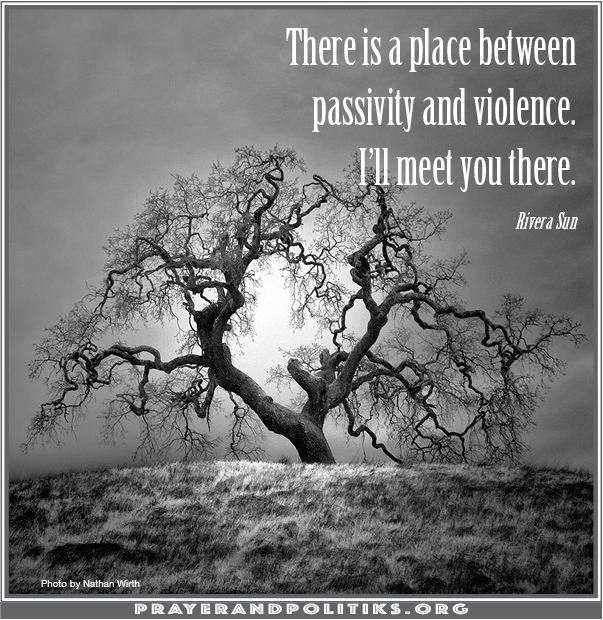
And in so doing, consider this invitation from Rivera Sun, novelist, activist, trainer in nonviolent social change: “There is a place between passivity and violence. I’ll meet you there.”

  1. Resolve to be an intercessor. If that sounds overly pious, that’s because our language has been hijacked. Here’s how New Testament scholar and activist Walter Wink speaks of such work:

“Intercessory prayer is spiritual defiance of what is in the way of what God has promised. Intercession visualizes an alternative future to the one apparently fated by the momentum of current forces. History belongs to the intercessors. . . . By means of our intercessions we veritably cast fire upon the earth and trumpet the future into being.”

It is primarily in our communal worship—however formal or folksy, however clearly defined or fluid the membership—that we practice such imagination. It is from others that we receive crucial information about who we are, the contour of our gifts, and when and where to practice them. We are not autonomous, self-made, solitaries or sovereigns, but rather are built for relation and communion. Not even the dirt is self-made: A single gram of forest soil can contain as many as a billion bacteria, up to a million fungi, hundreds of thousands of protozoans, and nearly a thousand roundworms.

It is no cause for qualm that we are each such small creatures in the scheme of things. Rather, it is a wondrous revelation that we are part of such a colossal unfolding of spirit into flesh, flesh into spirit. Reweaving the torn and mangled parts, however anear or afar, is our joyful calling.

§  §  §

Hymn of resolve. “I Wanna Be Ready,” Amos Machanic.

§  §  §

             3.5. Finally, the point-five: Instead of a fourth recommendation, because this one is neither the same
as the third nor is it separate, unmoored, or optional.

In the course of our intercessions, concrete possibilities for interdiction will open, when we actively, in sometimes granular detail, and fearlessly work to forestall the powers of shaming and maiming and nudge, however incrementally, beggarly life toward its promised flourishing, when “each will sit ‘neath their own vine and fig tree, and none shall be afraid” (Micah 4:4).

It is an exculpatory illusion to say “I love everybody.” Nobody loves everybody. You can only love this one, that one, the other one. Love requires the expenditure of assets—time, attention, security, reputation—and (I say with constant regret) we all have limits.

We each invest our paltry assets as best we know how, and make adjustments or redirection as circumstances indicate. The goal remains: that, someday, scarcity gives way to bounty, sorrow gives way to rejoicing, the hungry are fed and suppressive thrones will tumble. Our primordial mothers—Hannah (1 Samuel 2:1-10) and Mary (Luke 1:46-53)—testify to this uprising of Heaven’s intent for Earth’s reconstitution.

So we live, as best we can and with all our imperfections, as if this truth is even now springing from the ground. And we pray: Come quickly, Lord Jesus.

§  §  §

Benediction. “A prayer for the New Year.” (2:30 video)

Recessional. “Benedictus.—Karl Jenkins from “The Armed Man: A Mass for Peace,” performed by Hauser with the Zagreb Philharmonic Orchestra and Choir Zvjezdice  of Zagreb, Croatia

[For more on the topic of new year’s resolutions, see “New Year’s Resolutions: Promise-making in response to the Word of God”]

#  #  #


Pastoral empathy and prophetic discord

Against the backdrop of the war in Gaza

Ken Sehested

“For you shall go out in joy, and be led back in peace;
the mountains and the hills before you shall
burst into song, the trees in applause.”
—Isaiah 55:12

§  §  §


Prelude. “I don’t know how my mother walked her trouble down / I don’t know how my father stood his ground / I don’t know how my people survive slavery / I do remember, that’s why I believe. . . . / My God calls to me in the morning dew / The power of the universe, It knows my name / Gave me a song to sing and sent me on my way / I raise my voice for justice, I believe…” —“I Remember, I Believe,” Sweet Honey In the Rock

§  §  §

One of the great misfortunes in believing communities is the segregation of pastoral and prophetic vocations. As if you have to choose; as if, for pastors, you want to keep your job. As if being civil (“friendly”) is the highest Christian virtue.

It is certainly true that it is difficult to affect people’s attitudes and behaviors if you do not love them, if you are unavailable in moments of crisis (and celebration). And many of those moments, especially the unpleasant ones, do not occur in timely sequence or on orderly schedule.

Being call “prophetic” may seem complimentary; but it often is a polite way of saying “you make me uncomfortable.” And making people uncomfortable, is . . . well . . . pretty close to uncivil and unfriendly. You may get some begrudging admiration; but it doesn’t make people want to hang out with you.

When I was an organizer on justice and peace matters, a pastor asked me to preach while he was away. It was a complement, his church being a prominent one. But he ended his note of invitation saying “you can come stir things up and I’ll return to settle them down.”

Or earlier, when my focus was on the scourge of world hunger and food insecurity, I was asked to spend a weekend with a congregation, doing training and then preach on Sunday morning. The training was focused on helping a small group in the congregation find “handles” to get involved in their own location. (See “Pastoral Principles for Prophetic People.”)

Building on strategies for actual engagements with impoverished communities (theologian Gustavo Gutiérrez once commented: “So you love the poor? Name them.”), we explored the necessity for setting one’s local situation with larger national and international institutions, policies, and practices. Doing analysis is important: comprehending the structural forces which create poverty is essential if we are to move beyond charity to the work of justice.

I had several good conversations with the family who housed and fed me during this weekend. So much so that near the end of our time together, the wife admitted she was very nervous about what meals to prepare.

“I wondered if you subsisted on bean sprouts and tofu.”

Laughing, I said “No, locusts and honey.”

I doubt John the Baptizer got many guest preacher invitations; even fewer invites to Sunday dinner.

As the popular aphorism says, if you give a person a fish, they can eat for a day; but if you show them how to fish, they will eat for a lifetime. Which isn’t true: To flourish, they need fishing gear; transportation to a market; regulatory enforcement so that buyers do not exploit those who provide commodities; plus a trade network, with fair wages and just profits, to bring goods to a larger public, thus providing a reliable and sustainable circuit of production and consumption.

Then, of course, the training involved sitting these engagements and analysis within our spiritual tradition. There are some 2,000 biblical texts that insist on God’s special concern for the poor, the marginalized, those with no seat at the table of Creation’s bounty—a reality which God has promised to abolish. The point is, we undertake this advocacy not because we’re committed liberals but because this work is rooted in God’s pathos which, according to Scripture, is to be reflected in those walking in the Way of Jesus. Or as St. Augustine said so concisely, “We imitate whom we adore.”

I’m not keen on the framework of “inner” and “outer” when it comes to personal and public spirituality. But I can’t think of an alternative. The one sense in which I am still an evangelical—the one and only sense—is my conviction that human hearts must be disarmed as well as nations. Decisions about “horses” and “houses” (biblical metaphors for war and wealth) are deeply rooted in the human hearts. (See “Horses, housing, and human hearts: Giving your heart to Jesus will make you odd.”)

Spiritual formation is a lifelong process. Among my favorite quotes is from the legendary migrant labor organizer and proponent of nonviolent struggle, Cesar Chavez, who wrote, “I am a violent man learning to be nonviolent.”

The pastoral vocation, if it is to be effective, entails the need for prophetic disclosure, which is often discomfiting, even controversial. The prophetic vocation, to be efficacious, must include attention to the pastoral needs of its constituency—and the refusal to demonize opponents.

Early on in my organizing career (later confirmed in my role as a local church pastor), I learned that helping people find needed resources in pursuit of their gospel passions, helping them connect with others who share their convictions, was laying the groundwork for a larger mobilization designed to thwart the rule of public corruption and exploitive policies. Such work requires much patience and perseverance. You never know in advance when the “ripe” moment arrives for large scale change. And most do not live to experience that breakthrough.

This is pastoral work, and the vast majority of my time (in addition to funding a nonprofit) was consumed with this work. This work creates the building blocks which are ready, when the moment arrives, to mobilize in publicly dramatic ways.

Likely the least remembered quote from Dr. King is among his best insights: “Our most powerful nonviolent weapon is, as would be expected, also our most demanding, that is organization. To produce change, people must be organized to work together in units of power.”

It’s true that the strategies and tactics of pastoral work differ from those of prophetic work. And some people are better at one than the other. But it is essential that we build communities who know and understand that to meet the challenges we face, both of these practices must be engaged, must work in tandem, must discern at any given moment what is the timely need and emphasis and focus.

Of course, conflictive encounters arise both in interpersonal and in highly public encounters. A modern framing of the older construct contrasting pastoral and prophetic work in this regard is referred to (particularly in feminist and anti-racist training) as “calling in” and “calling out.” (See “Calling In and Calling Out Guide.”)  There are times that conflict should be dealt with, at least initially, one-on-one or in small groups; other times, what’s called for is a very public form of reprimand. Both methodologies have risks. Discerning which to do when isn’t always simple or easy.

Nevertheless, be clear about this, as South African Bishop Desmond Tutu insisted: “If you are neutral in situations of injustice, you have chosen the side of the oppressor. If an elephant has its foot on the tail of a mouse, and you say that you are neutral, the mouse will not appreciate your neutrality.”

§  §  §

What stimulated the essay above was the desire to post two very different pieces of writing.

The first one—“Buttered hot biscuits,” a riff on Romans 12:9-21—is a litany composed for use as the call to worship in my congregation.

The second is an excerpt from a stunning essay by Omer Bartov, an Israeli-American historian, one of the world’s leading authorities on Holocaust studies who is also a veteran of the Israeli Defense Force. One long paragraph in his article—“As a former IDF soldier and historian of genocide, I was deeply disturbed by my recent visit to Israel”—is a stark, utterly discomfiting summary of the impunity of ranking Israeli politicians regarding the war in Gaza.

These two pieces couldn’t be more different. But both speak to the questions of who we are? What time is this? Why we are needed? And for what and where?

[As a reminder of that war’s present casualties: More than 40,000 Gazans killed, more than 16,000 of them children; nearly 100,000 injured; at least 10,000 missing. Israeli citizens and soldiers killed: 335. Israelis injured: 6,465.}

#  #  #

Buttered hot biscuits
Inspired by Romans 12:9-21

Sisters and brothers: Before we get down to business, wrestling with what the Spirit has to say today, let’s do some stretching exercises. Don’t want any muscle strains in the house of the Beloved. Easy does it—bend and stretch and tip-toe fetch.

  • Love from your devotion, not from your ambition.
  • Be quick to praise, slow to blame.
  • Don’t quit in hard times. Show what you’re made of.
  • Practice hospitality—without issuing debt.
  • Laugh ‘til you cry with friends in their rejoicing; cry ‘til you laugh with those doubled in grief.
  • Don’t wrestle with pigs. It only makes them mad and makes you muddy.
  • Be relentless in prayer, patient in pardoning, quick to encourage, and urgent to amend.
  • Don’t fight fire with fire—let your baptismal waters do their work.
  • Settle old scores with buttered hot biscuits.

Now the warm-ups are over. Ready to break a sweat?

Descend, Holy Spirit. Take us to the mat.

—Ken Sehested

§  §  §

“Two days after the [7 October 2023] Hamas attack, defence minister Yoav Gallant declared, ‘We are fighting human animals, and we must act accordingly,’ later adding that Israel would ‘break apart one neighbourhood after another in Gaza’. Former prime minister Naftali Bennett confirmed: ‘We are fighting Nazis.’ Prime minister Benjamin Netanyahu exhorted Israelis to ‘remember what Amalek has done to you’, alluding to the biblical call to exterminate Amalek’s ‘men and women, children and infants’. [See 1 Samuel 5:1-3, where Samuel tells King Saul that God has ordered the extermination of the Amalekites, men, women, children, even animals.] In a radio interview, he said about Hamas: ‘I don’t call them human animals because that would be insulting to animals.’ Deputy Knesset speaker Nissim Vaturi wrote on X that Israel’s goal should be ‘erasing the Gaza Strip from the face of the Earth’. On Israeli TV he stated, ‘There are no uninvolved people … we must go in there and kill, kill, kill. We must kill them before they kill us.’ Finance minister Bezalel Smotrich stressed in a speech, ‘The work must be completed … Total destruction. Blot out the remembrance of Amalek from under heaven.’ Avi Dichter, agriculture minister and former head of the Shin Bet intelligence service, spoke about ‘rolling out the Gaza Nakba’. [In 1948 over 700,000 Palestinians were forced from their homes, or fled for their lives, from the land that is now the Nation of Israel]. One Israeli 95-year-old military veteran, whose motivational speech to IDF troops preparing for the invasion of Gaza exhorted them to ‘wipe out their memory, their families, mothers and children’, was given a certificate of honour by Israeli president Herzog for ‘providing a wonderful example to generations of soldiers’. No wonder that there have been innumerable social media posts by IDF troops in Gaza calling to ‘kill the Arabs’, ‘burn their mothers” and ‘flatten’ Gaza.”—The Guardian


[See also my own recent conclusion, “When discussing the war in Gaza, we must ask the question about genocide.”]

§  §  §

Benediction

Our journey with the Spirit leads us into the Earth’s pathos, reflecting that same pathos which afflicts Heaven. But all is not suffering. In the cracks and crevices springs Resurrection Day’s promise of joy. Of wonderment and reverential awe. An alleluia! sounds as signal that, finally, death shall not have the last word; that the meek will be the true inheritors of the earth; that the day hastens when enmity (including its eventual blossom as war) will no longer be learned or celebrated or calibrated. We find ways, however modestly or dramatically, to locate ourselves in compassionate proximity to those who most fervently longing for that sound. The very hills signal the advance of that Great Coming, with the trees breaking forth in applause. On that Bright Morning all tears will be dried; mourning will dissipate; and death will be no more in the boundaries of the new heaven and the new earth. (See Revelation 21:1-4)

We ourselves may not live to see that day. (See Hebrews 11:39) But in no way is our labor in vain, for in the midst of this present tribulation, joy girds our loins, shores wobbly knees, restores weak arms, and renews weary feet. For this is the buoyant, persevering, unquenchable resolve of God’s love.

In the immortal words of Stephen Stills: “Carry on; love is coming. Love is coming for us all.”

§  §  §

Postlude. “Drop, drop, slow tears, and bathe those beauteous feet, / which brought from heaven the news and Prince of Peace. / Cease not, wet eyes, his mercies to entreat; / to cry for vengeance sin doth never cease. / In your deep floods drown all my faults and fears; / nor let his eye see sin, but through my tears.” —“Drop, Drop, Slow Tears,” Orlando Gibbons, Tennebrae Choir

#  #  #

Days of hysteria (madness), promise of hilaria (rejoicing)

On maintaining the heart’s composure amid electoral mania

Ken Sehested

There is a certain pathology in our current season,
electoral follies punctuated by fresh tales of human
fury and nature’s duress—the combination exaggerated
if not unique. All the more reason to be reminded:

There is a life beneath, above, on the other side of this
present madness, a brightness excelling all expectation,
but not necessarily the one imagined, a surprise ending
beyond the sadness, a gladness for which we can only

wait in vigilant stillness—stillness, not inertia—where
the stilling is an ascetic centering and concentration
of the heart’s innermost desire reaching past the
boundaries of skin and kin, beyond stingy

care-fullness to generous care-lessness, where hope
eclipses fear’s gravitational pull, freeing hands to
practice the things that make for peace, releasing feet
to comport the good news of earth’s impending

reclamation and renewal. Despite much evidence,
those with eyes on the prize of a different, deeper
calling arise to confess that terror’s bedeviling will
not last. Creation’s aria and Redemption’s descant

may yet be heard above the dissonance, bolstered by
a chorus of witnesses, some as recent as yesterday,
sometimes even the stones themselves, in simple
melodies and complex harmonies. God’s orchestration

is not yet done. The finale is assured. Those with ears
to hear, persevere. Adagio. Be still. Hysteria’s reign is
in recession. Hilaria’s days of rejoicing approach.
Maranatha. Come quickly!

#  #  #

A remembrance of Will D. Campbell

on the anniversary of his birth, 18 July 1924

by Ken Sehested 

I was a stranger in a strange land, having left behind a Baylor University football scholarship for the alluring but intimidating environs of New York University’s Greenwich Village campus in Manhattan. I was so over being who I was, so eager for, if frightened by, what was to come. Odd that it was there, so far from home, that I should encounter the iconoclastic voice of a fellow Baptist-flavored Southerner whose testimony would come to profoundly impact the tenor of my own.

“Here’s somebody you should know about,” said Dr. Carse, my religion department mentor, as he tossed an open copy of Newsweek magazine across his desk. The upturned page contained a one-column profile of self-styled bootleg preacher, Rev. Will Campbell.

I quickly scanned the article through to the final paragraph which nearly jumped off the page, ending with a quote from Will: “Jesus is Lord, goddamnit!”

Will’s name may not be widely known, but his presence was deeply felt, and in the oddest assortment of circles, including Civil Rights activists, literary illuminati, death penalty opponents and the patrons of Gass’s honkytonk near Will’s home in Mt. Juliet, Tenn.

Will and his wife Brenda took my wife and me there for a catfish sandwich one weekend when we were guests. As soon as we ordered dinner Will got up and began to make the rounds of people he knew at several other tables, standing and chatting, occasionally pulling up a chair for longer conversation.

“He’s doing his pastoral visitations,” Brenda said, with a smirky smile. The local band that evening invited “Bro. Will” to join them as guest soloist for their last song before intermission, and Will obligingly belted out that country favorite, “Red Necks, White Socks and Blue Ribbon Beer.”

That’s one of the important lessons he taught me: that you might be a redneck if white liberals got rich making fun of you. The other really important lesson, from my earlier, first visit with him, newly-minted Master of Divinity from northern, liberal Union Seminary that I was: “Don’t confuse your job with your vocation.”

Prior to that initial in-person visit, Will gave me one of the most significant blessings a young writer could receive.

I had written a few book reviews for a Baptist publication, one of them of Brother to a Dragonfly. A few weeks after its publication, to my great astonishment, I got a letter from Will, typed on what was obviously an ancient manual typewriter. It was a thank you note.

“. . . At first I resolved that I would not read reviews,” he wrote. “Being fully human, fully sinner, when they began telling me that the reviews were favorable, I broke that resolution. ‘But, by god,’ I said, ‘I won’t be stupid enough to respond to any of them.’ Now I am breaking that resolution, though I believe for the very first time. “

“I break it for a number of reasons. I could say that I respond because you obviously understood what the book is about, and that was not the case with all reviewers. . . . But I am sure that the real reason is because of who you are—yes, ‘FAMILY.’ I am no longer a Southern Baptist preacher. But I will be, for so long as I live, a Baptist preacher of the South. There is a difference. . . .”

He went on to talk about his identity with our early Baptist forebears—before, as he wrote, “we went to Baal-Peor and became like the things we detested” (referencing Hosea 9:10), especially on the Anabaptist side. By that time he was fully exiled from every Baptist institution (indeed just about every Christian institution).

Then he closed by saying, “I am grateful to you for pasting a small snapshot [of me] in the back of the family album.”

About 15 years later, after speaking to a Baptist Peace Fellowship summer conference, he wrote again (and returned an honorarium check I’d sent), this time one hand-written sentence saying, “They’re ain’t enough of us to take money from one another.”

Campbell’s eccentricities are legendary. A small town Mississippi native, at age 17 he was ordained to the ministry by a Southern Baptist church in 1940, his Brother to a Dragonfly memoir (which reads like a novel) won in 1977 the Lillian Smith Prize in fiction and was a finalist for the National Book Award. He would later be the only white person in attendance at the founding of the Southern Christian Leadership Conference (through which Martin Luther King Jr. would galvanize much of the modern Civil Rights Movement’s history) and be the only white allowed in the mourning circle outside Dr. King’s Lorraine Motel room in Memphis following the assassination that set numerous US cities ablaze in despair.

In a high profile debate at a university over the question of capital punishment, Campbell took to the podium—after his debate partner’s learned, lengthy defense of the practice—to utter a one-sentence response: “I just think it’s [capital punishment] tacky.” Then he sat down.

Will received death threats for his outspoken opposition to segregation when he served as chaplain of the University of Mississippi; he accompanied African American children attempting to integrate a Little Rock, Ark., school; he counseled Nashville students—including telling them they could be killed, which they nearly were—as they planned to pick up the Freedom Ride which had been disrupted by a Birmingham, Ala., mob attack. Yet he carried out pastoral ministry to infamous Ku Klux Klan leaders, infuriating closest allies by insisting that “if you’re gonna love one, you gotta love ‘em all.”

Will knew that red necks were the mark of white tenant farmers and laborers who knew nothing of the wealth accumulated by the nation’s (and not just the South’s) moneyed elites.*

Personally, I suspect Will would be privately pleased and vocally horrified that the New York Times assigned a Pulitzer Prize-winning journalist to write his obituary. I have witnessed a few moments when recognition—a feeling of being welcomed and celebrated by kindred—was an experience of surprised delight that showed in his face. None of us can be exiles everywhere and all the time. Yet he constantly ridiculed notoriety of every sort, savaged institutions of every cut and cloth, and few riled him more than fawning fans.

He was, as John Leonard wrote so long ago in his New York Times review of Brother to a Dragonfly, “a brave man who doesn’t like to talk about it. . . .” Similarly, Rep. John Lewis, an icon of the Civil Rights Movement era, tweeted on the news of Will’s passing, “He never received the recognition he truly deserved.”

Hearing such, I can imagine Will pausing his heavenly choir rehearsal of “Red Necks, White Socks and Blue Ribbon Beer” long enough to grouse, “Yes, John, that’s just the point. Mr. Jesus didn’t say ‘blessed are you who find fame for your trouble.’

Trouble? What trouble?

#  #  #

* Another account of where the word “redneck” comes from is the “Battle of Blair Mountain,” an August 1921 violent confrontation between coal miners in West Virginia and a paramilitary force assembled by a mining company. The miners wore red bandanas around their necks to identify themselves. For more see “The Battle of Blair Mountain,” Evan Andrews, History

Injunctions for Lent

Ken Sehested

Lent’s emphasis on ascetic practices—prayer, fasting, and almsgiving—is not an obligatory gauntlet of self-abuse, designed to curry favor with the Beloved. These practices, rather, are illustrative means (there are many others) by which we can check personal and communal appetites, which so easily get out of control and function as illusions for what leads to the flourishing life intended from the Beginning. Of course, these aren’t limited-time-only practices; but during Lent the community of the Way devotes special attention to their observances.

A modern illustration: Some newer autos are equipped with a GPS-guided feature that sets off an audible alarm when it detects the car’s drift out of its lane of traffic. This is Lent’s training purpose for deepening life in the Spirit.

During Lent we are called on to do two things which seem at odds with each other. First, that we give focused attention to the world’s bursting seams and frayed conditions are resulting in repressive injury and mortal wounds.

On the other hand, we are also urged to resist the temptation to despair over the frightful state of the world’s condition.

The common assumption about hope is of the sort articulated by Countess Violet Crawley (played by Maggie Smith) on PBS’s “Downton Abbey” series when she said: “Hope is a tease designed to keep us from accepting reality.” Hope as fantasy, as magical thinking, as fluffy sentiment, as delusion.

In her extraordinary book, Hope in the Dark: Untold Histories, Wild Possibilities, Rebecca Solnit writes:

“It’s important to say what hope is not: it is not the belief that everything was, is, or will be fine. The evidence is all around us of tremendous suffering and tremendous destruction. The hope I’m interested in is about broad perspectives with specific possibilities, ones that invite or demand that we act. It’s also not a sunny everything-is-getting-better narrative, though it may be a counter to the everything-is-getting-worse narrative. You could call it an account of complexities and uncertainties, with openings. . . .”

Hear now these supplications and injunctions.

§  §  §

A supplication for Ash Wednesday

Return to your heart, O you transgressors, and hold fast to the One who made you. Stand with the Beloved and your footing shall be firm. Rest in the Merciful One and you shalt be buoyed.

Where do you go along these rugged paths, pilgrim, so far from home yet so winsomely loved? Be clear about what you seek, and where you seek, for the beatific life cannot be found in the land of illusion.

But do not despair, for life is stirring in cracks and clefts and barren terrain. Train your eyes to see through the tangle of disordered desire.

Resist, even to death, that which bedevils the common good. Welcome and foster all that shields the battered, that restores harrowed fields and forests, that reclaims despoiled waters and all creatures great and small.

In these lie your spiritual duty: the performance of your praise and the practice of your baptismal vows. By such does your heart’s delight align with your hand’s valor.

Thereby you shall you go out in peace and be led back in joy, the hills bursting in song, the trees in applause.

(borrowing from St. Augustine and Isaiah 55:12)

§  §  §

Admonitions for Lent

First Sunday

Kindred, lend your ears, set your sights, awaken your hearts! Lent’s rending work has begun. Your veiled life is destined for the Spirit’s tearing. Not for your woe, but for your weal; not for your injury, but for your delivery. The discomfort caused by Lent’s disciplines— prayer, fasting, almsgiving—is like that of the soil’s disturbance, the necessary rupture as preparation for receiving the seed. Trek with Jesus into the wilderness of risky provision. Venture into the wilderness of your own heart and habitation, where demons are wrestled and angels attend. Sustenance for this perilous journey entails a departing blessing. As you enter this feral landscape, hear Heaven’s assurance—as did Jesus, in Jordan’s penitential wake that you are beloved.

Second Sunday

Kindred, rouse from your slumber and sleepy-eyed repose! Awaken to Lent’s invitation to the storm’s squall and the desert’s besetting threat. Here, where desolation banishes distraction, set your face against the Tempter’s bargain and Mammon’s rule. Your detox recovery awaits, with the rough work of separation from addictive illusion and assumptions of privilege. Here the veil of self-sufficiency is lifted, eyes regain their focus, and the heart’s fibrillation realigns with the Beloved’s desire. Here begins the work repairing the rift between Earth’s agony and Heaven’s delight. Mind not the brow’s sweat, the hands’ callous, the arms’ ache, the legs’ fatigue. Treasure awaits.

Third Sunday

Kindred, Lent’s invitation is to move beyond prudence and discretion to a life on back roads, across furrowed fields and through tangled forests, at the summons of an eccentric vagabond like Jesus, escort on the migration out of slavery, hastening under cover of darkness with nothing but the stars as compass, uncertain provisions, no cushy pillow for to lay your head, knowing there are bloodhounds tracking your scent and rough men on your trail, destination uncertain, caution to the wind and risks galore, with only the whiff of freedom to assuage muscle ache, parched throat, and bloodied feet. Lift the veil on every sin-sick soul to the Light of God’s healing countenance.

Fourth Sunday

Kindred, Brazilian theologian Odja Barros, when asked to speak of where she saw God at work in the world, said instead: ““I confess that the first thing that comes to mind is to say where I see God’s absence,” detailing a few of those places, where the landscape is afflicted. Deus absconditus. “The hidden God.” Or, more literally (and more shockingly), the “absconding God.” “Truly, you are a hidden God” (45:15), Isaiah complained. “Why have you forsaken me,” cries the psalmist (22:1) and, later, at the last, cried Jesus (Matt. 27:46). Is this daring act of interrogating the Most High too impertinent to consider? Imagine instead if God could be contained by human forecast, held in check by creedal rigor, ritual purity, devotional sanctity, or moral precision. Thereby, as many prefer, God Becomes a mascot, a butler, an amulet—ornamentation to disguise blood lust. In the end, our Lenten prayer concludes, “Abba, into your hands I commend my spirit.”

Fifth Sunday

Kindred, in our secret prayers we demand to know: Why, Beloved, have you led us from the prosperous land of shopping and homeland security to this discomforting and inconvenient place where death’s scent is strong and life’s failures are on display? Know this, pilgrim: Lent’s labor may be disconcerting but it is never demeaning. The relinquishment God asks of us—the desert into which Jesus guides us—is not a kind of spiritual immolation. Nor is the bent-kneed posture of Lent a form of groveling, as a beggar to a patron. The flame of the Spirit’s igniting presence does not scorch us. It makes us radiant. The ascetic practices of spiritual discipline are training for life unleashed from our shriveled little egos. The fruition of Lent’s labor has less to do with what you give up than with what you take up. May the promise of the season’s eventual delight be sufficient to endure its demands.

Sixth Sunday

Kindred, we stand on the cusp of Jesus’ final confrontation with Rome’s rulers and temple bouncers. We ourselves wish getting right with God were a more civil, emotionally satisfying affair. Instead, Lent beckons us to peer into the face of history’s tragedies, including those in our own hearts. Not because God is a sadist and has need of masochists. But because mercy is available—the opportunity to reverse the brutal momentum of enmity’s sway. Then to reestablish neighborliness, to realign life to its accurate plumb. What Lent asks of us is not for the faint of heart. It’s rending entails a kind of scouring, a veil shredded, and a frightful vulnerability. Soon, we submit to ashen dust—not of humiliation and stigma but as a blaze marking the way to the New Jerusalem, where death will meet its match. So “let the heavens hear it: the penitential hymn.  Come healing of the spirit, come healing of the limb.”*

*line from Leonard Cohen’s “Come Healing”

§  §  §

Benediction. “Arvo Pärt: Cantus in Memoriam Benjamin Britten,” Baltic Sea Youth Philharmonic, conducted by Kristjan Järvi

#  #  #