Signs of the Times • 9 May 2018 • No. 161
¶ Processional. “Holy Mother, where are you? / Tonight I feel broken in two. / I've seen the stars fall from the sky. / Holy mother, can't keep from crying. / Oh I need your help this time, / Get me through this lonely night. / Tell me please which way to turn / To find myself again.” —Eric Claption & Luciano Pavarotti, “Holy Mother”

Above: April the giraffe’s new calf, born in 2017 at Animal Adventure Park in Harpursville, N.Y. Photo by Buddhika Weerasinghe/Getty Images. Watch this short (2:56) video of mom washing her newborn.
Special Edition
MOTHER'S DAY
¶ Invocation. “. . . and his arms were made agile . . . by El-Shaddai [“the Almighty”] who will bless you with blessings of heaven above, blessings of the deep that lies beneath, blessings of the breasts and of the womb.” —Genesis 49:24-25
¶ El Shaddai (feminine noun), literally “the God of the mountains” and translated “God Almighty” can also be translated “God of the breast,” conveying the quality of nourishing, satisfying and supplying needs. Used seven times in Scripture (see Genesis 17:1). The English translation of “El Shaddai” as “God Almighty” is misleading, because “almighty” suggests omnipotence, the capacity to overpower or destroy. Whereas “Shaddai” infers sufficiency and nourishment (i.e., “blessings of the breasts and of the womb”) and has a certain fecudity. —for a detailed, scholarly exposition of this word, see Roger Good, “El Shadday: It’s Meaning and Implications”
¶ Call to worship. “Women: Arise, then, women of this day! Arise, all women who have hearts, whether your baptism 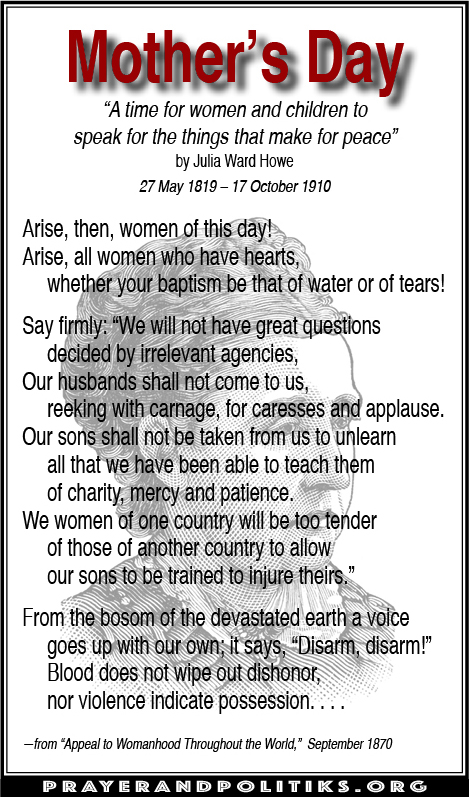 be that of water or of tears! / Men: Speak up, that all may hear! / W: Say firmly: “We will not have great questions decided by irrelevant agencies. / M: Say it loud, say it proud! / W: Our husbands shall not come to us, reeking with carnage, for caresses and applause. / M: Oh, brothers, can you hear? / W: Our sons shall not be taken from us to unlearn all that we have been able to teach them of charity, mercy and patience.” —continue reading “Mother’s Day: A litany for worship, drawn from the words of Julia Ward Howe”
¶ Hymn of praise. “The Lord is my Shepherd, I have all I need, / She makes me lie down in green meadows, / Beside the still waters, She will lead. / She restores my soul, She rights my wrongs, / She leads me in a path of good things, / And fills my heart with songs. —“Psalm 23,” Bobby McFerrin, using feminine imagery for God
¶ Anne Jarvis is often credited as the organizer for our existing Mother’s Day cultural observances. However, “As soon as Mother’s Day became truly popular, Jarvis hated it. After it received official recognition, Mother’s Day quickly became commercialized as retailers focused on selling flowers, candy and greeting cards to those wishing to shower their mothers with love. Jarvis tried to control the holiday and boycotted events and threatened lawsuits.” —for more see Abigail Abrams, “Mother’s Day History And Traditions: 5 Surprising Facts You May Not Know About The Holiday’s Dark Origins,” International Business Times
¶ Although others are given credit for founding the observance, Julia Ward Howe led in establishing what some believe to be the first observance of Mother’s Day in the U.S. (2 June 1872) after witnessing the carnage of the U.S. Civil War and the Franco-Prussian War in Europe. Howe’s concept of Mother’s Day was considerably different from today’s celebration. Her idea was to mobilize women as agents of resistance against the policies that led to injustice and war. In her Reminiscences she wrote: “Why do not the mothers of mankind interfere in these matters, to prevent the waste of human life which they alone bear and know the cost?” —continue reading “A brief history of Mother’s Day”
¶ More background to Mother’s Day. “Mother’s Day Traditions Around the World,” care.com.
¶ Mary, the mother of Jesus, has always played a large part in the lives of many Christians. Life magazine once 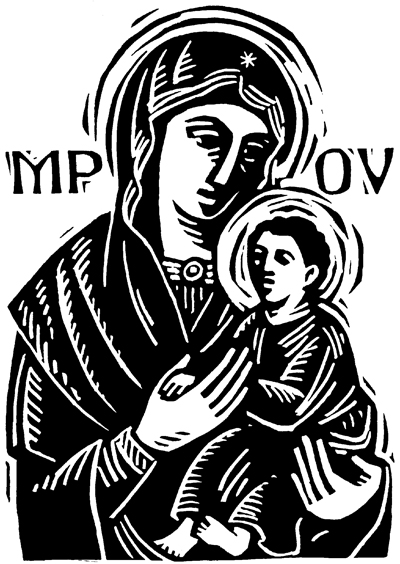 estimated the prayer “Hail Mary” is said two billion times every day. Mary’s “Magnificat” (Latin for “[My soul] magnifies”), also known as Mary’s Song, is the powerful canticle she speaks when visiting her cousin Elizabeth, recorded in Luke 1:46-55.
That prophetic speech has been deemed subversive by national governments. It was banned in the mid 1970s in Argentina after the Mothers of the Disappeared used it to call for nonviolent resistance to the military junta. In the 1980s the government of Guatemala banned its public recitation. After Chilean General Augustine Pinochet came to power in a 1973 military coup, he likewise banned the Magnificat as a public prayer.
During the British rule in India, the singing of the Magnificat in church was prohibited because of its incendiary lyrics. So, on the final day of British rule in India, Gandhi, who was not a Christian, requested that this song be read in all places where the British flag was being lowered.
¶ Confession. “There'll be icicles and birthday clothes / And sometimes there'll be sorrow.” Mother’s Day is not always happy. In 1964 at age 21, singer-songwriter Joni Mitchell’s boyfriend left her, pregnant. She kept it a secret from her family and gave her daughter up for adoption. Her 1970 song “Little Green” speaks to that experience. This grief is also behind her song “River”: “Oh, I wish I had a river so long / I would teach my feet to fly / I made my baby say goodbye.” She and her daughter reunited in 1997. Sometimes joy catches up from behind.
¶ Words of assurance. “As truly as God is our Father, so truly is God our Mother.” —Julian of Norwich, 14th century English anchoress, Christian mystic and theologian
¶ “In the early years of our congregation’s life, we pastoral leaders put special effort in planning Mother’s (and Father’s) Day—though without the sentimental trappings—to highlight and honor the work of parenting. . . . But afterwards, to our genuine surprise, we got more than a little pushback.” —continue reading “The pastoral dilemmas of observing Mother’s Day”
¶ Hymn of supplication. “Sometimes I Feel Like a Motherless Child,” Sweet Honey in the Rock.
¶ Short story. “I remember the first tim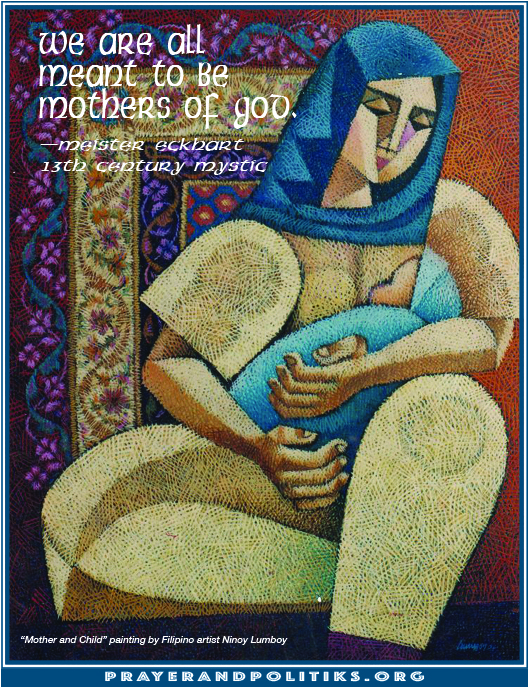 e I encountered the image of God as a laboring woman. I was reading Isaiah” for a seminary class. When I got to the “middle of chapter 42, I was stopped cold: ‘For a long time I have held my peace, I have kept still and restrained myself; now I will cry out like a woman in labor, I will gasp and pant’ (v. 14). What came to mind was an old photograph, “grainy, black-and-white” of “a woman in a hospital bed . . . her face knotted in agony. . . . You could practically hear a low, loud groan emerging from her throat.
“So there I was sitting on my sofa, reading Isaiah picturing . . . God’s face contorted in struggle; God groaning the way that a laboring woman groaned . . . and I felt profoundly uncomfortable. I felt disturbed.” (In addition to depicting God as a laboring woman, Isaiah also likens God to a midwife and a nursing mother.)
These images “compel me in their suggestion of a divine body that suffers, changes, swells, and leaks. For me, a divine body that leaks is also a divine body that discomfits.” —Lauren F. Winner, “Divine contractions,” The Christian Century
¶ Hymn of intercession. “From the north to the south / from the west to the east / hear the prayer of the mothers / bring them peace / bring them peace.” —Yael Deckelbaum & Prayer of the Mothers, “This Land”( English translation of Hebrew and Egyptian Arabic lyrics), a 14-member ensemble of Jewish, Arab and Christian women
¶ Preach it. “When Pharaoh’s daughter goes to bathe in the Nile, she hears the cries of the infant, is filled with compassion, and seizes the moment to act. Some verses later, when Moses is already grown and God reveals God’s self to Moses, God uses the same words: ‘I heard the cries of my people.” So what we have here is not imitatio Dei. Here we have a story where God imitates us, a woman, no less, and an Egyptian daughter of a tyrant.” —Rabbi Naamah Kelman, in “The holy work of dialogue,” Changing the Present, Dreaming the Future: A Critical Movement in Interr eligious Dialogue, Hans Ucko, editor
¶ In honor of National Teacher Appreciation Day, see “Reversal of fortunes,” written with thanksgiving for the teachers and educational administrators who know that knowledge is more than information, that character is not subject to cost analysis, and that learning potential exceeds the boundaries of test results. Don’t just thank a teacher. Argue for a different definition of national security.
¶ Hymn of resolve. “All the weary mothers of the earth will finally rest; / We will take their babies in our arms, and do our best. / When the sun is low upon the field, / To love and music they will yield, / And the weary mothers of the earth will rest.” —Joan Baez, “All the Weary Mothers of the Earth”
¶ Can’t makes this sh*t up. “Energy Secretary Rick Perry says he thinks using fossil fuels can help prevent sexual assault. . . . Speaking at an event sponsored by Axios and NBC News, Perry said electricity also was important ‘from the standpoint of sexual assault. When the lights are on, when you have light that shines the righteousness, if you will, on those types of acts.’” —PBS News Hour
¶ Call to the table. “My sweet Lord . . . are you not my mother and more than my mother? . . . For when the hour of your delivery came you were placed on the hard bed of the cross . . . and your nerves and all your veins were broken. And truly it is no surprise that your veins burst when in one day you gave birth to the whole world. . . . Ah! sweet Lord Jesus—who ever saw a mother suffer such a birth?” 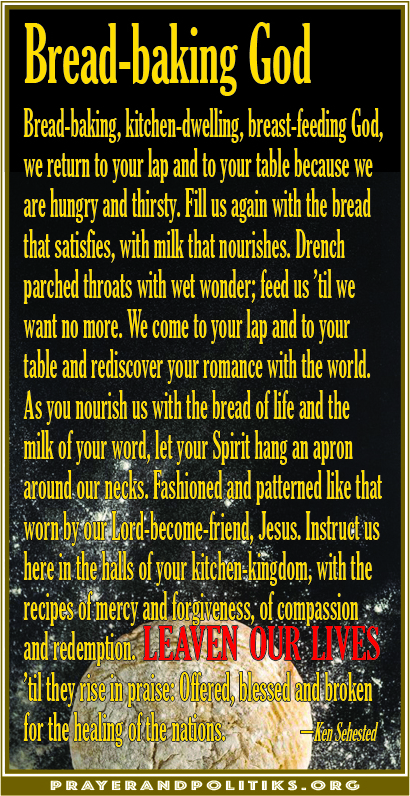 —Marguerite d’Oingt, thirteenth-century French nun
¶ In 2018, spending on Mother’s Day is expected to top $23 billion, an average of $180 per person. The 2018 breakdown includes spending of $4.6 billion on jewelry, $4.4 billion on dinner or brunch, $2.6 billion on flowers, $2.5 billion on gift cards, $2.1 billion on clothing, and the same amount on electronics. —Susan Campbell, WPRI
¶ The state of our disunion. No doubt one of the Britain’s royal couples, Duchess Kate and Prince William, received deluxe hospital care for the birth of their son, Prince Louis. Even so, the cost of that aristocratic delivery was about two-thirds the cost of average births here in the US. —USAToday
¶ For the beauty of the earth. In praise of “mothering” work everywhere, of every sort, and by everyone. Birthing work almost always involves some level of discomfort and often risk. Watch this 5:07 video of a sea turtle’s exhausting work of getting back to the surf after laying eggs at Topsail Beach, NC. (Thanks Deborah.)
¶ Altar call. “Mother Mary, full of grace, awaken. / All our homes are gone, our loved ones taken. / Taken by the sea – / Mother Mary, calm our fears, have mercy. / Drowning in a sea of tears, have mercy. / Hear our mournful plea. / Our world has been shaken, / we wander our homelands, forsaken.” —Eliza Gilykson, “Requiem,” written after the 26 December 2004 earthquake in the Indian ocean, creating a tsunami which struck Indonesia, killing over 260,000 (Thanks Steve.)
¶ Benediction. “Slumber, my darling, till morn's blushing ray / Brings to the world the glad tidings of day / Fill the dark void with thy dreamy delight / Slumber, thy mother will guard thee tonight.” —“Slumber My Darling,” performed by Allison Krauss, Yo-Yo Ma, Edgar Meyer and Mark O’Connor
¶ Recessional. “If I Could Hear My Mother Pray Again,” Staple Singers. (Thanks Mike.)
¶ Lectionary for this Sunday. Three litanies for worship inspired by Psalm 1:
• “We Shall Not Be Moved”
•”Multiply Their Presence”
•”Bound to this freedom”
 ¶ Lectionary for Sunday next. “When Pentecostal power erupts, all / heaven’s gonna’ break loose. / The boundaries will be compromised; / barriers will be broken; and / borders will be breached. / Economies of privilege will be fractured / and the politics of enmity will be impeached. / The revenge of the Beloved is the / reversal of Babel’s bequest.” —continue reading “Pentecostal passion,” a poem for Pentecost
¶ Just for fun. Making tacos in space—demonstration by an astronaut. (1:36 video. Thanks Sally.)
# # #
Featured this week on prayer&politiks
• “The pastoral dilemmas of observing Mother’s Day,” short commentary
• “Dry bones,” a poem inspired by Ezekiel 37:1-14
• A dozen new annotated book reviews under "What are you reading and why?"
Other features
• Resources for Pentecost Sunday worship planning: Litanies, poem, sermon, commentary, and a script for a choral reading of Acts 2:1-13
• “Reversal of fortunes,” brief commentary written with thanksgiving for the teachers and educational administrators who know that knowledge is more than information, that character is not subject to cost analysis, and that learning potential exceeds the boundaries of test results.
 ©Ken Sehested @ prayerandpolitiks.org. Language not otherwise indicated above is that of the editor, as are those portions cited as “kls.” Don’t let the “copyright” notice keep you from circulating material you find here (and elsewhere in this site). Reprint permission is hereby granted in advance for noncommercial purposes.
Feel free to copy and post any original art on this site. (The ones with “prayer&politiks.org” at the bottom.) As well as other information you find helpful.
Your comments are always welcomed. If you have news, views, notes or quotes to add to the list above, please do. If you like what you read, pass this along to your friends. You can reach me directly at kensehested@prayerandpolitiks.org.

 plastic bags and containers.
  disassociated from punishment as possible.” —Bryan Stevenson, on the opening of the National Memorial for Peace and Justice, quoted in “
 11:23
11:23 West
West ¶ “Here’s all the data Facebook and Google have on you.” —
 —continue reading “
 Featured this week on prayer&politiks