
Recent

The Promise of Pentecost

A sermon for Pentecost

by Ken Sehested
Texts: Acts 2:1-21; Ezekiel 37:1-14; Romans 8:22-23

      Word association: What images or associations come to your mind when you hear the word “Pentecostal”?

      Three texts intersect for today’s service:

      •the “dry bones” story from Ezekiel

      •the lyrical prose from Paul’s letter to the church at Rome, where he writes that “the whole creation has been groaning in labor pains until now.” Creation—not just human beings—are destine for redemption.

      •the story in Acts 2, read a few minutes ago.

      This text in Acts is among the most fantastic in all the New Testament. But it’s also among the most embarrassing:

      •all those awkward names

      •the coming of a “violent wind” and “tongues of fire”

      •Peter preaching on the street in Jerusalem (those street preachers are always embarrassing)

      This is a story chocked full of symbolic language and images and references from Hebrew Scripture:

      •It was in Isaiah that God promised that the divine mandate would be spoken by means of “strange men and a new tongue” (28:11)

      •It was a mighty wind (or “breath”) that divided the Red Sea so that the Hebrew people could make their escape from Pharaoh’s pursuing army

      There is a full restating of the remarkable prediction in the book of Joel of a day when God’s Spirit, God’s “breath,” will be poured out on all flesh, “and your sons and your daughters shall prophesy, and your young ones shall see visions, your old ones shall dream dreams. Even upon my slaves, both men and women, I will pour out my Spirit.”

      It is the divine breath which appears to the Prophet Ezekiel, showing him the valley of dry bones, asking the impossible: “can these bones live?”

      And of course there is the miracle of “tongues”—not the “tongues” of ecstatic speech, but the amazing capacity of all present to understand each other’s native language.

      The timing of this story is the Jewish festival known as the Feast of Weeks. It’s basically a celebration of the harvest, of the ingathering of crops, of provision being made for the coming year. And Jerusalem is crowded with people from all over.

      In fact, if you know the geographic background to all those strange nationalities mentioned in the story—Parthians, Medes, Elamites, Mesopotamia, Cappadocia, Pontus and Asia, Phrygia, Pamphylia, Egypt, Libia, Romans, Cretans, and Arabs—you know that the writer of this story is saying: From every point of the globe, from every imaginable place. This is no regional gathering. This is a global event.

      Most importantly, though, is a reference that is implicit in the text but never specifically mentioned: the story of Pentecost is the cosmic account of the undoing of the Babel story of Genesis 11. Do you recall it? It is the story of the beginnings of civilization itself. “Now the whole earth had one language, and the same words. And as they migrated from the east, they came upon a plain in the land of Shinar and settled there. And the said to one another, “Come, let us make bricks. And they had brick for stone and bitumen for mortan. And they said, “Come let us build ourselves a city, and a tower with its top in the heavens, and let us make a name for ourselves.”

      The story accounts in this way the emergence of human technological arrogance. By building a tower with its top in the heavens, we will become masters of our own fate. We will become as gods.

      And the text says “The Lord came down to see the city . . . and said, ‘This is only the beginning of their impirial ambitions.” And so God “confused their language, so they could no longer understand each other, and the people scattered over the face of the earth.

      So what does Pentecost signify for us? To answer that question, we first need to back up to Luke’s Gospel. Luke, as you may know, is also the author of the book of Acts. Near the end of his Gospel account, he records the final words of instruction from the resurrected Jesus, and Jesus says: Wait. Don’t go anywhere just yet. The announcement of the Reign of God must be proclaimed to all the earth. But first you have to be empowered to take on this mission.

      The revolution has begun, but it's far from over yet. God intends to restore the work of creation. The Deceiver has staged a palace coupe, taken over, and now rules with an iron fist. Babel’s power is still in force. But the Deceiver's days are numbered. The triumphant assault against death itself has begun. But don't you go off half-cocked. Wait here. Supplies are coming. Reinforcements are coming. Fire power is coming—fire like you've never seen, power like no one has ever seen. The flames of Pentecost are about to erupt. That will be your sign to break out of your hiding places at full speed. You've experienced the resurrection moment; next comes the resurrection movement.

      These are militant images. To be sure, it is a militancy governed by Jesus’ own submission to the cross (instead of calling forth 12 legions of angelic protection, cf. Matt. 26:53). But militant nonetheless, for there are times and occasions that offend our sweet-tempered disposition.

      Easter is God's resurrection moment; Pentecost is God's resurrection movement, the birthday of the church, the shock troops of the Kingdom. On Easter God declares divine intention; on Pentecost God deploys divine insurgents. On Easter God announces the invasion; Pentecost is when God establishes a beachhead. At Easter God announces, "I Have a Dream." On Pentecost Sunday, the marchers line up, the police close in, the first tear gas canisters fly, the first arrests are made. But the people of God keep on marching, heading for the courthouse, headed for the White House, headed for the jail house, headed for the school house, headed for the big house. Headed for every house that's not built on the solid rock of God's righteousness, God's justice; headed for every house that's been stolen from the hands that built it; headed for every house in every segregated neighborhood; headed for every house that shelters oppression, every house that welcomes bigotry, every house that schemes violence.

      "For the vineyard of the Lord of hosts is the house of Israel," said Isaiah, "and the Lord looked for justice, but behold, bloodshed; for righteousness, but behold, a cry! Woe to those who join house to house, who add field to field, until there is no more room, and you are made to dwell alone in the midst of the land" (5:7-8).

      "Therefore," says Amos, "because you trample upon the poor and take from them exactions of wheat, you have built houses of hewn stone, but you shall not dwell in them" (5:11)

      "Woe to you, scribes and Pharisees, hypocrites!" Jesus warned, "for you devour widows houses and for a pretense you make long prayers" (Matt. 23:14).

      But at Pentecost, the stolen house, the segregated housed, the house of oppression, even the big house is slated for redemption. Recall this description of the houses of the first Pentecostal powered community: "There was not a needy person among them, for as many as were possessors of lands or houses sold them, and brought the proceeds of what was sold and laid it at the apostles' feet; and distribution was made to each as any had need" (Acts 4:34).

      Pentecostal power is an assault on segregation; Pentecostal power is antagonistic to apartheid; Pentecostal power extinguishes ethnic cleansing; Pentecostal power negates nationalism; Pentecostal power wreaks havoc on racism; Pentecostal power triumphs over tribalisms of every kind.

      Now, notice here—and this is very important—the Pentecost story in Acts doesn't say everyone suddenly started speaking the same language. Pentecost does not destroy the various distinctives between and among people. But the story does affirm that these differences are brought under the binding power of the Holy Spirit. They can no longer claim autonomy. They are no longer barriers to community. They are now in the service of God—the very God who repeatedly, time after time after time, has acted to nudge creation back to its purpose in Genesis.

      Pentecostal power is the power to overcome ancient hostility, to gather the excluded, to scale the walls of social, racial, even class divisions. Between gay and straight.

      I'm convinced that Pentecost is now the most important season for us as Christians. The true energy of Easter is more than, is fundamentally different from the "sugar high" you get from eating chocolate Easter bunnies. That kind of energy burns off within hours, leaving us weary, exhausted. That kind of energy is quickly dissipated. Within a week the Body of Christ is dragging its sparse remnants to a half-hearted post-Easter Sunday service. The resurrection moment is producing very little movement.

      A cynical journalist once wrote that a conservative is someone who worships a dead radical. Dead radicals can't bother us anymore. We quickly domesticate their memories, kind of like the way we do with Dr. King. Of course, we don't think of Jesus as dead; but he does seem to be safely tucked away in heaven. And from a lot of the preaching I hear, you'd think our job is simply to convince people they need to start making payments on a ticket to join him there when they die. No threatening movement seems to occur when Pentecostal power is preached from our pulpits.

      By and large the believing community has become strangers to the power Jesus promised. The subversive character of his life has been entombed in memorial societies we call churches. We revere his memory but we renege on his mission. The proclamation of the Gospel no longer threatens the new world order our leaders envision for us. The erupting, disrupting flow of Pentecostal power has been pacified, rendered harmless, packaged for television broadcast.

      There was a time when the redemptive power activated at Pentecost was the power to mend the rips within our social fabric, to restore splintered relationships, to repair broken communities. Pentecostal power once indicated the power to stand in the cracks, to face the hostilities without fear, to confess, repent and repair.

      Among the names for God in Scripture is one that means “Advocate.” Or, you could say, “Counsel for the Defense.” In other words, someone who is For Us, a Divine Protagonist—not to get us or trap us or force us into embrace. But One who is in the process of turning us all toward each other, even to our enemies. A Protagonist who lets us in on the divine secret: the world is headed for a party, not a purge. A Protagonist who assures us that we can risk much because we are safe, that nothing—not even death—can forestall the divine purpose of redemption. This Protagonist, the Holy Spirit, this wind and fire, is taking us into the very heart of God’s and God’s purposes, aligning us with divine intention for creation. In the Pentecostal movement, God is pitching a tent in our midst.

      What would it look like if the Circle of Mercy were immersed in such power?

      We will carry on this conversation more specifically next Sunday when we focus on the call of Isaiah.

Circle of Mercy Congregation
Asheville NC
4 June 2006

©Ken Sehested @ prayerandpolitiks.org

News, views, notes, and quotes

7 May 2015  •  No. 20

Special issue on
IMAGINATION

RIP: Guy Carawan. Few, if any, songs carry the politically realistic power of imagination more than “We Shall Overcome.” It likely began as a song sung by farm working slaves as “I’ll be all right someday.”  In 1901 Rev. C. Albert Tindley published “I’ll Overcome Someday,” though its lyrical and musical structure is significantly different.
        The song’s history is deliciously ironic: Molded in large part by Guy Carawan (at left—he was affectionately known as a “hippy-hillbilly”), which became the unofficial anthem of the Civil Rights Movement in the US, and sung since by hope-filled dissenters from South Africa to North Korea, Beirut to China’s Tiananmen Square. I was taught the Arabic version by a group of children in Baghdad in 2000. (Watch this one minute video of Jordanian young women singing “We Shall Overcome” in English.)

        Carawan, folk musician and musicologist who died this past week, is not well known outside certain musical and civil rights circles. A California native, he more than any other is responsible for what we now know as “We Shall Overcome.” (Here is an 8+ background audio story on National Public Radio. See also this story from the Roanoke Times)

        Carawan, who says he learned the song from a friend in California, began regularly using the song at the Highland Center in east Tennessee, a social justice training center founded in 1932, initially to train labor organizers, later focusing on civil rights, where members of the Student Nonviolent Coordinating Committee (then other civil rights leaders) first learned it. Carawan, Highlander co-founder Zilphia Horton (who took the lead in making cultural arts a part of training), Frank Hamilton and Pete Seeger jointly own the copyright.
        Here’s is a rendition of Carawan singing the song. For choral music fans, here is the Morehouse College Glee Club’s rendition. Numerous other musical celebrities have versions on YouTube.

§ § §

In honor of everyone, everywhere,
who remain steadfast in the conviction that
what is promised is more than what is present,
here is a collection of quotes on imagination.

§ A vision without a task is but a dream, a task without a vision is drudgery, a vision with a task is the hope of the world. ~Church inscription, Sussex, England (1730)

§ Imagination is more important than knowledge. ~Albert Einstein

§ Violence is the behavior of someone incapable of imagining other solutions to the problem at hand. ~Vicenç Fisas

§ While the Passover narrative [in Exodus] energizes Israel’s imagination toward justice, Israel’s hard work of implementation of that imaginative scenario was done at Mt. Sinai. . . . Moses’ difficult work at Sinai is to transform the narrative vision of the Exodus into a sustainable social practice that has institutional staying-power, credibility, and authority. ~Walter Brueggemann

§ It always seems impossible until it’s done. ~Nelson Mandela

§ I believe our task is to develop a moral and aesthetic imagination deep enough and wide enough to encompass the contradictions of our time and history, the tremendous loss and tragedy as well as greatness and nobility, an imagination capable of recognizing that where there is light there is shadow, that out of hubris and fall can come moral regeneration, out of suffering and death, resurrection and rebirth. ~Richard Tarnas

§ All things are possible to the one that believes. ~Jesus

§ Hold fast to dreams, / for if dreams die,  / life is a broken-winged bird / that cannot fly. / Hold fast to dreams / For when dreams go / Life is a barren field / Frozen with snow. ~Langston Hughes

§ A person will worship something, have no doubt about that. We may think our tribute is paid in secret in the dark recesses of our hearts, but it will out. That which dominates our imaginations and our thoughts will determine our lives, and our character. Therefore, it behooves us to be careful what we worship, for what we are worshiping we are becoming. ~Ralph Waldo Emerson

§ Moral imagination is the capacity to imagine something rooted in the challenge of the real world yet capable of giving birth to that which does not yet exist. . . . The moral imagination believes and acts on the basis that the unexpected is possible. It operates with the view that the creative act is always within human potential, but creativity requires moving beyond the parameters of what is visible, what currently exists, or what is taken as given. . . .  ~John Paul Lederach

§ Every great advance in science has issued from a new audacity of imagination. ~John Dewey

§ To hope is a duty, not a luxury. To hope is not a dream, but to turn dream into reality. Happy are those who dream dreams, and are ready to pay the price to make them come true. ~Cardinal Leo Suenens

§ In order to create an effective movement for redemptive engagement, reflective work must be integrated with affective learning in the context of a community of conviction. Mind and imagination must be addressed, and these must be tethered to disciplines of concrete and communal commitments. ~Ken Sehested

§ Every imperial agent wants to reduce what is possible to what is available. ~Walter Brueggemann

§ If you want to change people's obedience then you must change their imagination. ~Paul Ricoeur

§ The step between ecstatic vision and sinful frenzy is all too brief. ~Franciscan priest William of Manchester (played by Sean Connery), in the movie “The Name of the Rose”

§ You can't depend on your eyes when your imagination is out of focus. ~Mark Twain

§ The Eucharist has been preempted and redefined in dualistic thinking that leaves the status quo of the world untouched, so congregations can take the meal without raising questions of violence; the outcome is a “colonized imagination” that is drained of dangerous hope. ~Walter Brueggemann

§ To be sane in a mad time / Is bad for the brain, worse / For the heart. The world / Is a holy vision, had we clarity / To see it. ~Wendell Berry

§ Most peacemakers don’t begin with a grand vision. They begin with the troubles at hand and the resources they have. Then you act for good, for justice, for healing, for hope, for peace. It’s as simple as that. ~Dan Buttry

§ As for me, the grounds of my hope have always been that history is wilder than our imagination of it and that the unexpected shows up far more regularly than we ever dream. ~Rebecca Solnit

§ When we are dissatisfied with things as they are, or suffer and know pain, we begin to imagine what the world would be like if things were different—if there were no hunger or thirst and all tears were wiped away (Rev. 7:14). Creative imagination reaches toward God, and glimpses a new heaven and new earth. The new reality has nothing to do with the present order. In fact, the one who responds to call seeks to put something more beautiful in the place of what she sees. This is where the friction and fight begin. ~Elizabeth O’Connor

§ Imagination is better than a sharp instrument. To pay attention, this is our endless and proper work. ~Mary Oliver

§ The two, suffering and hope, live from each other. Suffering without hope produces resentment and despair. Hope without suffering creates illusions, naïveté, and drunkenness. Let us plant dates, even though we who plant them will never eat them. We must live by the love of what we will never see. This is the secret discipline. ~Rubem Alves

§ Logic will get you from A to B. Imagination will take you everywhere. ~Albert Einstein

§ When we are dreaming alone, it is only a dream. When we are dreaming with others, it is the beginning of reality. ~Dom Helder Camara

§ You can’t depend on your eyes when your imagination is out of focus. ~Mark Twain

§ I have a dream my four children will one day live in a nation where they will not be judged by the color of their skin but by the content of their character. ~Martin Luther King Jr.

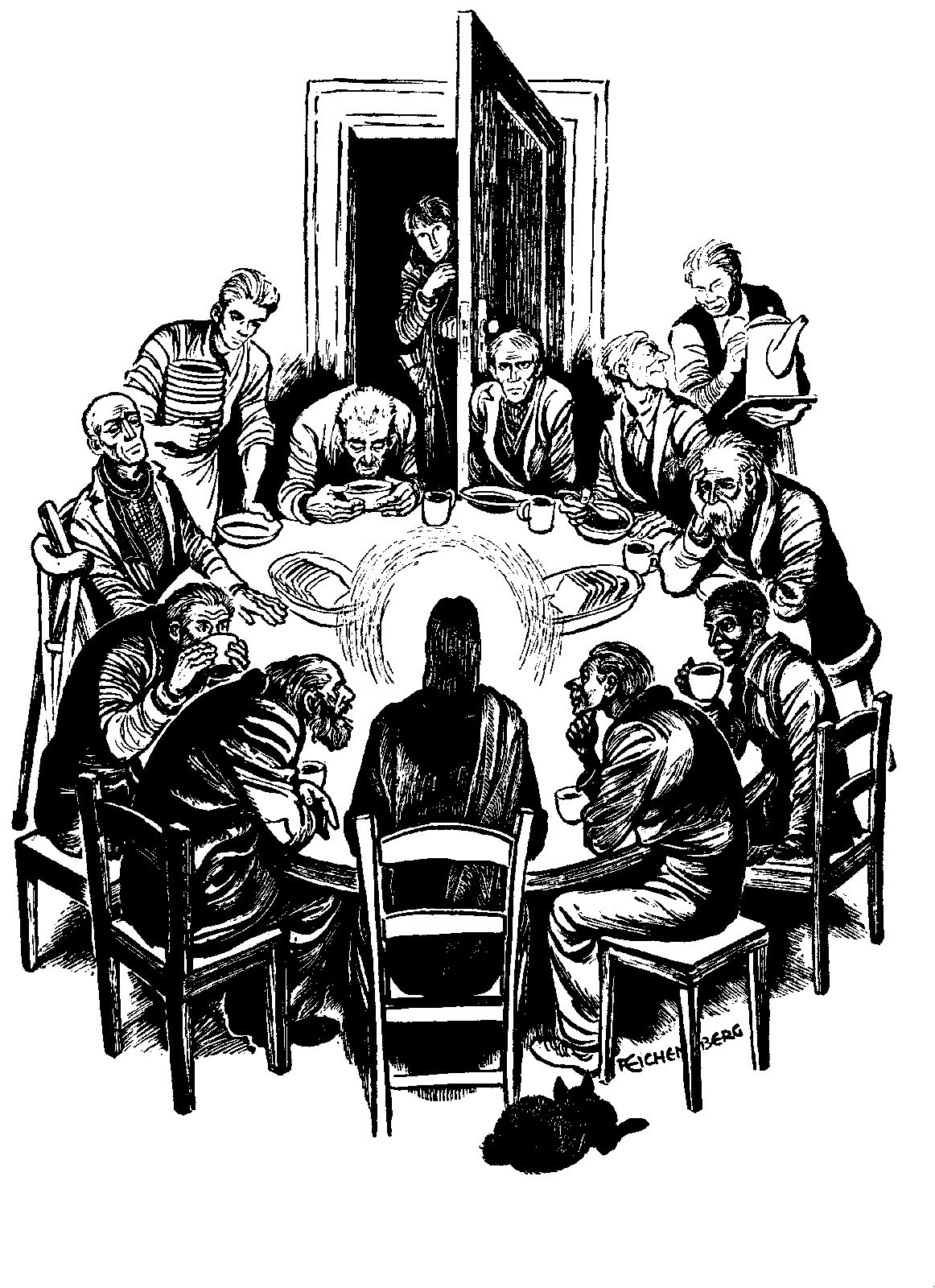
Left: Woodcut by Fritz Eichenberg (cf. Isaiah 11).

§ Those who dream by day are cognizant of many things that escape those who dream only at night. ~Edgar Allan Poe

§ Any real change implies the breakup of the world as one had always known it, the loss of all that gave one identity, the end of safety, and at such a moment, unable to see and not daring to imagine what the future will bring forth, one clings to what one knew, to what one possessed or dreamed that one possessed. Yet, it is only when a man is able, without bitterness or self pity, to surrender a dream he has long cherished, or a privilege he has long possessed, that he is set free—that he has set himself free—for higher dreams, for greater privileges. ~James Baldwin

§ Vision is the art of seeing things invisible. ~Jonathan Swift

§ The real voyage of discovery consists not in seeking new landscapes but in having new eyes. ~Marcel Proust

§ All people dream: but not equally. / Those who dream by night / in the dusty recesses of their minds / wake in the day to find that it was vanity. / But the dreamers of the day / are dangerous people, / for they may act their dream with open eyes / to make it possible. ~T.E. Lawrence

§ Fantasy mirrors desire. Imagination reshapes it. ~Mason Cooley

§ Rationalism is merely the human structuring of reality by those in power. ~author unknown

§ You will recognize your own path when you come upon it, because you will suddenly have all the energy and imagination you will ever need. ~Jerry Gillies

§ The Possible’s slow fuse is lit / by the Imagination. ~Emily Dickinson

§ Sometimes imagination pounces; mostly it sleeps soundly in the corner, purring. ~Terri Guillemets

§ Sometimes I've believed as many as six impossible things before breakfast. ~Lewis Carroll

§ Things are only impossible until they're not. ~Jean-Luc Picard, Star Trek: The Next Generation

§ Perhaps imagination is only intelligence having fun. ~George Scialabba
§ Discovery consists of seeing what everybody has seen and thinking what nobody has thought. ~Albert Szent-Györgyi

§ The difficulty lies not so much in developing new ideas as in escaping old ones. ~John Maynard Keynes

§ Love in action is a harsh and dreadful thing compared with love in dreams. Love in dreams is greedy for immediate action, rapidly performed and in sight of all. Men will give their lives if only the ordeal does not last long but is soon over, with all looking on and applauding as if on the stage. But active love is labor and fortitude. ~Fyodor Dostoyevsky

§ When we engage in what we are naturally suited to do, our work takes on the quality of play and it is play that stimulates creativity. ~Linda Naiman

§ It seems to be one of the paradoxes of creativity that in order to think originally, we must familiarize ourselves with the ideas of others. ~George Kneller

§ It is good to be introduced by someone with a glib tongue, a vivid imagination and an elastic conscience. ~Foy Valentine

 § You can crush the flowers, but you can’t stop the spring. ~Alexander Dubcek, hero of the Prague Spring uprising of 1968

§ We do not live by what is possessed but by what is promised. ~Walter Brueggemann

§ The person who loves their dream of community will destroy community, but the person who loves those around them will create community. ~Dietrich Bonhoeffer

§ I slept and dreamt that life was joy; / I awoke and saw that life was service; / I acted and, behold, service was joy. ~Rabindranath Tagore

§ Whoever you are, no matter how lonely, / the world offers itself to your imagination, / calls to you like the wild geese, harsh and exciting — / over and over announcing your place / in the family of things. ~Mary Oliver

§ There are times when life is cruel beyond imagination and beyond explanation. At such times, we simply wrap our arms around the still-breathing bodies of those we cherish. And we pray, and we sing, and we speak tenderly through the tears, chanting aloud or silently the promise that one day, all tears will be dried; one day, all mourning will pass away; one day, all crying will cease; one day, death itself shall come undone (Rev. 21:4). ~Ken Sehested

Right: Woodcut by Meinrad Craighead.

§ We are a little lost here in America. Too many of us have tuned out, and too many of us are deeply tuned in to the wrong things. Our eccentricities have curdled into crochets. Our love for the strange and deeply weird has soured into a devotion to the mean and deeply angry. Our renegade national soul has given itself up to petty outlawry. . . . Imagination always has been the way out—a faith in that which seems impossible, a trust that not every mystery is a murder mystery, and that not every mysterious creature is a monster. Imagination is the way out—a belief that safety is not necessarily the primary (or even the secondary) goal of democratic citizenship, and that a self-governing political commonwealth does not always come with a lifetime guarantee. Yes, we are a little lost here in America, but we can find our way, and the best way that we can find is the one that seems like the least secure, the darkest trail, the one with the long, sweeping bend in the road that leads god knows where. ~Charles P. Pierce, “Goodbye to All That”

§ Where there is no vision, the people perish. ~Proverbs 29:18

#  #  #

Featured this week on prayer&politiks:
• “The Worst Alternative Ending Ever,” a sermon about Jonah (and about bowling in Baghdad)
• A new group of annotated reviews under “What are your reading and why?

©Ken Sehested @ prayerandpolitiks.org. Language not otherwise indicated above is that of the editor. Don’t let the “copyright” notice keep you from circulating material you find here (and elsewhere in this site). Reprint permission is hereby granted in advance for noncommercial purposes.

Your comments are always welcomed. If you have news, views, notes or quotes to add to the list above, please do. If you like what you read, pass this along to your friends.

 

The Worst Alternate Ending Ever

The story of Jonah

Sermon by Ken Sehested

      Along with the weekly columns for my online journal, I’m also slowly adding other material I’ve written in the past. Back in February I decided to add four columns I wrote for the Asheville Citizen-Times a dozen years ago: one just prior to my last trip to Iraq and three written while I was in Baghdad. I left on that three-week trip in early February 2003, shepherding the last group of volunteers with Christian Peacemaker Teams to enter the country prior to the US “shock and awe” invasion.

      One of the most unusual stories from that trip started with dinner one evening at the hotel where I stayed. I sat down to eat with Charles, another team member, who had been in Baghdad several weeks. As we finished, he casually asked me, “Would you like to go bowling tonight?”

      Bowling? In Baghdad?! On the verge of a massive invasion?!? (“Bowling in Baghdad” sounds like a Jon Stewart Daily Show skit.)

      My new friend Charles, a professional photojournalist, had gotten to know the neighborhood where we were staying, on the banks of the Tigris River as it runs through Baghdad. He had discovered, just a few blocks away, a small two-lane bowling alley, and he’d been there several times. I said “sure!” and off we went.

      Thankfully one of the lanes was empty, so we were able to start immediately. Midway through our first game I noticed that the three Iraqis in the lane next to us were quite good. One in particular. He kept rolling strike after strike. After our second game, I nudged Charles and said, “Did you see how good this guy is?” Charles said, sure, I met Akmed here before. He’s a former Iraqi national bowling champion.” I was floored. I had no idea Iraq had bowling championships.

      I whispered to Charles, “Do you think Akmed would be willing to give me his autograph.” “I think he would,” Charles said, who walked over and said something to one of the other Iraqis who spoke English, who then relayed my request to Akmed, who then smiled brightly at me. I began looking around for a piece of paper for his signature as he walked over to a desk near the door, opened a drawer, pulled out something which seemed to have a string attached. And he was writing on it as he made his way back to me, where he then handed me this medallion. Turns out it was one of his bowling medals. Nothing fancy—he probably had a bunch of them. But he signed his name on the back, and he gave it to me.

      I thought of this story, and the story of Jonah, our text for today, after reading that in 2014 the Jihadist group known as ISIS had blown up the Tomb of Jonah in the city of Mosul, the largest city of northern Iraq.

      Mosul, the modern name of the ancient city of Nineveh, the very place to which the prophet Jonah was sent by God. Mosul, where until recently Chaldean Catholics had worshiped continuously for nearly two millennia. (Tradition has it that Thomas and Thaddeus, two of Jesus’ apostles, traveled to this region and started a new congregation in the first century C.E.)

      The story of Jonah is among the most recognizable in all of Scripture. It’s that whale that made him famous—though the text only says Jonah was swallowed by a “large fish.”

      The Book of Jonah is among the shortest in the Bible, a total of four chapters, two pages in the edition I use. It’s also one of the funniest books in the Bible; but the humor is so understated that it doesn’t come through—a modern production of the story would surely have a laugh track played at several points in the story.

      Since most people generally only know the first chapter, let me do a quick preview of the whole narrative.

      The book begins abruptly—in fact, every change of scene is abrupt and provides minimal detail. Without explanation, it begins, “Now the word of the Lord came to Jonah, son of Amittai, saying, ‘Go at once to Nineveh, that great city, and cry out against it; for their wickedness has come up before me.’” The story’s original hearers would have boo-ed and hiss-ed at the speaking of the city’s name. Nineveh! Capital of the hated Assyrian empire which destroyed Israel, wiping its people from the pages of history.

      By the way, the Hebrew phrase translated as “the word of the Lord” is devar Ha-Shem, which literally means “The Name.” The Name came to Jonah.

      Jonah’s response was nothing like that of Peter, Andrew, James and John—Jesus’s disciples—who when called immediately dropped their nets and followed Jesus as instructed. Jonah, on the other hand, immediately booked passage on a freighter headed for Tarshish, in the opposite direction.

      By verse four of the first chapter we learn that The Name stirred up a great storm which threatened to sink the boat Jonah was on. The sailors “each cried to his god”—this was a pious group—and began tossing cargo overboard to lighten the load. They also decided to interrogate this Hebrew passenger who, the story says, was still asleep in the hold. Over the course of several verses of conversation, the sailors come to know that Jonah worships The Name, and that Jonah is somehow at the center of this storm. Jonah admits he’s the guilty one and invites the crew to toss him overboard to save their necks.

      Against all odds, Jonah didn’t drown, but was swallowed by a large fish, which, in utter brevity, the text says was actually arranged by The Name. (This is one of several places in the story which should have the sounds of a laugh track.) That’s the last of chapter one.

      The entirety of chapter two is a prayer by Jonah, who’s managed to find an air pocket in that fish’s gullet. “I called to The Name out of my distress, and The Name answered me. . . . The waters closed over me . . . weeds were wrapped around my head at the roots of the mountains. I went down to the land whose bars closed upon me forever.” Then the frame changes from second person to first: “Yet you,” Jonah says, addressing God directly, “you brought up my life from the Pit.” The chapter closes—without explanation or commentary: “Then The Name spoke to the fish, and it spewed Jonah out upon the dry land.”

      Chapter three begins simply repeating the original marching orders from The Name: Go to Nineveh. No threats. No warning. No cajoling. Just the mandate. This time Jonah obeys and sets out, covered in fish vomit, for the great and wicked city.

      Somewhere on the way to Nineveh The Name reveals the message Jonah is to deliver. And it’s the shortest sermon in history, a total of five words in the original Hebrew: “Forty days more, and Nineveh will be overthrown!”  Jonah declared to the residents. Again, no details. No explanation. No recitation of the charges. No long-winded harangue. No where to hide.

         With no transition other than a period at the end of Jonah’s threat, the text reports that Nineveh’s king repented and demanded all citizens to do the same. Again, there should be a laugh track after verse 8, when not only humans but all the animals (cue the laugh track) of the city are to be dressed in sackcloth and covered with ashes, the traditional ancient Middle Eastern ritual of penitence. The wording of this act of contrition is especially interesting. The text says “All shall turn from their evil ways and from the violence that is in their hands” (v. 8).

         Evil, a “spiritual” reality, and violence, a “material” phenomenon, are always and everywhere intertwined and self-reflecting. As we might say, “where there’s smoke, there’s fire.” Each is indicative of the other. This is whey learning to live nonviolently is so central to our common life.

         Meanwhile, Jonah left the city, found a little shade, and sat down to watch the fireworks, waiting for The Name to unleash “shock and awe.” But, as chapter three ends, the text simply says “When God saw what the Ninevites did, how they turned from their evil ways,” God repented. Withdrew the threat. Called off the invasion.

         And Jonah’s reaction? Hallelujah! Thanks be to God!! A miracle has happened!!!

         No. Jonah was mad as hell. Threw a hissy-fit. Storms into God’s face yelling, “This is why I took off for Tarshish in the first place. I knew you are [quote] ‘a gracious God and merciful, slow to anger, and abounding in steadfast love, and ready to relent from punishing.*’” Jonah is angry because God has gotten soft on crime.

         [*This is actually a quote from Exodus 34:6, a refrain about God’s character which prophets and psalmists would return to over and over again.]

         This episode, chapter four, gets played out in a little drama where Jonah is depicted as little more than a petulant child. God causes a bush to grow to shade Jonah in his discomfort. But the very next morning God appointed a worm to eat the bush. That’s when Jonah’s pouting begins. God asks,

         “So, you’re angry about the bush-gone-bad?” (Cue the laugh track.)

         “Yes!” Jonah shrieks. (More laughter in the audience.)

         Then comes the punch line: “So, Jonah, let me get this straight: You’re angry about the bush, for which you did not labor and which you did not grow. . . . Should I not be concerned about Nineveh, home to more than 120,000 who do not know their right hand from their left?” Then—for further comic effect—“and also many animals?”

         It’s not fair! Jonah keeps repeating, bottom lip curled and poking out. It’s just not fair!! How many times I’ve caught myself repeating Jonah’s complaint when I didn’t get something I deserved—or when my enemies didn’t get something they deserved.

         One final story.

         Most mornings I end my breakfast routine reading the “Non Sequitur” cartoon in the morning paper. I don’t know anything about Wiley Miller, the cartoonist who creates the zany characters of his cartoon strip. But I’m quite sure he grew up in Sunday school, because more than a few of his cartoon strips assume some minimal knowledge of biblical stories.

         My all-time favorite appeared late last year. It’s a single-frame cartoon, with a spindly man in top hat and tails dancing and singing on the back of a whale headed toward the sun’s horizon. The caption’s brevity beats that of Jonah’s five-word sermon. Wiley’s is: “Worst alternate ending ever.”

         Any guesses as to what this means?

         I’m pretty sure Wiley has read the story of Jonah. And what’s behind the punch line “Worst alternate ending ever. . . .”? In this alternate version of the story, Jonah didn’t have to spend three days in the belly of that fish. Most spiritual formation happens in the depth of some stormy sea, somewhere down near the “roots of the mountains.” In this version of the story, Jonah didn’t even get wet, much less cry out from his very life.

         What’s more, in this alternate ending Nineveh disappears altogether from the story. There is no confrontation with wickedness and violence. Jonah doesn’t have to face his arrogance and pride—he didn’t have to encounter that One known simply as The Name, whose ways do not conform to human calculations and management, the One who refuses to be anybody’s good luck charm, to be any nation’s mascot. God may indeed bless American . . . or Papua New Guinea, for that matter, but not for the reasons we think appropriate.

         The worst alternate ending ever is a sarcastic take so much of what passes for “spirituality” these days, both the “new age” variety as well as the other, traditional versions. In this version, spiritual formation is reduced to positive thinking and happy-clappy sentiment. The challenge of Nineveh disappears altogether. You can ignore the fishy tale, the fleshly discomfort, the mandate to a kind of holy madness whose passion entails the welfare of enemies.

         You can choose to never go bowling in Baghdad. To never risk arrest at a Federal Energy Resources Commission meeting. To remain silent in the face of educational and health industries driven by profit motives. You can choose to fume against your neighbor rather than speak to them over conflicts of interest. Shun a friend, or a family member, or someone you know right here in this Circle, rather than risk a tempestuous conversation to clear the air. The risk of faith comes in all sizes; mostly in ordinary and routine occasions, occasionally in uncommon episodes. You can ignore the risk of being wronged, of being dismissed, of being emotionally or physically injured, maybe even the risk of death itself. These risks are all cut from the same cloth.

         The choices come in endless varieties, and we almost never get to pick which sets of choices we most want. All we can do is get ready.

# # #

Benediction: Non sequitur is Latin for “it does not follow.” A non sequitur is a conclusion that does not follow from its premises. It comes, seemingly, from out of nowhere. The work of the Spirit almost always comes from out of nowhere, from a place beyond our predictions, market forecasts, national security strategies and political tailwinds. What we do here in worship is help each other prepare for and spot the Spirit’s movement in the world and provoke each other to enlist in the The Name’s mobilization. So go and live what you have learned.

Postscript: After this service a friend suggested that maybe this Wiley cartoon’s reference was from Melville’s novel, Moby Dick. The more I think about it, the more I think he’s right. (Don’t you hate it when a thoughtful listener undermines the central metaphor of your sermon!)

Circle of Mercy, 3 May 2015

©Ken Sehested @ prayerandpolitiks.org

Greater Than Caesar

by Thomas Thatcher, reviewed by Vern Ratzlaff

“John’s act of writing a gospel, what he claims about Christ, and how he makes these claims, all represent fundamental rejection and subservience of Caesar’s power. . . . John believed that Christ is in every way superior to Caesar. . . . He reverses the normal public meaning of Jesus’ encounter with the agents of the Roman Empire” (p. ix).

Thatcher points out that the same story can have quite different meanings, e.g., a Jewish delegation meeting with Roman emperor, Caligula. One report, the official minutes of the encounter, shows the Jewish support of the emperor. Philo, a Jewish writer, points out what the Jewish delegation really felt.  The story illustrates the two faces every victim of imperial power must always wear. “These things happened,” Philo says, “but they didn’t mean what the people in power thought they meant” (pp. 23-25).  Thatcher develops his theory of public and “hidden transcripts,” “the little traditions,” the counter memories” (p. 26). “Every situation of conflict between Jesus and the authorities may be read at two levels: the normal public meaning of the events, and in John’s ‘little tradition,’ reinterpretation of those events as expressions of Christ’s absolute sovereignty” (p. 46).

In John’s story the Romans are not in control. The Jewish authorities, on whom Caesar depends, granting them the status of Roman prefects, are helpless, unable to stop Jesus’ mission or even protect their own interests (John 12, 18). Crucifixion was a major part of Roman policy of intimidation and control, but in John’s story fulfilled prophecy (e.g., division of Jesus’ clothing, Jesus’ death, the piercing with a spear) make the ultimate story of defeat end in conquest (p. 107). Jesus is in control to the very end. Even the Roman political order is not in final control. In John’s story, Pilate (the Roman governor) appears in seven scenes, without the results he wishes (28 verses; in the synoptics, Pilate gets a combined total of 37 verses), and  the Roman governor “is afraid” (19:8). Even after his vicious scourging, Jesus continues his words coherently against Pilate (19:12). Rome’s victims followed Rome’s script; Jesus has his own script (even washing his disciples’ feet—a sharp retort to Roman imperial practise).

In fact, even the very act of writing a gospel in which the Romans come off so badly—simply writing that gospel is a seditious act (p. 30).

Vern Ratzlaff is pastor and professor of historical theology at Lutheran Theological Seminary in Saskatoon, Saskatchewan, Canada

Empire: The Christian Tradition

by Kwok Pui-lan, Don Compier, Joerg Rieger (editors), reviewed by Vern Ratzlaff

This is a wonderful compilation of 29 theologians and comments on their work as seen in the empires they wrote in. They range from Paul, through Calvin, Luther, Bonhoeffer and Niebuhr, and end with several present-day African theologians. The rationale of the anthology is to see how differing imperial and cultural perspectives affected their writing. The editors point to the tensions between the Christian tradition and the empire in the infancy narratives—the presence of Caesar Augustus and of Herod.

The convening of church councils focused the tensions of the empire and the book details the intersection of theology and empire. “Without understanding how we are shaped by empire, we cannot properly identify those institutions, and insights that point us beyond the horizons of empire” (pp. 10, 13).

I will touch only on St. Paul and on east African theologian John Mbiti, but each of the people surveyed demonstrates the effect his or her particular empire had on their theology. Paul is an interesting example; Tatha Wiley points out how her readers’ perspectives, shaped by their empire, affected the interpretation of Paul, and she points out two Pauline analyses, the one reflecting the early church’s empire influence. The empire’s influence is driven not only in the writer (Paul) but in the interpretation (pp. 56, 57). Perkinson’s summary of Mbiti focuses on the concept of “time”: “present future” that extends only six months hence, and the “present” that is “yesterday” (p. 463)—time is largely two-dimensional, focused on past and present. Or how would one gain concrete perspective on the precise place where “Christianity” can be distinguished from “imperial violence” (p. 460)?

Powerful treatment of key people, pointing out the effects of imperial perspectives and their influence on theological conversations. —Vern Ratzlaff, pastor and professor of historical theology at Lutheran Theological Seminary in Saskatoon, Saskatchewan, Canada

The Empathy Exams

by Leslie Jamison, reviewed by Richard Cook

In these essays, Leslie Jamison is Frida Kahlo on the printed page. Pain is her subject; her objective is to feel her way into somber communion, a common sharing.

As a medical actor Leslie works to transcend the script: "I am not just an unmarried woman faking seizures for pocket money." In her portrayal of sundry sicknesses unto death, Leslie strives to make the medical students realize "a root system of loss stretches radial and rhizomatic under the entire territory of my life." This is not an act; this is the journey.

As a teachers/tourist in Nicaragua, Leslie is accosted by a purse snatcher in Granada, who smashes her in the face with his fist. "My nose was broken. The bones of the bridge got shifted. The flesh swelled like it was trying to hide the fracture beneath. This is how speech swells around memory. How intellect swells around hurt."

Jamison, suspicious of sentimentality, invokes David Foster Wallace: "An ironist at an AA meeting is like a witch in church." But she refuses to discard sentimentality; it can chauffeur you into the neighborhood of deeper feelings.

After an abortion, Leslie wanted to hear from the man and told him so. "I'd be lying if I wrote that I remember exactly what he said. I don't. Which is the sad half-life of arguments—we usually remember our side better."

This is a book filled with flairs Leslie Jamison sends up into a threatening sky.

—Richard Baldwin Cook, Baltimore County Maryland, writes poetry and the occasional book review and is working to end the military occupation of Palestine by the State of Israel.

Texts that Linger, Words that Explode

by Walter Brueggemann, reviewed by Vern Ratzlaff

Brueggemann emphasizes the force of words in molding the nation: Words generate a cultural/historical movement, words are advocates for specific tasks, words identify the central features of the community’s story and self awareness, words are warnings against ignoring consequences. Sometimes words explode in remarkable imagination (e.g., the impact of Rachel, whose story is told in Genesis but which comes again in Jeremiah and in Matthew), and to the community of faith today. Brueggemann cites the Holocaust as a point along Rachel’s story, but her weeping goes well beyond even that, to the homeless of our cities, and to the tragedies of children caught in Syria and Iraq (or in the treatment of aboriginal cultures faced by forced abduction of their children as a result of assimilationist ideologies). The text keeps surfacing as a weapon of the weak (p. 9).  It is a powerful reminder that the “prophetic tradition preserves for us those staggering enactments of redemptive madness” (p. 19). And that’s only the first chapter of the book.

Brueggemann deals equally devastatingly with other texts. He draws attention to Amos 9:7, where Amos confronted his listeners with the pointed reference that Yahweh was not really just a tribal god; Ethiopians, Philistines, Arameans and Israelites are all part of Yahweh’s redeeming act, a radical pluralism (p. 97). And he emphasizes the task of words in Israel (in their liturgy, in their festivals) in remaining an intentional, distinctive country in the world dominated by Egypt, Assyria, Babylon and Persia, and of how Israel maintained its identity in and under the empire with the gifts of texts and words.  The church needs to keep its identity vibrant through the “daily discipline and practises” of our Christian faith story (p. 87).  Wow!  What a book! —Vern Ratzlaff, pastor and professor of historical theology at Lutheran Theological Seminary in Saskatoon, Saskatchewan, Canada

Anxious About Empire

by Wes Avrum (editor), reviewed by Vern Ratzlaff

This collection of 13 essays was compiled when the United States was still the virtually unchallenged player on the world political scene, in the aftermath of Bush and 9/11; today, sharply reduced political and military influences puts these essays into a different perspective.  But some of the essays remain remarkably prescient, speaking to the issues of “loving neighbours in a globalized world,” “international justice,” “being Christian in an Age of Americanism” and emphasizing the “transnational nature of Christian discipleship.”  The essays still raise the basic issues of what the church’s message is and what discipleship urges on us.

Two essays especially focused my agenda. (Mennonite) Arthur Paul Boers draws on pastoral leadership as a component of counter-empire living, emphasizing the contribution of worship and of community; underscoring the need for mentors, saints and models, of testimonies of those who have stood against the empire and its war making preoccupation; the need for strategies in dealing with media (including the personal aspects of fasting and abstinence, p. 168).  Lillian Daniel outlines how the ordo (the typical Sunday morning order of worship), through text and liturgy, focuses on how “many of the questions about empire get hit upon with frightening regularity (p. 174).”  Through, e.g. the psalms, we in the empire are reminded that “we come from a long lineage of life’s losers” (p. 175).  The announcements, prayer requests, confession, passing of the peace, the offertory, the communion table—remind us that in the “bones of worship each Sunday we find the tools with which to recognize blasphemy when we walk the streets on Monday or watch the news on Tuesday. . . . Our salvation lies in the practices of worship that subverts the paltry promise of empire” (p. 182).

A wonderful book. —Vern Ratzlaff, pastor and professor of historical theology at Lutheran Theological Seminary in Saskatoon, Saskatchewan, Canada

News, views, notes, and quotes

30 April 2015  •  No. 19

Invocation. “In the book of love's own dream, where all the print is blood / Where all the pages are my days, and all my lights grow old / When I had no wings to fly, you flew to me, you flew to me.” —“Attics of My Life,” performed by the Levon Helm band, written by the Grateful Dead’s Robert Hunger and Jerry Garcia

In case you missed last week’s 25th anniversary commemoration of the Hubble Space Telescope, view a few of its spectacular images.

Call to worship. A seven-year-old’s recitation of “All things bright and beautiful, all creatures great and small.”

Speaking of creatures great and small. There are an estimated 100,000,000,000 galaxies in the universe. Of those, our own—the Milky Way—is some 90,000 light years across and contains some 200,000,000,000 stars. The average human body has about 37,200,000,000 cells.
       Extra credit question: If each of these heavenly bodies housed about the same number of human beings as does Earth, calculate the total number of cells.

This is “the greatest threat to the Grand Canyon in the 96-year history of the park.” —Grand Canyon National Park Superintendent Dave Uberuaga, speaking of plans for Escalade, a private developer’s massive housing development, strip malls and tourist resort near the Canyon’s southern border. The prospect of jobs and economic development has divided the Navajo Nation in that area and provoked angry responses from nearby Hopi and Zuni Nations.
        “My mother was told by my great-grandmother, ‘You don’t go to the rim without a serious reason. You don’t go there just to look. You go there to pray.’” —Renae Yellowhorse, Navajo reservation resident

Hymn of praise. John Rutter’s musical rendition of “A Gaelic Blessing” sung by Millennium Youth Choir.

Not so woolly-headed after all: Realistic thinking about nonviolent struggle. A 12+ minute talk by Erica Chenoweth at TEDxBoulder about the success of nonviolent civil resistance.

Of everything I’ve read on the death of Freddie Gray while in Baltimore police custody, “Why Freddie Gray ran,”  an editorial in the Baltimore Sun, is the best. Also recommended, “The problem with wanting ‘peace’ in Baltimore,” by Kazu Haga, Waging Nonviolence.

Why the rest of the world is incredulous at Americans grousing over the “sluggish” US economy, now in the eight year of recovery from the Great Recession. Bets on this week’s professional boxing match between Floyd Mayweather and Manny Pacquiao could reach the $100 million mark. Secondary market ringside seats are averaging $10,500 each, some as high as $30,000. The single event record for Vegas betting was $119+ million for 2014’s Super Bowl between the Denver Broncos and the Seattle Seahawks.

In better sporting news. Lydia Ko, the world’s top woman golfer, announced this week she will donate all her prize money from an upcoming tournament to earthquake relief efforts in Nepal. Should she win, the contribution would be $195,000.

“2 Americans killed on Everest.” Headline in USA Today. At last count, 6,000+ non-Americans also died in the devastating earthquake in Nepal (now counting 4 US citizens). Want to contribute? Here is a site profiling numerous reputable, engaged humanitarian relief organizations if you want to contribute to relief efforts.

Lection for Sunday next. If you’re willing to jump the lectionary tracks on Mother’s Day (10 May), consider focusing on the evocative character of “Wisdom” in Proverbs 8-9.

We are all meant to be mothers of god. What good is it to me if this eternal birth of the divine Son takes place unceasingly but does not take place within myself? And what good is it to me if Mary is full of grace if I am not also full of grace? What good is it to me for the Creator to give birth to [God’s] Son if I do not also give birth to him in my time and my culture. This then is the fullness of time: When the Son of God is begotten in us.” —Meister Eckhart

Right: Design by Ken Sehested.

Speaking of Mother’s Day, see “A Brief History of Mother’s Day” and “Mother’s Day,” a litany for worship drawn from the words of Julia Ward Howe

Bread and Roses.”  “As we go marching, marching, we bring the greater days. / For the rising of the women means the rising of us all. / No more the drudge and idler, ten toil where one reposes. / But a sharing of life’s glories, bread and roses, bread and roses.” —The 1912 textile workers strike in Lawrence, Massachusetts, is referred to as the “bread and roses” strike. Some say the phrase came from a James Oppenheim poem; others, from union organizer Rose Schneiderman. The poem was set to music by Carolina Kohisaat and, later, a different version by Martha Coleman.

This week marks the second anniversary of the Rana Plaza garment factory collapse in Dhaka, Bangladesh, killing 1,129, the majority of them women. It is the deadliest structural failure in modern history. Garments made there supplied numerous retailers in the US. Such costs are not factored in to calculations of “free” trade.

Song of lament.Sometimes I Feel Like a Motherless Child,” Sweet Honey in the Rock.

Discerning vocation. I recently had reason to respond to a friend’s ache and confusion over the apparent collapse of her aspired career: I think you already know there’s no getting around the discomfort—just never forget that the Discomforter’s purpose is to guide and not to punish.

 “I remember the first time I encountered the image of God as a laboring woman. I was reading Isaiah” for a seminary class. When I got to the “middle of chapter 42, I was stopped cold: ‘For a long time I have held my peace, I have kept still and restrained myself; now I will cry out like a woman in labor, I will gasp and pant’ (v. 14). What came to mind was an old photograph, “grainy, black-and-white” of “a woman in a hospital bed . . . her face knotted in agony. . . . You could practically hear a low, loud groan emerging from her throat.
            “So there I was sitting on my sofa, reading Isaiah picturing . . . God’s face contorted in struggle; God groaning the way that a laboring woman groaned . . . and I felt profoundly uncomfortable. I felt disturbed.” (In addition to depicting God as a laboring woman, Isaiah also likens God to a midwife and a nursing mother.)
        These images “compel me in their suggestion of a divine body that suffers, changes, swells, and leaks. For me, a divine body that leaks is also a divine body that discomfits.” —Lauren F. Winner, “Divine contractions,” The Christian Century

Photo at right by Jennifer Loomis, from her book “Portraits of Pregnancy: The Birth of a Mother.”

“. . . and his arms were made agile . . . by El-Shaddai [“the Almighty”] who will bless you with blessings of heaven above, blessings of the deep that lies beneath, blessings of the breasts and of the womb.” —Genesis 45:24-25

“Only those with wombs of welcome . . . can magnify God heal the earth.” —Ken Sehested, “Annunciation

“There'll be icicles and birthday clothes / And sometimes there'll be sorrow.” Mother’s Day is not always happy. In 1964 at age 21, singer-songwriter Joni Mitchell’s boyfriend left her, pregnant. She kept it a secret from her family and gave her daughter up for adoption. Her 1970 song “Little Green” speaks to that experience. This grief is also behind her song “River”: “Oh, I wish I had a river so long / I would teach my feet to fly / I made my baby say goodbye.”
       She and her daughter reunited in 1997. Sometimes joy catches up from behind.

Joni Mitchell, by Mardeen Gordon, embroidered replica of Mitchell’s “Both Sides Now” cover painting.

If you buy flowers in the days leading up to Mother’s Day, there’s a 70% chance they come from Colombia, which has the dubious distinction of having the world’s longest-running civil war (since 1948, deepened further in 1964) as well as the country with the largest population of internally displaced persons. These realities sustain the paltry income of flower industry workers (about $250 per month), and the intentional removal of import duties by the US on Colombia flower imports as one element in it “war on drugs” campaign make for a thriving cash crop economy. Colombia receives more US military assistance than any other country in the western hemisphere.
        •The Mennonite Central Committee annually sponsors Days of Prayer and Action for Colombia,” which includes extensive worship and advocacy materials for local congregations.
        •Since 2012 the government of Cuba, supported by the Norwegian government, has sponsored peace negotiations between the Colombian government and Colombia’s largest insurgent group, the Revolutionary Armed Forces of Colombia.
        •The US war on drugs has had a host of unintended consequences, including the killing of an American missionary Veronica Bowers and her infant daughter when their plane, suspected to be smuggling drugs, was shot down over Peru. Watch this dramatic five-minute video of CIA pilots tracking the plane arguing that the Bowers plane “does not fit the profile.”

Hymn of Assurance.All the Weary Mothers of the Earth.” —Joan Baez

Preach it. An inspiring 50-second video of Colombians saying, “La Paz de Mañana Empieza Hoy (Tomorrow’s Peace Starts Today)"

Former Wall Street slave market. “Walk down the canyon of Wall Street and you'll come across several of Lower Manhattan's 38 historical markers, most of them celebrating achievements in fields like finance and skyscraper-building. But soon a new marker will raise a more ominous subject: how New York City was built on the backs of slaves. It will be the city's first acknowledgement on a sign designed for public reading that in the 1700s New York had an official location for buying, selling, and renting human beings,” beginning in 1626. —Jim O’Grady, “City to Acknowledge It Operated a Slave Market for More Than 50 Years,” WYNC News

Harper's Magazine illustration of the New York City slave market in 1643. Harper's/Wikipedia Commons.

        The forerunners of some of the same financial institutions now ensconced in the area—like Aetna, New York Life and JPMorgan Chase—bankrolled the Southern plantation economy even after these Manhattan slave markets disappeared. (Though, one could argue, it's now just a different kind of slavery—fully as legal, morally justifiable, and socially acceptable as the other kind once was. We need a new breed of abolitionists.)

Seasoned Supreme Court observers report that Tuesday’s oral arguments over same-sex marriage revealed mixed opinions. Judge Anthony Kennedy wondered if the topic needs more time for public discussion, saying the consensus on one-man-one-woman marriage arrangements has been in place for millennia.
        Of course, the same is true for polygamy (not to mention slavery), a practice limited to the wealthy who could afford extensive property holdings, which included women. It’s right there in the Bible. Exodus 20-21 has multiple references to women on lists of property, including the last (20:17) of the Ten Commandments.
       But Judge Kennedy's comment illustrates what we often forget: Lasting social change requires shifts both in public policy and in public consensus. At least half of the work doesn't happen in DC. It happens on streets whose signs are familiar to you.

Call to the table. “We must risk delight. We can do without pleasure, but not delight. Not enjoyment. We must have the stubbornness to accept our gladness in the ruthless furnace of the world. To make injustice the only measure of our attention is to praise the Devil. If the locomotive of the Lord runs us down, we should give thanks that the end has magnitude.” —Jack Gilbert, “A Brief for the Defense

Art at left ©Julie Lonneman.

Benediction. The Brooklyn Rider string quartet’s “Walking on Fire” is emotive rehearsal for what lies just outside the sanctuary door—and for which the sanctuary is not an escape but a preparation. Cf. Isaiah 43:2.

#  #  #

Featured this week on prayer&politiks:

“A brief history of Mother’s Day”

Mother’s Day,” a litany for worship

Netting the Absurd: Fishing on the other side of what we think possible,” a sermon by Nancy Hastings Sehested


©Ken Sehested @ prayerandpolitiks.org. Language not otherwise indicated above is that of the editor. Don’t let the “copyright” notice keep you from circulating material you find here (and elsewhere in this site). Reprint permission is hereby granted in advance for noncommercial purposes.

Your comments are always welcomed. If you have news, views, notes or quotes to add to the list above, please do. If you like what you read, pass this along to your friends.


Netting the Absurd

Fishing on the other side of what we think possible

Nancy Hastings Sehested
John 21:1-14

While standing in line at a bookstore a small girl in front of me turned around, looked up at me and said, “I’m scared of spiders.” I’m not accustomed to such forthright honesty in a check-out line. As far as I could tell there wasn’t a spider in sight. I thought I should be bold and confess my fears too.

“I’m scared of lightning,” I said.

“Oh, I’m not scared of lightning,” my little friend said. “I just get under my bed. You can do that too. It makes the ‘scaries’ go away.”

Don’t we wish that getting under our beds would make the “scaries” go away? Of course, how much time would we be spending under our beds if we named all our fears?

This past week we observed the 40th anniversary of Earth Day. What would you name as some of the scaries of our earth home? Climate changes and environmental disasters bring out the “scaries” in us for good reasons.

What’s next? What will happen next? What do we do next?

Maybe that was what Peter was wondering when he decided to go fishing. What’s next?

With Jesus’ appearing and disappearing like a shooting star in the night, Peter was confused, disoriented, and wondered what was next. What would become of their small band of followers in Jesus’ radical movement? And hadn’t he been a leader, even called “Rock” by Jesus? Was their movement dead in the water? What next?

Peter couldn’t sit still. He couldn’t go back. He couldn’t go forward. When all else failed, he went to the familiar…fishing. Some of the disciples joined him, “Hey wait up. We’re going with you.” They went back to the same place that they’d been called just a few years before…to the seas.

It was a long hard night of fishing. They cast the nets and hauled it in again and again. Peter stripped down for the strenuous work. Near the break of day their empty nets matched their empty hearts. Nothing.

A voice from the shoreline yelled out to them. “Hey guys! Good morning! Catch anything for breakfast? No? Try fishing on the other side of the boat.”

Who was this guy? Hadn’t they tried everything? Hadn’t they already given it all they had, tried every possible spot already? But they had nothing to lose. They tried it one more time. They threw their nets on the other side of the boat. Lo and behold….fish! So many fish they weren’t strong enough to haul it in.

One of them yelled, “It’s Jesus!” Peter threw on his clothes and jumped into the sea and swam to shore. The others pulled the haul of fish with the boat to reach shore.

Jesus had a fire going and invited them to throw some of those fish on it. Peter joined the haulers and pulled in the load of fish. One hundred and fifty-three fish in un-ripped nets.

One hundred fifty-three. It’s a number that has stumped theologians and historians trying to figure out the symbolic significance. Pope Gregory the Great was great in coming up with the idea that the sum of the numbers 1 through 17, multiplied by 3 (the number of the trinity) adds up to 51 and multiplied by 3 again makes 153. Historian Jerome thought there were 153 species of fish corresponding to the 153 known nationalities.

How about another explanation? Someone said, “Wow! Look at all this fish. I wonder how many there are?” And don’t fisherfolk count their fish? No matter how you count it, 153 was an absurd number after a night of nothing.

Can you imagine all those disciples pulling the fish out of the net and counting, “One, two, three, four….” And while they were putting the fish in piles, Jesus was standing there ignored. Maybe he kept tending the fire, amused by their choice of what to do next when he was standing right there among them.

In the resurrection stories Jesus had a knack for sneaking up on people, and looking not much like himself. Mary thought he was a gardener. She recognized Jesus by his voice. Thomas thought Jesus was dead man. He recognized Jesus by his wounds. Disciples on the road to Emmaus thought he was a stranger. They recognized him by his supper table blessing of bread. Disciples huddled in the upper room thought they’d seen a ghost. They recognized him by his storytelling. Peter and those disciples fishing all night long….they thought Jesus was an opinionated shore line fish consultant. They recognized him by his cooking.

With every story we see Jesus appearing as a mischief-maker…letting things play out, maybe with a twinkle and a grin….playing along with whatever the misperception seemed to be in the moment….and then doing something very simple and mundane….and ordinary….and suddenly there was a new way of seeing.

In the quest for the historical Jesus we discover the hysterical Jesus. Jesus was funny! Easter absurdities. Tragedy resurrected can become comedy. This is our story. Fish on a different side of the boat. Throw those nets out again. Net the absurdities of life that is still being hauled out of the dark nights into the dawn of a new day.

Friday April 24 was the 25th anniversary of the launch of the Hubble telescope. Jason Kalirai, an astronomer with the Space Telescope Science Institute spoke of one image that really changed everything. In December of 1995, the telescope stared for ten days at a tiny patch of apparently empty sky. The patch was named the Deep Field, revealing more than a thousand undiscovered galaxies. It made researchers realize that earth is even smaller than we thought. “We're basically sitting on a rock orbiting a star, and that star is one of a hundred billion in our galaxy," Kalirai says. "But the Deep Field tells us that galaxy is one galaxy out of a hundred billion in the universe. I think Hubble's contribution is that we're not very special. I think it's exciting. It gives us a lot more to learn about…If we're not very special, you can continue to ask that question: 'What's next?' "  (NPR 4.24.15)

What next indeed. There’s a galaxy of difference between people who ask with resignation and despair, “What’s next?” and people of curiosity and expectation who ask, “What’s next?” It can mean the difference in netting some absurdities that we couldn’t have imagined. Just think about some of the things people once thought absurd. Abolishing slavery? Women with voting rights? Civil rights laws? State-sanctioned same gender marriages? Absurd!

We are in the midst of a community of people who throw our nets on the other side of the boat to catch the absurd. Our curious and faithful community knows how to ask, “What’s next?” We know that every day is Earth Day. We give ourselves to the small and big efforts of being merciful to our common earth home.

In the summer of 2013, eight of our members joined the Walk for our Grandchildren. It was a one hundred mile walk from Camp David to the White House. Mahan at 78 years old was the oldest walker and his 11-year-old granddaughter Leigh was the youngest walker to make the whole journey. At the rally, Mahan threw out the net with other grandparents to say, “We make it together or we don’t. We can speak out and act out with a sense of urgency…It’s not time to re-tire. It’s time to re-commit.”

One of our consistent encouragers in our community is Greg Yost. He has a gift for writing with clarity and passion about our common concern for our earth. In deciding to make the walk, he wrote these words:

I used to be isolated. I'd sit in front of a computer screen and read scientists' predictions about the consequences of carbon pollution and I'd feel so low, not just because the predictions were depressing, but also because it seemed no one was paying attention. It was difficult to talk about, to be that guy who brought it up to friends and family, at work or at church. Good, otherwise emotionally healthy people have filters in place to screen the stuff that is depressing or scary, and especially if they feel like there's nothing they can do about it, anyway. For a long time, climate change was simply getting caught in the filters.

But that's been changing. At some point in the last few years I feel like the tiny little trickle of awareness I had about the enormity of the climate challenge became one tributary to a gathering river of people. These folks aren't just worrying or wringing their hands, either. Like any good river, they're moving. We're taking action. I've even learned how to do it myself and it's actually not so hard. You just empty your hands, setting aside a few parts of your life for a moment to ready yourself for work that needs doing. Then you think about what you love and want to protect, you roll up your sleeves, and you wade in. (excerpt from “Why I am Walking,” July 12, 2013)

Greg carries pictures of his high school math students to every environmental action he participates in. He gave copies of the photos to the judge at his trial for his December arrest in the non-violent action at the construction site of the $4 billion LNG export facility of Dominion Resources in Maryland.

I am responsible for these young people even after I clock out of my teacher job. Because the battle for their future is being waged right now in Cove Point, Maryland, I have to report for duty.

We gather here each week to remember our holy orders, to prepare ourselves to report for duty again. Whatever the call, personally or communally, it means what its always meant when Jesus is around…fishing on the other side of what we think is possible. It means casting into those same waters to discover gifts from the sea hidden just below the surface of our perception.

As we throw those nets in the waters with all the love and courage we can muster, we might just haul in some Easter absurdities. And we’re sure to see Jesus with a twinkle and a grin, smiling at the haul, offering us bread, feeding us again. It is there the question lingers, “So what’s next?”

Circle of Mercy
April 26, 2015
 

©Nancy Sehested @ prayerandpolitiks.org