Recent

Penitential Opportunity

A Liturgy of Grief and Resolve over the My Lai Massacre in Vietnam

Prelude – “Symphony of Sorrowful Songs” (Henryk Gorecki, Symphony No. 3, first movement, part two; Zofia Kilanowicz, soprano, Polish National Radio Symphony Orchestra, directed by Antoni Wit)

{10 minutes. Begin playing 5 minutes before the service’s starting time.}    

*Opening Song – “Come, Ye Disconsolate”

Cantor: Come, ye disconsolate, where’er ye languish,
              Come to the mercy seat, fervently kneel.
              Here bring your wounded hearts, here tell your anguish;

All: Earth has no sorrow that heaven cannot heal.

Cantor: Joy of the desolate, light of the straying,
             Hope of the penitent, fadeless and pure!
             Here speaks the Comforter, tenderly saying,

All: “Earth has no sorrow that Heaven cannot cure.”
{Lyrics: Thomas Moore; music: “Consoator,” Samuel Webbe, Sr., arranged by Thomas Hastings} 

The Occasion
[introduction to the service, read aloud by one person]

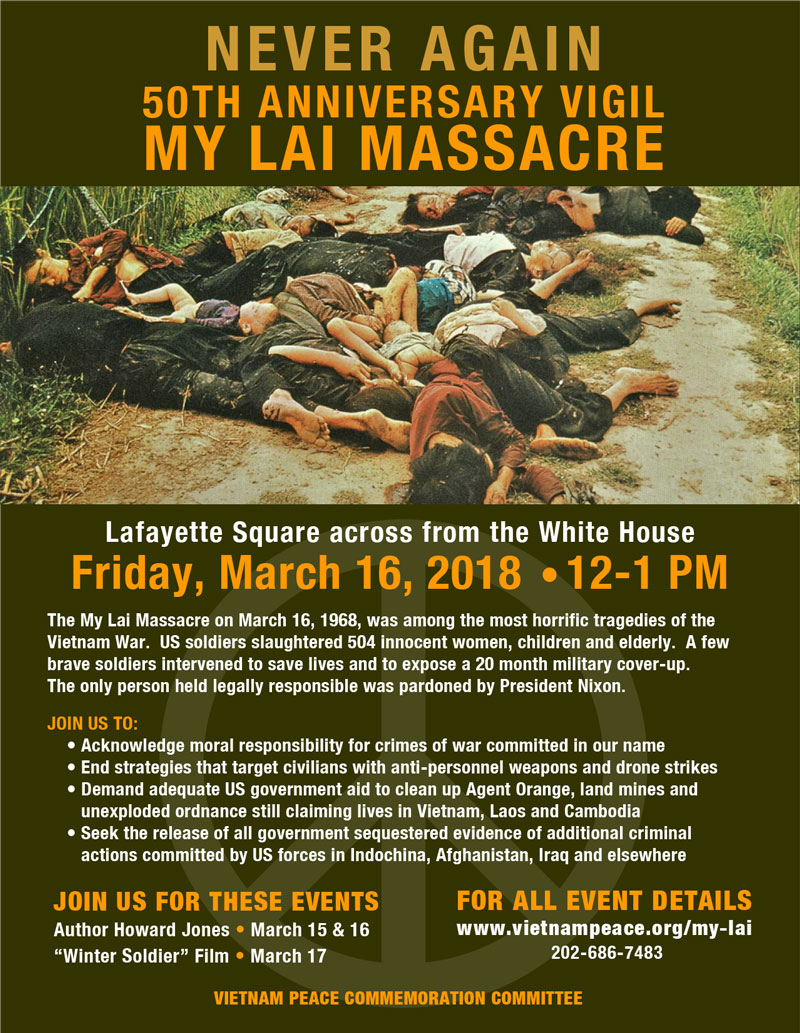
        On March 16th, 1968, US Army Lt. William Calley, platoon leader in Charlie Company, 1st Battalion, 20th Infantry, 11th Brigade, 23rd Division, led his men into the hamlet of My Lai in the Quang Ngai Province of the coastal lowlands of Vietnam. Expecting a military encounter, they found only women, children, and old men.

        Frustrated by earlier casualties in their ranks due to snipers and land mines, the soldiers took out their anger on the villagers, indiscriminately shooting people as they ran from their huts, rounding up the survivors and leading them to a nearby ditch where they were executed. Some women and girls were raped before they were killed. The killing went on for several hours. Thus was carried out a systematic massacre of more than 500 Vietnamese civilians. No U.S. soldiers were threatened, fired upon, injured, or killed.

        In the end, only Lt. Calley was found guilty of any crime. Convicted of premeditated murder, he was sentenced to life in prison at hard labor. That sentence was eventually reduced to 10 years, though President Richard Nixon pardoned Calley after he served only three-and-a-half years under house arrest.

        Although this episode is unparalleled in scope, it was not unique. A whistle-blower in the division wrote to U.S. Army Chief of Staff General William Westmoreland, pleading for an investigation of murders of Vietnamese civilians. He reported that there was the equivalent of “a My Lai each month.”

        The purpose of this service is not to renew judgment on any of the soldiers at My Lai, or their commanding officers, or even the US presidents (from both parties) who engaged in a decades-long pattern of withholding truth or outright lying. Our purpose in this service is to acknowledge and face these crimes done in our name, to grieve and make penitential commitments, and to ask how this pattern of behavior continues to afflict our longing for what Dr. Martin Luther King Jr. called the Beloved Community.

Call to Worship

One: We gather to remember a story of war that haunts us to this day, to remember a wrong that must be made right.
All: We gather to reckon with the sorrow that still pains the souls of many—to reckon with the brokenness that remains within the living who cannot forget the dead.
One: We gather to reflect upon the prospects for meaningful justice and the compelling call for healing and reconciliation.
All: We gather to resolve not to leave this place unchanged or unwilling to transform this haunting memory into something good. In the words of Rabbi Abraham Yitzak Kook, “We don’t speak because we have the power to speak; we speak because we don’t have the power to remain silent.”
{Paul C. Hayes}

Observing Silence
“To speak about God and remain silent on Vietnam is blasphemous.” —Rabbi Abraham Joshua Heschel

Opening Prayer
        Holy Light, we stand somewhere in the shadows, in between the battlefield of our struggles and the sanctuary of our souls. Shed a little light on our way. Keep your lighted sanctuary within us portable, able to see clearly, to walk courageously, to withstand the forces that corrupt the truth of our belonging to your one worldwide family.
        Keep our madmen world leaders away from buttons of annihilation. Keep them clearly out of range from pushing our buttons toward hopelessness and helplessness. Don’t give them security clearness to our spirits. Keep us ever secure in You. Shed a little light on our way.
        Shed your light of healing on all who struggle with illness of body, mind and spirit. Shed your light of grace on all who stumble with regrets and shame too tender to touch. Shed your light of mercy on all who fear for their lives, who are caught in the crucible of suffering. Here, now, once again…shed a little light on us all. Amen.
{Nancy Hastings Sehested}

*Singing – “Come, Ye Disconsolate”
Cantor: Here see the Bread of Life, see waters flowing
              Forth from the throne of God, pure from above.
              Come to the feast of love; come, ever knowing

All: Earth has no sorrow but heaven can remove.

Cantor: Shame’s power remanding, war’s brutal rending,
             Who can unbind us from memory’s remorse?
             Come now, O Gentle One, with fierce love contending

All: For earth’s days of splendor, in mercy endorse.
{Lyrics: Thomas Moore v. 1; Ken Sehested  v. 2}

Observing Silence
“There are things that can be seen only with eyes that have cried.”
—Roman Catholic Archbishop Christophe Munzihirwa, martyred in 2001 in the war in the Democratic Republic of Congo

Words of Praise and Adoration
One: Jump for joy, oh people! For amid the screaming commercials and blithering campaign ads, the Redeemer has heard our aching voice.
All: God hears! God knows! Therefore we will praise that Unspeakable Name forever.
One: When misery and madness encompassed me, when anguish threatened to undo me, when heartache split my soul, I uttered my cry to any who would hear.
All: God hears! God knows! Therefore we will praise that Unspeakable Name forever.

*Singing – “Abide With Me”
      Abide with me; fast falls the eventide;
      The darkness deepens; God, with me abide.
      When other helpers fail and comforts flee,
      Help of the helpless, O abide with me.

      I need Thy presence every passing hour.
      What but Thy grace can foil the tempter’s power?
      Who, like Thyself, my guide and stay can be?
      Through cloud and sunshine, God, abide with me.
      {Lyrics: Henry Francis Lyte; “Eventide” tune by William Henry Monk}

Observing Silence
Almighty and everlasting God, you hate nothing you have made nd forgive the sins of all who are penitent.
—Book of Common Prayer, prayer for Ash Wednesday

Confession and Absolution
One: The One who extends Presence into the most desolate region—even to the place of utter abandonment—is mighty in mercy, strong in tenderness, powerful in pardoning.
All: God hears! God knows! Therefore we will praise that Unspeakable Name forever.
One: Relax, oh my soul, in the arms of the One who dries tears, who swaddles our fretful limbs, whose light in the night scatters dragons, and whose promise is bounty and abundance.
All: God hears! God knows! This is our assurance against the ravages of fear. Therefore we will praise that Unspeakable Name forever.

*Singing – “Abide With Me”
      Open thy hand to every living thing
      Hill, meadow, forest, raise your voice and sing!
      And in due season grant thy Jubilee
      ’Til then stir confidence, abide with me. 

      As empires rage, unbounded truth disdained
      My soul grows weary, hope’s approach restrained
      When fears encroach and eyes no longer see
      Blessed and Gracious One, abide with me.
      {Lyrics by Ken Sehested}

Observing Silence
“If all we feel is shame after reviewing of the carnage of racism, materialism and militarism, we miss the point—
and, in fact, yet again we’ve made the conversation about ourselves. The awareness is indeed painful, but the pain’s purpose is not punishment but a penitence that generates the resolve to engage the difficult work of reconciliation.”
—Ken Sehested

Words of Assurance

One: Be assured that the God who shakes heaven and earth, whom death could not contain, who lives to disturb us and heal us, blesses us with the power of the Spirit to redeem and to restore with justice and in love.
{Adapted from Janet Morley’s All Desires Known}

Professing Our Faith
One: For what do we hope?
i We hope for the Beloved’s promise to overtake the world’s broken-hearted threat.
One: For what do we long?
All: We long for the moist goodness of God to outlast the parched climate of despair.
One: For what do we lack?
All: We lack for nothing—save the need for hearts enlarged by the assurance that every hostage will be freed.
One: For what do we strive?
All: We strive for lives marked by goodness, purified of deceit and malice, and hands made gentle by the tender caress of Wisdom’s approach.
One: For what do we struggle?
All: We struggle for the fate of every child whose sighs and cries are muffled by the market’s disdain.
One: In what do we rejoice?
All: We rejoice in rebellious acts of abundance in the face of every stingy arrangement.
One: For what prize do our eyes arise?
All: Our eyes arise for the Beloved Community’s embrace of earth’s abode and Heaven’s favor.
One: Peace be with you!
All: And also with you!

*Singing – “Come, Ye Disconsolate”
Cantor: Hark, to the mending work, penitence demands it,
              Kneel in confessional, sprint to repair
              All sorely wounded, each debt acquitted

All: Heaven’s sure deliv’rance and earth’s pain forbear.

Cantor: Though death e’re be prowling, sorrow confounding
              Enter the halls of praise—weep, shout and sing.
              Here lay your fears aside, here hope’s amending

All: Rejoice! all you creatures, O Death, where art thy sting?
{Lyrics by Ken Sehested}

Observing Silence
“Repentance for silence is better than repentance for speaking.”
—Moorish proverb

[Options for special music]

• Have a choral group learn and perform “For All the Sufferings of the World,” by Rodolfo Gaede Neto. {Here is the sheet music.}
•Play a recording of “Study War,” by Moby.
•Play a recording of “Why do we build the wall,” written by Anaïs Mitchell, sung by Greg Brown.
• Congregation singing “This Is My Song, O God of All the Nations”
[More musical options are in the “Additional Worship Resources” section of this resource.]

*Benediction
One: Among the memory prods in every tragedy’s aftermath is this reminder of the Spirit’s directives—
All: About whose presence we must foster,
One: About which whereabouts we must locate,
All: Whether the season calls for laughter or lament,
One: Whether patience or militance is called for, caressing hand or shaking fist.
All: Only after this interrogation can our speaking and silence, our moving and stillness, put us in the position to see and know what is to be done,
One: With whom it is to be done, in what place and time it is to be done,
All: And by what authority we proceed.
One: In and through our penitence, grant the bounty of grace and the risk of resolve.
All: Resolve to break the silence; to remember afresh; to hope that is stronger than fear; to persevere beyond fatigue.
One: You shall know the truth, beloveds, and the truth will make you odd!
All: So may it be, from henceforth and evermore.

*Recessional
[Congregation recesses, starting with the front row, then row after row until all are exited. Cantor leads in continued singing of this refrain throughout, exiting with the final row.]

Ain’t gonna let nobody turn me around,
turn me around, turn me around,
Ain’t gonna let nobody turn me around,
Keep on a-walkin’, keep on a-talkin’
Headed up to freedom land.
{African-American Civil Rights song}

*Please rise in body or spirit.

©ken sehested @ prayerandpolitiks.org. This liturgy was created by Ken Sehested, a founding co-pastor of Circle of Mercy in Asheville, North Carolina, and the creator of prayer&politiks. Unless otherwise noted, the writing is his.

A Litany of Reflection and Resolve

In Commemoration of the 50th Anniversary of the My Lai Massacre

by Paul C. Hayes

Moral shame and injustice bear long legacies. Fifty years after the horrific massacre of Vietnamese villagers by U.S. soldiers this egregious crime of war has not faded from the memories of the living or the dead. The blood of the innocent still cries out from their graves, and the surviving generations of victims and offenders alike carry the burden of this loss. In the words of Kim Phuc, whose anguished escape as a child from a napalm attack was captured in a photograph and seen around the world, “I will always remember that day when we ran from life to death.”

Thus says YHWH: “A voice is heard in Ramah, mourning and bitter weeping.  Rachel, weeping for her children, refuses to be comforted, for her children are no more.” (Jeremiah 31:15)

To name the pain is the beginning of accountability, and to sense remorse for the harm done is the genesis of forgiveness. Remembering the sorrow awakens the heart to re-engage in the search for justice.

You who believe, uphold justice and bear witness to Allah, even if it is against yourselves, your parents, or your close relatives…Refrain from following your own desire, so that you can act justly—if you distort or neglect justice, Allah is fully aware of what you do. (Qur’an 4:135)

The distance of time and circumstance mitigate the call for retribution.  But the hope of justice can yet be fulfilled restoratively through forgiveness and peacebuilding. “Forgiving is not forgetting,” as Desmond Tutu has said. “It’s actually remembering—remembering and not using your right to hit back. It’s a second chance for a new beginning. And the remembering part is particularly important, especially if you don’t want to repeat what happened.”

God has sent me to bring good news to those who are poor; to heal broken hearts…to comfort all who mourn, to provide for those who grieve…to give them a wreath of flowers instead of ashes, the oil of gladness instead of tears, a cloak of praise instead of despair. (Isaiah 61:1-3)

As Howard Zehr has written, “Justice will not be served if we maintain our exclusive focus on the questions that drive our current justice systems: What laws have been broken?  Who did it?  What do they deserve? True justice requires, instead, that we ask questions such as these: Who has been hurt? What do they need? Whose obligations and responsibilities are these? Who has a stake in this situation? What is the process that can involve the stakeholders in finding a solution?”

Don’t refuse a kindness to those who deserve it when it is in your power to do it.  Don’t say to your neighbor, “Go away, I will give to you tomorrow,” if you can give today. (Proverbs 3:27-28)

 “Retributive theory believes that pain will vindicate,” as Zehr explains, “but in practice that is often counterproductive for both victim and offender.  Restorative justice theory, on the other hand, argues that what truly vindicates is acknowledgement of victims’ harms and needs, combined with an active effort to encourage offenders to take responsibility, make right the wrongs, and address the causes of their behavior.  By addressing this need for vindication in a positive way, restorative justice has the potential to affirm both victim and offender and to help them transform their own lives.”  (Howard Zehr, The Little Book of Restorative Justice)

It is in the nature of things that joy arises in a person free from remorse. (The Buddha)

The time has come to examine ways to heal the wounds of this terrible act of evil. It is time to hear the accounts of the living and the stories of the dead. It is time to speak truth to the generations who rise up from these shallow graves to address the harm that has been done and prevent it from being forgotten. It is time to embrace the call for justice to allow the hope for reconciliation to be realized.

Blessed are those who are poor in spirit: the kindom of heaven is theirs.
Blessed are those who are mourning: they will be consoled.
Blessed are those who are gentle: they will inherit the land.
Blessed are those who hunger and thirst for justice: they will have their fill.
Blessed are those who show mercy to others: they will be shown mercy.
Blessed are those whose hearts are clean: they will see God.
Blessed are those who work for peace: they will be called children of God.
Blessed are those who are persecuted because of their struggle for justice:
The kindom of heaven is theirs. (Matthew 5:3-10)

#  #  #

Rev. Dr. Paul Hayes is pastor, Noank Baptist Church, Noank, Connecticut

The Ties That Bind

The Integrity of Penitence, on the 50th Anniversary of the Massacre at My Lai

Ken Sehested

The following essay appears in a worship resource packet, "A Penitential Opportunity," created for (and soon to be available from) the Vietnam Peace Commemoration Committee to call attention to the 50th anniversary of the 16 March 1968 massacre by US troops of more than 500 civilians in My Lai, Vietnam.


"Concealment makes the soul a swamp. Confession is how you drain it."
—Charles M. Blow, New York Times columnist

        Except in a few traditional religious settings, penitence is a seldom used word. While its more common synonyms—confession, apology, contrition, and repentance—are standard parts of many church liturgies, the images they convey have generally fallen out of favor. There are good reasons why this is so. The primary definition of penance is “voluntary self-punishment inflicted as an outward expression of repentance for having done wrong.” A web search for penance reveals more than a few pictures of people whipping themselves.

        But we privilege confession and absolution in our liturgy not because God enjoys our humiliation. Just the opposite. By the grace of God, confession frees us from the power of our failures. Confession provides the possibility to begin again. It means we are not defined by our past. It means a different future is possible. The wreckage wrought by human behavior is real; but the future is not thereby fated.

        What does attention to penitential life have to do with the 50th anniversary of the My Lai massacre? Everything—if we’re looking for root causes and not merely explanations.

           On March 16, 1968, a platoon of U.S. soldiers led by Lt. William Calley committed war crimes in the small village of My Lai, Vietnam. They were expecting a military encounter that didn’t occur. Then, for reasons beyond human capacity to comprehend, they began systematically killing women, children, and elderly men—500 or so. Of the 26 officers and soldiers initially charged with crimes at My Lai, only Lt. Calley was convicted—of premeditated murder, for which he could have received the death penalty. Instead he was remanded to life in prison at hard labor. Eventually his sentence was reduced to 10 years, but he served only five months in prison and 35 months under house arrest. Though he finally made a public admission of remorse for My Lai in 2009, Calley never wavered from his trial testimony that he was simply following orders.

           Fiftieth anniversaries are occasions to recognize personal transitions and public events, to reconsider their meaning and highlight their function in shaping current commitments and future outcomes. Yet it’s reasonable to ask, Why focus attention on such a horrific memory? Does that not simply embed its lasting, traumatizing impact? For those of us who weren’t there—maybe even weren’t alive—on what basis can we repent for something we didn’t do?

§  §  §

"They have treated the wound of my people carelessly. They acted shamefully,
they committed abomination, yet they did not know how to blush."

—Jeremiah 6:14-15

§  §  §

           Our recent national history is replete with apologies of the “mistakes were made” variety that deny responsibility and vague, scattershot “I apologize if I offended anyone” excuses for unconscionable behavior. It’s easy to understand public disdain for any sort of penitential language. If absolution comes with no resolution—to live differently, in whatever small and incremental way—confession has been emptied of all meaning, and worse: it is become religious armor for infamy. Mercy opens a portal to repentance, characterized not so much by apologetic expression as by the hard work of repairing the damage, of reestablishing trustworthy relations.

           If we are to envision anything other than a dystopian future—rule of the brutal, by the brutal, for the brutal—we must recover language for what the Greek New Testament calls metanoia, meaning “to turn around, to change one’s life,” usually translated as “repentance.” To get there involves several precepts.

           The first is distinguishing between shame and guilt. Insidiously, in our culture guilt is confused with shame, a form of self-preoccupation that engenders paralysis and passivity, an escape—knowingly or not—from response-ability. Shame removes agency, whereas the proper function of guilt is to authorize and mobilize the work of restoration.

        The second precept in the recovery of penitential language is recognition of such work as a public process, not just a private solitary event.

        The third precept is comprehending the purpose of judgment as restoration, not retaliation; the reclamation of virtue, not the authorization of vengeance. This framework has ancient antecedents in the Hebrew phrase tikkun olam (repair of the world) from the Jewish Mishnah, the Talmud, and the mystic Kabbalah literature in speaking of the matrix of spiritual transformation.

        The fourth precept is acknowledging that the process of restoration is almost always discomforting, frightening, and strenuous. Powerful interests are invested in keeping things the way things are. Rabbi Abraham Joshua Heschel, who sat next to Dr. Martin Luther King Jr. in 1967 as he delivered his controversial “Beyond Vietnam” speech in New York City’s Riverside Church, wrote “God is not nice. God is not an uncle. God is an earthquake.”

        The resolve to no longer be silent in the face of abuse is the fifth precept in a recovery of penitential living. Among the many memorable lines from Dr. King’s bold and dangerous speech critiquing the Vietnam War is “A time comes when silence is betrayal.”

        Ending silence in the face of abuse begins with the ritual work of lament, itself a form of penitence. This sixth precept is among many things to be learned from African-American communities of faith. The articulation of grief—whether in speech or music or dance or moaning—contains in its very performance the generative power of assurance that siphons away the power of fear. Our capacity to grieve and lament are directly related to our capacity for hope, much like the circumference of a tree’s canopy is proportionate to its root system.

        The last of these seven precepts, drawn from Rebecca Solnit’s amazing book Hope in the Dark: Untold Histories, Wild Possibilities, brings us back to where we began. Solnit writes, “Hope is not like a lottery ticket you can sit on the sofa and clutch, feeling lucky. Hope is an ax you break down doors with in the case of emergency. . . The future is dark, with a darkness as much of the womb as of the grave.”

        The penitential life, which begins in disillusionment and grief, pushes toward clarity, which leads toward a kind of hope that is more than daydreaming. To hope for something is not a wouldn’t-it-be-nice sentiment. Hope binds us to a process designed to overcome injustice by forging equitable relations.       

        Conflict mediation specialist Byron Bland has written that two truths make healthy community difficult: that the past cannot be undone, and that the future cannot be controlled. However, two counterforces are available to address these: the practice of forgiveness, which has the power to change the logic of the past; and covenant-making, which creates islands of stability and reliability in a faithless, sometimes ruthless world.

        As Dr. King wrote in his anguished essay “Letter from a Birmingham Jail,” “We are caught in an inescapable network of mutuality, tied in a single garment of destiny.” These cords neither smother nor strangle. Such covenants are essential both for human and ecological flourishing. And this is what it means to be righteous in the eyes of God.
§  §  §

“You shall know the truth, and the truth will set you free; but first it will make you miserable.”
—author unknown

§  §  §

           In what way does a commemoration of the My Lai massacre represent a penitential opportunity? The short answer: Because as a nation we have never allowed ourselves to fully acknowledge the carnage—not just in My Lai or in Vietnam more generally. Daniel Ellsberg’s release of the top-secret Pentagon Papers in 1971 revealed a long pattern of lies, cover-ups, and prevarication by the U.S. government and military commanders over the course of four presidencies and different political affiliations.

           The purpose for marking March 16 on our calendars this year is not to re-litigate those charged in the massacre, or their commanding officers, or the top elected officials who created and sustained the conditions for, and covered up the results of, those killing fields. The purpose for remembering My Lai begins with the fundamental notion of citizen responsibility within democratic political systems. We are responsible for demanding truthfulness from our leaders, along with insisting on the implementation of the ideals of justice embedded in our governing documents. Remembering that we have been lied to before, on a massive scale, requires continuing vigilance.

           For people of faith—and the theme of penitence is common to a great many religious traditions—remembering My Lai reminds us of the human capacity for brutality and for its rationalization of political corruption, military domination, and economic expansion. Public confession over My Lai has been minimal at best. Initially chastened after the war following revelations of its corrupt pursuit, the public has long since forgotten the impact of treachery when commercial pursuit, political deceit, and military aggression collude.

           Considering this legacy alongside the rise in the U.S. of national chauvinism and white supremacy, in the hands of an increasingly authoritarian political culture in which truthfulness is a consumer choice, the result an environment mobilizing against anything remotely resembling the tikkun olam of Judaism, of Jesus’ announcement of the reign of God, or of Dr. King’s vision of the Beloved Community.

           The fact that this year on April 4, less than three weeks after the My Lai anniversary, we also mark the 50th anniversary of the assassination of Dr. King is especially instructive. King was not murdered because he was a dreamer; nor even for insisting on integrated water fountains, bus seating arrangements, and voting rights. He was murdered because he dared to identify a more persistent and deep-seated flaw in our national character which gave (and continues to give) rise both to domestic oppression and international aggression.

           This flaw is stuck in our craw. The penitential opportunity, with this year’s coincidence of golden anniversaries, remains open to us all.

Things are not getting worse. They are getting uncovered.
We must hold each other tight and continue to pull back the veil.
—adrienne maree brown

#  #  #

©ken sehested @ prayerandpolitiks.org

Poems

Included in the "Penitential Opportunity" worship resource

An Outline for a Service Acknowledging War Crimes
Has the United States ever apologized? Or are we too big to apologize?”
—Warrant Officer Hugh Thompson, helicopter pilot, U.S. Army

The Chaplains Handbook has no prayer or rite,
Nor Book of Common Prayer nor missalette,
For scrutinies that beg forgiveness from

The mutilated dead. We come contrite
For reports of helicopter gunships.
The Chaplains Handbook has no prayer or rite

For bodies observed in a ditch; the undress
Of a girl who covered only her eyes—
A scrutiny that begs her forgiveness—

Noncombatant gang rape, with bayonette.
Old age we robbed from them, our years condemn.
The Chaplains Handbook has no prayer or rite.

We confess to you, brothers and sisters,
Our Agnus Dei mocked your mutilation,
Lacked sufficient scrutiny to beg you.

“Kill anything that moves,” bloodlust, U.S.
Five hundred and four in My Lai, Son My.
The Chaplains Handbook has no prayer or rite
For scrutinies of war crimes. We beg. Forgive.

Old age we robbed from them, our own years condemn.
We confess to you, brothers and sisters,
We will remember them.

—Rose Marie Berger, poetry editor and senior associate editor, Sojourners magazine, written for the 50th anniversary of the My Lai Massacre. Hugh Thompson was the helicopter pilot who tried to halt the massacre, rescuing civilians while training his machine gun on U.S. soldiers, threatening to shoot if they did not stop the slaughter.

#  #  #

Sorry, sorry, sorry: The political meaning of “collateral damage” repentance

We kill and bomb
Murder and maim
Target and terrorize mostly
      (for high-tech armies)
from great distance
the better not to see actual faces
or severed limbs, or intestines oozing through
holes where belly buttons used to testify
to being a mother-born child

But then we apologize
      Sorry
            So sorry
                  Deeply regret
                        Such a tragedy!
                              Sorry, sorry, sorry

We do everything we can to limit civilian casualties
“This isn’t Sunday school”
      (one politician’s actual words)
Didn’t have those children in our sights
Impossible to see, at 10,000 feet,
      whether Kalashnakovs are present
Smart bombs aren’t flawless
Flawed intelligence
      (as if a test score were at stake)
Military necessity
Rules of engagement need refining
S**t happens
We gave them advance warning
War is hell

The unintended consequences and inevitable
eventualities in hostile force-reduction and
counter-insurgency strategic operations
      (See s**t happens)
Freedom isn’t free
Do unto others before they do unto you
Asymmetrical warfare
      (“Why don’t they come out and fight like men!”)
No independent verification of claims of civilian massacre
      (aka, no one left standing)
“This is no My Lai” (Vietnam, where as many as 504—
      the Pentagon says only 347—unarmed women,
      children and old men were killed by U.S. troops, no
      weapons recovered, for which one soldier was
      convicted, spending 4 months in prison.)

We fight them there so we don’t have to fight them here
      (which is why the U.S. needs 1,000 or so military
      bases outside its borders, dozens with golf courses)

Won’t happen again, unless it does, then
                                    Sorry, Sorry, Sorry
Video, and sentiments, at the top of the hour
      They left us no option
            Forced into this corner
                  Them or us
                        Hearings to be convened
                              We’ll get to the bottom of this
We need to wait ’til all the facts are in

But only eyes, no heads, will roll:
      foreign-born blood being cheap as it is
If war is the answer
      the question must be really stupid

—Ken Sehested, editor/author of prayerandpolitiks.org, written after hearing one too many public officials rationalize “collateral damage” against innocent victims of military strikes

#  #  #

The Bullet

I tried to domesticate the bullet,
To take her with me to school,
To teach her the alphabet
And have her speak.
But she is made of black clay
And stuffed with canned blood.

I tried to domesticate the bullet,
To take her to the water spring,
To the fields of dew.
But she has consumptive lips
That love to kiss the lips of death,
To rummage our wreck
And blow ashes in our eyes.

I tried to domesticate the bullet,
To lead her to the truth,
To wash her copper with perfumes
And replace her gun powder with sweets.
But she refused to be unlocked,
And remained dripping pus,
With poison in her breath.

—written by an unidentified Iraqi soldier following the 1991 Gulf War

#  #  #

We

In a museum of the city
once called Saigon, are snapshots. One’s
been blown up so we can all see
it clearly. An American,

a young foot soldier, stands on battle
pocked land, his helmet at a jaunty
tilt, posed for buddies as the Model
Grunt. In his left hand he is dangling,

like Perseus, a head by its hair.
Though not Medusa’s, it’s his charm
for turning fear to stone. Its stare
will quiet, awhile, his throbbing chest.

The tattered flesh that once dressed collar
bones hangs rags from this Vietnamese
neck, captured with the soldier’s scar
of grin by a friend’s camera.

Is it enough to see it clearly?
We all know what to think. The whitewashed
walls of a second room show nearly
as many black-and-white shots of

Cambodian atrocities
against Vietnamese. No room’s hung
with what was done to enemies
of Vietnam, just as there’s no

American museum built
to show off snapshots of My Lai.
One pronoun keeps at bay our guilt –
they they they they they they

—Karen Swenson, an award-winning poet and journalist who has traveled extensively in Southeast Asia

Quotes from Jewish, Christian and Islamic scripture and tradition

Supplement to the "Penitential Opportunity" worship resource

§ The bows of the mighty are broken, but the feeble gird on strength. Those who were full have hired themselves out for bread, but those who were hungry have ceased to hunger. . . . [God] raises up the poor from the dust [and] lifts the needy from the ash heap, to make them sit with the rulers and inherit a seat of honor. —1 Samuel 2:4-5, 8a

§ You have heard that it was said, “An eye for an eye, and a tooth for a tooth.” But I say to you, Do not resist an evildoer. But if anyone strikes you on the right cheek, turn the other also. . . . You have heard that it was said, “You shall love your neighbor and hate your enemy.” But I say unto you, Love your enemies and pray for those who persecute you. —Matthew 5:38-39, 43-44

§ The Messenger of God (peace and blessings be upon him) said: Whoever is untrustworthy in his dealings has no faith, and whoever is not committed to his promises has no religion. —Bayhaqi

§By three things the world is preserved, by [restorative] justice, by truth, and by peace, and these three are one: if [restorative] justice has been accomplished, so has truth, and so has peace. —JT Ta'anit 4:2

§ True evangelical faith cannot lie dormant. It clothes the naked; it feeds the hungry; it shelters the destitute; it serves those that harm it; it binds up that which is wounded. It has become all things to all. —Menno Simons (c. 1496-1561)

§ Do then those who devise evil feel secure that ALLAH will not cause the earth to swallow them up or that the wrath will not seize them from directions they little perceive? Or that He may not call them to account in the midst of their goings to and fro without a chance of their frustrating Him? Or that He may not call them to account by a process of slow wastage? For your Lord is indeed full of kindness and mercy. —Qur’an, Surah Nahl, 45-47

§ A king is not saved by his great army; a warrior is not delivered by his great strength. The war horse is a vain hope for victory, and by its great might it cannot save. —Psalms 33:16-17

§ Repay no one evil for evil. . . . Beloved, never avenge yourselves, but leave it to the wrath of God. . . . If your enemies are hungry, feed them. . . . Do not be overcome by evil, but overcome evil with good. —Romans 12:17a, 19a, 20a, 21

§ The Messenger of God (peace and blessings be upon him) said: It does not befit a faithful person to have a full belly while his neighbor goes without. —Bukhari and Muslim

§ Not by military might, and not by force of arms. By spirit [nonviolence] alone, says Adonai.  —Zechariah 4:6

§ Then I saw a new heaven and a new earth; for the first heaven and the first earth had passed away. . . . And I heard a loud voice saying, “See, the home of God is among mortals. [God] will wipe away every tear from their eyes, and death shall be no more, neither shall there be mourning nor crying nor pain any more, for the former things have passed away.” —Revelation 21:1, 3a, 4

§ To each among you We have prescribed a Law and an Open Way. If ALLAH had so willed He would have made you all one community but [He wishes] to test you in that which He has given you, so compete with each other in good works. The goal of you all is ALLAH; it is He that will show you the truth of the matters in which you dispute. —Qur’an, Surah Ma’idah, 48

§ Seek peace and pursue it. —Psalm 34:15

§ I am a soldier of Christ; it is not lawful for me to fight. —St. Martin of Tours (c.335-397)

§ The Messenger of God (peace and blessings be upon him) said: When God created the creation, he inscribed upon the Throne, “My Mercy overpowers My wrath.” —Bukhari and Muslim

§ Because you have trusted in your power, and in the multitude of your warriors; therefore the tumult of war shall rise among your people. —Hosea 10:13b-14

§ When Christ disarmed Peter in the garden, he disarmed all Christians. —Tertullian (c.160-c.225)

§ The recompense of an ill deed is the like thereof. But whosoever pardons and amends, his reward is due from God, who does not love tyrants. —Qur’an, Surah Shura, 40

§ Do not do unto others that which is hateful to you. That is the entire Torah. Now go study. —Hillel

§ Acquire the spirit of peace and a thousand souls around you will be saved. —St. Seraphim of Sarov (1759-1833)

§ The Messenger of God (peace and blessings be upon him) sent Mu’adh [as a governor] to Yemen and said, “Be afraid of the curse of the oppressed, for there is no screen between their prayer and God.” —Bukhari

§ The accomplishments of Gandhi and Martin Luther King, Jr. suggest that Isaiah's dictum is not so much sentimentalism as it is realpolitik of the spirit: "For thus said the Lord God, the Holy One of Israel: In turning and stillness shall you be saved.  In tranquility and trust shall be your strength. . . ." —Everett E. Gendler, "The Roots of Jewish Nonviolence," quoting Isaiah 30:15

§ What causes wars, and what causes fightings among you? Is it not your passions that are at war in your members? You desire and do not have; so you kill. And you covet and cannot obtain; so you fight and wage war. —James 4:1-2

§ The Messenger of God (peace and blessings be upon him) said: That man whose neighbor is not safe from harassment has no faith. —Bukhari and Muslim

§ Then justice will dwell in the wilderness, and righteousness abide in the fruitful field. And the effect of righteousness will be peace. —Isaiah 32:16-17

§ May we look upon our treasures, the furniture of our houses and our garments and [judge] whether the seeds of war have nourishment in these our possessions. —John Woolman (1720-1772)

§ The Messenger of God (peace and blessings be upon him) said: The best jihad is to speak a word of truth to an unjust ruler. —Abu Dawud

§ He judged the cause of the poor and needy; then it was well. Is not this to know me? Says the Lord. —Jeremiah 22:16

§ Contrary to the rest of men enlist yourself in an army without weapons, without war, without bloodshed, without wrath, without stain. . . . If the loud trumpet summons soldiers to war, shall not Christ with a strain of peace to the ends of the earth gather up his soldiers of peace? A bloodless army he has assembled by blood and by the word, to give them the Kingdom of Heaven. —Clement of Alexandria (c.150-c.215)

§ The Messenger of God (peace and blessings be upon him) said: “Help your fellow Muslim whether oppressor or oppressed.” “We know how to help the oppressed, but how are we to help the oppressor?” “Your help to him is to prevent him from oppressing.” —Bukhari

§ But I will have pity on the house of Judah, and I will deliver them by the Lord their God; I will not deliver them by bow, nor by sword, nor by war, nor by horses, nor by horsemen. —Hosea 1:7

§ Imagine the vanity of thinking that your enemy can do you more damage than your enmity.  —St. Augustine (354-430)

§ The Messenger of God (peace and blessings be upon him) said: God has mercy upon those who are merciful to others. —Bukari

§ If a person of learning sits in his or her home and says to herself, “What have the affairs of society to do with me?  Why should I trouble myself with the people's voices of protest?  Let my soul dwell in Peace!” If he does this, he overthrows [destroys] the world. —Tanhuma Mishpatim

§ The Spirit of the Lord is upon me, because he has anointed me to preach good news to the poor. He has sent me to proclaim release to the captives and recovering of sight to the blind, to set at liberty those who are oppressed, to proclaim the acceptable year of the Lord. —Luke 4:18-19

§ The Messenger of God (peace and blessings be upon him) said: There are people among the servants of God who are neither prophets nor martyrs; the prophets and martyrs will envy them on the Day of Resurrection for their rank before God, the Most High.” People asked: “Tell us, Messenger of God, who are they?” He replied: “They are people who love one another for the spirit of God, without any mutual kinship or exchange of property. I swear by God, their faces will glow and they will stand in light. They will have no fear when the people will fear, and they will not grieve when the people will grieve.” He then recited the Qur’anic verse: “Behold! Verily for the friends of God there is no fear, nor shall they grieve.” —Abu Dawud

# # #

The above quotes are selected from longer lists in “Peace Primer II: Quotes from Jewish, Christian, and Islamic Scripture & Tradition,” Lynn Gottlieb, Rabia Terri Harris, and Ken Sehested, Wipf & Stock Publishers, 2017.

News, views, notes, and quotes

Signs of the Times  •  15 February 2018  •  No. 152

by Ken Sehested

“A child of God is dead. Can not we acknowledge
in this country that we cannot accept this?”

—former FBI agent and counterterrorism expert Philip Mudd, breaking into tears when talking about the 15 February 2018 school shooting in Broward County, Florida. Who could predict that a terror expert could be anointed as the Spirit’s agent in prophetic protest against the spirit of the age?

nothing says ash wednesday
or valentine’s day
like murdered children

thoughts and prayers
yachts and snares
crackpots and debonairs

mascots and nom de guerres
mug shots and glares
onslaughts and concierges

whatnots and au pairs
Croats and Khmers
tater tots and teddy bears

the next public figure
who offers thoughts and
prayers to grieving parents

and traumatized teachers
should be sentenced to
cradling stillborn babies

in their arms
for at least
half an eternity

and tie gun barrels
into knots
for the remainder

we have had
on average
one school schooling

per week in the
last five years
this year alone

138 children have
died or been wounded
by gunfire

the nra be damned
can you imagine the
sh*tstorm of missiles

that would fly
toward Syria
if US troops endured

such casualties
it requires no
grammatician

to read the
second amendment
where the dependent clause

“the right to bear arms”
is subordinate to
the independent clause

“a WELL REGULATED militia”
g-ddam the nra and their
every congressional lackey

“unfortunately, lessons are
never, never learn” was the
response of news anchor

Wolf Blitzer to Philip Mudd
who broke into sobs
when asked to make

sense of such abomination
there was no emotion in
Blitzer’s voice, only

resignation, as if so say
“that’s the way  the world is”
and will be, world without

end this is lent’s reproach
to easter’s promised rise
for whose approach we

will never intercede
short of facing these
facts, drinking these

dregs, eating this
sorrow, with (literal)
death-defying resolve

that another
WORD
is yet to be heard

©ken sehested@prayerandpolitiks.org


Vietnam, My Lai, and U.S. Involvement

Historical Notes

§ On March 16, 1968, Lt. William Calley led his platoon into the hamlet of My Lai in the Quang Ngai Province of Vietnam. They raped women and girls and shot indiscriminately at civilians as they ran from their huts. Survivors were rounded up and executed in a ditch. Over several hours, more than 500 civilians were massacred. Only Lt. Calley was found guilty of any crime. Convicted of premeditated murder, he was sentenced to life in prison at hard labor but was pardoned by President Richard Nixon after serving five months in prison and 35 months under house arrest.

§ “I was ordered to go in there and destroy the enemy. That was my job that day. That was the mission I was given. I did not sit down and think in terms of men, women, and children. They were all classified as the same, and that’s the classification that we dealt with over there, just as the enemy. I felt then and I still do that I acted as I was directed, and I carried out the order that I was given and I do not feel wrong in doing so.” Lt. William Calley

§ At Calley’s trial, one defense witness testified that he remembered Captain Ernest Medina ordering the soldiers to destroy everything in the village that was “walking, crawling or growing”.

§ “Hugh Thompson was the helicopter pilot who tried to halt the My Lai massacre…. [H]e rescued 15 defenseless civilians while training his machine guns on US infantrymen…threatening to shoot if they did not stop the slaughter.” — “Hugh Thompson: US pilot who tried to stop the My Lai massacre of civilians in the Vietnam war,” The Guardian

        See also “Helicopter Pilot Who Stopped My Lai Massacre Was Called A Traitor In America & Almost Court-Martialed,” Sharon Russell, War History Online.

§ Due to immense pressure to produce significant “body counts” as evidence of U.S. success in Vietnam, during the war the policy effectively became “If it’s dead and Vietnamese, it’s VC [Viet Cong].” In the aftermath, an entry on the Pentagon’s official Vietnam War Commemoration website for My Lai, which describes the massacre as an “incident,” initially underreported the casualties as 200, not 500, and now says simply “hundreds.” A whistle-blower contacted U.S. Army Chief of Staff William Westmoreland, pleading for an investigation of civilian casualties. The resulting study revealed that the body count was equivalent to “a My Lai each month.” —Nick Turse, “Was My Lai just one of many massacres in Vietnam war?” BBC News

§ It took 19 months for the truth of what happened at My Lai to be exposed, by independent investigative journalist Seymour Hersh, on November 12, 1969, on the Associated Press wire service.

§ “We intend to tell who it was that gave us those orders; that created that policy; that set that standard of war bordering on full and final genocide. We intend to demonstrate that My Lai was no unusual occurrence, other than, perhaps, the number of victims killed all in one place, all at one time, all by one platoon of us. We intend to show that the policies of Americal Division, which inevitably resulted in My Lai, were the policies of other Army and Marine divisions as well. We intend to show that war crimes in Vietnam did not start in March 1968, or in the village of Son My or with one Lieutenant William Calley. We intend to indict those really responsible for My Lai, for Vietnam, for attempted genocide.” 1st Lt. William Crandell, 199th Light Infantry Brigade, Americal Division, at the 1971 Winter Soldier Investigation organized by Vietnam Veterans Against the War

§ “Many in the United States were outraged by Calley’s sentence…. After the conviction, the White House received over 5,000 telegrams; the ratio was 100 to 1 in favor of leniency. In a telephone survey of the American public, 79 percent disagreed with the verdict, 81 percent believed that the life sentence Calley had received was too stern, and 69 percent believed Calley had been made a scapegoat.”

§ “On August 19, 2009, while speaking to the Kiwanis Club of Greater Columbus, Calley issued an apology for his role in the My Lai massacre: ‘There is not a day that goes by that I do not feel remorse for what happened that day in My Lai. I feel remorse for the Vietnamese who were killed, for their families, for the American soldiers involved and their families. I am very sorry…. If you are asking why I did not stand up to them when I was given the orders, I will have to say that I was a 2nd Lieutenant getting orders from my commander and I followed them—foolishly, I guess.’”

§ “In war, these sorts of horrible things happen every now and again.” Then-Secretary of State Colin Powell, speaking in 2004 of the time that he, as an Army major in Vietnam, was assigned the task of investigating reports of the My Lai massacre. His report concluded “relations between [U.S. troops] and the Vietnamese people are excellent.”

§ The Pentagon Papers, a top-secret study of the history of U.S. involvement in Indochina commissioned in 1967 by then-Secretary of Defense Robert McNamara and leaked in 1971 by Marine veteran and Pentagon defense analyst Daniel Ellsberg, contains a Defense Department memo under the Johnson Administration listing three pro-rated reasons for continuing prosecution of the war in Vietnam:

        •70% – To avoid a humiliating defeat.

        •20% – To keep South Vietnam and the adjacent territory from Chinese hands.

        •10% – To permit the people of South Vietnam to enjoy a better, freer way of life.

§ Because of the Vietnam War, “The image of America will never again be the image of revolution, freedom and democracy, but the image of violence and militarism.” —Martin Luther King Jr., “Beyond Vietnam” speech, April 4, 1967

§ For more about U.S. involvement and deception regarding Vietnam, see the PBS documentary The Most Dangerous Man in America: Daniel Ellsberg and the Pentagon Papers. The Post, a 2018 commercial film, is a riveting portrayal of The Washington Post’s conflicted decision to print a portion of “The Pentagon Papers.”

#  #  #

Compiled by ©ken sehested @ prayerandpolitiks.org

Introduction to the Penitential Opportunity Resources

The meaning of penitence in the face of the My Lai massacre's 50th anniversary

by Ken Sehested

Those of us who worked on the My Lai Massacre 50th Anniversary resources share a belief that truth is found in many faith traditions. A list of relevant quotes from Islam, Judaism, and Christianity is included. What we believe we all share in common is the longing and struggle for a world characterized by mercy, in turn mediating the demands of justice and the prerequisites of peace.

Those who planned the sample liturgy are Christians, and we write from our own experience; we do not presume the ability to leap from our context to construct a service incorporating the insights from other spiritual traditions. We recognize that honest interfaith engagement does not include abandoning our own confessional expressions, though it does mean holding such convictions with humility. Among other things, humility requires listening, the most penitential posture when approaching God, who always—always—calls to us from beyond borders and boundaries.

We trust that those who gather with us from other traditions, or of no particular religious affiliation, will participate as fully as vision and conscience allow. Even more, we hope that you may find some useful material in these resources (from which you are free to borrow and edit or adapt as seems appropriate) to develop a “Penitential Opportunity” service appropriate to your own tradition.

Included in addition to the liturgy are several supplemental resources: suggestions for additional music, litanies, and other readings; a meditation on the meaning of penitence, a theme integral to many religious traditions; a brief collection of historical facts to help in understanding the context of the My Lai massacre; a collection of quotes to guide deeper reflection and seasoned conviction; and a testimony from a volunteer in My Lai.

We recognize the pastoral challenge of getting local communities of faith to devote focused attention on an episode of brutality, 50 years past, in a place thousands of miles away, where few U.S. citizens have ventured to visit. This is particularly true in a culture in which communicating God’s promise, purpose, and provision is often confused with a desire to accentuate the positive.

The writing and compiling of these liturgical resources was done in anticipation of the Christian season of Lent, when penitence is a key theme, culminating in Easter’s hopeful promise of a redemptive future. This year the 50th anniversary of the assassination of Dr. Martin Luther King Jr. is April 4, only three days after the church’s buoyant proclamation of death’s coming annulment. We seek prayers from every quarter to assist us in knowing how to seek the Beloved Community he proclaimed, and to live animated by Resurrection’s promise, in the face of the world’s seemingly endless confidence in what theologian Walter Wink called “the myth of redemptive violence.”

#  #  #

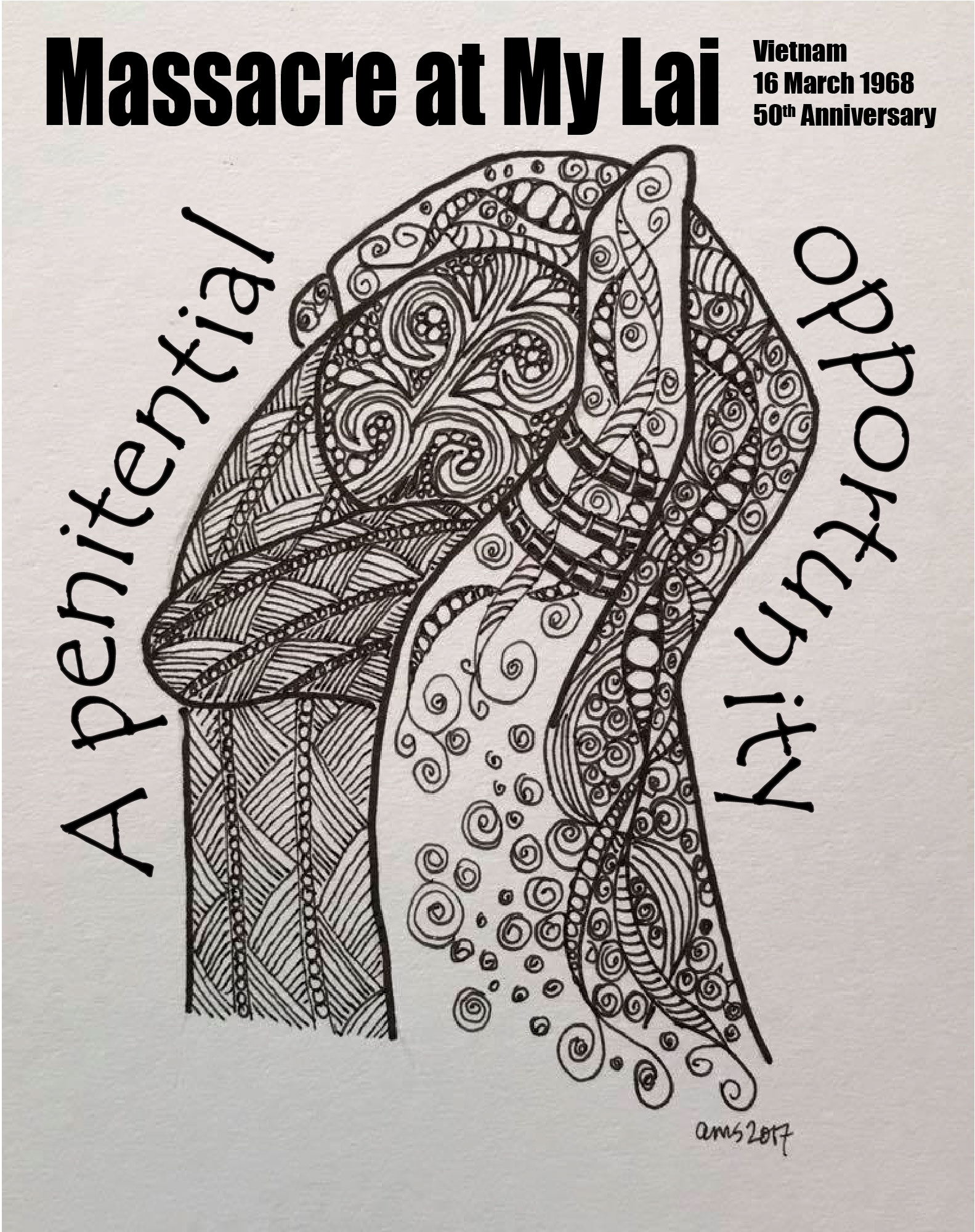
Ken Sehested, author and editor of prayerandpolitiks.org, wrote, compiled, and edited the material in this resource on behalf of the Vietnam Peace Commemoration Committee. Unless otherwise attributed, the writing is his. Angela Sudermann, a retired denominational missions coordinator now caring for her parents full-time, produced the illustration (“Resting in God’s Hand”) on the cover. Art design is by Kaki Roberts and Ken Sehested. All material is ©copyrighted, though reprint permission is granted for all non-commercial uses.

Thirty-five interesting facts about Cuba and its US relations

To commemorate US President Barack Obama’s stunning announcement on 17 December 2014 of executive action reestablishing formal diplomatic relations with Cuba, here are a few facts that might surprise.

by Ken Sehested

1. The worlds’ smallest hummingbird and smallest frog are found in Cuba.

2. Christmas did not become an official holiday in Cuba until 1997.

3. Cuba sent more medical professionals to combat the Ebola virus outbreak in West Africa than any other country.

4. In 1820 Thomas Jefferson thought Cuba "the most interesting addition which could ever be made to our system of States" and told Secretary of War John C. Calhoun that the United States "ought, at the first possible opportunity, to take Cuba."

5. There are no animals or plants in Cuba that are poisonous or lethal to humans.

6. In May 2001 Texas state legislators were the first to officially petition for an end to the US embargo of Cuba. One possible reason: Cuba imports more than two-thirds of its rice, mostly from Asia.

7. Ernest Hemingway wrote For Whom the Bell Tolls and The Old Man and the Sea while he lived in Cuba.

8. The 1898 Treaty of Paris ended the Spanish-American War. The US took control of several Spanish colonies, including Puerto Rico, Cuba, parts of the Spanish West Indies, the Island of Guam in the Marianas Islands, and the Philippines. Cuba was later granted its independence after agreeing to assert the 1901 Platt Amendment into its 1902 constitution. That Amendment guaranteed the US the right to unilaterally intervene in Cuban affairs. In arguing for US Senate approval of the Platt Amendment, Senator Knute Nelson said, “Providence has given the United States the duty of extending Christian civilization. We come as ministering angels, not despots.” On the other (losing) side of the debate, Senator George Frisbie Hoar argued, “This Treaty will make us a vulgar, commonplace empire, controlling subject races and vassal states, in which one class must forever rule and other classes must forever obey.” Immediately after the signing of the treaty, the US-owned "Island of Cuba Real Estate Company" opened for business to sell Cuban land to Americans.

9. From the air, the island of Cuba resembles a crocodile or alligator and so Cuba is often referred to in Spanish as "El Cocodrilo" or "El Caimá".

Left: Political cartoon satirizing the Platt Amendment granting the US authorization to interfere in Cuba's internal affairs.

10. Cuba has the highest doctor to patient ratio in the world. More than two-thirds of Cuban physicians are women.

11. For 27 years in a row the UN General Assembly voted overwhelmingly to condemn the US embargo of Cuba. With the exception of the 2016 vote, when the US abstained (reflecting President Obama’s pursuit of normalized relations with Cuba), the US and Israel have been the only opposing votes, a few times joined by Palau, the Marshall Islands, and Uzbekistan. There are 193 nations represented at the UN.

12.  Fidel Castro stopped smoking cigars in 1985.

13. Christopher Columbus’ first landfall in the Americas was on 28 October 1492, in Barlay, a bay on the northeast coast in what is now the Holguin Province. He thought he was in India—thus Indians as the term for indigenous peoples.

14. Hatuey, legendary chief of the Taino people of Ayiti (now Hispaniola, shared by the modern nations of Haiti and the Dominican Republic), is celebrated in Cuba as its “First National Hero.” Leading the first indigenous resistance to the invading Spanish, Hatuey fled to Caobana (Cuba) to warn the inhabitants. Eventually captured by the Spaniards, he was burned at the stake. Beforehand, a Roman Catholic priest asked Hatuey if he wished to be baptized before dying so he could escape hell and go to heaven. The chief asked the priest if Spaniards went to heaven. Yes, if baptized, came the reply. “Then I don’t want to go there, but to hell so as not to be where they were and where he would not see such cruel people.” Monuments to Hatuey are located in the Baracoa and in Yara.

15. Havana, Cuba, and Mobile, Alabama, are sister cities.

16. Among the businesses itching to get into Cuba is Major League Baseball, where the sport is a passion and has been since the 1870s.

17. Cuba’s infant mortality rate is lower than that of the US.

18. In spite of the embargo, the US sends a monthly $4,085 check to Cuba as rent for Guantanamo Bay. Cuba has never cashed them.

19. There are at least 3 nightclubs/love music venues paying tribute to the Beatles: The Yellow Submarine in Havana, The Beatles Bar-Restaurant in Varadero, and The Cavern in Holguin. And there is an official statue of John Lennon in Havana, where Lennon is named a “true revolutionary.” However, the Cuban government initially banned music by the Beatles, considering it “decadent” and declared a nationwide ban of Beatles music in 1964.

20. According to a World Wildlife Fund report in 2007, Cuba is the only country with sustainable development, based on its ecological footprint.

21. In 1975 the US Senate’s Select Committee to Study Government Operations with Respect to Intelligence Activities substantiated eight attempts by the Central Intelligence Agency to assassinate Cuba’s President Fidel Castro. Fabian Escalante, a retired chief of Cuba's counterintelligence, was tasked with protecting Fidel Castro, estimated the number of assassination schemes or actual attempts by the Central Intelligence Agency to be 638.

22. In 1906, the Chicago Tribune editorialized, “The possession of Cuba has been the dream of American statesmen ever since our government was organized. . . . We have as righteous a claim to it as the people who are now occupying it.” Leonard Wood, the general who governed the island under US occupation, said that the United States “must always control the destinies of Cuba.”

23. A recent ecumenical retreat for young pastors (35 and younger) hosted by the Cuban Council of Churches had over 40 participants representing 19 different denominations including Baptist, Methodist, Presbyterian, Episcopalian, Quaker, and several branches of Pentecostalism.

Right: Satellite photo of the island of Cuba.

24. US President John F. Kennedy purchased 1,200 Cuban cigars hours before signing the executive order to embargo Cuba.

25. Cuban rum is, hands down, the best around.

26. Cuba’s inclusion on the US State Department’s “state-sponsored terrorism” list has been called into question by numerous sources. The independent Council on Foreign Relations 2010 report says “intelligence experts have been hard pressed to find evidence that Cuba currently provides weapons or military training to terrorist groups. The State Department’s most recent “Country Report on Terrorism” report says "There was no indication that the Cuban government provided weapons or paramilitary training to terrorist groups."

27. The literacy rate in Cuba is higher than in US.

28. In 1992 Cuba’s constitution was revised to remove the word “atheistic” as a descriptive term. In that same year Rev. Raúl Suarez, pastor of Ebenezer Baptist Church in Havana, was the first Christian elected to the Cuban National Assembly. Rev. Suarez, a pacifist and founder of the Martin Luther King Center in Havana, was wounded while driving an ambulance for the Cuban army as it repelled the 1961 Bay of Pigs invasion by the US.

29. Fidel Castro was rumored to be the only Cuban who doesn’t dance well.

30. At any given time some 25,000 Cuban medical professionals are performing national service in underdeveloped countries. Currently there are approximately 500 US citizens studying to be doctors at Cuba’s Latin American School of Medicine. Cuba is often referred to a medical research superpower, though the simplest of medications are often scarce.

31. All Cuban government vehicles are legally required to pick up hitchhikers.

32. Over the years the US Congress has approved a handful of exemptions to the embargo of Cuba, which currently buys (cash only) a half billion dollars worth of agricultural products from US growers.

33. While churches were never closed by the government following the 1959 Cuban Revolution, Castro and other leaders’ opinions of the church was colored by its close association with the former military dictatorship of Fulgencio Batista. At the time of the Revolution, US companies owned about 40 percent of Cuba’s sugar cane plantations, almost all the cattle ranches, 90 percent of the mines and mineral concessions, 80 percent of the utilities, practically all the oil industry, and supplied two-thirds of Cuba’s imports. Oh . . . and the American crime syndicates had found Batista a welcoming host for their casino and brothel businesses.

34. According to polling, since 1999 the majority of US citizens support normalizing relations with Cuba. A June 2014 opinion poll of Cuban-Americans in South Florida revealed that 68 percent favored restoring diplomatic relations with Cuba and 52 percent said the US should end the embargo. In March 2016 a CBS/New York Times poll found that 55 percent of all US citizens support ending the embargo of Cuba.

35. The official flower of Cuba is the Butterfly Jasmine (pictured at right).

#  #  #

For further reading:

Special Issue: Historic Cuban election

• “Bring Down the Wall in the Caribbean,” a United Church of Christ resolution in support of renewed diplomatic relations between the U.S. and Cuba

• “Martin Luther King Jr. in Cuba,” a Cuban pastor's story of King's influence

• “Background to the touch down,” President Barack Obama's historic visit to Cuba

• “A Cuban pastor responds to President Obama's visit,” Rev. Eduardo Gonzalez, pastor of Iglesia Enmanuel, Ciego de Avila

• “Reflections on Changes in US-Cuba Relations,” by Stan Hastey

• “My Sling is That of David,” US-Cuba Relations as an emerging agenda

©Ken Sehested @ prayerandpolitiks.or

Bring Down the Wall in the Caribbean

A resolution in support of renewed diplomatic relations between the U.S. and Cuba

Approved by the 23-25 June 2016 United Church of Christ
Southern Conference annual meeting, Elon, North Carolina

BACKGROUND

            On some medieval maps, the phrase “Here be dragons” was written just beyond the boundary of known exploration. For nearly six decades this image has applied to U.S. citizens’ perceptions of Cuba.

            Our incomprehension and enmity have developed because of: a partial trade embargo against Cuba announced by President Dwight D. Eisenhower in 1960; the rupture in diplomatic relations in 1961, vividly symbolized by the shuttering of the U.S. and Cuban embassies in Havana and Washington, respectively; the imposition in 1962 of a total trade embargo by President John F. Kennedy; the passage by Congress and signing into law by President Bill Clinton of the Helms-Burton Act of 1998, the reversal of which requires both congressional and presidential agreement in a new law; all of which together have resulted in the effective blockading of information about our nearest overseas neighbor and constitute the last remaining vestige of the Cold War.[1]

            Clearly the time has come, indeed has long since passed, to tear down our own “Berlin Wall” in the Caribbean.

            Thankfully, over the past year and a half, the dismantling of that barrier between the United States and Cuba has begun. Evidences of this thaw in bilateral relations include the joint announcements of 17 December 2014, made concurrently by Presidents Barack Obama and Raúl Castro, of the restoration of full diplomatic relations; the removal of Cuba from the U.S. Department of State’s list of “state sponsors of terrorism” on 29 May 29 2015; and the subsequent executive actions on the part of both governments to ease trade and travel restrictions.

BIBLICAL/THEOLOGICAL GROUNDING

            Such transforming initiatives are especially encouraging for those of us formed by a biblical vision. Jesus’ mandate to love enemies is more than sentiment. It included feeding them (Prov. 25:21; Rom. 12:20). Jesus went so far as to say that worship, the act of adoration, is dependent on the initiative of reconciliation (Matt. 5:23-24). Indeed, the Apostle Paul considered the ministry of reconciliation to be at the heart of our calling (2 Cor. 5:18).

WHEREAS

            Accordingly, the Southern Conference of the United Church of Christ resolves as follows:

            WHEREAS, the United Church of Christ (UCC) has previously urged this diplomatic renewal with resolutions in the General Synods of 1979 and 1993, and the General Council action of 1983; and

            WHEREAS on 10 March of this year UCC General Minister and President Rev. Dr. John C. Dorhauer co-signed a letter to President Barack Obama, with other Christian and Jewish leaders in the U.S., expressing support for the president’s historic trip to Cuba in March 2016, for the reopening of the U.S. embassy in Havana, and for President Obama’s executive actions easing some of the travel and trade restrictions; and

            WHEREAS, respected international human rights organizations like Human Rights Watch and Amnesty International have long opposed the U.S. embargo of Cuba;

            WHEREAS, every year since 1992 the United Nations General Assembly has overwhelmingly condemned the U.S. embargo of Cuba; and

            WHEREAS, recent polling indicates that 73 percent of all U.S. citizens (including 59 percent of Republicans) favor ending the embargo;[2] and

            WHEREAS, 53 percent of Cuban Americans, traditionally the Cuban government’s most fervent critics, now favor ending the embargo, with only 31 percent wanting it continued;[3] and

            WHEREAS, the governments of the United States and Cuba have resumed formal diplomatic relations; President Obama has become the first sitting U.S. chief executive to visit Cuba in more than 80 years, and has used his constitutionally authorized executive prerogative to ease some trade and travel restrictions; and

            WHEREAS, members of congregations belonging to the Southern Conference of the United Church of Christ in recent years have initiated people-to-people connections between Christians here and in Cuba, resuming a legacy of border crossings led by Rev. Theodore Braun, a longtime UCC pastor who beginning in 1979 led 40 delegations of Christians from the U.S. for meetings with their sisters and brothers in Cuba;

BE IT RESOLVED

            THEREFORE, BE IT RESOLVED, that the delegates to the 51st Annual Gathering of the Southern Conference of the United Church of Christ, meeting 23-25 June in Elon, N.C., give thanks to God for the progress made over the past year and a half by the governments of Cuba and the United States toward the normalizing of diplomatic and economic relations, and particularly applaud President Obama’s initiative from the U.S. side in giving high priority to the same; and

            BE IT FURTHER RESOLVED, that we applaud the initiatives of UCC congregations and others in developing friendships across the divide separating our countries, encourage additional delegations from our churches to visit Cuba, and to invite and host Cuban clergy and lay leaders to visit us, thereby strengthening our ties as sisters and brothers in Christ and mutually encouraging one another to pursue the consensus of public opinion in both countries needed to implement new political policies; and

            BE IT FURTHER RESOLVED, that we encourage every level of Southern Conference life to give priority attention to the history of Cuba, of U.S.-Cuba relations, and the life of churches in Cuba; and

            BE IT FURTHER RESOLVED, that we will continue to advocate for further U.S. administrative actions and congressional legislation in order to secure the full normalization of relations between our two countries, including the consideration and passage of current bills H.R. 664, The Freedom to Travel to Cuba Act; H.R. 3238, The Cuba Trade Act of 2015; and H.R. 3687, The Cuba Agricultural Exports Act of 2015, and their companion bills in the U.S. Senate; and

            BE IT FURTHER RESOLVED, that the UCC Southern Conference heartily supports honest and respectful negotiation between our governments to restore mutual dignity and to resolve political differences; and

            BE IT FINALLY RESOLVED, that Christians in the U.S. need to attend the testimony of our Cuban brothers and sisters. Due to political circumstances, for three generations the churches in Cuba have learned to live without access to social privilege, a status we have long assumed, compromising our understanding of the kind of authority granted under the Spirit’s direction. “Not by might, nor by power, but by my Spirit, says the Lord” (Zechariah 4:6). We stand in need of being evangelized anew.

#  #  #

Written by Ken Sehested, founding co-pastor, Circle of Mercy Congregation, Asheville, N.C., with assistance from Stan Hastey, Tom Warren, and Elmer Lavastida.

NOTES
[1] See this summary history of U.S.-Cuban relations.
[2] "Growing Public Support for U.S. Ties With Cuba – And an End to the Trade Embargo,” Pew Research Center, 21 July 2015 .
[3] Bendixen & Amandi poll for the Miami Herald, 17 December 2015.