
Recent

“Jesus in the middle of the fighting”

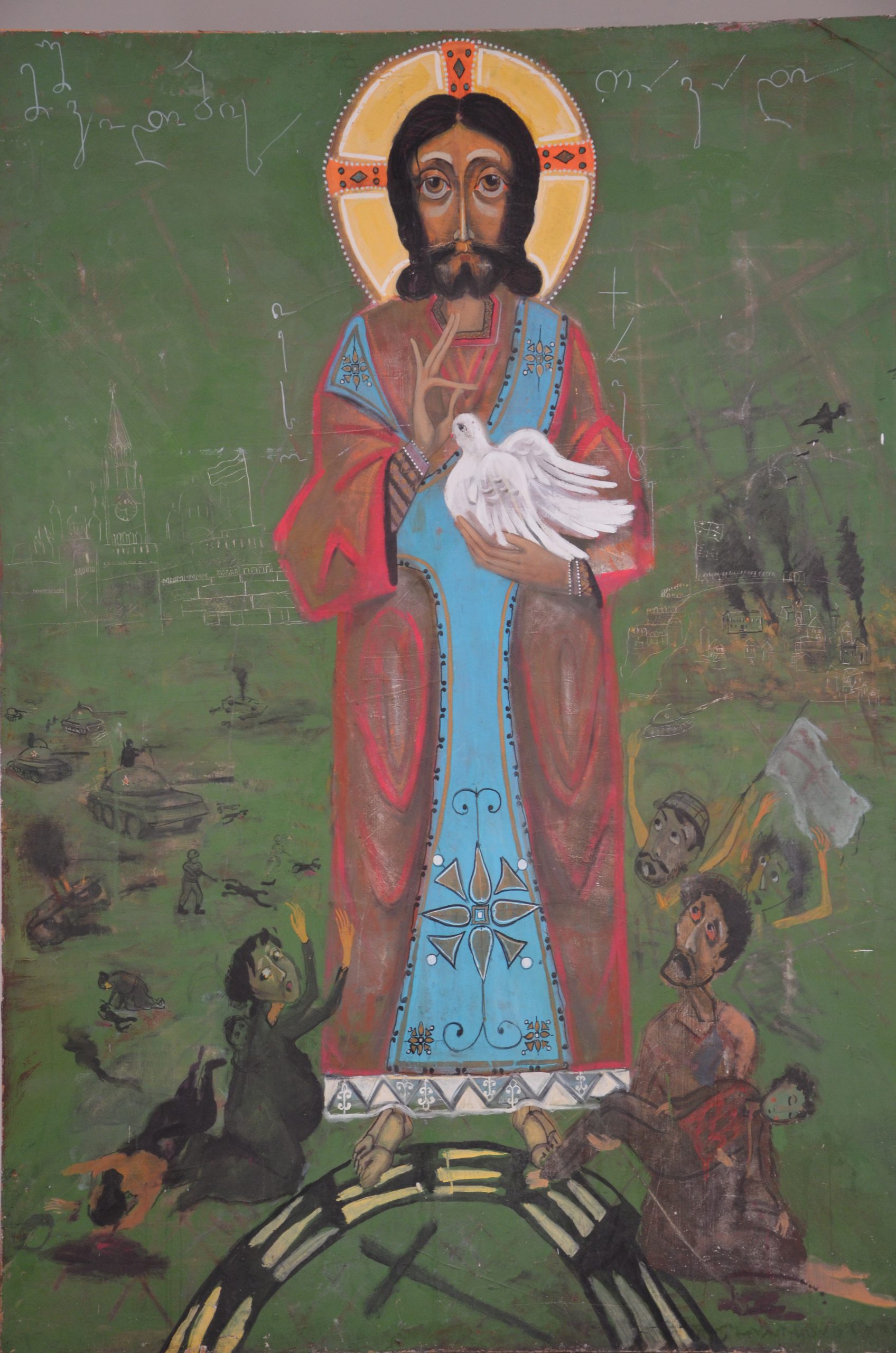
Story behind the “Jesus Prince of Peace” icon

by Ken Sehested

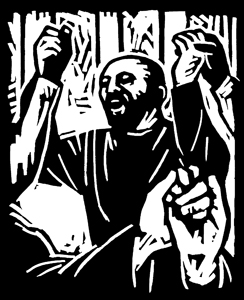
Two things distinguish the “Jesus Prince of Peace” icon (displayed below). One is the sheer fact of the hand-drawn images of brutality and violence surrounding the central figure. This isn’t normal iconographic practice.
The second distinctive is that the iconographer is a Baptist—not your usual religious affiliation for such artists. And he is from Georgia, but not that Georgia.

The artist’s name is Mamuka Kapanadze. He is the iconographer for the Evangelical Baptist Church of The Republic of Georgia, whose liturgical culture is heavily influenced by the Orthodox tradition.

As tensions were building before the 2008 war between Russia and Georgia, Mamuka wanted "to think of something as an expression of protest against the injustice we were experiencing, but on the other hand be nonviolent and speak about peace." His friend and pastor, Evangelical Baptist Bishop Malkaz Songulashvili (yes, Georgian Baptist have bishops) said “we need an image of Jesus as Prince of Peace.”

"I wondered if it was okay with iconographical dogmatics to paint Jesus in the middle of war,” Mamuka said. “I had ideas in my head, but I could not visualize how could it be that Jesus was in the middle of fighting with someone who is dead, someone who is exploded. When I finished the icon I took a photo and sent it to Malkhaz and asked if he was happy. He said it was perfect."

Malkhaz later took a photocopy to a meeting of the European Baptist Federation where Russian Baptists were present, and it was part of the reconciliation between the Georgian and Russian Baptists. It was first published in a British magazine.

At an ecumenical meeting the Russian Patriarchate was supposed to participate but then backed out. Malkhaz set a photocopy of the icon as an offer of friendship, and the Russian Orthodox representatives came to the meeting. Jesus amid war is a new item in iconography.

Georgian Baptists have been at the forefront of numerous civil rights struggles in that country, including advocacy for religious freedom and opposition to discrimination against Muslims and gayfolk.

Georgia (Georgians themselves refer to their country’s name as Sakartvelo) lies between the Black and Caspian Seas, with Russia and the Caucasus Mountains on its northern border, Turkey, Armenia and Azerbaijan to the South. The oldest human remains outside of Africa are from this region.

The Georgian language belongs to its own ancient linguistic group, including their own alphabet, unlike no other language spoken outside the region. It first became a unified kingdom in the 9th century; was conquered for a period by Mongols in the thirteen century; was the subject of rivalry between the Ottoman and Persian empires; was annexed by Russia in 1801; and did not regain its independence until 1991 after the dissolution of the Soviet Union.

The eastern Georgian Kingdom of Iberia became one of the first states in the world to convert to Christianity in the early fourth century, when the King of Iberia Mirian III established it as the official state religion. The missionary who effected this conversion was a woman—Saint Nino (pictured at left), thought to come from a Greek-speaking Roman family in Cappadocia (part of modern Turkey). Nino is venerated by Eastern and Oriental Orthodox Churches as well as Roman Catholic and Eastern Catholic Churches.

I think St. Nino would have been proud of this part of her legacy.

#  #  #

©Ken Sehested @ prayerandpolitiks.org
For a profile of Georgian Baptists’ first female bishop, see Ken Sehested’s “Listen to the Daisies: A profile of Georgian Baptist Bishop Rusudan Gotsiridze.”

I am indebted to my dear friend Dan Buttry for alerting me to this story and for providing key pieces of information. Dan has been present, shoulder to shoulder, with Georgian Baptists and others in nonviolent direct action resisting injustice in that country.

Listen to the daisies

A profile of Georgian Baptist Bishop Rusudan Gotsiridze

by Ken Sehested

      Baptists and bishops have never played well together. With a few exceptions, neither has been friendly to clergywomen. So how to explain the anomaly of Bishop Rusudan Gotsiridze of the Evangelical Baptist Church (EBC) of the Republic of Georgia?

      Certainly one of her influences was St. Nino, the 4th century Cappadocian woman who first evangelized her homeland, the region then known as Caucasian Iberia, which became only the second kingdom, following neighboring Armenia, to officially convert to Christianity. But there was also her grandfather, a Baptist pastor.

      “When our Archbishop started a Bible school in our church, lots of young women came to study theology. Most of us thought we would use this experience teaching Sunday school, or being good mothers for our future children. We never imaged some of us would become ministers.”

Right: Rusudan Gotsiridze (foreground left) during her 2008 ordination.

      I first met Rusudan at the 2009 Global Baptist Peace Conference held in Rome, Italy, where she led compline prayers each evening, and then noon prayers one day at the Basilica of St. Paul Outside the Walls, hosted by the Benedictine monks who shepherd that congregation. What many conferees considered liturgical boundary-crossing was no stretch to a Georgian Baptist, whose worship is heavily influenced by the Orthodox tradition, complete with incense, icons and colorful clerical garb.

      In their own country, the EBC is more known for human rights advocacy. Rusudan’s mentor, Archbishop Malkhaz Songulashvili, was a key figure in the nonviolent Rose Revolution of 2003 that swept from office holdovers from the country’s previous Soviet-aligned regime. He is known by many as a major voice in support of human rights and interfaith collaboration.

      Rusudan herself played a pivotal role in her country’s expanded protection of religious minorities. In July the parliament passed an amendment to Georgia’s Civil Code recognizing five other, non-Orthodox groups, including Baptists. Assigned to represent the EBC on a committee shaping that religious liberty legislation, Rusudan initiated a meeting with leaders of the other recognized religious bodies and convinced them to remove all limiting language, effectively extending legal status to all faith communities.

      Significantly, one of the first human rights initiatives taken by the EBC after the demise of the Soviet Union was opening a path to ordination for women. Though her graduate degree is in Western literature and language, she continued to take theology courses. Her talents were noticed by EBC’s leaders, who appointed her to a succession of church leadership.

      Long story short: On Pentecost Sunday 2008, the EBC ordained Rusudan as a bishop. Though, along with her pastoral duties, she also is a trainer on gender justice with the International Centre on Conflict and Negotiation, which she says “is just another form of my ministry.”

      “Perhaps the most difficult obstacle I faced [with church leadership roles] was my own self-perceptions. Being young, and being female, are two great disadvantages. It took some time before I could give myself the needed affirmation.”

      Sound familiar, anyone?

            “I never would have imagined taking on the responsibility of a bishop. On the Sunday I was ordained—kneeling in front of the altar with a huge open Bible over my head—all I could see was a bucket of daisies. The little flowers were looking at me. And I knew God was there with me, saying do not be afraid, my daughter. I will be with you.”

#  #  #

This article was originally published in the Winter 2012 issue of Folio, newsletter of Baptist Women in Ministry.
©Ken Sehested @ prayerandpolitiks.org


Background to the touch down

President Barack Obama's historic visit to Cuba

by Ken Sehested

       In case you missed this historic video (1:10)—of President Barack Obama and family deplaning in Havana, Cuba, on Monday morning, 21 March 2016.

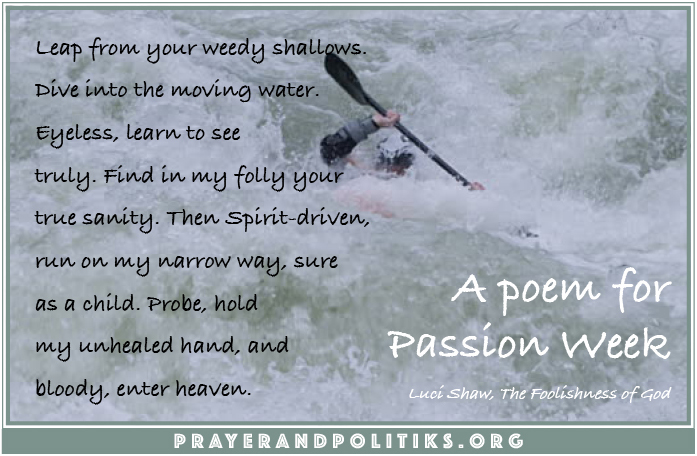
        Even now, during the Christian community’s Passion Week, a countersign—the Promise embedded within the Passion—can be discerned. History, despite its bloodied face, is not fated; and we, among history’s actors, need not abandon the field in hopes of a private realm of bogus atonement detached from fleshly circumstance.

Right: Air Force 1 on approach to the José Martí International Airport in Havana. Photo by Jose Luis Casal.

        The last (and only other) sitting US president to visit Cuba was Calvin Coolidge, in 1928, and then only to speak at the 6th Pan-American conference. Following his term in office, former US President Jimmy Carter visited Cuba in 2002 and 2011. In fact, shortly after Carter was elected in 1976 he issued a secret directive on Cuban policy aimed at normalizing diplomatic relations.

        (For more background on Carter’s visits to Cuba, see Jennifer Lynn McCoy, “How Jimmy Carter Paved the Way for Cuba Breakthrough” Newsweek,  and Peter Kornbluh, “Jimmy Carter: Lift Trad Embargo Against Cuba,” The Nation.)

         Following the Spanish-American War of 1898, when the US took control of Cuba and instituted a military occupation, planning for an “election” were set in motion, with US Administration vetting potential candidates with the intent of restricting the “mass of ignorant and incompetent” and promote “a conservative and thoughtful control of Cuba by Cubans,” in the words of US Secretary of War Elihu Root.

        Despite that move, members of the independence party of Cuba defeated most of the US-back candidates for office. Although the US recognized the new government, work began immediately on what became the US Congress’ Platt Amendment as part of the Military Appropriations Act of February 1901 governing the military occupation, which allowed control of Cuba without actual annexation.

        “Article I, limited the Cuban government from entering into any treaty or contract with a foreign power that would allow that foreign power any control over Cuba, politically or militarily.

        “Article II barred the Cuban government from contracting any public debt, paying interest on any debt, and ensured that the government of Cuba maintained adequate funds for government expenses as well as revenues of the island.

        “Article III stipulated the United States reserved the right to intervene in Cuba for the purposes of maintaining Cuban independence as well as ensuring that the Cuban government was capable of protecting human life and property.

        “Article VIII required these tenets to be incorporated into the new Cuban constitution.

        "Lastly, the Amendment ceded Guantanamo Bay to the United States for use as a naval base in perpetuity.” (Quoted in Ann-Marie Holmes, “The United States and Cuba: 1898-1959”)

        Forced to choose between partial sovereignty and no sovereignty, the Cuban legislature approved these stipulations.

        This particular story is a classic example of the “big print giveth, small print taketh away” aphorism and illustration of a longer, highly ambiguous pattern of US promotion of democratic values around the world.

        Before we can address these matters, we must first know them.

#  #  #

©Ken Sehested @ prayerandpolitiks.org

The Prophet Jesus and the Renewal of Israel

by Richard Horsley (2012), reviewed by Vern Ratzlaff

Horsley sketches the major problems in current discussions of the historical Jesus:  the apocalyptic Jesus and the Jesus of individual sayings (the results in a Jesus as wisdom teacher, and the separation of religion from political-economic life).  Horsley’s attempt is to show Jesus as a prophet generating a movement of renewal of Israel over against the rulers of Israel (p 5).

He presents a contextual Jesus, identifying the context of the historical figure; the particular historical situation, the situation of crisis, personal circumstances and qualities, role of leadership, leader’s interaction with the people, decisive confrontation of the leader with the dominant order.  Reading the gospels thus yields a multifactored historical situation (p 26).

Horsley sketches the renewal movements in Israel, elucidating Jesus’ mission, the roles he adapted and the movement that focused on him (p 83); he places Jesus in the role of prophet, pursuing independence from imperial rule and the renewal of Israelite society in justice under the direct rule of its G-d (p 94).  Horsley looks at the gospels, especially in Mark, to detail the contextual perspective. Jesus’ overall program was the renewal of Israel over against the rulers of Israel, and particular episodes of healing, exorcisms, controversies and confrontation were particular components of the agenda (p 103).

We need to take the gospels whole, and not isolate text fragment (e.g., the Jesus seminar, looking at Q [the hypothetical document containing material common to the first three Gospels] apart from the whole).  Jesus’ followers, who cultivated the Q speeches and the gospel of Mark, continued to understand Jesus primarily as the prophet who launched the renewal of Israel against the rulers of Israel, drawing on the memory of the Mosaic covenant.

Vern Ratzlaff is a pastor and professor of historical theology at Lutheran Theological Seminary in Saskatoon, Saskatchewan, Canada.

Jesus and the Powers: Conflict, Covenant and the Hope of the Poor

by Richard Horsley (2011), reviewed by Vern Ratzlaff

Horsley looks closely at the gospel accounts from the perspective of Jewish covenantal life. He sees the gospel stories as being full of conflict, as portraying Jesus carrying out a renewal of Israel, and as detailing a struggle between opposing powers (Herod, Caesar, high priests, temple system, unclean spirits and demons)(p1-3). He stresses the need to read the gospels as ‘whole stories’, to see the ‘individual sayings as components of speeches or of dialogue episodes on particular issue; to see that the conflict in the gospels is political-economic-religious (between Judaean, Hellenism and priestly) and details the ‘many resistance movements among the Judean and Galilean people against the Herodian and high priestly rulers as well as against Roman rule’ (p 8).

Horsley emphasizes the crucifixion as the key event that ‘transformed the power that was to intimidate and dominate in the power that inspired commitment and solidarity in forming an alternative social order’ (p 199).  Jesus’ renewal movement regenerated the  power of local solidarity, challenged the rulers publicly in Jerusalem(political/religious capital for Israelites and the Roman power in Judea (p 209).

The movement formed in response to Jesus’ mission provided an alternative society under the direct rule of G-d (the kingdom), expanded the movement in resistance to the power that sought to determine the conditions of their lives (demons, client kings, Roman forces). Horsley’s book emphasizes that Jesus’ followers continue their opposition to the imperial order (to the powers) in imitation of Jesus, so that the Roman instrument of terror became the way to see the Jesus way against the powers.

Vern Ratzlaff is a pastor and professor of historical theology at Lutheran Theological Seminary in Saskatoon, Saskatchewan, Canada.

Short Stories by Jesus: the Enigmatic Parables of a Controversial Rabbi

by Amy-Jill Levine (2014), reviewed by Vern Ratzlaff

Amy-Jill Levine, professor of New Testament and Jewish studies in Vanderbilt Divinity school and a self described ‘Yankee Jewish feminist’, brings a Jewish interpretation to Jesus’ parables.  The parables challenge us to look into the hidden aspects of our own values, our own lives.

Through the centuries ‘the parables have been allegorized, moralized, christologized and otherwise tamed into either platitudes such as ‘G-d loves us’ or ‘Be nice’ (p 3).  Jesus’ first followers would have understood more of them; ‘they knew that parables and the tellers of parables were there to prompt them to see the world in a different way’ (p 4).  Levine points out that just as rabbis held that parables were a means for understanding Torah (scripture), so Jesus the Jew uses parables to help his followers understand the kingdom of heaven (p 8).

She points out that  we need to see them in Jesus’ own context, flowing out of his stories and conversations, not reduced to one-line zingers (‘what would the parables have sounded like to people who have no idea that Jesus will be proclaimed Son of G-d by millions, no idea even that he will be crucified by Rome’ (p 3)).  She emphasizes the temptation to tame the parables into screeds against Jewish practice, ethics or theology (p 278).  ‘The people who first heard him did not, at first, worship him, yet they paid attention’ (282).  She details rabbinic (Jewish) perspectives on the implication of Torah (scripture) on the central perspectives of the parables.  I found her work on the prodigals (Luke 15) and Lazarus and the Rich Man (Luke 16) the most compelling.

Vern Ratzlaff is a pastor and professor of historical theology at Lutheran Theological Seminary in Saskatoon, Saskatchewan, Canada.

Exiles in the Empire: Believers Church Perspectives on Politics

by Nathan Yoder and Carol Sheppard, editors ( 2006), reviewed by Vern Ratzlaff

This is a book that explores the troubling paradox of the United States appearing to be both imperial and Christian, living the gospel authentically while also being citizen in an imperial superpower, of being exiles in the empire.  Eighteen essays explore themes of a believers Church Conference held in September 2004.

For me, the key chapters are ‘Jesus’ Confrontation with Empire’, ‘Seek the Welfare of the Empire’, ‘A Personal Journey to Political Involvement, ‘Why Believers Might Conscientiously Abstain from Voting’, ‘Prayer by the Chaplain’.  Several chapters reflect the situation and gospel witness in Lithuania, China, South Africa and Vietnam.

For the United States to be both Christian and imperial is troubling from a missiological, ecclesiological, ethical and Christological perspective.  Metaphors express that hope, metaphors of permanence and transience, of homeland and pilgrimage (p 2-4).  Ted  Grimsrud mentions four connecting points in ‘Jesus’ Confrontation with Empire:  empire’s agents care more about coercive power than about truth (e.g., Jesus and Pilate), the empire’s violence toward any all threats, Jesus’ contrast with imperial leadership styles, the resurrection as an ultimate counter-empire statement’ (p 42). 

‘Seek the Welfare of the Empire’ looks at the implications of Jeremiah’s counsel to the Jewish exiles, exploring the tension of theologically being exiles while politically being Christians, with three implications.  (1) G-d’s primary concern is not the United States empire but the state of the United States church.  (2)  Be prepared for the long haul.  (3)  Find a way booth to love and to resist the empire (e.g., prayer, practice and prophetic witness).  ‘Embodying a new reconciled reality, not advocacy to government, is our first order in a church. . . .  Our well being is not in defeating the empire but in providing viable alternatives to it’ (p 306).  A powerfully prophetic book.

Vern Ratzlaff is a pastor and professor of historical theology at Lutheran Theological Seminary in Saskatoon, Saskatchewan, Canada.

Resisting Structural Evil: Love as Ecological Economic Vocation

by Cynthia Moe-Lobeda (2013), reviewed by Vern Ratzlaff

Moe-Lobeda starts her book by pointing out the connection between the exploitation of sugar cane workers in the Dominican Republic and the vast profits made by corporate owners of the sugar cane industry located in the United States.  As a child, she believed that if you simply knew what was on the other end of material wealth, our economic patterns would change.  But mere knowledge is not enough to enable social change.

The chains of structural violence can, however, be resisted and dismantled.  While structural evil may be beyond the power of individuals to counter, it is composed of power arrangements that are humanly constructed and therefore may be dismantled by other human decisions.  ‘What humans have joined, let humans also put asunder.’  Her book  does not seek to instill guilt in the overcoming of claims, but attempts to identify the moral-spiritual resources in our culture, resources that are to be found in all of earth’s great spiritual traditions.

Each chapter tells a story dealing with people’s linkages, e.g., a community in India whose land is being eroded by bauxite mining, with North America the beneficiary of the bauxite in all the aluminum product.  A compelling section deals with love as transformative power, and reiterating that G-d’s love is the foundation of human love for G-d, self, others and earth.

Vern Ratzlaff is a pastor and professor of historical theology at Lutheran Theological Seminary in Saskatoon, Saskatchewan, Canada.

Mapping Exile and Return: Palestine Dispossessionism and a Political Theology for a Shared Future

by Alain Epp Weave (2014), reviewed by Vern Ratzlaff

1948 in Palestine saw the Nakba (catastrophe) which accompanied the creation of the state of Israel and resulted in the destruction of 500 Palestinian villages and the creation of refugees, a ‘deliberate displacement’ of the Palestinians by Israel as a matter of policy (p 17).  This policy has continued with land confiscations (from Palestinians) and the construction of physical and legal barriers separating Palestinians from Palestinians, ‘resident aliens’.  This has been reflected in Israeli mapping practices.

It is in this perspective that the Nakba provides a counter memory to Israeli policies, an attempt to resist  erasure of the communities that once were home to the now displaced.  Mapping Exile is a look at the Israeli attempt to remove cartographic (mapping) reminders of villages that once stood here but have since been bulldozed by the Israeli army.  It is also a look at the concept of exile, built on the writings of Palestinian Christians.  Weaver also acknowledges his own location as a descendant of European immigrants who settled on land held by Pawnee and Cheyenne nations.

Kufr Bir’im is one of over 120 destroyed Palestinian villages over which tourism and recreation sites have been established (p 97).  Summer camps in these villages for children and youth descended from the original inhabitants map the memories across generations, emphasizing rootedness in the face of uprooting (p 106).

A powerful book using traditional concepts of exile and land, attempting to see how these can grow into possibilities of reconciliation among the sons and daughters of Abraham.

Vern Ratzlaff is a pastor and professor of historical theology at Lutheran Theological Seminary in Saskatoon, Saskatchewan, Canada.

The General’s Son: Journey of an Israeli in Palestine

by Mike Peled (2012), reviewed by Vern Ratzlaff

Mike Peled was born in Jerusalem in 1961 into a well-known Zionist family.  His father, Matti Peled, was an Israeli army officer during the 1948 Israeli war of independence, and a general in the war of 1967 when Israel conquered the West Bank, Gaza, Golan Heights and Sinai.

The growing struggle between Israelis and Palestinians came into Peled’s family when his niece was killed in a suicide attack in Jerusalem.  Pele, who had been living in California, found the American Arab Anti-Discrimination Committee, and this began a warm relationship between Israelis and Palestinians.  Several other discussion groups were formed.  Here he heard Palestinian stories of people forced from their homes as children, and Peled and his new friends began to speak at Rotary clubs, sharing their stories of friendship and trust.

A major high point was when the two sons of a Palestinian friend slept over at the home of a Jewish Israeli home (Peled’s home).  The peace position for Peled developed as he heard more of what his father, an army office, had believed and held on to—how his father had “opposed the massive land confiscation Palestinians had to endure, helped those who had legal issues and spoke out against injustice when people were detained or deported” (p 137).

Through Rotary International, Peled and fellow Rotarians sought to bring medical supplies to Israeli and Palestinian victims, including wheel chairs.  He documents the ways in which Israeli officials, especially the army, held up the transfer of medical supplies, and even charged $7,000 in holding fees (p 133).  He shares the stories of arbitrary arrests and imprisonment (p 210) and the terror of check points, even to himself as an Israeli.  Reading his story brings back the arbitrary state terrorism of Jesus’ Galilean experience, except that it’s the Israelis who have assumed the role of the Roman occupation.  A new empire.

Vern Ratzlaff is a pastor and professor of historical theology at Lutheran Theological Seminary in Saskatoon, Saskatchewan, Canada.