Recent

News, views, notes, and quotes

Signs of the Times  •  16 March 2016  •  No. 63

Holy Week and unholy economies
A primer on economic inequality

Processional.Khen Ephran,” Coptic Orthodox hymn for Holy Week. 

Invocation. “Do not say to yourself, ‘My power and the might of my hand have gotten me this wealth.’” —Deuteronomy 8:17

The earth, too, experiences the trauma of Holy week. Picture (right) of a tar sands (bituminous) oil extraction pit in Alberta, Canada.
 
Call to worship.Wa Habibi” (Good Friday hymn) sung by Fairouz.

Confession. “Some people are so poor all they have is money.” —Bob Marley

Intercession. “In those years, people will say, we lost track / of the meaning of we, of you / we found ourselves / reduced to I / and the whole thing became / silly, ironic, terrible.” —Adrienne Rich, “In Those Years.” Listen to a reading of the poem by Chelsea Tobin.

¶ “It's official. The global 1% of wealth holders now own more than the rest of the world combined. The gap between the richest and poorest has widened so dramatically in the past 12 months that the world's 62 wealthiest individuals now own as much as the poorest half of the global population.” Lauren McCauley, Common Dreams

Hymn of resolve.Go to Dark Gethsemane.”

¶ “It is not that humans have become any more greedy than in generations past. It is that the avenues to express greed had grown so enormously.'' —former Federal Reserve Chairman Alan Greenspan, testifying 16 July 2002 to the Senate Banking Committee

Economic divide by race. “In 1963, the average wealth of white families was $117,000 higher than the average wealth of nonwhite families. By 2013, the average wealth of white families was over $500,000 higher than the average wealth of African American families ($95,000) and of Hispanic families ($112,000). Put another way, white families on average had seven times the wealth of African American families and six times the wealth of Hispanic families in 2013.” Urban Institute

Words of assurance. “May the angels protect you, trouble neglect you, / And mercy direct you when it’s time to go home. / May you always have plenty, your glass never empty, / And know in your belly you’re never alone.” —“Never Alone,” performed by Lady Antebellum and Jim Brickman

Income inequality in the US, visualized in a way that will rock your socks. (6:23 minutes. Thanks, Evelyn.)

American Gospel. “Greed, for lack of a better word, is good. Greed is right. Greed works. Greed clarifies, cuts through, and captures, the essence of the evolutionary spirit. Greed, in all of its forms; greed for life, for money, for love, knowledge, has marked the upward surge of mankind.” —Stockbroker Gordon Gecko, fictional character played by Michael Douglas, in the 1987 film “Wall Street”

Faith in trickle-down [economics theory] is a bit like feeding race horses superior oats so that starving sparrows can forage in their dung. — John Kenneth Gailbraith

Among the findings of a 2015 research study (“Is the United States Still the Best Country in the World? Think Again“) are the following:
        •America’s child poverty levels are worse than in any developed country anywhere.
        •Ranks last in median wealth per adult among 27 other high-income countries.
        •36th out of 162 countries in terms of people living below the poverty line.
        •Fourth highest wealth inequality in the world (slightly better than Chile, Mexico and Turkey. Jill Hamburg Coplan, Fortune magazine and Christopher Ingraham, Washington Post

Music for Holy Week. “God Almighty here I am / Am I where I ought to be / I’ve begun to soon descend / Like the sun into the sea / And I thank my lucky stars / From here to eternity / For the artist that you are / And the man you made of me.” —Kris Kristofferson, “Feeling Mortal

From 1947 to 1979 the income of the bottom fifth of Americans rose by 122%. From the introduction of Reaganomics in 1979 to 2009 the income of the top 1% rose by 270% while the other 99%’s income remained stagnant.  inequality.org

Locate yourself. The Global Rich List website shows you where you rank on the world's economic ladder with sobering specificity. See where you stand. 

See “35 astounding facts about inequality that will fry your brain.—Larry Schwartz’s “35 soul-crushing facts about American income inequality,” Salon

“The godless Galileans feed our poor in addition to their own.” —Roman Emperor Julian, speaking of the early Christian community, considered atheists because of their rejection of the pantheon of gods in the ancient world

Robert Reich, former Labor Secretary and now Professor of Public Policy at the University of California Senior Fellow at the Blum Center for Developing Economies, has mastered the art of brief illustrated videos to explain economic matters to common folk like us. View just these three for a crash course.
        •“The 7 Biggest Economic Lies,” with Robert Reich. (2:47)
        •“What are the 3 biggest economic myths propagated by the moneyed interests? (2:34)
        •“The war on the poor and working families.” (2.25)

¶ “Once we recognize that the most basic questions about economic systems were entwined with biblical religion and fought over as an intrinsic aspect of living religiously, we gain leverage to criticize and evaluate economic systems today.” —Norman Gottwald, The Hebrew Bible in Its Social World and in Ours

Music for Holy Week. “Little bee sucks the blossom / big bee gets the honey / poor man picks the cotton / rich man gets the money.” —Bob Wills and the Texas Playboys, “Take Me Back to Tulsa

In a 2014 study by Sorapop Kiatpongsan and Michael I. Norton, researchers “asked about 55,000 people from 40 countries to estimate how much corporate CEOs and unskilled workers earned. Then they asked people how much CEOs and workers should earn. The median American estimated that the CEO-to-worker pay-ratio was 30-to-1, and that ideally, it’d be 7-to-1. The reality? 354-to-1. Fifty years ago, it was 20-to-1.” Nicholas Fitz, Scientific American

Inequality.org, a project of the Institute for Policy Studies, has a large collection of helpful graphic information, as does United for a Fair Economy.

¶ “. . . when God forbids oppression of the poor in the Book of the Covenant [Exodus 22:21-24], it is the first time the Scriptures explicitly affirm that God becomes angry.” —Thomas D. Hanks, God So Love the Third World

Textbook case of biblical illiteracy. “When the pope criticizes an entire economic system and is negative about it, he is indulging in politics, and I don’t think he should. I personally do not want my spiritual life mixed up with my political life. I go to church to save my soul.” — Stuart Varney, Fox news commentator, criticizing Pope Francis’ statement that “unfettered capitalism is a new tyranny”

The Walmart-owning Walton family alone has more wealth than 42% of American families combined.

Music for Holy Week.Lamentations of Jeremiah I,” Choir of King’s College, Cambridge.

¶ “While debtors prisons were abolished in the 1800s and Supreme Court cases found that jailing people because they can’t pay debts without assessing their ability to pay violates the constitution, these practices have seen a resurgence across the country.” So much so that on Monday “officials at the Department of Justice (DOJ) will send a letter to chief justices and court administrators across the country warning them against operating modern-day debtors’ prisons.” Bryce Covert, thinkprogress.org

Others aren't happy with Roman Catholic Pope Francis’ attention to the poor. Said one souvenir seller near St. Peter’s, “He is always talking about the poor and so the poor come to the Vatican and they have no money to spend.”

¶ “The superfluities of the rich are the necessaries of the poor. Those who retain what is superfluous possess the goods of others.” —Saint Augustine

¶ “The mainstream consensus has long been that a growing economy raises all boats, to much better effect than incentive-dulling redistribution. . . . But now . . . research by economists at the International Monetary Fund suggests that income inequality slows growth, causes financial crises and weakens demand. . . . A survey for the World Economic Forum meeting at Davos pointed to inequality as the most pressing problem of the coming decade (alongside fiscal imbalances).” Zanny Minton Beddoes, The Economist

¶ “Reading the Bible with the eyes of the poor is a different thing from reading it with a full belly.” —Jürgen Moltmann, The Church in the Power of the Spirit

Music for Holy Week. “O all you who walk by on the road, pay attention and see: / if there be any sorrow like my sorrow. / Pay attention, all people, and look at my sorrow: / if there be any sorrow like my sorrow.” —Tomas Luis de Victoria (1548-1611), "Tenebrae Responsories – 14 – O vos omnes," performed by “The Sixteen

¶ “Former president Jimmy Carter said Tuesday on the nationally syndicated radio show the Thom Hartmann Program that the US is now an ‘oligarchy’ in which “unlimited political bribery” has created ‘a complete subversion of our political system as a payoff to major contributors.’” Jon Schwarz, The Intercept

Old world religion. “You know as well as we do that right, as the world goes, is only in question between equals in power, while [in situations of unequal power] the strong do what they can and the weak suffer what they must.” —5th century BCE Greek historian Thuycydides

Preach it. “Speak up for people who cannot speak for themselves. Protect the rights of all who are helpless. Speak for them and be a righteous judge. Protect the rights of the poor and needy.” —Proverbs 31: 8-9, Today’s English Version

Music for Holy Week.The Passion,” Fairouz

The State of our disunion. Noam Chomsky explains, in one sentence, how the interests of private capital undermine the public good, fostering survival-of-the-fittest ethics: “That’s the standard technique of privatization: defund, make sure things don’t work, people get angry, you hand it over to private capital.”

Robin Hood in Reverse: Climate Change Takes from Poor, Gives to Rich. “A new study finds that climate change is triggering a massive reallocation of resources to the world's wealthiest countries.” Nika Knight, Common Dreams

Call to the table. “For now I ask no more than the justice of eating.” —Pablo Neruda, Chilean poet and diplomat whose death was likely ordered by Chilean dictator Augusto Pinochet in 1973

In our day, “poor people find themselves denigrated and demeaned in ways that shock conscience. Former South Carolina Lt. Governor Andre Bauer once likened them to stray animals one feeds at the back door. Fox ‘News’ pundit John Stossel sees them as the enemy in a battle between ‘the makers and the takers.’ Nebraska Attorney General Jon Bruning compares them to scavenging ‘raccoons.’ Ann Coulter says welfare creates ‘irresponsible animals.’” —columnist Leonard Pitts

Music for Holy Week. “Dido’s Lament,” from the aria “When I am laid in earth” in Henry Purcell’s opera “Dido and Aeneas,” performed by Alison Moyet.

If Bill Gates could find a way to spend $1 million a day, it would take him 218 years before he bounced a check. Allison Jackson, GlobalPost

In this animated video Wesley P.P. Hall explains the root cause (a “mutant form of capitalism”) of war, poverty and terrorism in under two minutes.

“The comfort of the rich depends upon an abundant supply of the poor.” —Voltaire, 18th century French historian and philosopher

You don’t necessarily think of Forbes magazine (“reliable business news and financial information”) as the place to turn to for prophetic economic critique, as in Drew Hansen’sUnless It Changes, Capitalism Will Starve Humanity By 2050.”

And then there’s this, from Bloomberg News, crystal ball for the one-percenters and their wannabees. “Goldman Sachs Says It May Be Forced to Fundamentally Question How Capitalism Is Working.” Joe Weisenthal

Altar call. "Nobody gets to heaven without a letter of reference from the poor." —Rev. Dr. James Forbes

Music for Holy Week.Golgotha,” Logos Music.

¶ "There are two modes of invading private property; the first, by which the poor plunder the rich . . . sudden and violent; the second, by which the rich plunder the poor, slow and legal." —John Taylor, "An Inquiry into the Principles and Policy of the Government of the United States" (1814)

What can I do, you may ask, about economic inequality? Maybe the first place to start is to transfer some part of your savings or retirement funds (however meager) into community investing, in community development banks or microlending organizations. Get your congregation to do this, too. And lobby your denominational body (or labor union or civic club or university) to do the same. —Read the “Resolution in support of community investing: Putting a portion of household, congregational and denominational money where our mouths are.” At the end of that article are brief stories about two congregations’ choice to do this.

Benediction.Lo, I Am With You,” John Bell, performed by the Wild Goose Worship Group.

Recessional. One day we’ll have Easter Sunday recessionals like this.

Lectionary for Sunday next. “But Mary stood weeping, weeping, weeping, outside the tomb.” —see Ken Sehested’s “Choral reading of John 20:1-18," a script of John’s resurrection account for 8 voices”

#  #  #

Featured this week on prayer&politiks:

• “Refuge in the shadow,” a collection of Scripture for Holy Week, on "darkness" and "shadow" as the place of God's abiding presence

• “Choral reading of John 20:1-18,” a script of John’s resurrection account for 8 voices

 • “Resolution in support of community investing: Putting a portion of household, congregational and denominational money where our mouths are.” Something you can do to rebuild a holy economy.

• “Come to the Waters: Litany of Confession and Pardon,” inspired by Isaiah 55

©Ken Sehested @ prayerandpolitiks.org. Language not otherwise indicated above is that of the editor. Don’t let the “copyright” notice keep you from circulating material you find here (and elsewhere in this site). Reprint permission is hereby granted in advance for noncommercial purposes.

Your comments are always welcomed. If you have news, views, notes or quotes to add to the list above, please do. If you like what you read, pass this along to your friends. You can reach me directly at klsehested@gmail.com.


Who gonna’ roll that stone?

Easter sermon

Easter morning, Sunday 24 April 2011
Marion Correctional Institution
(maximum security prison for men)
Text: John 20:1-18

by Ken Sehested

        It was still dark when Mary Magdalene crept away from her home, down the street, up into the garden to where Jesus had been buried two days before. Joseph of Arimathea had bravely volunteered to take Jesus’ body away from the Golgotha killing ground. Nicodemus, with whom Jesus had earlier met secretly at night, also came to the burial place, bringing traditional ointments and spices to retard the smell of a decomposing body, along with linen, the customary burial garment of the time.

        No one—not Joseph, nor Nicodemus, not the disciples, nor even the women, who at that point had been the most courageous of any of Jesus’ followers, certainly not the high priest or Pilate or the Roman soldiers—no one expected Jesus to survive. Empty tombs don’t tell no lie; but who gonna’ roll that stone?

        But just in case Jesus’ followers tried to pull a fast one, to come and steal his body and make some ridiculous claims about being resuscitated, the authorities posted armed guards. And, to make double-sure, the placed a boulder over the entrance of the tomb. Stones like that don’t roll away. Threats like Jesus don’t get away. That’s what the authorities teach us to think.

        Empty tombs don’t tell no lie; but who gonna’ roll that stone?

        In each of the four Gospel accounts it is the women who first risk the venture out from behind locked doors to go and care for Jesus’ body, just like they were the only ones who stayed with Jesus on the cross until the bitter end. The men-folk were too scared. And—get this—the women were the first to encounter our Resurrected Lord. Great God Almighty! They became the first evangelists!

        Reminds me of the speech by Sojourner Truth, the 19th century woman born a slave who later became one of the greatest anti-slavery advocates in the country.

“That man over there says that women need to be helped into carriages, and lifted over ditches, and to have the best place everywhere. Nobody ever helps me into carriages, or over mud-puddles, or gives me any best place! And ain't I a woman? Look at me! Look at my arm! I have ploughed and planted, and gathered into barns, and no man could head me! And ain't I a woman? I could work as much and eat as much as a man—when I could get it—and bear the lash as well! And ain't I a woman? I have borne thirteen children, and seen most all sold off to slavery, and when I cried out with my mother's grief, none but Jesus heard me! And ain't I a woman?

“Then that little man in black there, he says women can't have as much rights as men, 'cause Christ wasn't a woman! Where did your Christ come from? I said, where did your Christ come from? From God and a woman! Man had nothing to do with Him.”

        In John’s resurrection story, Mary Magdalene is alone when she comes to the garden. Some scholars think she is the same as Mary of Bethany, brother of Lazarus, who Jesus raised from the dead. But the text is clear that it was this same Mary that, earlier in John’s Gospel, that anointed Jesus’ feet with costly perfume. It was the kind of anointing given to royalty, usually in the presence of a king, staged in the palace by a high-ranking religious official, probably in the company of a legion of Rome’s elite feared soldiers. But in this case it was only a peasant, in an ordinary house. And a mere woman at that! A woman who had no place being in the public company of men.

        Ah . . . but ain’t I a woman. “And in my mother’s grief, none but Jesus heard me.”

        Empty tombs don’t tell no lie; but who gonna’ roll that stone?

        Listen with the ears of your heart to this story, to the footsteps of Mary Magdalene sneaking up to the garden tomb under the cover of darkness—the same darkness that hovered over Egypt as the slaves escaped. Can you hear the angels singing that more modern slave song: “O, Mary don’t you weep, don’t you mourn. Oh, Mary don’t you weep, don’t you mourn. Pharaoh’s army got drown-ded. Oh, Mary don’t you weep.”

        Can you hear it? Empty tombs don’t tell no lie; but who gonna’ roll that stone? Or maybe it’s Mary you hear, singing that Gospel tune:

        “I come to the garden alone, While the dew is still on the roses. And the voice I hear falling on my ear, The Son of God discloses.

        “And He walks with me, and He talks with me, And He tells me I am His own; And the joy we share as we tarry there, None other has ever known.

        Empty tombs don’t tell no lie; but who gonna’ roll that stone?

§  §  §

        A few years ago I was working as a stone mason. I got a job doing what’s called a “dry stack” wall, which means you don’t use any mortar. It takes a lot more skill to dry stack a rock wall. You have to match the stone shapes more carefully, and make sure you use gravity to keep them in place.

        This particular job was especially difficult because I had to actually cut a walkway about half-way up along a steep hill. Just standing up was hard enough, while using a pick and shovel to clear a level path for the base of the retaining wall. On top of that I had to lug 50-100 pound rocks up that hill and try to keep them in place just behind me, or just above, as I cleared the path a step or two at a time.

        I had a lot of rocks go tumbling down that hill. Gravity is a powerful force! Like water, rocks are always trying to go downhill, as if they’re trying to go back to the place where they came from.

        In the same way, those rocks are always trying to get back down in front of that tomb, to seal it up,

      •to keep Jesus from rising up,

      •to tear the heart out of the resurrection story,

      •to keep Mary from her rendezvous with the Lord,

      •to keep the disciples hidden behind closed doors and shivering in fear,

      •to halt the sun’s rising on Easter Morning!

      Is there a stone in front of your life, sealing up your hope for resurrection? Are you still wrapped in the linen of the dead, no way to breathe, no way to sing about “Up From the Grave He Arose”? No way to venture out in the darkest hour just before dawn to join Mary in her walk with the resurrected Christ? No way to sing about the “joy we share as we tarry there”?

        And it continues to happen, even up to this day: the stones of the world keep rolling back in place to keep us in the tombs of our self-centered ways and our violent days. To keep the grave sealed on our anger and rage, steeled in the cell of embittering gaze?

        Empty tombs don’t tell no lie; but who gonna’ roll that stone?

§  §  §

        The circus was coming to town. Before each stop on their travels, an advance team would show up first to do promotion and advertising. One person in that advance team was a high-wire acrobat. A wire was strung fronm one tall building to another. All the media was alerted: “Come see this death-defying act!” It always guaranteed a lot of free publicity for the big tent that would soon arrive, with its elephants and clowns and cotton-candy and sometimes lions and tigers, too.

        The acrobat would first walk the wire with a long balancing poll. The gathering crowd politely applauded. Then he put aside the pole and walked the wire, suspending high over the hard pavement below, with no safety net and nothing but his sheer skill and balance. This time the applause was more hearty.

        Then he announced that he would now push a wheelbarrow across the wire; and after several tense moments, when it appeared he might lose his balance and fall to the street below, he finally made it safely to the rooftop across the way. By now the assembled crowd was cheering wildly.

        After quieting the crowd, which by this time had gotten very large, he shouted down: “Do any of you think I can put someone in my wheelbarrow and roll it across to the other side?”

        The crowd went nuts. SURE! Yes! Of course!! Everybody wanted to see such a spectacle like that.

        Then, when the shouts of encouragement finally died down, the acrobat looked down and said, “Do I have any volunteers?”

        Dead silence. The cheers were gone. Everyone is thinking, “I want to see someone else do that. But not me.”

        Brothers and sisters, Easter morning is not just for pleasant conversation with the Risen Christ, “while the dew is still on the roses.” Yes, “he walks with me, and he talks with me, and he tells me I am his own.”

        But what does it mean to be among Christ’s “own”? What does it mean to belong to Jesus, to walk and talk with him. To hear the promise of mercy and grace which he offers. To know that his arms are large enough even to carry your failures, your broken heart, even your prison sentences? What does it mean to know that no stone is too large that it can’t be rolled away? Or to hear Jesus sing out, “Ain’t no grave can hold my body down”?

        What do these things mean? Is it more than a pleasant garden stroll lit by the sun’s early rays? Is it more than rubbing shoulders with the Son of God? Maybe a picnic breakfast, with the Holy Spirit frying up some potatoes and bacon—or cheese grits, if that’s what you prefer? Scrambling some eggs, offering hot biscuits right out of the oven slathered in butter and a whole row of jellies and jams? Maybe a delicious pastry and a little fresh fruit on the side? With plenty of strong coffee and all the cream and sugar you need? And the angel choir hovering overhead, singing “Up From the Grave He Arose”?

        And you can get seconds, even thirds, if you’ve worked up a good appetite.

        Makes me hungry just thinking about that feast.

        But I don’t think that’s what it mean to be claimed by Jesus, to be considered among his own. To be paroled from jail and go directly to the streets of gold. To have St. Peter ready to open those pearly gates, and bring out the party hats, the moment he sees you coming, one of the prodigal sons returning home.

        No, I don’t think so. I’m pretty sure that’s not it. Nope—it’s something else, something else altogether to being claimed by Christ as one of his own.

        What it means is getting in that wheelbarrow! Are you ready for that wheelbarrow? What it means is to let you life hang in the balance. To face up to the fear of falling to your death. For it will take your death, so to speak—it will take your willingness to die to your own self-centered life, to give pardon and mercy to those around you, without the expectation of return.

        Love is not something you barter to get what you want. Love is something you offer, because it is something you have received. Salvation is more than the promise of a heavenly crown. Salvation is more than a lifeboat, keeping you alive while others all around you are drowning. Salvation is jumping in to those tempestuous waters, risking your life, to save others from the raging sea.

        Your capacity to receive Christ’s pardon is directly related to your willingness to extend it to others. Otherwise, your religion is nothing more than a clanging symbol. Otherwise, your piety is a whitewashed tomb full of rot and stench and the bones of the dead.

        The promise of Easter morning’s saving sunrise hinges on a Good Friday death. You don’t get to skip over it. As we will soon witness, there is first the dying symbolized in the waters of baptism. Only then can we rise with Christ.

        Are you ready for that kind of baptism? Are you ready for that stone to roll?

        Wade in the waters, children; for God’s gonna’ trouble the waters.

©Ken Sehested @ prayerandpolitiks.org

Dueling psalms

A litany for Good Friday, with texts contrasting Psalms 22 and 23

by Ken Sehested

Oh LORD, you are my shepherd, I shall not want.

My God, my God, why have you forsaken me? Why are you so far from helping me, from the words of my groaning?

You make me lie down in green pastures; You lead me beside still waters.

O my God, I cry by day, but you do not answer; and by night, but find no rest.

You restore my soul and lead me in right paths for the Heaven’s Holy Namesake.

In you our ancestors trusted, and you delivered them. To you they cried, and were saved; in you they trusted, and were not put to shame.

Even wending through the darkest valley, I fear no evil.

Do not be far from me, for trouble is near, and there is no one to intervene.

But the scent of Your Presence is there.

O LORD, do not be far away! O Help of the helpless, come quickly to my aid!

Your rod and Your staff — they comfort me.

On you I was cast from my birth, and since my mother bore me you have been my God.

You prepare a table before me in the presence of my enemies.

I am poured out like water, and all my bones are out of joint.

You anoint my head with oil. My cup overflows.

My mouth is dried up like a potsherd, and my tongue sticks to my jaws.

Surely goodness and mercy track my steps all the days of my life.

For the Beloved One did not despise or abhor the affliction of the afflicted.

And I shall inhabit the house of the LORD my whole life long.

To the Ancient of Days, indeed, shall all who sleep in the earth bow down; before the Architect of Creation shall bow all who go down to the dust, and I shall live for this Advocate.

©Ken Sehested @ prayerandpolitiks.org
Bounty and abundance

A litany for worship inspired by Psalm 116

by Ken Sehested

Jump for joy, oh people! For amid the screaming commercials and blithering campaign ads, the Redeemer has heard our aching voice.

God hears! God knows! This is our assurance against all blistering deceit.

When misery and madness encompassed me, when anguish threatened to undo me, when heartache split my soul, I uttered my cry to any who would hear.

God hears! God knows! This is our assurance against the rule of regret.

The One who extends Presence into the most desolate region—even to the place of utter abandonment—is mighty in mercy, strong in tenderness, powerful in pardoning.

God hears! God knows! This is our assurance against every heart-battering threat.

Relax, oh my soul, in the arms of the One who dries tears, Who swaddles our fretful limbs, Whose light in the night scatters dragons, and Whose promise is bounty and abundance.

God hears! God knows! This is our assurance against the ravages of fear. Therefore we will praise that Unspeakable Name forever.

©Ken Sehested @ prayerandpolitiks.org

Refuge in the shadow

A collection of Scripture for Holy Week, on "darkness" and "shadow" as the place of God's abiding presence

by Ken Sehested

Turning from darkness (death) to light (life) is a major theme in Scripture. But there is also a minority report, where darkness and shadow are the place of God’s abiding Presence.

“Hear a just cause, O Lord; attend to my cry; give ear to my prayer from lips free of deceit. Guard me as the apple of the eye; hide me in the shadow of your wings.” —Psalm17:1, 8

“How precious is your steadfast love, O God! All people may take refuge in the shadow of your wings.” —Psalm 36:7

“Be merciful to me, O God, be merciful to me, for in you my soul takes refuge; in the shadow of your wings I will take refuge, until the destroying storms pass by.” —Psalm 57:1

“O God, you are my God, I seek you, my soul thirsts for you; my flesh faints for you, as in a dry and weary land where there is no water. My soul is satisfied as with a rich feast, and my mouth praises you with joyful lips when I meditate on you in the watches of the night; for you have been my help, and in the shadow of your wings I sing for joy.” —Psalm 63:1, 5-8

“You who live in the shelter of the Most High, who abide in the shadow of the Almighty, will say to the Lord, ‘My refuge and my fortress; my God, in whom I trust.’ For God will deliver you from the snare of the fowler and under God’s wings you will find refuge. You will not fear the terror of the night, or the arrow that flies by day, or the pestilence that stalks in darkness, or the destruction that wastes at noonday. God will command the angels concerning you to guard you in all your ways. ‘I will protect those who know my name. When they call to me, I will answer them.’” —Psalm 91:1-3, 5-6, 15-16

“They shall again live beneath my shadow, they shall flourish as a garden; they shall blossom like the vine, their fragrance shall be like the wine of Lebanon.” —Hosea 14:7

For a significant part of the ancient Hebrews’ history, Egypt was the world’s sole superpower. Abiding in God’s “shadow” contrasts with such political allegiance:

“Oh, rebellious children, says the Lord, who carry out a plan, but not mine; who make an alliance, but against my will; who set out to go down to Egypt without asking for my counsel, to take refuge in the protection of Pharaoh, and to seek shelter in the shadow of Egypt. Therefore the protection of Pharaoh shall become your shame, and the shelter in the shadow of Egypt your humiliation. For thus said the Lord God, the Holy One of Israel: In returning and rest you shall be saved; in quietness and in trust shall be your strength.” —Isaiah 30:1, 3, 15

Zechariah, father of John the Baptizer in his song of praise when Elizabeth gave birth, made this prediction: “By the tender mercy of our God, the dawn from on high will break upon us, to give light to those who sit in darkness and in the shadow of death, to guide our feet into the way of peace.” —Luke 1:78-79

©Ken Sehested @ prayerandpolitiks.org


Breath of Heaven

A litany for worship inspired by Psalm 71

by Ken Sehested

O Breath of Heaven and Earth’s Delight, to your shelter we flee from enmity’s fright.

Incline your ear to each whimpering voice collapsed by the weight of earth-splitting fear.

O Rock of Ages, refuge of sages, deflect every threat of sin-soaked rages.

From murderous scheme and unraveling seam deliver from slavery to freedom’s bright dream.

Let not the work of Creation’s good pleasure be subject to plundering, pillaging measure.

Speak pardon to injury; mercy to adversity; entreat us and greet us with grace-filled audacity.

’Twas your hand that caught us, squalling glee with our lung when, from mother’s full womb, we emerged: Praise be sung!

Unbind us, remind us, entwined as we are with joy, adoration, dark night’s guiding star.

©Ken Sehested @ prayerandpolitiks.org

News, views, notes, and quotes

Signs of the Times  •  10 March 2016  •  No. 62

Processional. St. Mary’s Academy (New Orleans) Marching Band.

Invocation. “Pleni sunt caeli et terra gloria tua. Osanna, Osanna in excelsis” (“Heaven and earth are full of thy glory. Hosanna, hosanna in the highest”), “The Ground,” by Ola Gjeilo, performed by the Heritage Concert Choir at Western Washington University.

Right: Chimney Rock, Ghost Ranch, Abiquiu, New Mexico. Photo by Patti Temer at Sol y Luz Photography.

Call to worship. “Who then will contend, or with malice descend with a heart made bitter with blame? No longer shall dread rear its fraudulent head, for my Vindicator stands by my way. —read Ken Sehested’s “Sustain the weary with a word,” a litany for worship inspired by Isaiah 50:4-9a

This decision has encouraging long-term implications. “The U.S. Supreme Court, without hearing oral argument, has unanimously reversed an Alabama Supreme Court ruling that denied parental rights to a lesbian adoptive mother who had split with her partner. The decision is a direct repudiation of an Alabama Supreme Court decision that refused to recognize a Georgia adoption.” —Nina Totenberg, NPR

Paulley Perette (key character on the highly successful “NCIS” TV series, and now executive producer of “An Act of Love”) offers concise (45 seconds) Wesleyian theological affirmations in support of LGBTQ people in the United Methodist Church. Reconciling Ministries Network

Encouraging news. “[Georgia] Governor Nathan Deal, a reliably conservative Republican, cited Jesus last week to cast doubt on the wisdom of broadly worded ‘religious liberty’ legislation that has passed Georgia’s legislature and awaits his action. His stunning words might signal that the anti-gay fever that has swept conservative Christian America, especially in the wake of the 2015 Supreme Court gay marriage decision, could be about to break.” —David Gushee, Religion News Service

Left: Honduran environmental activist Berta Caceres accompanied The Nation‘s expose of the US role in her death. (image: Goldman Environmental Prize)

Women’s History Month profile. Berta Cáceres, Honduran environmental activist supporting the rights of indigenous people, was murdered in her home in La Esperanza on 3 March. A winner of this year’s Goldman Environmental Prize, many think Cáceres was targeted by the Honduran government which came to power in a 2009 US-supported coup against former President Manuel Zelaya. —see Adam Johnson, FAIR
       For a longer background piece on the US role in recent Honduran politics, see Greg Grandin, The Nation.

Confession. “We walk on through the darkness / we walk on through the light / through the confusion and illusion / through the floods and the fire / we walk back to the future / we walk back from the flame / we walk back to the beginning / where we’re given a new name.” —“We Walk On," Tonio K. (Thanks, Keith.)

On International Women’s Day, “It is right and proper to retrieve and celebrate the memory of women of significant achievement who model excellence, infused with righteousness, for us all. However, the vast majority of such women (and men) are highly contextual, inconspicuous, and will only be known to a handful of witnesses. Kathy Waters is one of those.” —continue reading Ken Sehested’s “Wedding on the oncology ward: A meditation on the hurried-up wedding of my youngest and the occasion of International Women’s Day

“Know your history” (see art at right) is the first of “Seven sacred works for young activists (like me)” by Lydia Wylie-Kellermann, from “For the Love of Justice,” Geez

Prophetic word from Republican Senator Margaret Chase Smith in 1950, decrying the state of her political party: “I don’t want to see the Republican Party ride to political victory on the Four Horsemen of Calumny—Fear, Ignorance, Bigotry and Smear. . . . I don’t believe the American people will uphold any political party that puts political exploitation above national interest.”

Women who changed the world. If you’ve not already seen this, get a visual preview (2:08) of 48 female Nobel Laureates.

Words of assurance. “You who endure contentious tongues, threatened by gangsters and banksters of every sort, / Come to the Sheltering Presence of the One who knows, / The One who tapes your photo to Heaven’s refrigerator door, / The One who rekindles in you the gift of love on the wings of a dove.” —continue reading Ken Sehested’s “By Thy might,” a litany for worship inspired by Psalm 31

Needless to say, not all women’s history is salutary.  Few remember that 23 October 1923 was declared “Ku Klux Klan Day" at the Texas State Fair in Dallas, drawing many thousands to march downtown and crowd the fair grounds. Some 800 women were welcomed as new members of the Klan’s female auxiliary. 5,631 men pledged the new member loyalty oaths. —Bryan Woolley, Dallas Morning News

Lenten lesson from Phyllis Tickle. "And in these last months, Phyllis has been teaching me about one final, very important (and yet not so important), matter: death. Mainly, that it is nothing to be afraid of. Death is merely the next step, the next part of the journey toward the heart of God." —see more of Jana Riess’ tribute to Trible, who died 22 September 2015

St. Patrick's Day. St. Patrick wasn’t Irish, didn’t expel snakes from Ireland, has no “miracle” attributed to him (which now is required for sainthood), and didn’t write the poem “St. Patrick’s Breastplate(which was likely penned 3-4 centuries after Patrick died in the late 5th century). Ironically, though, his fame was sufficiently established in his lifetime that his followers waged a war for custody of his body. Relatively little is known for certain about his life, but this much is documented: He was likely the first early church leaders to speak out against the abuse of women.

Hymn of praise. Among my all-time favorite recordings is “The Deer’s Cry,” aka “St. Patrick’s Breastplate,” performed here by Angelina.

Listen to Sinead O’Connor sing the mournful song, “Skibberren,” about the Irish famine of 1846-47, when as many as 400,000 died of starvation and related disease even though British landlords were exporting huge amounts of food. For more on that history see Bill Bigelow, “The Real Irish-American Story Not Taught in Schools.
        “Oh, it's well I do remember, that cold December day,  / The landlord and the sheriff came, to drive us all away  / They set my roof on fire, with their demon yellow spleen  / And that's another reason why I left old Skibbereen.”

As preparation for Holy Week' confrontation, watch this amazing storm photos video. (42 seconds. Thanks, Susan.)

In case you hadn't already figured this out, you can listen to the musical recommendations on this page while you read the text. Simply open the prayer&politiks site on two different tabs, listening on one, reading on the other, switching back and forth between them.

Best one-liner humor. “God only gives us what we can handle. Apparently God thinks I’m a bas-ass.”

¶ “Faith-based efforts are a common but often underplayed component of the progressive coalition,” says Jack Jenkins, regarding Flint, Michigan’s struggles to overcome its horrific water crisis, “It’s worth noting that . . .  most of the first responders turned out to be faith groups of all stripes and creeds, with Unitarians, Catholics, Muslims, and other religious institutions working together. —“Last Night’s Democratic Debate Went Theological. Here’s Why That Matters,” ThinkProgress

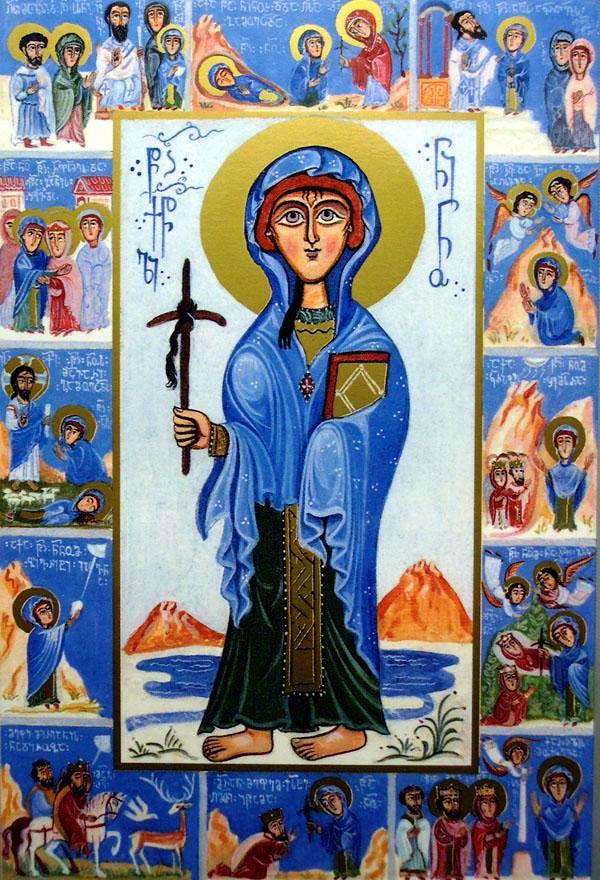
Left: St. Brigid, Patron of Ireland, Students, Infants & Saint for House-Blessing.

Prayer of intercession. “Who said that everything's lost? / I'm here to offer my heart, / So much blood carried away by the river, / I'm here to offer my heart.” —first verse in English translation of “Yo vengo a ofrecer mi corazón,” Mercedes Sosa

Highly relevant Lenten discipline. On the first Sunday of Lent, Annapolis, Maryland United Church of Christ Pastor Rev. Ryan Sirmons was one of several faith leaders who encouraged his congregation to give up plastic bags instead of chocolate. They have the backing of environmental groups that are pushing a bill in the Maryland General Assembly that would ban plastic bags and levy a 10-cent fee on paper bags. —Pamela Wood, The Baltimore Sun

Prophetic photo? A fuel truck (at right) broke through the ice on one of the Canadian Northwest Territories “ice roads” crossing Great Bear Lake near Deline. (Thanks, Margaret.)
        • Federal meteorologists say the winter that has just ended was the hottest in US records, thanks to the combination of El Nino and man-made global warming. Last month was the second warmest February. The fall of 2015 also was a U.S. record. —Seth Borenstein, Associated Press
        •In January scientists report that 2015 was the globe’s hottest year on record, breaking the previous record set in 2014.

Anticipating Easter’s promise: "And the desert shall bloom." Watch this video (1:01) of a “super bloom” of wildflowers in Death Valley.

More promising news. “After years of being ravaged by severe weather and shrinking habitats, the monarch butterflies hibernating in the Mexican mountains rebounded last year. The World Wildlife Fund said that the species, which fly more than 2,500 miles each year from Canada and the United States to a cluster of mountain forests in Mexico, covered about 10 acres this winter, an area more than three times as large as the space they covered last year.” —Victoria Burnett, New York Times

Preach it. “The greatest threat to children in modern liberal societies is not that they will believe in something too deeply, but that they will believe in nothing very deeply at all.” —William Galston, Liberal Purposes

You could say this as well about more than a few Methobapterians. “Her Episcopalian friends were persuading her to their wishy-washy way of worship. They really believed you could get to heaven without any shouting.” —novelist Dorothy West, The Living Is Easy

My “Most Creative Electoral Commentary” award goes to “Ralph Cramden Rips Donald Trump a New One.” (54 seconds. Thanks, David.)

Lectionary for Sunday next. “With glad songs of vict’ry, from the formerly vanquished, let the festal procession loot the treasury of fear. With soul-rested hope doth my voice still rejoice. Incline us, consign us, to steadfast Embrace.” —read Ken Sehested’s “Mutinous lips,” a litany for worship inspired by Psalm 118

Spectacular photos. See the winners of the 2016 World Press Photo Contest.

Call to the table.What a Wonderful World,” Israel Kamakawiwo'ole.

Altar call.Swing Low Sweet Chariot,” B.B. King.

Benediction. “Lord, Now lettest Thou Thy Servant Depart In Peace,” by Sergey Rachmaninoff, performed by the Orthodox Singers Male Choir.

Recessional. “God Be With You Till We Meet Again,” Gospel-styled by Gene Martin.

Just for fun. An indigenous instrumental rendition of “Unchained Melody” (remember the Righteous Brothers’ 1965 version?) by Alex North and Hy Zaret.

#  #  #

Featured this week on prayer&politiks:

• “Sustain the weary with a word,” a litany for worship inspired by Isaiah 50:4-9a

• “By Thy might,” a litany for worship inspired by Psalm 31

• “Wedding on the oncology ward: A meditation on the hurried-up wedding of my youngest and the occasion of International Women’s Day

• “Mutinous lips,” a litany for worship inspired by Psalm 118

Other resources for Lent

• “Raucous: God’s mutiny against Lenten tedium and patriotic pablum,” particularly if Lenten piety gets wearisome or politician’s God-promotion makes atheism a viable option

• “Fasting: Ancient practice, modern relevance

• “Wilderness: Lenten preparation: A collection of biblical texts that speak of wilderness

• “Lent is upon us,” a liturgy for Lent

• “Deepening the Call: A wilderness fast opposing a “Desert Storm,” a Lenten essay protesting the 1991 Gulf War

©Ken Sehested @ prayerandpolitiks.org. Language not otherwise indicated above is that of the editor. Don’t let the “copyright” notice keep you from circulating material you find here (and elsewhere in this site). Reprint permission is hereby granted in advance for noncommercial purposes.

Your comments are always welcomed. If you have news, views, notes or quotes to add to the list above, please do. If you like what you read, pass this along to your friends. You can reach me directly at klsehested@gmail.com.


Sustain the weary with a word

A litany for worship inspired by Isaiah 50:4-9a

by Ken Sehested

Is there no song to be sung, no bell to be rung, no laughter from the fields at play with their yield? Would that my mouth be formed and my lips unleashed to speak a word, a true and hearty word, to all grown deaf with grief.

Make our tongues worthy—make them constant and true—to sustain the weary with a word.

Morning by morning my Sovereign awaits my wakeful embrace of the dawn. My ears rise, eager, despite my heart’s meager consent to the summons of grace.

Make our tongues worthy—make them constant and true—to sustain the weary with a word.

Though the day brings reproach, and enemies approach, I vow no transaction in spite. Whatever befall me, no shame will ensnare me, my lungs draw unmeasured delight.

Make our tongues worthy—make them constant and true—to sustain the weary with a word.

Who then will contend, or with malice descend with a heart made bitter with blame? No longer shall dread rear its fraudulent head, for my Vindicator stands by my way.

Sisters, stand up together; brothers, rise and declare: A Champion is stationing near, to forge tongues that are worthy, and constant and true, to sustain the weary with a word.

©Ken Sehested @ prayerandpolitiks.org

By Thy might

A litany for worship inspired by Psalm 31

by Ken Sehested

The Rock of the Righteous is our God:

Who marks the boundaries between justice and vengeance;

Who blazes the Way from enmity to peace;

Who causes the wicked to stumble in their folly

But protects the weak against howling storms of contempt.

Oh, Strong Refuge, incline your ear to the clamor of children and all of weary voice.

Hasten now, all you whose life is spent with sorrow, you of bone-wasting days, of sighing weeks and storm-tossed years,

You who endure contentious tongues, threatened by gangsters and banksters of every sort,

Come to the Sheltering Presence of the One who knows,

The One who tapes your photo to Heaven’s refrigerator door,

The One who rekindles in you the gift of love on the wings of a dove.

Thou who hast by thy might led us into the light, keep us forever in the path, we pray.*

*Last line from “Lift Every Voice and Sing”
©Ken Sehested @ prayerandpolitiks.org

Mutinous lips

A litany for worship inspired by Psalm 118

by Ken Sehested

From the depths of distress, every sail sagged and limp,
my mutinous lips offer insurrecting sighs.

With heart-aching hope doth my voice still rejoice.
Incline us, consign us, to steadfast Embrace.

Fealty abandoned, no horizon in sight, my stride still
ascends the steep provident path.

With bone-bruising hope doth my voice still rejoice.
Incline us, consign us, to steadfast Embrace.

For I know that great stone, once rejected, now anchors
a mansion of welcome to both strangers and kin.

With feet-wearied hope doth my voice still rejoice.
Incline us, consign us, to steadfast Embrace.

With glad songs of vict’ry, from the formerly vanquished,
let the festal procession loot the treasury of fear.

With soul-rested hope doth my voice still rejoice.
Incline us, consign us, to steadfast Embrace.

©Ken Sehested @ prayerandpolitiks.org