Selected and edited by Ken Sehested
Introduction: A special issue of “Signs of the Times” devoted to Thomas Merton (31 January 1915 – 10 December 1968) quotes was already in the works, to mark the centennial of his birth. But when Pope Francis, in his historic address to a joint session of Congress, lifted Merton's name for special recognition (along with three other Americans), it seemed timely to move up the schedule. (Continue reading Ken Sehested’s "Introduction: The Quotable Thomas Merton.")
§ § §
§ Meditation has no point and no reality unless it is firmly rooted in life.
§ The flight from the world is nothing else but the flight from self-concern.
§ Detachment from things does not mean setting up a contradiction between "things" and "God" as if God were another "thing" and as if earthly creatures were rivals. We do not detach ourselves from things in order to attach ourselves to God, but rather we become detached form ourselves in order to see and use all things in and for God.
§ Solitude is a way to defend the spirit against the murderous din of our materialism.
§ To say “God is love” is like saying, “Eat Wheaties”. . . . There’s no difference, except . . . that people know they are supposed to look pious when God is mentioned.
§ Prayer does not blind us to the world, but it transforms our vision of the world, and makes us see everyone and everything in the light of God.
§ I drink beer whenever I can lay my hands on any. I love beer, and, by that very fact, the world.
§ The beginning of the fight against hatred . . . is not the commandment to love, what must necessarily come before in order to make the commandment bearable and comprehensible. It is a prior commitment, to believe. The root of Christian love is not the will to love, but the faith that one is loved.
§ The humble receive praise the way a clean window takes the light of the sun. The truer and more intense the light is, the less you see of the glass. . . . Humility is the surest sign of strength.
§ What is the use of postmarking our mail with exhortations to “pray for peace” and then spending billions of dollars on atomic submarines, thermonuclear weapons, and ballistic missiles. This, I would think, would certainly be what the New Testament calls “mocking God”—and mocking God far more effectively than the atheists do.
§ We do not go into the desert to escape people but to learn how to find them.
§ Advertising treats all products with the reverence and the seriousness due to sacraments.
§ Few Christians have been able to face the fact that non-violence comes very close to the heart of the Gospel ethic, and is perhaps essential to it. But non-violence is not simply a matter of marching with signs under the eyes of unfriendly police. The partial failure of liberal non-violence has brought out the start reality that our society itself is radically violence and that violence is built into its very structure.
§ Merely to demand support and obedience to an established disorder which is essentially violent through and through will not qualify as “peace-making.”
§ The biggest human temptation is to settle for too little.
§ Solitude that is just solitude and nothing else (i.e., excludes everything else but solitude) is worthless. True solitude embraces everything, for it is the fullness of love that rejects nothing and no one, that is open to All in All.
§ If war propaganda succeeds it is because people want war, and only need a few good reasons to justify their own desire.
§ Now one of the things we must cast out first of all is fear. Fear narrows the little entrance of our heart. It shrinks our capacity to love. It freezes up our power to give ourselves. If we were terrified of God as an inexorable judge, we would not confidently await divine mercy, or approach God trustfully in prayer.
§ Violence is not completely fatal until it ceases to disturb us.
§ There is a pervasive form of contemporary violence to which the idealist fighting for peace by non-violent methods most easily succumbs: activism and over-work. The rush and pressure of modern life are a form, perhaps the most common form, of its innate violence. To allow oneself to be carried away by a multitude of conflicting concerns, to surrender to too many demands, to commit oneself to too many projects, to want to help every one in everything is to succumb to violence. The frenzy of the activist neutralizes his work for peace. It destroys the fruitfulness of his own work, because it kills the root of inner wisdom which makes work fruitful.
§ It is only by making our knowledge part of ourselves, through action, that we enter into the reality that is signified by our concepts.
§ Yesterday Father Cellarer lent me the Jeep. I did not ask for it, he just lent it to me out of the goodness of his heart, so that I would be able to go over on the far side of the knobs. I had never driven a car before. . . . It has been raining heavily. All the roads were deep in mud. It took me some time to discover the front-wheel drive. I skidded into the ditches and got out again, I went through creeks, I got stuck in the mud, I bumped into trees. . . .
I drove the Jeep madly into the forest in a happy, rosy fog of confusion and delight. We romped over trestles and I said, "O Mary, I love you," as I went splashing through puddles a foot deep, rushing madly into the underbrush and back out again.
Finally I got the thing back to the monastery covered with mud from stern to stern. Father Cellarer just made me a sign that I must never, never, under any circumstances, take the Jeep out again.
§ A tree gives glory to God first of all by being a tree. For in being what God means it to be, it is imitating an idea which is in God and which is not distinct from the essence of God, and therefore a tree imitates God by being a tree.
§ God has the most annoying manner of showing up when we least want; of confronting us in the strangest ways.
§ Your life is shaped by the end you live for. You are made in the image of what you desire.
§ If you find God with great ease, perhaps it is not God you have found.
§ The peace the world pretends to desire is really no peace at all. To some, peace merely means the liberty to exploit other people without fear of retaliation or interference. To others, peace means the freedom to rob neighbors without interruption. To still others, it means the leisure to devour the goods of the earth without being compelled to interrupt their pleasures to feed those whom their greed is starving. And to practically everybody, peace simply means the absence of any physical violence that might cast a shadow over lives devoted to the satisfaction of their animal appetites for comfort and pleasure.
§ Where abstract thought and concrete existence enter into conflict, the mark of true contemplatives is that they are on the side of concrete existence.
§ The beginning of love is the will to let those we love be perfectly themselves, the resolution not to twist them to fit our own image.
§ A 1963 letter to French philosopher Jacques Maritain: I am putting into the mail a mimeographed copy of my "unpublishable" book on "Peace in the Post Christian Era." Unpublishable because forbidden by our upright and upstanding Abbot General who does not want to leave Christian civilization without the bomb to crown its history of honor. He says that my defense of peace fausserait le message de la vie contemplative [would falsify the message of the contemplative life]. The fact that a monk should be concerned about this issue is thought—by "good monks"—to be scandalous. A hateful distraction, withdrawing one's mind from Baby Jesus in the Crib. Strange to say, no one seems concerned at the fact that the crib is directly under the bomb.
§ Do not be too quick to assume your enemies are savages just because they are your enemies. Perhaps they are your enemies because they think you are a savage. Or perhaps they are afraid of you because they feel that you are afraid of them.
§ It seems to me that we have little genuine interest in human liberty and in the human person. What we are interested in, on the contrary, is the unlimited freedom of the corporation. When we call ourselves the “free world” we mean first of all the world in which business is free. . . . It was only when money became involved that the Negro demonstrations finally impressed themselves upon the American mind as being real.
§ [T]he Negro problem is really a White problem.
§ The “death of the old man” [in the history of Christian thought] is not the destruction of personality but the dissipation of an illusion, and the discovery of the new humanity is the realization of what was there all along.
§ Buddhist “mindfulness,” far from being contemptuous of life, is extremely solicitous for all life. It has two aspects: one, the penetration of the meaning and reality of suffering by meditation, and two, the protection of all beings against suffering by nonviolence and compassion.
§ Be still: / There is no longer any need of comment. / It was a lucky wind / That blew away his halo with his cares, / A lucky sea that drowned his reputation.
§ I don’t feel that I can in conscience, at a time like this, go on writing just about things like meditation, though that has its point. I cannot just bury my head in a lot of rather tiny and secondary monastic studies either. I think I have to face the big issues, the life-and-death issues: and this is what everyone is afraid of.
§ There has generally been no conception at all that whites had anything to learn from the Negro. And now, the irony is that Negroes are offering us a “message of salvation,” but we are so blinded by our own self-sufficiency and self-conceit that we do not recognize the peril in which we have put ourselves by ignoring the offer. . . . [Negroes] are offering us the occasion to enter with them into a providential reciprocity willed for us by God.
§ Do not depend on the hope of results. You may have to face the fact that your work will be apparently worthless and even achieve no result at all, if not perhaps results opposite to what you expect. As you get used to this idea, you start more and more to concentrate not on the results, but on the value, the rightness, the truth of the work itself. You gradually struggle less and less for an idea and more and more for specific people. In the end, it is the reality of personal relationship that saves everything.
§ The word of the Gospel is understood only when it is obeyed. It is known to those who strive to practice it.
§ The beginning of the fight against hatred, the basic Christian answer to hatred, is not the commandment to love, but what must necessarily come before in order to make the commandment bearable and comprehensible. It is a prior commandment, to believe. The root of Christian love is not the will to love, but the faith that one is loved.
§ When I pray for peace, I pray not only that the enemies of my own country may cease to want war, but above all that my own country will cease to do the things that make war inevitable.
§ When all the men of war are killed / And flags have fallen into dust / Your cross and mine will tell men still / He died on each for both of us / That we might become the brothers of God / And learn to know the Christ of burnt men.
§ The Negro spirituals of the last century remain as classic examples of what a living liturgical hymnody out to be, and how it comes into being: not in the study of the research worker or in the monastery library, still less in the halls of curial offices, where human being suffer oppression, where they are deprived of identity, where their lives are robbed of meaning, and where the desire of freedom and the imperative demand of truth forces them to give it meaning.
§ A white detective in Birmingham, watching the children file by the score into paddy wagons, gave expression to the mind of the nation when he said: “If this is religion, I don’t want any part of it.” If this is really what the mind of white America has concluded, we stand judged by our own thought.
§ In the end contemplatives suffer the anguish of realizing that they no longer know what God is . . . because “God is not a what” . . . but a “Who.”
§ At the close of what turned out to be his final talk, at the December 1968 interfaith conference of monastics held in Bangkok, Merton quipped: So I will disappear from view, and we can all go have a Coke or something.
# # #
Have a Merton quote or anecdote or other resource to share? Offer it below in the reader comment section.
RESOURCES
Video resources on the web
Listen to Kate Campbell's original song, "Prayer of Thomas Merton," using the words to Merton's "My Lord God" prayer in designed format, above.
“Thomas Merton – PBS Video,” 11 minutes
CBS “Modern Masters of Religion,” program on Merton (27 minutes)
“Thomas Merton from ‘Who Cares About the Saints?’ with Ft. James Martin SJ” (11+ minutes)
“Fr. Matthew remembers Thomas Merton,” recollections of one of Merton’s fellow monks at the Abbey of Gethsemani (15 minutes)
“Soul Searching,” three 2+ minutes videos of different periods in Merton’s life
Biography
There are more than two dozen Merton biographies. Of the ones I’ve read, Jim Forest’s Living With Wisdom: A Life of Thomas Merton (revised edition, 2008) is far and away the best. (While you’re at it, Forest’s biography of Dorothy Day, All Is Grace, is also my favorite in that collection.)
For an essay-length overview of Merton’s legacy, see Jim Forest’s “Thomas Merton’s Advice to Peacemaker,” Jim Forest
Also of interest. Bellarmine University in Louisville is home to the Thomas Merton Center. Their site also has a brief biographical sketch along with an extensive Merton bibliography.
Alas, I cut nearly three-fourths of my collection of quotes to maintain the parameter of “Signs of the Times.” That extra material is posted in this “More Merton quotes” file.
Special note on language edits. When alteration of the above quotes for gender inclusivity is relatively simple, I have done so. When such changes would generate awkward sentence construction or the piling up of words, I have left existing language in place. When language ceases to be transparent, calling attention to itself rather than the ideas being expressed, it fails. These are, of course, subjective choices. Unfortunately, there is no unadulterated language. (As Merton might say, this is why the deepest level of prayer goes beyond words—or as the Apostle Paul knew, some things require expression in “sighs too deep for words.” —Romans 8:26)
Gender inclusive language itself is hardly sufficient, given its reliance on anthropomorphic imagery for God. And Lord knows what else. But that’s a discussion for another time. —Ken Sehested


 sure to come, no longer checked by the dams of possibility and doubt shored with the black mortar of cynicism.” —continue reading “
 ¶ Harriet Tubman wins vote to replace Andrew Jackson on $20 bill. “
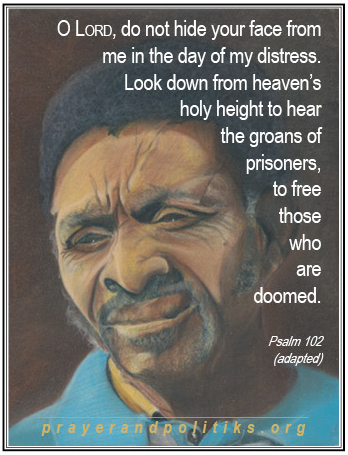 from his “The Three Hermits” opera, lyrics by Michael Dennis Browne, adapted from a Russian Orthodox prayer, sung here by the Minnesota-based ensemble
  punishment. The justices denied the case at least in part because of the execution of the original plaintiff, Alfredo Prieto, who was given a lethal injection October 1 by the state of Virginia before the high court could rule on his final stay application.” —Richard Wolf,
 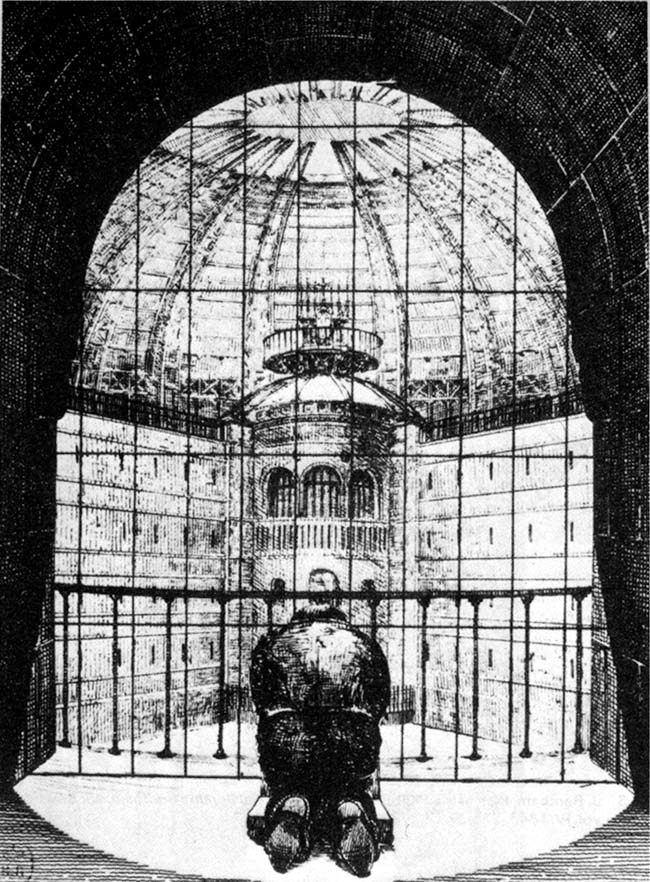 thought that forced “solitude” would encourage repentance leading to positive social behavior.
 ¶ “Nothing sucks more about prison than missing the people who own beachfront property in your heart.” —“Ghost,” a maximum security prisoner, in a letter to his former chaplain after transferring to another facility
 ¶ Call to the table. “Hope has two beautiful daughters. Their names are anger and courage: anger at the way things are and courage to see that they do not remain the way they are.” —St. Augustine
 EXTRA Good news! A note from Gerald, prayer&politiks’ guardian angel and synod convener.
 lame my gait if I / could not free myself from / the weight of other's / malice. —Rabia of Basri (c. 717-801), among the most influential female Islamic saints and a central figure in the Sufi tradition
 ¶ New painting (right) by John August Swanson. “Psalm 67: Our God has blessed the earth, our common home, with a wonderful harvest!” ©
 ¶ When the military self-blesses and Fox News blames atheists for criticism. Sign on the left at the Marine Corps Base in Kaneohe, Hawaii. —“
 ¶ Resource for your church. Each fall the
  ¶ Send in the clowns! As of August “Argentina has a new law for treating children in hospitals that requires doctors to literally send in the clowns. The groundbreaking law—the first in the world—for Argentina’s largest province, Buenos Aires, was inspired by the 'laughter therapy' of US physician Hunter 'Patch' Adams.'” (Robin Williams played the lead role in the "Patch Adams" movie.) —Kamilia Lahrichi, “
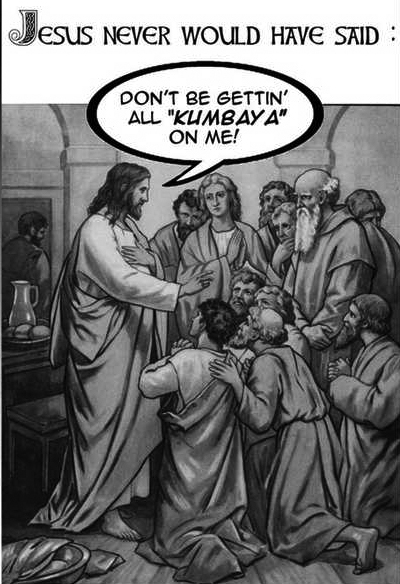 become a required sign of toughness and pragmatism in American politics today, and this is especially true since the September 11 attacks."
 ¶ Preach it. “Hagar’s story [Genesis 16:1-16, 21] is prominently located in the early parts of our text because God wants us to know that in the beginning not only was there the word, not only did God create the world, but in the beginning God saw, heard and looked after people like Hagar. Hagar sees God face to face and doesn’t die. Hagar names God El-Roi, meaning “you are a God who sees.” Hagar is really the first theologian of the Bible. Sarah and Abraham fumble and stumble in God’s midst; Hagar boldly stands in the presence of God.” —Elijah Zehyoue, a pastoral resident at Calvary Baptist Church in Washington, DC, “