Recent

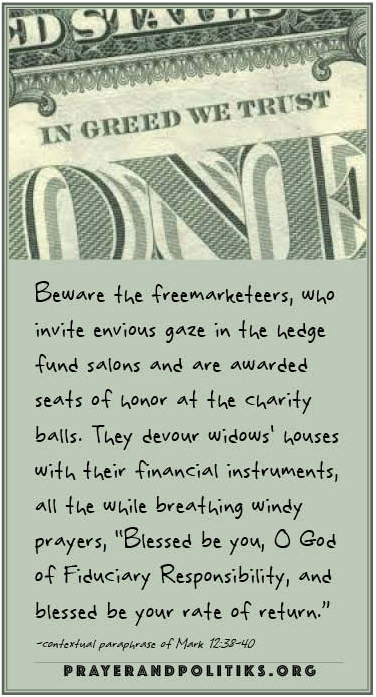
In Greed We Trust

Greedlock and the god of fiduciary responsibility: The question of idolatry is with us still

by Ken Sehested

       You likely heard recently that former hedge fund manager-turned-entreperneur Martin Shkreli’s company, Turing Pharmaceuticals, bought the patent to a drug treating toxoplasmosis, a potentially deadly parasite disease, increasing the per pill cost from $13.50 to $750. (Before being sold several previous times, the Daraorun medication per pill cost was $1.00.)

        Now San Diego-based Imprimis Pharmaceuticals has announced it would manufacture customized versions of the drug for less than $1.00 (though the Federal Drug Administration has yet to sanction the new drug).

        In his announcement, Imprimis CEO Mark L. Baum conveys the contradiction in which we live. He begins with generous sentiment, saying “recent generic drug price increases have made us concerned” for the well-being of “a needy population.”

        But then he continues, “While we respect Turing’s right to charge patients and insurance companies whatever it believes is appropriate. . . .”

        (This, in case you didn’t know, is the meaning of “fiduciary responsibility,” the legal imperative dictating that rate of financial gain must trump all other investment considerations.)

        People of faith and conscience need to say a loud no to the “whatever” portion of Baum’s statement. There should be no respect given for such a decision: no justification, no rationalization, no exoneration.

        Greed should be named for what it is: avarice, gluttony, piggishness. The notion that the common good will best be served by establishing self-interest as the unquestioned criterion and singular motivation for economic activity is patently absurd. As Voltaire noted, “Those who can make you believe absurdities can make you commit atrocities.”

        Otherwise we should be honest and say, with stockbroker Gordon Gecko (the fictional character played by Michael Douglas in Oliver Stone’s movie, “Wall Street”): “Greed, for lack of a better word, is good. Greed is right. Greed works.”

        “What we need,” as Anne Brower famously wrote, coining a new word, “is a cure for greedlock.” What we need—speaking here more confessionally—is a confrontation with idolatry.

        The question of idolatry remains at the center of our vocation. It’s not a question of statues in the temple or figurines on the dashboard, but rather confusion over whose presence, promise and provision can be trusted to secure the future.

        Idolatry? Really? The suggestion seems anachronistic, a problem for ancient and primitive peoples. What does the standard for economic decision-making have to do with idols? Didn’t modernity thrust us beyond such superstition? Shouldn’t we leave economics to the economists, politics to the politicians, national defense to military planners and environmental questions to the scientists?

        Such questions reveal the extent of our biblical illiteracy. It exposes the degree to which spirituality—following Jesus, as we Christians would say—has been emptied of its content, still occasionally “full of sound and fury” (I think of the TV marketeers of piety, the kind Will Campbell called “soul snatchers”) but largely “signifying nothing.” (Shakespeare had a way with words.)

        “Do not say to yourself, ‘My power and the might of my own hand have gotten me this wealth’” (Deuteronomy 8:17), God warned, by way of Moses to the Sinai assembled children of Israel. “You cannot serve God and mammon,” (Matthew 6:19) Jesus warned atop another Mount to a later assemblage—“from Galilee, the Decapolis, Jerusalem, Judea and from beyond the Jordan”—mammon being a common Aramaic term for wealth-assured security.

        “We’ll worship the hind legs off Jesus, but not do a thing he says,” Clarence Jordan sharply noted. Or, as in the “Family Circus” cartoon appearing on Mother’s Day some years ago, young Billy says to his sister Dolly, “I think I’m going to give Mom a spiritual bouquet and save my money for a catcher’s mitt.”

        Of course, recognizing that the God of Scripture does in fact have a bias for those on the margins of social, economic and political life (and marginalization is manifold in its variety—most of us having at least a little of both) does not effortlessly resolve our dilemmas or easily answer all our questions. Unfortunately, Jesus was notoriously vague about details involved in following the Way, something which theologians and preachers and everyday believers have worked ceaselessly to overcome for two millennia. The terms still require discernment, within communities, even tumultuous and competing conclusions by equally devoted hearts both within and among such communities.

        I can imagine Jesus saying “I didn’t promise it would be easy. I said it would be worth it.”

        We live and breathe, work and pray, not with confidence in privileged access to the Mind of Christ amid all disputation. We rest in the kind of stillness where God is found, and cooperate with the Spirit’s mobilization against both personal meanness and structural injustice, because we know that the Way involves an ongoing act of repenting vain self-centeredness and anxiety-driven security demands. And we learn, time and again and from risky lived experience, that it is from the margins that God’s restfulness and God’s energy intersect.

        Prayer unfolds as care, and care drives us deeper into prayer.

        Such is the posture and geography of honest-to-goodness freedom—contra the greedlock of free marketeering, in iconoclastic resistance to the god of fiduciary responsibility—while we simultaneously plow and plant and water and hoe what Clarence colloquially referred to as “demonstration plots” for the truly Common-wealth of God, liturgically returning—traditional or contemporary-styled, it matters not—to that original praise song, “Thy kingdom come, Thy will be done, on earth. . . .”

#  #  #

I am indebted to my longstanding friend, Andy Loving, for the phrase "God of fiduciary responsibility." An ordained minister, Andy and his partner/spouse Susan Taylor devote their full-time attention to encouraging and facilitating socially-responsible investing. See more at Just Money Advisors.
 

©Ken Sehested @ prayerandpolitiks.org

Resolution in support of community investing

Putting a portion of household, congregational and denominational money where our mouths are

A statement of resolve unanimously approved by participants in the
28-30 March 2008 Alliance of Baptists Convocation, New Orleans
(a similar resolution was approved in June 2008 by the United Church of Christ Southern Conference)

Written and submitted by Ken Sehested

Beware, God warns, lest you say in your heart,
“My power and the might of my hand have gotten me this wealth.”

—Deuteronomy 8:11-17

Among the Alliance of Baptists’ distinctives, in the words of our Covenant, is the call to “social and economic justice” as reflective of our faith in Jesus Christ. Over the years the annual Convocation has approved numerous resolutions in support of such initiatives.

With this resolution we, the members of the Alliance meeting in annual session, hereby urge the Alliance board of directors, affiliated congregation and individual members to practice “community investing” as a form of Christian discipleship: by depositing or investing savings into financial institutions that focus on serving those on the margin, here in the U.S. and abroad.[i]

            Specifically, we recommend that a minimum of 10% of discretionary capital (savings, endowments, emergency funds, etc.) be placed in community investments.[ii]

            1. The call to pursue justice saturates Scripture. In several texts, doing justice and loving God are identical realities. The only heavenly-entrance exam Jesus outlined involves our care of “the least of these.”

            2. The work of charity will always be part of our mission. Too often, though, such work eclipses the demand for structural justice. Ancient Israel’s “gleaning” law—those forbidding landowners to reap to the edges of their fields, to allow harvest by those in need (cf. Leviticus 23:22) —was an order, not an option.

            3. Unfortunately, when it comes to handling money, many people think of only two choices: we hoard it or we abhor it. While Christian discipleship surely includes a commitment to simplicity, it also requires a commitment to steward the assets available to us in ways that mirror God’s preferential option for the poor.

            4. As Clarence Jordan once wrote, what the poor need are not social workers but partners. He was not denigrating the former; he was highlighting the work of empowerment, of providing tools for self-development and thereby recovering both sustenance and dignity.

            5. By depositing savings into community investing institutions, we are removing assets from the control of large financial institutions whose interests are not those of the Gospel but of solely maximizing profit. This need is especially critical in our time, when economic institutions increasingly eclipse the ability of political authorities to insure our commonwealth. Political democracy is no guarantee of economic democracy. Their clashing interests are escalating.

            6. Finally, commitment to community investing encourages local congregations to put the question of money—maybe the last taboo in our ranks—on the table for discussion in light of our calling as Christians.

            7. There are many things needing to be done. Because it is relatively simple, safe and accessible to virtually every individual and congregation, community investing should be among our common spiritual disciplines. When you tally up the collective savings assets even of people like us—we who don’t come close to the fortunes of sports and entertainment celebrities or corporate chiefs—it’s obvious that we can, if we work together, leverage significant sums of money to serve our convictions.[iii]

#   #   #

Notes

[i] Community investment institutions include both “microlending” (or “microfinance”) organizations that provide small loans for business development and “community development banks” that provide loans for things like housing development. Both provide working capital to individuals and businesses most in need and least likely to receive loans from mainstream investment institutions. While rates of return from community investments are sometimes lower than traditional financial institutions, community investors are motivated by missional convictions, not just financial returns.
            Some means of community investing are federally-insured, some are not. While not insured, many microlenders have excellent histories of responsible management. For example, Oikocredit, founded in 1975 by World Council of Churches member bodies, has never lost a single penny of investors’ funds.
            The significance of microlending to long-term prospects for world peace was recognized when Mohammad Yunus, founder of the Grameen Bank in Bangladesh, was awarded the 2006 Nobel Peace Prize. Started in 1976 by Professor Muhammad Yunus with $27.00 from his own pocket, Grameen Bank today serves more than six million poor families with loans, savings, insurance and other services. The bank is fully owned by its clients and has been a model for microfinance institutions around the world.
          Community investing is different from “screened” investing. The phrase “socially-responsible investing” sometimes refers to both “community” and “screened” options. The latter employ a wide variety of ethical considerations (more than the traditional vices of alcohol, tobacco and gambling) to regulate capital investment choices.

[ii] Federal law prohibits certain kinds of economic institutions—for instance, retirement funds—from offering you the option of choosing investments that offer lower rates of return. This is what is meant by the phrase “fiduciary responsibility.” In this case, federal law trumps biblical injunctions.

[iii] Two brief stories of Alliance-affiliated congregations.
            Several years ago members of one modest-sized congregation (less than 100 members, most households living on income below the national median) decided to challenge the community to redirect household savings to community investments. To everyone’s surprise, the cumulative total came to nearly $200,000.
            At about the same time another, slightly smaller congregation decided to set aside a small cash reserve—budgeting annual increments for this purpose toward a goal equal to two months’ operating expenses—as an emergency fund to cover unforeseen contingencies. These funds were then invested in three community investments: 25% with a local microlender that provides small loans and technical training to stimulate new small businesses, working with clients unlikely to qualify for conventional loans; 25% with a community development bank providing home ownership loans to low-income people in the state; and 50% with a microlending agency providing affordable loans to small businesspeople in developing countries. These investments were intentionally loaned at 0% interest, with the “lost” interest returns listed among the church’s annual missions-giving report.
            These are but two examples of how congregations can creatively encourage practical ways for members to “put our money where our mouth is.” For too long we have exempted this area of our lives from the claims of the Gospel, and we have allowed the god of maximum return (“fiduciary responsibility”) to rule our choices. To this extent, we have practiced idolatry and are in need of repentance.

Acquainted with grief

A litany for worship inspired by Psalm 42

by Ken Sehested

"Why are you cast down,
      O my soul,
             and why are you
      disquieted within me?" (Psalm 42:5a)

We are a people acquainted with grief.
In the bonds of this Body none need be embarrassed
     at the sound of sobbing, of the soul’s aching groan.

Here the tear is neither
     uncommon nor unwelcomed.

Here the strong confess their doubts,
     the fluent run out of words.

Here the gentle speak their rant and
     the hesitant shout their rage.

Here we acknowledge life’s daily
     bout matching
           faith with fear,
           hope with despair,
           love with contention,
           and joy with complaint.

We do so for matters whether
           small and personal,
           or large and public;
           whether near or afar,
           both named and anonymous.

Despite the odds-maker’s wager,
     we march on unencumbered:
           Sustained by the cadence
                                   of enamoring grace.

©Ken Sehested @ prayerandpolitiks.org.

News, views, notes, and quotes

22 October 2015  •  No. 43

Invocation.  “When hope is aroused—or even the possibility of that hope’s approach—the body, of it’s own accord, fills with a reservoir of bated breath, as though preparing for the shouts of joy and happiness, victory and triumph, that are sure to come, no longer checked by the dams of possibility and doubt shored with the black mortar of cynicism.” —continue reading “When hope is aroused” by “Ghost,” a maximum security prisoner

Photo by Peggy Coleman. See more of her award-winning photography.

Call to worship. “No greater love hath any than to yield / Privilege and pow’r to welcome and to shield / The least, the lost, the whole creation healed / Alleluia! Alleluia!” —continue reading Ken Sehested’s new hymn lyrics to “For All the Saints

Good news. “Can a shared love of hummus bring Jews and Arabs together? An Israeli restaurant near the coastal city of Netanya is offering 50% discounts on hummus for tables with both Jews and Arabs. A manager of the Hummus Bar, located in Kfar Vitkin, told the Times of Israel that “several” tables of Jews and Arabs have taken advantage of the offer since it began Oct. 13. “By us we don’t have Arabs! But we also don’t have Jews … By us we’ve got human beings!” the restaurant posted on Facebook. “And real excellent Arab hummus! And great Jewish falafel!” Jewish Telegraphic Agency  (Thanks, Ivan.)

Hymn of praise. There’ll be “Joy in the Morning,” Mississippi All-State Youth Choir & Orchestra.  (Thanks, Marti.)

Syria’s multiplex civil war. If you could use some help understanding the bloody, convoluted war happening inside and outside of Syria's borders, watch “Syria’s War: A five-minute history(5+ minutes) by Ezra Klein. 

Harriet Tubman wins vote to replace Andrew Jackson on $20 bill.Women on 20s,” a group that has been campaigning to replace Jackson with a woman has chosen Harriet Tubman, the 19th century abolitionist who escaped slavery and led other slaves to freedom via the ‘Underground Railroad.’ The group tallied more than 600,000 online votes over the last few months, narrowing a long list to 4 finalists: Tubman, the late first lady Eleanor Roosevelt, Rosa Parks, whose act of defiance sparked the Montgomery bus boycotts of the ‘60s, and Wilma Mankiller, the first female chief of the Cherokee nation. Tubman was announced the winner Tuesday.” KPIX CBS San Francisco Bay Area (Thanks, Beth.)

Says God: “I know I should stop appearing in Republicans’ dreams and saying ‘I command thee to run for President!’ but dammit, it’s so friggin’ fun.’” —line from David Javerbaum’s play, “An Act of God,” with God played by Jim Parsons, reported in The Christian Century

Can’t say I’m a ballet buff, but even lowbrow artistic tastes bow in awe at the sight of legendary Russian Ballerina Pliseţkaia Maia’s performance (3+ minutes). Maia died last week at the age of 89 years. The music is Camille Saint-Saëns’ “The Swan” from his “The Carnival of the Animals” ballet.

Intercession. “Even with darkness sealing us in, / We breathe Your name, / And through all the days that follow so fast, / We trust in You; / Endless Your grace, O endless Your grace, / Beyond all mortal dream.” —Stephen Paulus' majestic "Pilgrim's Hymn" from his “The Three Hermits” opera, lyrics by Michael Dennis Browne, adapted from a Russian Orthodox prayer, sung here by the Minnesota-based ensemble Kantorei

The painting at right is one of my wife’s treasures from her years as a prison chaplain. This is a self portrait by “Boots” (with a text from the Psalms superimposed), one of her former parishioners. It’s painted on a t-shirt—from back in the day when maximum security prisons allowed inmates access to a few art supplies. No more, at least in our state. In fact, that prison, home to over 700 inmates, is being turned into a “lock-down unit,” solitary confinement for all.

SOLITARY CONFINEMENT: aka “the hole,” “the hotbox,” “lockdown,” “punk city,” “SCU (Solitary Confinement Unit),” "AdSeg" (Administrative Segregation), the "SHU" (pronounced "shoe,” acronym for "special housing unit" or "security housing unit"), "the pound,” "the cooler."
        A few facts:
        • Some 80,000 prisoners in the US are housed in solitary confinement on any given day, living 22-23 hours in a sparse cell the size of a parking space, with virtually no human interaction and where the lights never go out.
        • The first prison records of harmful effects of solitary confinement come from late 19th century Denmark, where staff “noticed inmates were exhibiting signs of mental illnesses while in isolation, revealing that this persistent problem has been around for decades.”
        •Use of solitary confinement was largely discontinued in the United States in 1890 when the Supreme Court ruled that it led to mental deterioration and resulted in no rehabilitation of those incarcerated. The practice was re-implemented in the 1980s and 1990s as part of the get-tough-on-crime political agenda.
        •“In a 2003 report, Human Rights Watch estimated, based on available state data, that one-third to one-half of those held in isolation had some form of mental illness.” Solitary Watch
        • In July President Obama became the first president to visit a federal prison. While at El Reno Federal Penitentiary in Oklahoma he questioned whether “we really think it makes sense to lock so many people alone in tiny cells for 23 hours a day, sometimes for months or even years at a time.”
        •“The Supreme Court declined Tuesday [13 October] to decide whether states' use of solitary confinement for prisoners on death row is constitutional, putting off a major test of the 8th Amendment's ban on cruel and unusual punishment. The justices denied the case at least in part because of the execution of the original plaintiff, Alfredo Prieto, who was given a lethal injection October 1 by the state of Virginia before the high court could rule on his final stay application.” —Richard Wolf, USA Today

¶ “[Solitary confinement] units are virtual incubators of psychoses–seeding illness in otherwise healthy inmates and exacerbating illness in those already suffering from mental infirmities.” —Federal Judge William Wayne Justice, Ruiz v Johnson, 154 F.Supp.2d 975 (S.D.Tex.2001)

¶ “A general consensus has emerged among politicians, academics and prison officials that something is seriously wrong with the way we isolate tens of thousands of prisoners in solitary confinement.” —Terrence McCoy, Washington Post

¶ “In June of 2006 a bipartisan national task force, the Commission on Safety and Abuse in America’s Prisons called for ending long-term isolation of prisoners. Beyond about ten days, the report noted, practically no benefits can be found and the harm is clear.” —Atule Gawande, “Hellhole,” The New Yorker magazine

Ironically, Pennsylvania’s early Quaker leaders are credited with the initial experiments in solitary confinement for convicted criminals. (It’s note quite that simple.) Hint: the word “penitentiary” stems from the word “penitent.” It was thought that forced “solitude” would encourage repentance leading to positive social behavior.

At right: A prisoner, in his cell, kneeling at prayer before the central inspection tower.  N. Harou-Romain, Plan for a penitentiary, 1840. From: Michel Foucault, Discipline and Punish.]

¶ “We no longer seem to have faith in the ‘penitent’ part of ‘penitentiary,’ and our ‘corrections’ system no longer ‘corrects’ anti-social behavior but inevitably breeds it." —Brook Shelby Biggs, “Solitary Confinement: A Brief History

¶ “There are 10 times more mentally ill Americans in prisons and jails than in state psychiatric hospitals.” —“The Treatment of Persons With Mental Illness in Prisons and Jails

Solitary Watch has a 4-page “FAQ(frequently asked questions) summary background on solitary confinement. Also see “Solitary Fact Sheet.”

Confession.Can’t Find My Way Home,” Eric Clapton and Steve Winwood.

Words of assurance. “The thing that keeps me on my knees is the difference between Grace and Karma. . . . Grace defies reason and logic. Love interrupts, if you like, the consequences of your actions. . . .  I’d be in big trouble if Karma was going to finally be my judge. I’d be in deep shit.” —Bono, excerpts from “Bono on Bono: Conversations with Michka Assayas

Bumper sticker seen. “She who laughs, lasts.”

Good work, if you can find it. This week when Oprah Winfrey bought 6.4 million shares of Weigh Watchers, the stock price more than doubled in value, adding $70 million to her net worth in a single day.

¶ “Nothing sucks more about prison than missing the people who own beachfront property in your heart.” —“Ghost,” a maximum security prisoner, in a letter to his former chaplain after transferring to another facility

¶ “Super-PACS may be bad for America, but they’re very good for CBS.” —CBS CEO Les Moonves, March 10, 2012, at an entertainment law conference at the University of California in Los Angeles

Preach it. “The world is waiting for new saints, ecstatic men and women who are so deeply rooted in the love of God that they are free to imagine a new international order. . . . Most people despair that [it] is possible. They cling to old ways and prefer the security of their misery to the insecurity of their joy. But the few who dare to sing a new song of peace are the new St. Francises of our time, offering a glimpse of a new order that is being born out of the ruin of the old.” —Henri Nouwen

Just for fun. Robert DiNiro playing a Homeland Security spokesperson in a press briefing.

Not so much fun. In a speech to the World Zionist Congress on Tuesday, Israeli Prime Minister Benjamin Netanyahu blamed a Palestinian for the Holocaust. —William Booth, Washington Post

Call to the table. “Hope has two beautiful daughters. Their names are anger and courage: anger at the way things are and courage to see that they do not remain the way they are.” —St. Augustine

Altar call. “Everyone thinks forgiveness is a lovely idea until he has something to forgive.” —C.S. Lewis

At right: Art by behappy.me.

Lectionary for Sunday next (All Saints Day). “The saints of old don’t wear golden crowns, or sit on lofty perch, mouthing caustic comments on how poorly we yet-mortal souls measure up to the glory of days past. They, too, knew about keeping hope alive while getting dinner on the table, faucets fixed, carpools covered, and budgets balanced.” —continue reading Ken Sehested’s “All Saints Day” litany

Closing hymn. Let yourself be carried by Samuel Barber’s “Agnus Dei Op. 11” while you ponder the benediction below.

Benediction. "What is hope? It is the presentiment that imagination is more real and reality less real than it looks. It is the hunch that the overwhelming brutality of facts that oppress and repress are not the last word. It is the suspicion that reality is more complex than realism wants us to believe; that the frontiers of the possible are not determined by the limits of the actual; and that, in a miraculous and unexpected way, life is preparing the creative events which will open the way to freedom and resurrection.” —Brazilian theologian Rubem Alves

#  #  #

Featured this week on prayer&politiks:

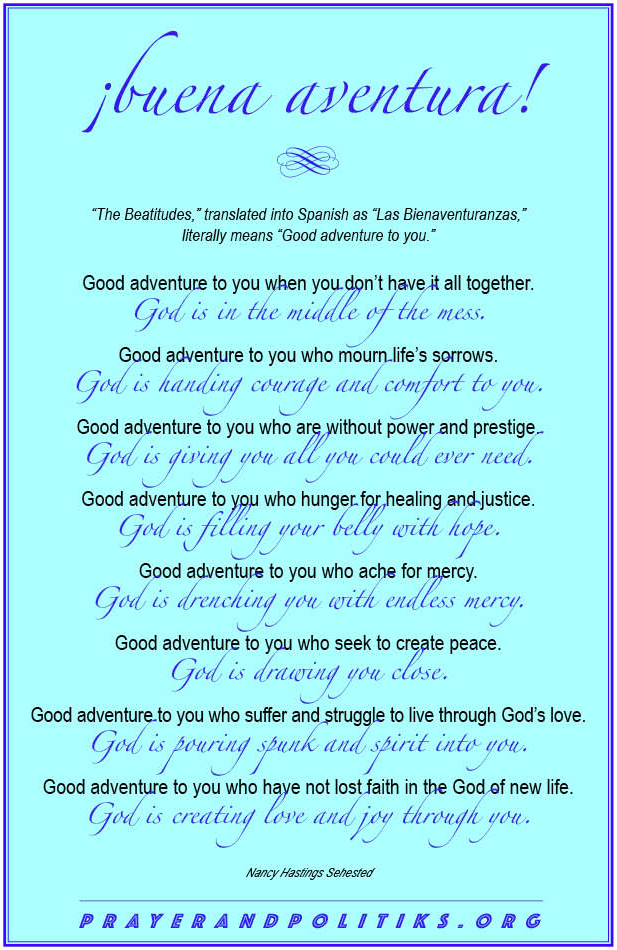
•“Beatitudes,” a litany for worship inspired by Matthew 5:1-12 (can also be sung to the Pat Wictor tune, "Love Is the Water")

•“All Saints Day,” a litany for worship

•“For All the Saints,” new lyrics for an old hymn

•“Hallowed Week,” a call to worship for All Hallow’s Eve and All Saints Day,” by Abigail Hastings

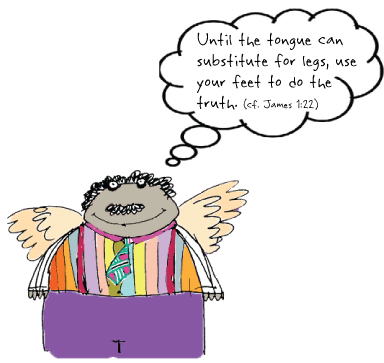
EXTRA Good news!  A note from Gerald, prayer&politiks’ guardian angel and synod convener.
       The advisory synod overseeing the vision and mission of prayer&politiks has heartily recommended another year of work. —Continue reading prayer&politiks’ first annual report, including a summary of the recent reader survey.

©Ken Sehested @ prayerandpolitiks.org. Language not otherwise indicated above is that of the editor. Don’t let the “copyright” notice keep you from circulating material you find here (and elsewhere in this site). Reprint permission is hereby granted in advance for noncommercial purposes.

Your comments are always welcomed. If you have news, views, notes or quotes to add to the list above, please do. If you like what you read, pass this along to your friends.

Good news report from Gerald

First prayer&politiks annual report

A note from Gerald, prayer&politiks’ guardian angel and synod convener

GOOD NEWS!  The advisory synod overseeing the vision and mission of prayer&politiks has heartily recommended another year of work.

When prayer&politiks began in November 2014, the commitment was for one year, to assess whether the need and the support was evident. In September we employed a communications consultant to help with evaluation. Her conclusions: both the quantity and the quality of the survey returns were “exceptional.”

            “You have a loyal base of readers and significant indicators of future financial support.”

As it happens, contributor income (to date) for 2015 is $1,436. Expenses: $1,440 (not counting consultant costs). The goal for this year was break even. Been there, done that.

To be sustainable in the long run, however, will require a modest monthly salary ($1,000) for the editor/author, whose weekly work averages 42 hours for research, writing, designing and posting. Thus our development goal for the next three years is to enlist 300 readers willing to contribute an average of $1 per week, for a total annual budget of $15,600.

It’s an ambitious—but not fanciful—goal.

So, angelic accolades to all who participated in the survey. (Your editorial suggestions will help refine prayer&politiks’ content.)

—Gerry

P.S. If you’ve not yet completed a survey—please do!—you can access the survey here.


When hope is aroused

by "Ghost," a maximum security prisoner

When hope is aroused—or even the possibility of that hope’s approach—the body, of it’s own accord, fills with a reservoir of bated breath, as though preparing for the shouts of joy and happiness, victory and triumph, that are sure to come, no longer checked by the dams of possibility and doubt shored with the black mortar of cynicism.

Unfortunately, this air, this breath, this Spirit, must go somewhere. No man, no woman, can live long with held breath! But where? Where, if disappointment is strapped to the back of the dawn, yet again, like a plow whose dull blade knifes through hearts swollen with hope?

Perhaps in a shout still, but one so new and full of hurt it must be swaddled in the torn, blood-soaked rags of rage. But what if the shouts of wrath and rage have long been beaten down and whipped into whispers of malice in the night that somehow becomes smiles in the morning. What, then, of that inhaled breath, that inhaled spirit? To know the answer is to know sorrow’s song.

©Ken Sehested @ prayerandpolitiks.org

Thomas Merton

A special edition of "Signs of the Times" featured quotes from that most unusual monk

Selected and edited by Ken Sehested

Introduction: A special issue of “Signs of the Times” devoted to Thomas Merton (31 January 1915 – 10 December 1968) quotes was already in the works, to mark the centennial of his birth. But when Pope Francis, in his historic address to a joint session of Congress, lifted Merton's name for special recognition (along with three other Americans), it seemed timely to move up the schedule. (Continue reading Ken Sehested’s "Introduction: The Quotable Thomas Merton.")

§  §  §

§ Meditation has no point and no reality unless it is firmly rooted in life.

§ The flight from the world is nothing else but the flight from self-concern.

§ Detachment from things does not mean setting up a contradiction between "things" and "God" as if God were another "thing" and as if earthly creatures were rivals. We do not detach ourselves from things in order to attach ourselves to God, but rather we become detached form ourselves in order to see and use all things in and for God.

§ Solitude is a way to defend the spirit against the murderous din of our materialism.

§ To say “God is love” is like saying, “Eat Wheaties”. . . . There’s no difference, except . . . that people know they are supposed to look pious when God is mentioned.

§ Prayer does not blind us to the world, but it transforms our vision of the world, and makes us see everyone and everything in the light of God.

§ I drink beer whenever I can lay my hands on any. I love beer, and, by that very fact, the world.

§ The beginning of the fight against hatred . . . is not the commandment to love, what must necessarily come before in order to make the commandment bearable and comprehensible. It is a prior commitment, to believe. The root of Christian love is not the will to love, but the faith that one is loved.

§ The humble receive praise the way a clean window takes the light of the sun. The truer and more intense the light is, the less you see of the glass. . . . Humility is the surest sign of strength.

§ What is the use of postmarking our mail with exhortations to “pray for peace” and then spending billions of dollars on atomic submarines, thermonuclear weapons, and ballistic missiles. This, I would think, would certainly be what the New Testament calls “mocking God”—and mocking God far more effectively than the atheists do.

§ We do not go into the desert to escape people but to learn how to find them.

§ Advertising treats all products with the reverence and the seriousness due to sacraments.

§ Few Christians have been able to face the fact that non-violence comes very close to the heart of the Gospel ethic, and is perhaps essential to it. But non-violence is not simply a matter of marching with signs under the eyes of unfriendly police. The partial failure of liberal non-violence has brought out the start reality that our society itself is radically violence and that violence is built into its very structure.

§ Merely to demand support and obedience to an established disorder which is essentially violent through and through will not qualify as “peace-making.”

§ The biggest human temptation is to settle for too little.

§ Solitude that is just solitude and nothing else (i.e., excludes everything else but solitude) is worthless. True solitude embraces everything, for it is the fullness of love that rejects nothing and no one, that is open to All in All.

§ If war propaganda succeeds it is because people want war, and only need a few good reasons to justify their own desire.

§ Now one of the things we must cast out first of all is fear. Fear narrows the little entrance of our heart. It shrinks our capacity to love. It freezes up our power to give ourselves. If we were terrified of God as an inexorable judge, we would not confidently await divine mercy, or approach God trustfully in prayer.

§ Violence is not completely fatal until it ceases to disturb us.

§ There is a pervasive form of contemporary violence to which the idealist fighting for peace by non-violent methods most easily succumbs: activism and over-work.  The rush and pressure of modern life are a form, perhaps the most common form, of its innate violence. To allow oneself to be carried away by a multitude of conflicting concerns, to surrender to too many demands, to commit oneself to too many projects, to want to help every one in everything is to succumb to violence. The frenzy of the activist neutralizes his work for peace. It destroys the fruitfulness of his own work, because it kills the root of inner wisdom which makes work fruitful.

§ It is only by making our knowledge part of ourselves, through action, that we enter into the reality that is signified by our concepts.

§ Yesterday Father Cellarer lent me the Jeep. I did not ask for it, he just lent it to me out of the goodness of his heart, so that I would be able to go over on the far side of the knobs. I had never driven a car before. . . . It has been raining heavily. All the roads were deep in mud. It took me some time to discover the front-wheel drive. I skidded into the ditches and got out again, I went through creeks, I got stuck in the mud, I bumped into trees. . . .
        I drove the Jeep madly into the forest in a happy, rosy fog of confusion and delight. We romped over trestles and I said, "O Mary, I love you," as I went splashing through puddles a foot deep, rushing madly into the underbrush and back out again.
        Finally I got the thing back to the monastery covered with mud from stern to stern. Father Cellarer just made me a sign that I must never, never, under any circumstances, take the Jeep out again.

§ A tree gives glory to God first of all by being a tree. For in being what God means it to be, it is imitating an idea which is in God and which is not distinct from the essence of God, and therefore a tree imitates God by being a tree.

§ God has the most annoying manner of showing up when we least want; of confronting us in the strangest ways.

§ Your life is shaped by the end you live for. You are made in the image of what you desire.

§ If you find God with great ease, perhaps it is not God you have found.

§ The peace the world pretends to desire is really no peace at all. To some, peace merely means the liberty to exploit other people without fear of retaliation or interference. To others, peace means the freedom to rob neighbors without interruption. To still others, it means the leisure to devour the goods of the earth without being compelled to interrupt their pleasures to feed those whom their greed is starving. And to practically everybody, peace simply means the absence of any physical violence that might cast a shadow over lives devoted to the satisfaction of their animal appetites for comfort and pleasure.

§ Where abstract thought and concrete existence enter into conflict, the mark of true contemplatives is that they are on the side of concrete existence.

§ The beginning of love is the will to let those we love be perfectly themselves, the resolution not to twist them to fit our own image.

§ A 1963 letter to French philosopher Jacques Maritain: I am putting into the mail a mimeographed copy of my "unpublishable" book on "Peace in the Post Christian Era." Unpublishable because forbidden by our upright and upstanding Abbot General who does not want to leave Christian civilization without the bomb to crown its history of honor. He says that my defense of peace fausserait le message de la vie contemplative [would falsify the message of the contemplative life]. The fact that a monk should be concerned about this issue is thought—by "good monks"—to be scandalous. A hateful distraction, withdrawing one's mind from Baby Jesus in the Crib. Strange to say, no one seems concerned at the fact that the crib is directly under the bomb.

§ Do not be too quick to assume your enemies are savages just because they are your enemies. Perhaps they are your enemies because they think you are a savage. Or perhaps they are afraid of you because they feel that you are afraid of them. 

§ It seems to me that we have little genuine interest in human liberty and in the human person. What we are interested in, on the contrary, is the unlimited freedom of the corporation. When we call ourselves the “free world” we mean first of all the world in which business is free. . . . It was only when money became involved that the Negro demonstrations finally impressed themselves upon the American mind as being real.

§ [T]he Negro problem is really a White problem.

§ The “death of the old man” [in the history of Christian thought] is not the destruction of personality but the dissipation of an illusion, and the discovery of the new humanity is the realization of what was there all along.

§ Buddhist “mindfulness,” far from being contemptuous of life, is extremely solicitous for all life. It has two aspects: one, the penetration of the meaning and reality of suffering by meditation, and two, the protection of all beings against suffering by nonviolence and compassion.

§ Be still: / There is no longer any need of comment. / It was a lucky wind / That blew away his halo with his cares, / A lucky sea that drowned his reputation.

§ I don’t feel that I can in conscience, at a time like this, go on writing just about things like meditation, though that has its point. I cannot just bury my head in a lot of rather tiny and secondary monastic studies either. I think I have to face the big issues, the life-and-death issues: and this is what everyone is afraid of.

§ There has generally been no conception at all that whites had anything to learn from the Negro. And now, the irony is that Negroes are offering us a “message of salvation,” but we are so blinded by our own self-sufficiency and self-conceit that we do not recognize the peril in which we have put ourselves by ignoring the offer. . . . [Negroes] are offering us the occasion to enter with them into a providential reciprocity willed for us by God.

§ Do not depend on the hope of results. You may have to face the fact that your work will be apparently worthless and even achieve no result at all, if not perhaps results opposite to what you expect. As you get used to this idea, you start more and more to concentrate not on the results, but on the value, the rightness, the truth of the work itself. You gradually struggle less and less for an idea and more and more for specific people. In the end, it is the reality of personal relationship that saves everything.

§ The word of the Gospel is understood only when it is obeyed. It is known to those who strive to practice it.

§ The beginning of the fight against hatred, the basic Christian answer to hatred, is not the commandment to love, but what must necessarily come before in order to make the commandment bearable and comprehensible. It is a prior commandment, to believe. The root of Christian love is not the will to love, but the faith that one is loved.

§ When I pray for peace, I pray not only that the enemies of my own country may cease to want war, but above all that my own country will cease to do the things that make war inevitable.

§ When all the men of war are killed / And flags have fallen into dust / Your cross and mine will tell men still / He died on each for both of us / That we might become the brothers of God / And learn to know the Christ of burnt men.

§ The Negro spirituals of the last century remain as classic examples of what a living liturgical hymnody out to be, and how it comes into being: not in the study of the research worker or in the monastery library, still less in the halls of curial offices, where human being suffer oppression, where they are deprived of identity, where their lives are robbed of meaning, and where the desire of freedom and the imperative demand of truth forces them to give it meaning.

§ A white detective in Birmingham, watching the children file by the score into paddy wagons, gave expression to the mind of the nation when he said: “If this is religion, I don’t want any part of it.” If this is really what the mind of white America has concluded, we stand judged by our own thought.

§ In the end contemplatives suffer the anguish of realizing that they no longer know what God is . . . because “God is not a what” . . . but a “Who.”

§ At the close of what turned out to be his final talk, at the December 1968 interfaith conference of monastics held in Bangkok, Merton quipped: So I will disappear from view, and we can all go have a Coke or something.

#  #  #

Have a Merton quote or anecdote or other resource to share? Offer it below in the reader comment section.

RESOURCES

Video resources on the web

Listen to Kate Campbell's original song, "Prayer of Thomas Merton," using the words to Merton's "My Lord God" prayer in designed format, above.

“Thomas Merton – PBS Video,” 11 minutes

CBS “Modern Masters of Religion,” program on Merton (27 minutes)

“Thomas Merton from ‘Who Cares About the Saints?’ with Ft. James Martin SJ” (11+ minutes)

“Fr. Matthew remembers Thomas Merton,” recollections of one of Merton’s fellow monks at the Abbey of Gethsemani (15 minutes)

“Soul Searching,”  three 2+ minutes videos of different periods in Merton’s life

Biography

There are more than two dozen Merton biographies. Of the ones I’ve read, Jim Forest’s Living With Wisdom: A Life of Thomas Merton (revised edition, 2008) is far and away the best. (While you’re at it, Forest’s biography of Dorothy Day, All Is Grace, is also my favorite in that collection.)

For an essay-length overview of Merton’s legacy, see Jim Forest’s “Thomas Merton’s Advice to Peacemaker,” Jim Forest

Also of interest. Bellarmine University in Louisville is home to the Thomas Merton Center. Their site also has a brief biographical sketch along with an extensive Merton bibliography.

Alas, I cut nearly three-fourths of my collection of quotes to maintain the parameter of “Signs of the Times.” That extra material is posted in this “More Merton quotes” file.

Special note on language edits. When alteration of the above quotes for gender inclusivity is relatively simple, I have done so. When such changes would generate awkward sentence construction or the piling up of words, I have left existing language in place. When language ceases to be transparent, calling attention to itself rather than the ideas being expressed, it fails. These are, of course, subjective choices. Unfortunately, there is no unadulterated language. (As Merton might say, this is why the deepest level of prayer goes beyond words—or as the Apostle Paul knew, some things require expression in “sighs too deep for words.” —Romans 8:26)
        Gender inclusive language itself is hardly sufficient, given its reliance on anthropomorphic imagery for God. And Lord knows what else. But that’s a discussion for another time. —Ken Sehested

Thomas Merton

A special edition of "Signs of the Times" featured quotes from that most unusual monk

Selected and edited by Ken Sehested

Introduction: A special issue of “Signs of the Times” devoted to Thomas Merton (31 January 1915 – 10 December 1968) quotes was already in the works, to mark the centennial of his birth. But when Pope Francis, in his historic address to a joint session of Congress, lifted Merton's name for special recognition (along with three other Americans), it seemed timely to move up the schedule. (Continue reading Ken Sehested’s "Introduction: The Quotable Thomas Merton.")

§  §  §

§ Meditation has no point and no reality unless it is firmly rooted in life.

§ The flight from the world is nothing else but the flight from self-concern.

§ Detachment from things does not mean setting up a contradiction between "things" and "God" as if God were another "thing" and as if earthly creatures were rivals. We do not detach ourselves from things in order to attach ourselves to God, but rather we become detached form ourselves in order to see and use all things in and for God.

§ Solitude is a way to defend the spirit against the murderous din of our materialism.

§ To say “God is love” is like saying, “Eat Wheaties”. . . . There’s no difference, except . . . that people know they are supposed to look pious when God is mentioned.

§ Prayer does not blind us to the world, but it transforms our vision of the world, and makes us see everyone and everything in the light of God.

§ I drink beer whenever I can lay my hands on any. I love beer, and, by that very fact, the world.

§ The beginning of the fight against hatred . . . is not the commandment to love, what must necessarily come before in order to make the commandment bearable and comprehensible. It is a prior commitment, to believe. The root of Christian love is not the will to love, but the faith that one is loved.

§ The humble receive praise the way a clean window takes the light of the sun. The truer and more intense the light is, the less you see of the glass. . . . Humility is the surest sign of strength.

§ What is the use of postmarking our mail with exhortations to “pray for peace” and then spending billions of dollars on atomic submarines, thermonuclear weapons, and ballistic missiles. This, I would think, would certainly be what the New Testament calls “mocking God”—and mocking God far more effectively than the atheists do.

§ We do not go into the desert to escape people but to learn how to find them.

§ Advertising treats all products with the reverence and the seriousness due to sacraments.

§ Few Christians have been able to face the fact that non-violence comes very close to the heart of the Gospel ethic, and is perhaps essential to it. But non-violence is not simply a matter of marching with signs under the eyes of unfriendly police. The partial failure of liberal non-violence has brought out the start reality that our society itself is radically violence and that violence is built into its very structure.

§ Merely to demand support and obedience to an established disorder which is essentially violent through and through will not qualify as “peace-making.”

§ The biggest human temptation is to settle for too little.

§ Solitude that is just solitude and nothing else (i.e., excludes everything else but solitude) is worthless. True solitude embraces everything, for it is the fullness of love that rejects nothing and no one, that is open to All in All.

§ If war propaganda succeeds it is because people want war, and only need a few good reasons to justify their own desire.

§ Now one of the things we must cast out first of all is fear. Fear narrows the little entrance of our heart. It shrinks our capacity to love. It freezes up our power to give ourselves. If we were terrified of God as an inexorable judge, we would not confidently await divine mercy, or approach God trustfully in prayer.

§ Violence is not completely fatal until it ceases to disturb us.

§ There is a pervasive form of contemporary violence to which the idealist fighting for peace by non-violent methods most easily succumbs: activism and over-work.  The rush and pressure of modern life are a form, perhaps the most common form, of its innate violence. To allow oneself to be carried away by a multitude of conflicting concerns, to surrender to too many demands, to commit oneself to too many projects, to want to help every one in everything is to succumb to violence. The frenzy of the activist neutralizes his work for peace. It destroys the fruitfulness of his own work, because it kills the root of inner wisdom which makes work fruitful.

§ It is only by making our knowledge part of ourselves, through action, that we enter into the reality that is signified by our concepts.

§ Yesterday Father Cellarer lent me the Jeep. I did not ask for it, he just lent it to me out of the goodness of his heart, so that I would be able to go over on the far side of the knobs. I had never driven a car before. . . . It has been raining heavily. All the roads were deep in mud. It took me some time to discover the front-wheel drive. I skidded into the ditches and got out again, I went through creeks, I got stuck in the mud, I bumped into trees. . . .
        I drove the Jeep madly into the forest in a happy, rosy fog of confusion and delight. We romped over trestles and I said, "O Mary, I love you," as I went splashing through puddles a foot deep, rushing madly into the underbrush and back out again.
        Finally I got the thing back to the monastery covered with mud from stern to stern. Father Cellarer just made me a sign that I must never, never, under any circumstances, take the Jeep out again.

§ A tree gives glory to God first of all by being a tree. For in being what God means it to be, it is imitating an idea which is in God and which is not distinct from the essence of God, and therefore a tree imitates God by being a tree.

§ God has the most annoying manner of showing up when we least want; of confronting us in the strangest ways.

§ Your life is shaped by the end you live for. You are made in the image of what you desire.

§ If you find God with great ease, perhaps it is not God you have found.

§ The peace the world pretends to desire is really no peace at all. To some, peace merely means the liberty to exploit other people without fear of retaliation or interference. To others, peace means the freedom to rob neighbors without interruption. To still others, it means the leisure to devour the goods of the earth without being compelled to interrupt their pleasures to feed those whom their greed is starving. And to practically everybody, peace simply means the absence of any physical violence that might cast a shadow over lives devoted to the satisfaction of their animal appetites for comfort and pleasure.

§ Where abstract thought and concrete existence enter into conflict, the mark of true contemplatives is that they are on the side of concrete existence.

§ The beginning of love is the will to let those we love be perfectly themselves, the resolution not to twist them to fit our own image.

§ A 1963 letter to French philosopher Jacques Maritain: I am putting into the mail a mimeographed copy of my "unpublishable" book on "Peace in the Post Christian Era." Unpublishable because forbidden by our upright and upstanding Abbot General who does not want to leave Christian civilization without the bomb to crown its history of honor. He says that my defense of peace fausserait le message de la vie contemplative [would falsify the message of the contemplative life]. The fact that a monk should be concerned about this issue is thought—by "good monks"—to be scandalous. A hateful distraction, withdrawing one's mind from Baby Jesus in the Crib. Strange to say, no one seems concerned at the fact that the crib is directly under the bomb.

§ Do not be too quick to assume your enemies are savages just because they are your enemies. Perhaps they are your enemies because they think you are a savage. Or perhaps they are afraid of you because they feel that you are afraid of them. 

§ It seems to me that we have little genuine interest in human liberty and in the human person. What we are interested in, on the contrary, is the unlimited freedom of the corporation. When we call ourselves the “free world” we mean first of all the world in which business is free. . . . It was only when money became involved that the Negro demonstrations finally impressed themselves upon the American mind as being real.

§ [T]he Negro problem is really a White problem.

§ The “death of the old man” [in the history of Christian thought] is not the destruction of personality but the dissipation of an illusion, and the discovery of the new humanity is the realization of what was there all along.

§ Buddhist “mindfulness,” far from being contemptuous of life, is extremely solicitous for all life. It has two aspects: one, the penetration of the meaning and reality of suffering by meditation, and two, the protection of all beings against suffering by nonviolence and compassion.

§ Be still: / There is no longer any need of comment. / It was a lucky wind / That blew away his halo with his cares, / A lucky sea that drowned his reputation.

§ I don’t feel that I can in conscience, at a time like this, go on writing just about things like meditation, though that has its point. I cannot just bury my head in a lot of rather tiny and secondary monastic studies either. I think I have to face the big issues, the life-and-death issues: and this is what everyone is afraid of.

§ There has generally been no conception at all that whites had anything to learn from the Negro. And now, the irony is that Negroes are offering us a “message of salvation,” but we are so blinded by our own self-sufficiency and self-conceit that we do not recognize the peril in which we have put ourselves by ignoring the offer. . . . [Negroes] are offering us the occasion to enter with them into a providential reciprocity willed for us by God.

§ Do not depend on the hope of results. You may have to face the fact that your work will be apparently worthless and even achieve no result at all, if not perhaps results opposite to what you expect. As you get used to this idea, you start more and more to concentrate not on the results, but on the value, the rightness, the truth of the work itself. You gradually struggle less and less for an idea and more and more for specific people. In the end, it is the reality of personal relationship that saves everything.

§ The word of the Gospel is understood only when it is obeyed. It is known to those who strive to practice it.

§ The beginning of the fight against hatred, the basic Christian answer to hatred, is not the commandment to love, but what must necessarily come before in order to make the commandment bearable and comprehensible. It is a prior commandment, to believe. The root of Christian love is not the will to love, but the faith that one is loved.

§ When I pray for peace, I pray not only that the enemies of my own country may cease to want war, but above all that my own country will cease to do the things that make war inevitable.

§ When all the men of war are killed / And flags have fallen into dust / Your cross and mine will tell men still / He died on each for both of us / That we might become the brothers of God / And learn to know the Christ of burnt men.

§ The Negro spirituals of the last century remain as classic examples of what a living liturgical hymnody out to be, and how it comes into being: not in the study of the research worker or in the monastery library, still less in the halls of curial offices, where human being suffer oppression, where they are deprived of identity, where their lives are robbed of meaning, and where the desire of freedom and the imperative demand of truth forces them to give it meaning.

§ A white detective in Birmingham, watching the children file by the score into paddy wagons, gave expression to the mind of the nation when he said: “If this is religion, I don’t want any part of it.” If this is really what the mind of white America has concluded, we stand judged by our own thought.

§ In the end contemplatives suffer the anguish of realizing that they no longer know what God is . . . because “God is not a what” . . . but a “Who.”

§ At the close of what turned out to be his final talk, at the December 1968 interfaith conference of monastics held in Bangkok, Merton quipped: So I will disappear from view, and we can all go have a Coke or something.

#  #  #

Have a Merton quote or anecdote or other resource to share? Offer it below in the reader comment section.

RESOURCES

Video resources on the web

Listen to Kate Campbell's original song, "Prayer of Thomas Merton," using the words to Merton's "My Lord God" prayer in designed format, above.

“Thomas Merton – PBS Video,” 11 minutes

CBS “Modern Masters of Religion,” program on Merton (27 minutes)

“Thomas Merton from ‘Who Cares About the Saints?’ with Ft. James Martin SJ” (11+ minutes)

“Fr. Matthew remembers Thomas Merton,” recollections of one of Merton’s fellow monks at the Abbey of Gethsemani (15 minutes)

“Soul Searching,”  three 2+ minutes videos of different periods in Merton’s life

Biography

There are more than two dozen Merton biographies. Of the ones I’ve read, Jim Forest’s Living With Wisdom: A Life of Thomas Merton (revised edition, 2008) is far and away the best. (While you’re at it, Forest’s biography of Dorothy Day, All Is Grace, is also my favorite in that collection.)

For an essay-length overview of Merton’s legacy, see Jim Forest’s “Thomas Merton’s Advice to Peacemaker,” Jim Forest

Also of interest. Bellarmine University in Louisville is home to the Thomas Merton Center. Their site also has a brief biographical sketch along with an extensive Merton bibliography.

Alas, I cut nearly three-fourths of my collection of quotes to maintain the parameter of “Signs of the Times.” That extra material is posted in this “More Merton quotes” file.

Special note on language edits. When alteration of the above quotes for gender inclusivity is relatively simple, I have done so. When such changes would generate awkward sentence construction or the piling up of words, I have left existing language in place. When language ceases to be transparent, calling attention to itself rather than the ideas being expressed, it fails. These are, of course, subjective choices. Unfortunately, there is no unadulterated language. (As Merton might say, this is why the deepest level of prayer goes beyond words—or as the Apostle Paul knew, some things require expression in “sighs too deep for words.” —Romans 8:26)
        Gender inclusive language itself is hardly sufficient, given its reliance on anthropomorphic imagery for God. And Lord knows what else. But that’s a discussion for another time. —Ken Sehested

For All the Saints

New lyrics for an old hymn

by Ken Sehested

From earth’s wide bounds, from ocean’s farthest coast*
We praise the Name alone in which we boast
Seal our unity around Thy Host
Alleluia! Alleluia!

We stand amid the wonderment and woe
Caressing each other, as You our hearts console
Break forth in song, all creatures here below!
Alleluia! Alleluia!

Ringed by this cloud of witnesses divine
We feebly struggle, they in glory shine
Yet in your love our faithful lives entwine
Alleluia! Alleluia!

This mercy circle longs to shine your Light
Attend our yearning, restore to us our sight
By your grace, our hearts with hope incite
Alleluia! Alleluia!

O love the Lord, with all your heart and mind
And welcome neighbors, make them kin and kind
Then to our Christ we’ll ever be resigned
Alleluia! Alleluia!

Hasten the day, when tears no longer stain
All then shall rise to sing that great refrain!
Enliven our lungs to shout Hosanna’s Reign!
Alleluia! Alleluia!

The saints are living still, their voices heard
Speaking, reminding, of Heaven’s dream deferred
Hasten to hear, that earth’s woe may be cured
Alleluia! Alleluia!

No greater love hath any than to yield
Privilege and pow’r to welcome and to shield
The least, the lost, the whole creation healed
Alleluia! Alleluia!

©Ken Sehested @ prayerandpolitiks.org

*first line from William W. How

Beatitudes

A litany for worship inspired by Matthew 5:1-12

by Ken Sehested

Blessed are the poor, they shall all be raised
Blessed, you mournful, sorrow turning to praise
Blessed are the meek, all the earth be yours
Blessed: all the hungry-hearted shall endure.

Chorus:  Rock on, you beatitudes, teach me to pray.
               Rock on, you beatitudes, help me obey.
               Jesus, lead me on along the Pilgrim Way.
               Rock on, ‘til the coming of the Bright New Day.

Blessed be the merciful, you’ll get the same
Blessed, pure in spirit, God will call you by name
Blessed every peace-imparted soul, rejoice!
God-birthed children gonna raise their voice!   Chorus

Blessed, when the persecutors wale on you;
Rejoice, be glad, God will pull you through.
Salt of the earth and light for the world,
Good God a’mighty let your flag unfurl!    Chorus

These lyrics may be sung to the tune of "Love is the Water,” by Pat Wictor

©Ken Sehested @ prayerandpolitiks.org